


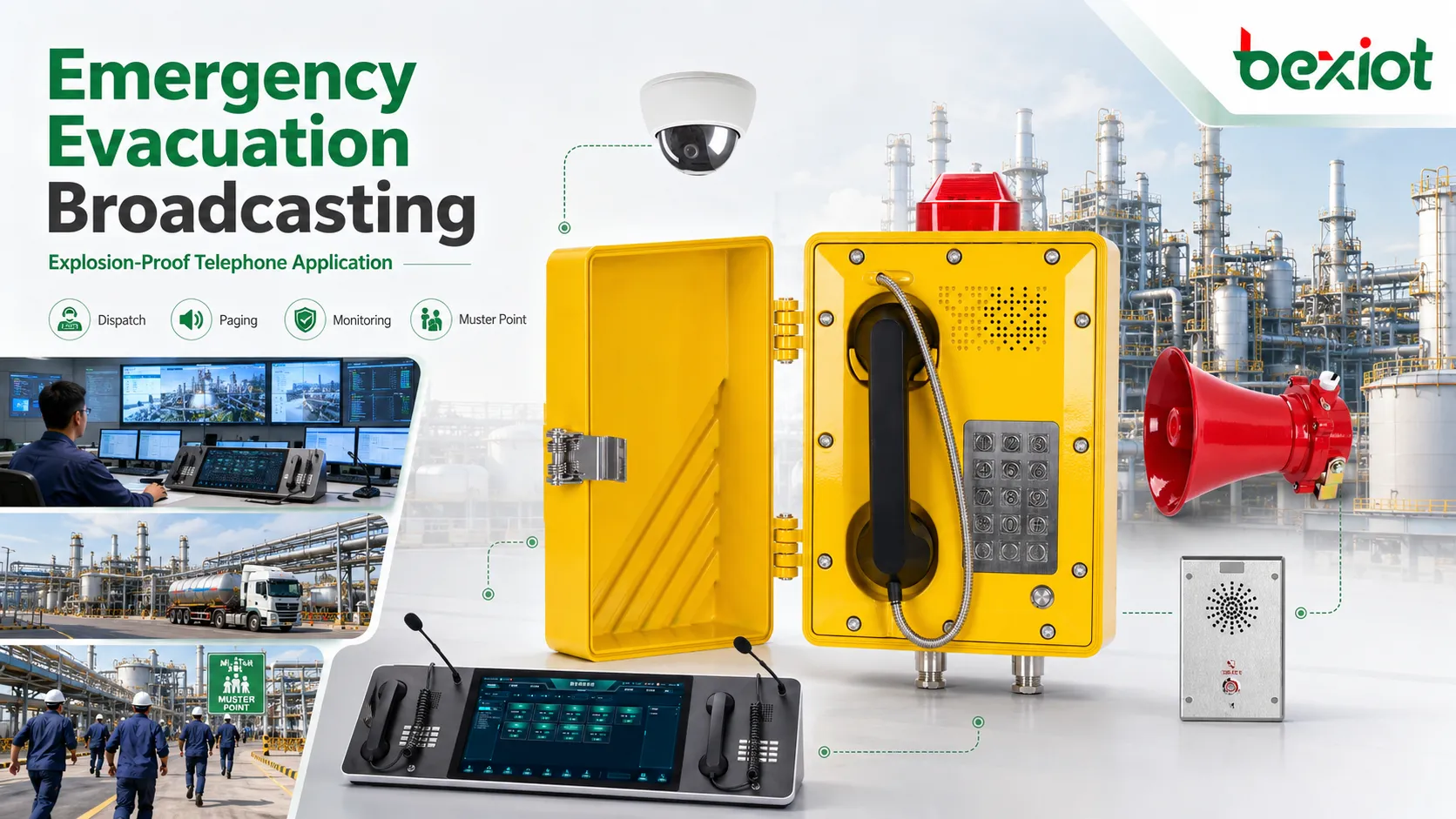
In hazardous industrial environments, communication equipment must do more than complete ordinary calls. When fire, gas leakage, explosion risk, equipment failure, chemical release, power abnormality, or evacuation demand occurs, workers need to receive clear instructions quickly. A delayed message, unclear announcement, or unavailable field telephone may increase risk during the most critical minutes.
Explosion-proof telephones are designed for locations where flammable gas, vapor, dust, or harsh industrial conditions may exist. When emergency evacuation broadcasting is integrated into the telephone system, the device is no longer only a call endpoint. It becomes part of a safety communication chain that connects field workers, control rooms, alarms, paging zones, dispatch centers, and emergency response teams.
Why evacuation broadcasting matters in hazardous areas
Hazardous areas often have several communication challenges at the same time. Workers may be spread across process units, tank farms, compressor stations, loading areas, pump rooms, offshore platforms, tunnels, power rooms, or chemical storage zones. Background noise may be high, visibility may be poor, and the available response time may be short. In these conditions, relying only on manual phone calls is usually not enough.
Emergency evacuation broadcasting allows a control room or authorized operator to deliver one clear message to the required area. The message may instruct personnel to evacuate, move to a muster point, avoid a hazardous zone, stop hot work, prepare for shutdown, or wait for further command. Compared with one-to-one calling, broadcasting reaches more people faster and provides unified instructions.
For explosion-proof telephone systems, the value is that communication can be placed directly inside or near hazardous operating zones while still supporting emergency information delivery. Workers do not need to leave the area first to receive instructions. The communication point is already installed where risks may occur.
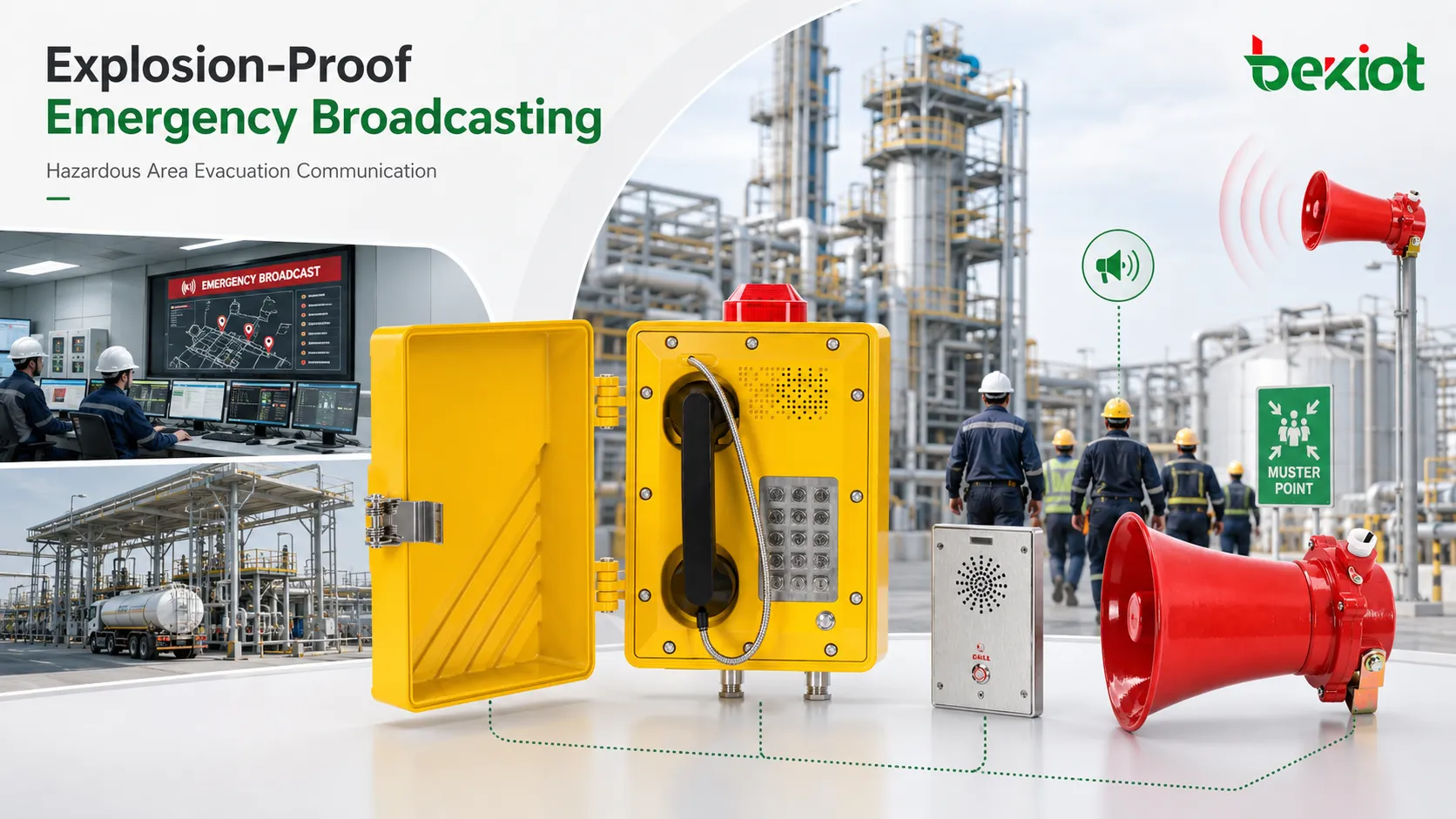
How the function works
Voice input from control room or field point
The broadcasting process usually begins from an authorized voice source. This may be a control room microphone, dispatch console, SIP phone, emergency command terminal, public address system, or explosion-proof telephone itself. The operator speaks the evacuation instruction, and the system sends the audio to selected endpoints or zones.
In some projects, the field telephone can also be used to report a dangerous condition. A worker may call the control room from an explosion-proof telephone, explain the situation, and the operator may then activate the related evacuation broadcast. This turns field reporting and centralized announcement into one connected workflow.
Zone selection and priority control
Emergency broadcasting should not always cover the entire facility. Some events require site-wide evacuation, while others affect only one unit, one building, one tank area, or one outdoor zone. A good system should support zone-based broadcasting so that the instruction reaches the people who need it without creating unnecessary confusion elsewhere.
Priority control is also important. Emergency announcements should override routine paging, background audio, ordinary calls, or low-priority messages where required. In hazardous industrial environments, a high-priority evacuation message must not be blocked by daily communication.
Alarm linkage and automatic triggering
Evacuation broadcasting may be activated manually by operators or automatically through alarm linkage. A fire alarm, gas detector, emergency button, process alarm, or safety control system may trigger a predefined broadcast rule. The system can then play a live or pre-recorded evacuation message to the affected zone.
Automatic triggering improves response speed, but it must be designed carefully. False activation can interrupt production and create unnecessary panic. The system should support verification, permission, priority, event recording, and clear operating procedures.
Main functional characteristics
The emergency evacuation broadcasting function of explosion-proof telephones has several important characteristics. First, it supports communication in hazardous locations where ordinary telephones may not be suitable. The telephone body, electrical design, sealing method, cable entry, and installation structure must match the environmental risk and site requirements.
Second, it supports direct voice interaction between field workers and control rooms. A worker can report abnormal conditions, request help, or confirm evacuation status. The operator can provide instructions and coordinate response through the same communication system.
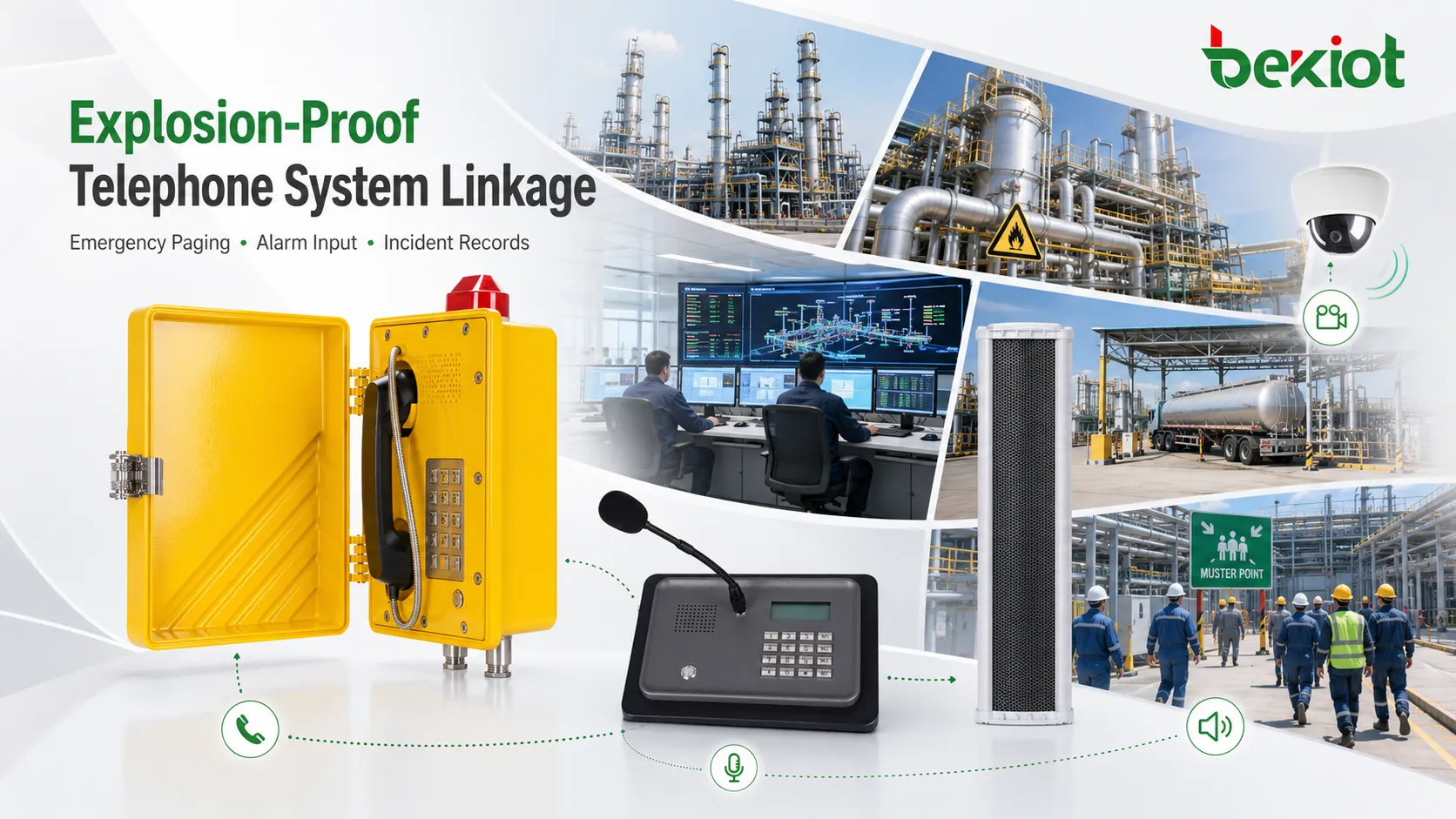
Third, it can be integrated with paging and public address systems. The explosion-proof telephone may work with horn speakers, amplifiers, SIP paging gateways, dispatch platforms, or alarm systems. This allows the site to combine point-to-point calling with wide-area announcement.
Fourth, it supports traceable emergency response. When linked with a platform, call records, broadcast logs, alarm events, operator actions, and response timing can be saved for later review. This is useful for safety management, incident investigation, and procedure improvement.
Products such as the Becke Telcom EX-BH621 explosion-proof telephone can be used as a field communication terminal in hazardous industrial areas where reliable voice calling, emergency communication, and system linkage are required. In evacuation-oriented projects, the key is not only the device itself, but how it is integrated with the alarm, dispatch, and broadcasting workflow.
Application scenarios
Oil, gas, and petrochemical facilities
Oil refineries, gas stations, petrochemical plants, tank farms, and compressor stations often include hazardous areas where fast evacuation instructions are critical. Explosion-proof telephones can be installed near process units, loading points, pump areas, and control rooms to support both routine communication and emergency broadcasting linkage.
When a gas alarm, fire alarm, or process abnormality occurs, the system can help operators communicate with the field and issue evacuation messages to affected areas. This improves response coordination and reduces reliance on mobile phones, which may not be allowed or reliable in some hazardous zones.
Mines, tunnels, and underground facilities
Mines, tunnels, and underground utility corridors may have long distances, limited visibility, high humidity, dust, and difficult escape routes. Communication points must be fixed, reliable, and easy to identify. Explosion-proof or industrial-grade telephones can provide call access at key locations, while broadcasting functions support evacuation and warning messages.
In these spaces, message clarity is especially important. Workers must understand whether they should evacuate, move to a refuge area, avoid a section, or contact the control room. The telephone and broadcasting system should be tested under real acoustic conditions.
Power plants and heavy industrial sites
Power plants, steel mills, cement plants, chemical workshops, and large manufacturing facilities often contain noisy environments and equipment hazards. Explosion-proof telephones may be required in areas where flammable substances or special risks exist, while evacuation broadcasting supports emergency instructions during abnormal operation.
The system can also support daily production coordination. Operators may use field telephones for maintenance communication, equipment checks, and safety confirmation. During emergencies, the same infrastructure can support higher-priority announcements and command communication.
Marine, offshore, and port environments
Offshore platforms, ships, terminals, and port loading areas may need robust communication equipment that can resist corrosion, moisture, vibration, and hazardous atmospheres. Explosion-proof telephones installed in strategic points can support emergency calls, deck communication, loading area coordination, and evacuation announcements.
For offshore and marine scenarios, system reliability is critical because evacuation routes and emergency response resources may be limited. Broadcasting should be integrated with alarm signals, muster station procedures, and command communication.
Design considerations
Match the hazardous area classification
Explosion-proof telephones should be selected according to the actual hazardous area conditions. Different sites may have different gas groups, dust risks, temperature requirements, protection levels, and installation rules. The equipment should match the safety requirements of the specific environment rather than being selected only by appearance.
Engineers should also consider cable glands, wiring methods, grounding, sealing, and enclosure integrity. A certified device can still become unsafe if installed incorrectly. Installation quality is part of explosion-proof performance.
Plan broadcast zones carefully
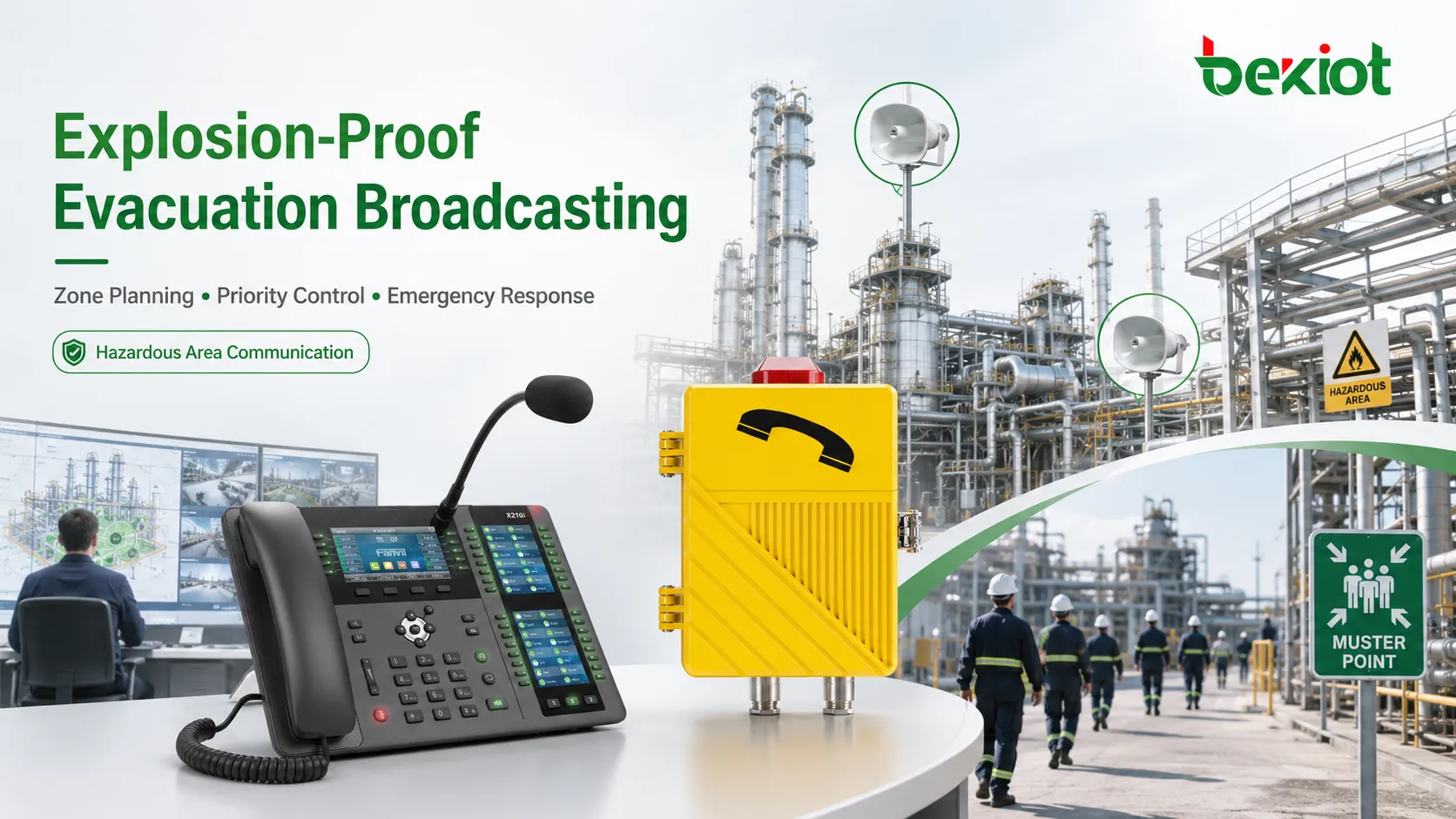
Evacuation broadcasting should be planned by physical risk area, process unit, building, floor, outdoor zone, or emergency route. A message for one unit should not necessarily interrupt the whole plant unless the incident requires it. At the same time, critical zones should not be missed.
Broadcast zone planning should be reviewed together with emergency procedures. The question is not only where speakers or telephones are installed, but who needs to hear which instruction under which event condition.
Ensure audio intelligibility
Industrial emergency announcements must be understandable. High volume alone is not enough. Noise from machinery, ventilation, pumps, vehicles, alarms, and outdoor conditions can reduce speech clarity. Speaker placement, telephone audio quality, microphone design, amplifier capacity, and message wording all affect the result.
Field testing should be performed during realistic operating conditions. If users cannot understand the broadcast during normal plant noise, the system may fail during an actual emergency.
Define permission and priority rules
Emergency broadcasting should be controlled by role and authority. Operators, safety officers, emergency commanders, and control room staff may have different permissions. Routine users should not be able to activate full-site evacuation broadcasting accidentally.
Priority rules should define what happens when calls, paging, alarms, and broadcasts occur at the same time. Emergency messages should have the correct override behavior, while routine communication should remain orderly during normal operation.
Maintenance and testing
Explosion-proof telephone and evacuation broadcasting systems should be tested regularly. The test should include telephone calling, control room answer, speaker output, zone selection, alarm linkage, emergency priority, recording, and power recovery. A device that is installed but not tested may provide a false sense of safety.
Physical inspection is also important. Technicians should check enclosure condition, cable entry, screws, gaskets, grounding, corrosion, button response, handset condition, speaker clarity, microphone pickup, and visible labels. In hazardous areas, damaged housings or improper cable entries should be handled seriously.
System logs can help maintenance teams confirm whether emergency broadcasts were activated correctly, whether calls were answered, and whether endpoints remained online. For large sites, routine maintenance records should be tied to safety management procedures.
Common problems and optimization
One common problem is treating explosion-proof telephones as isolated devices. If the telephone can only make a call but is not connected with alarm, dispatch, or broadcasting workflows, its emergency value is limited. The system should be designed as a communication network, not a collection of separate phones.
Another problem is poor audio coverage. A broadcast may be technically activated, but workers may not hear it clearly because of noise, distance, speaker direction, or unsuitable volume. Optimization should focus on speech intelligibility in real working conditions.
Incorrect zone configuration is also a serious issue. If an alarm triggers the wrong broadcast zone, the message may fail to reach affected workers or may disturb unrelated areas. Zone mapping should be verified during commissioning and after site changes.
Finally, maintenance is sometimes ignored after installation. Harsh environments can affect cables, enclosures, microphones, speakers, and buttons over time. Regular testing and inspection are necessary to keep the system dependable.
Evaluation standards
A good explosion-proof telephone evacuation broadcasting solution should be evaluated from several angles. The device must match the hazardous area and installation conditions. The call function should be reliable. The emergency broadcast should reach the correct zones. The speech should be clear under real noise conditions. Priority and permission rules should work as designed.
The system should also support traceability. Emergency calls, broadcast actions, alarm linkages, and operator handling should be recorded where the platform supports it. This helps managers review whether the response process was timely and correct.
Long-term maintainability should also be considered. The equipment should be easy to inspect, the wiring should be documented, the platform should show device status where possible, and replacement or service procedures should not require excessive shutdown.
Closing Notes
The emergency evacuation broadcasting function of explosion-proof telephones expands the role of field communication equipment. It allows hazardous-area telephone points to participate in emergency reporting, command communication, zone announcement, alarm linkage, evacuation guidance, and response traceability. This makes the telephone part of a wider safety communication system.
Its value is most visible in oil and gas, petrochemical, mining, tunnel, power, offshore, port, and heavy industrial environments. In these locations, reliable communication is not only a convenience; it supports worker safety, operational control, and emergency response quality.
For projects that require explosion-proof field telephones with practical integration capability, Becke Telcom can provide model options such as the EX-BH621 for hazardous industrial communication scenarios. The final solution should be selected according to site classification, installation conditions, communication platform, paging design, and emergency response workflow.
FAQ
What is the emergency evacuation broadcasting function of an explosion-proof telephone?
It is the ability to connect explosion-proof field communication points with paging, public address, alarm, or dispatch systems so that emergency instructions can be announced to selected zones or personnel during hazardous events.
Can an explosion-proof telephone directly broadcast to speakers?
It depends on the system design. Some telephones may connect through SIP, paging gateways, dispatch platforms, amplifiers, or public address systems. The telephone is often one part of a larger broadcasting workflow.
Where are explosion-proof telephones with evacuation broadcasting used?
They are used in oil and gas facilities, petrochemical plants, mines, tunnels, power plants, offshore platforms, ports, loading areas, and other hazardous industrial environments.
Why is zone planning important for evacuation broadcasting?
Zone planning ensures that the right people hear the right message. It prevents missing affected areas and avoids unnecessary disturbance in unrelated zones.
What should be tested after installation?
Testing should include call function, audio quality, broadcast zones, alarm linkage, priority override, recording, power recovery, and physical condition of the explosion-proof telephone and connected equipment.







