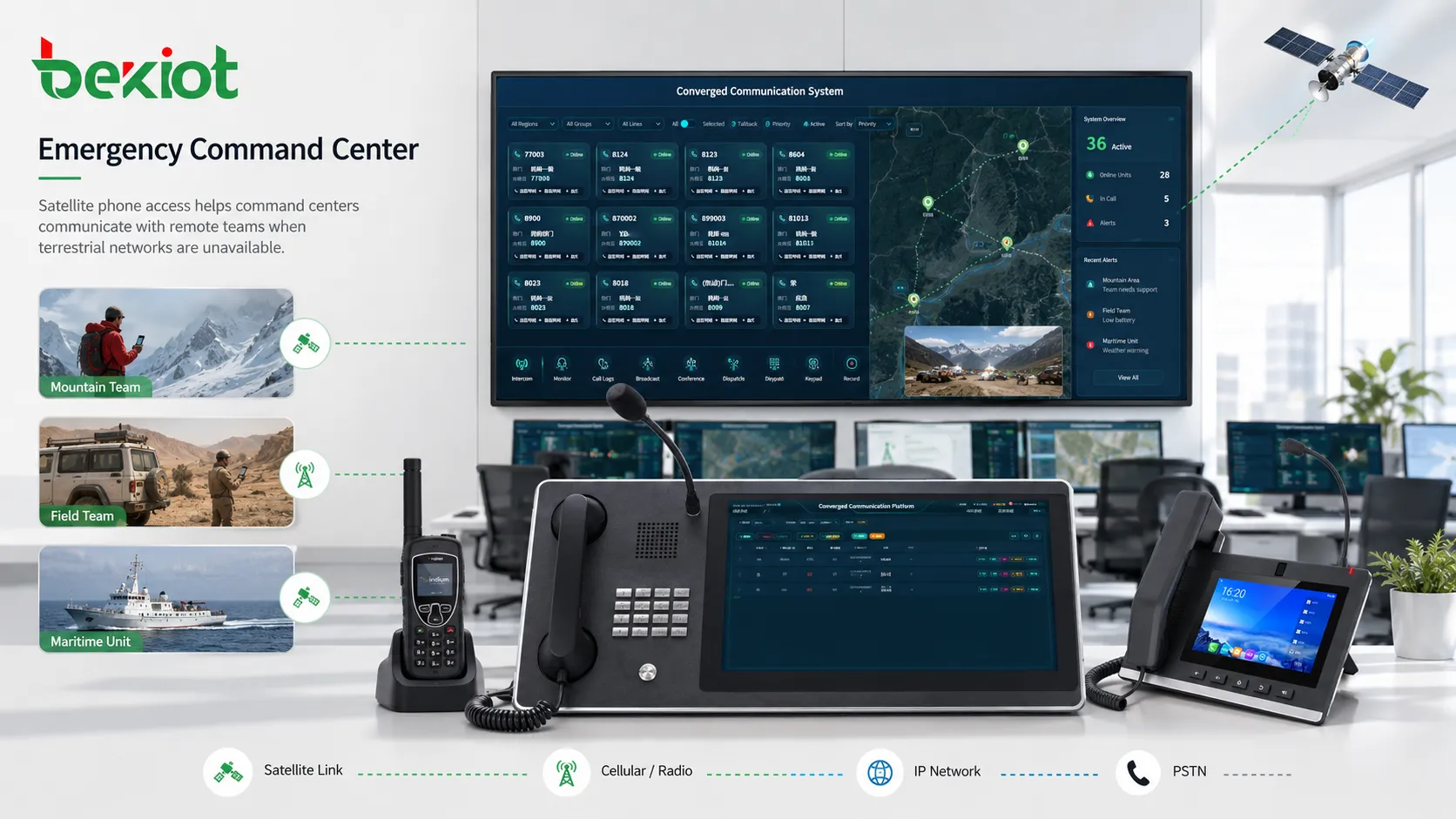
Satellite phones are increasingly used in emergency command, rescue coordination, remote site operation, maritime communication, field engineering, and public safety projects. In many converged communication deployments, customers may ask whether satellite phones can communicate with IP phones, dispatch consoles, smart terminals, or other users inside the system.
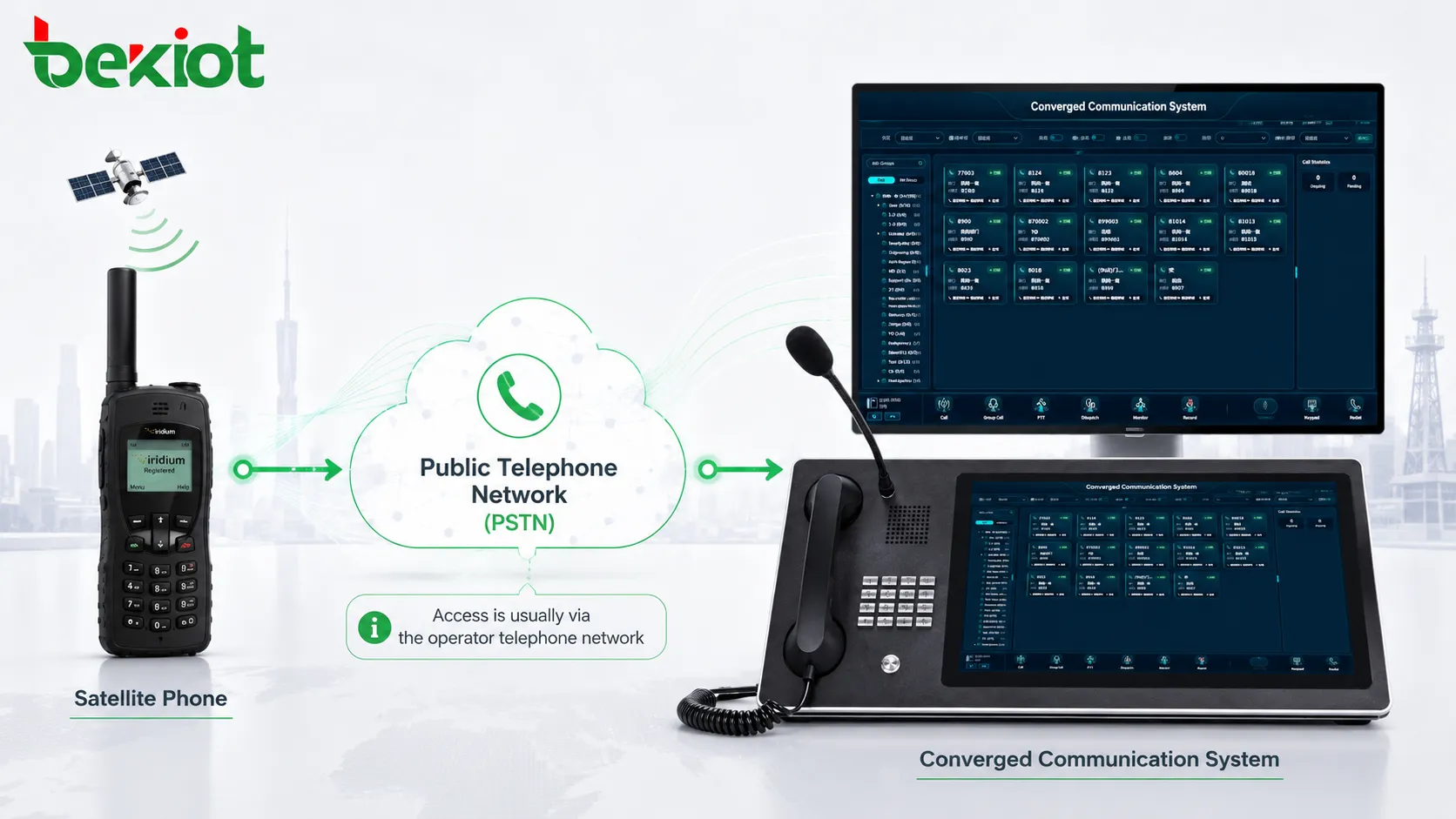
The answer is yes. In most cases, a converged communication system does not need to connect directly to the satellite phone itself. The practical solution is to connect the communication platform to the public telephone network through suitable voice trunks. Once the platform can access the operator telephone network, satellite phones and internal communication terminals can call each other like normal telephone users.
Why This Requirement Appears in Emergency Projects
In many emergency communication scenarios, normal mobile networks may be unavailable, overloaded, damaged, or not deployed at all. This is common in remote mountains, offshore areas, disaster sites, forest fire zones, border areas, temporary rescue camps, and large outdoor engineering projects.
Satellite phones can provide voice communication beyond the coverage of terrestrial cellular networks. For this reason, they are often used as a backup voice channel in emergency command systems. A commander in a control room may need to call a field team using a satellite phone, while the field team may also need to reach IP extensions, dispatch desks, emergency hotlines, or operation centers inside the converged platform.
The main challenge is that many project teams are familiar with SIP phones, IPPBX systems, dispatch platforms, and audio terminals, but they may not understand how satellite phones enter the overall communication network. Some users may assume that a special satellite interface is required. In reality, the architecture is often simpler.
Start by Understanding Satellite Phone Numbering
A satellite phone is similar to a normal mobile phone in one important way: it has a unique telephone number. This number allows the satellite phone to be reached through the public telephone network, as long as the relevant operator service is available and the number is correctly routed.
For example, China’s Tiantong-1 satellite phone service uses mobile number segments beginning with 1740 to 1745. If a user receives a call from a number beginning with 1740, the call may look like an ordinary mobile call unless someone explains that it is from a satellite phone.
This unique numbering mechanism is the key to system integration. A satellite phone does not need to be treated as an isolated device. From the perspective of call routing, it can be reached through telephone numbering, just like other phones connected through an operator network.
How a Satellite Call Is Routed
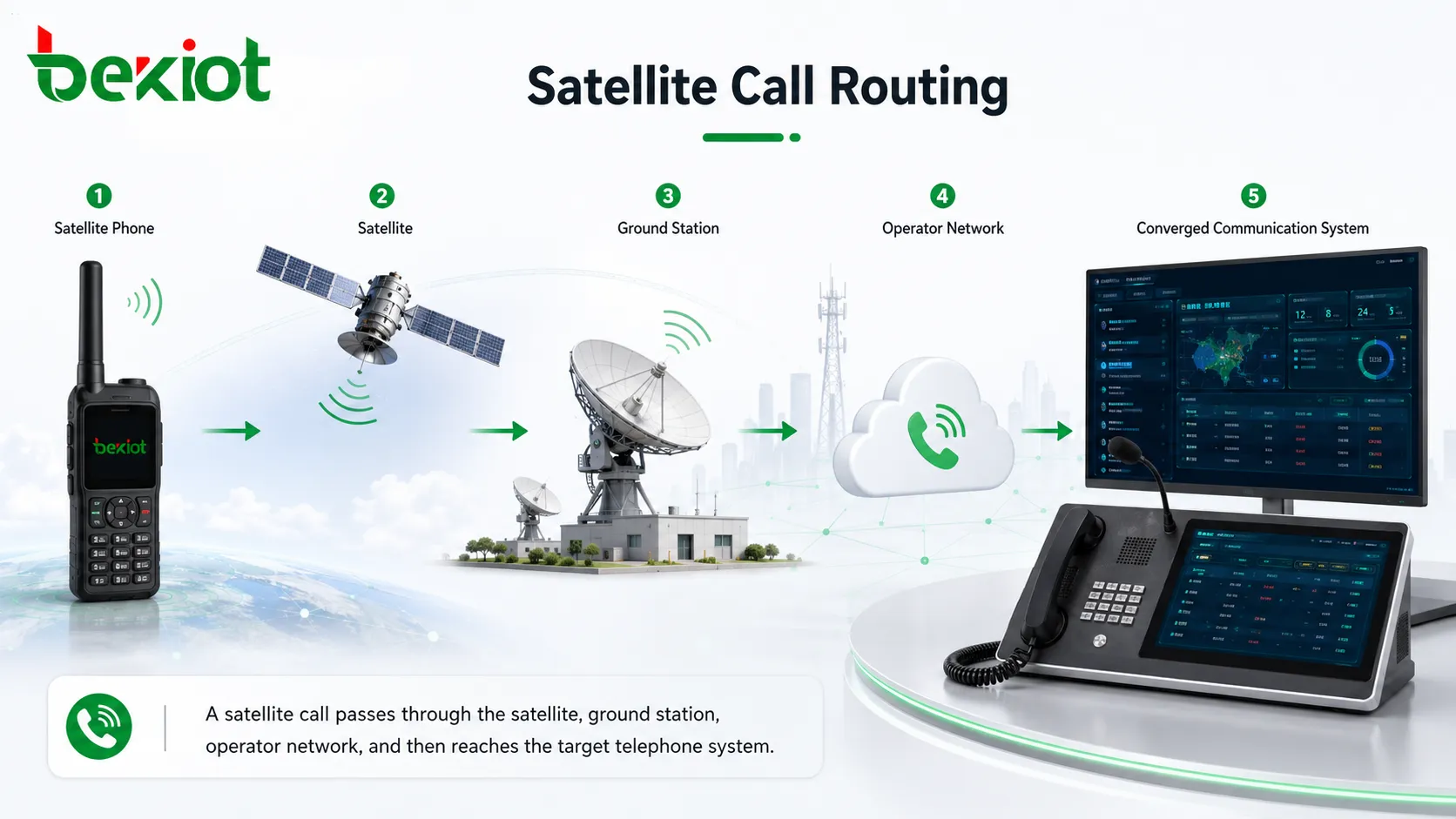
When a satellite phone starts a call, the handset first establishes a wireless link with a satellite. The satellite then forwards the call to a ground station. The ground station is connected to the telecom operator’s telephone system, where the call is routed based on the dialed number.
The reverse direction works in a similar way. When a normal phone, IPPBX trunk, dispatch platform, or other telephone user calls a satellite phone number, the operator network identifies the number as a satellite phone service. The call is routed to the satellite ground station, then sent to the satellite, and finally delivered to the satellite handset.
This means the satellite phone is not normally connected to the converged communication platform through a private satellite data interface. Instead, both sides meet through the telephone network. The converged system only needs a reliable way to enter that network.
The Practical Access Architecture
To connect satellite phones with a converged communication system, the platform should be connected to the operator telephone network. This is usually done through a voice gateway or trunk interface deployed in the communication equipment room.
The gateway connects one side to the converged communication platform and the other side to telephone lines provided by the carrier. Once this connection is completed, users inside the platform can make outbound calls to satellite phone numbers, and satellite phone users can call into the system through assigned public numbers.
The core idea is straightforward: the converged communication system does not need to “recognize” the satellite phone as a special device. It only needs to support normal inbound and outbound telephone calls through properly configured trunks, number rules, and routing policies.
Related solution: Becke Converged Communication System
Using Analog Lines or Digital Trunks
In many projects, the access method depends on what the telecom operator can provide at the site. If the operator provides analog telephone lines, an FXO voice gateway can be used. The FXO gateway connects analog telephone lines to the IP-based communication platform.
If the operator provides an E1 digital trunk, an E1 gateway or digital trunk gateway can be used. E1 trunks are often suitable for projects that require more channels, higher call capacity, centralized numbering, or more formal telecom-grade access.
Both analog and digital trunk methods can achieve the same basic goal: interconnection between the converged communication system and the public telephone network. Once the trunk is available, satellite phone calls are handled through telephone numbers rather than through a separate satellite interface.
| Access Method | Typical Interface | Best-Fit Scenario |
|---|---|---|
| Analog telephone line | FXO gateway | Small sites, limited call channels, simple emergency access |
| Digital trunk | E1 gateway | Command centers, dispatch platforms, multi-channel projects |
| Operator SIP trunk | SIP trunk interface or SBC | IP-based carrier access, centralized VoIP deployment |
How Calls Work After Integration
After the telephone gateway or trunk is deployed, internal users can dial satellite phone numbers from IP phones, dispatch consoles, operator seats, emergency telephones, or smart terminals. The converged platform routes the call to the outbound trunk, and the telecom operator completes the delivery to the satellite phone network.
For inbound calls, the satellite phone user dials a public number assigned by the operator. The call reaches the trunk connected to the converged communication system. The platform can then route the call to a dispatch console, duty extension, emergency command group, IVR menu, ring group, recording system, or selected department.
This architecture allows the satellite phone to become part of the communication workflow. It can participate in voice dispatch, emergency reporting, rescue coordination, command center communication, duty response, and cross-network calling.
Number Planning and Routing Design
A successful deployment requires clear number planning. The project team should define which users need to call satellite phones, which satellite users are allowed to call into the platform, which public numbers are assigned to the system, and how inbound calls should be distributed.
For example, calls from satellite phones may be routed directly to an emergency dispatch desk during rescue operations. In another project, the same calls may enter an IVR menu first, allowing the caller to choose command center, logistics, security, medical support, or maintenance teams.
Outbound rules should also be controlled. Satellite calls may have higher cost than ordinary internal calls, so the system can restrict dialing permissions by department, user role, extension group, or emergency priority. This prevents misuse while keeping the channel available for critical communication.
Benefits for Command and Dispatch Operations
The greatest value of this integration is continuity. When mobile networks are unavailable or unreliable, satellite phones can still provide a voice path between field teams and the command center. The command platform can maintain communication with people in remote or damaged areas.
The second value is unified operation. Dispatchers do not need to use a separate satellite phone for every call. They can use the existing dispatch console, IP phone, or command platform interface to call satellite numbers, transfer calls, conference users, record conversations, and coordinate multiple teams.
The third value is scalability. Once the platform is connected to the telephone network, the same architecture can support satellite phones, ordinary mobile phones, fixed phones, public switched telephone network users, and other external voice users. The project does not need to build a separate access method for each phone type.
Key Deployment Considerations
Confirm carrier service and line availability
Before integration, confirm what type of telephone access the operator can provide at the equipment room. The available options may include analog lines, E1 digital trunks, SIP trunks, or other local carrier services.
The number of required lines or channels should be estimated based on the expected call volume. A small emergency duty room may only need a few channels, while a regional command center may require more simultaneous calls.
Check dialing rules and number formats
Satellite phone numbers may use special number segments or international dialing formats. The converged communication platform should be configured with correct outbound prefixes, route matching rules, and number transformation policies.
If the project involves cross-region or international satellite phone communication, the dialing plan should be tested with real numbers. This helps avoid failed calls caused by missing prefixes, carrier restrictions, or incorrect number normalization.
Design inbound call handling carefully
Inbound calls from satellite phones should not simply ring one random extension. In emergency projects, the call flow should be designed according to duty rules, response levels, and operational workflow.
The platform may route calls to a dispatch group, duty desk, emergency hotline, command room, or recording-enabled extension. If the first destination does not answer, the system can forward the call to backup personnel or another response group.
Prepare backup power and network reliability
Satellite phones are often used when ordinary infrastructure is under pressure. Therefore, the gateway, IPPBX, dispatch platform, network switch, router, and related equipment should have reliable power protection.
For command and emergency systems, UPS power, redundant network links, backup routing, and regular call testing can improve real-world availability. The satellite phone itself is only one part of the chain; the local communication platform must also remain operational.
Recommended Solution Flow
A practical deployment can follow a simple process. First, confirm the satellite phone service and the number segment used by the customer. Second, confirm the operator telephone access available at the communication room. Third, select the appropriate trunk access method, such as analog line, E1 trunk, or SIP trunk.
Next, connect the gateway or trunk interface to the converged communication platform. Configure extension permissions, outbound routes, inbound routes, call recording, emergency groups, and dispatch destinations. Finally, perform real call testing between satellite phones, IP phones, dispatch consoles, and external telephone users.
The acceptance test should include outbound calls to satellite phones, inbound calls from satellite phones, missed-call handling, call transfer, conference call, dispatch call, recording playback, and failure scenarios. This ensures that the system works not only in normal demonstrations, but also in real emergency operation.
FAQ
Does the communication platform need a direct satellite interface?
Usually no. In most projects, the platform only needs to connect to the public telephone network through a suitable trunk or voice gateway. The satellite phone is reached through its telephone number.
Can satellite phones call IP phones inside the system?
Yes. A satellite phone can call a public number assigned to the system. The converged platform can then route the call to IP phones, dispatch consoles, ring groups, or emergency duty extensions.
Can internal users call satellite phones directly?
Yes, as long as outbound trunk access and dialing rules are configured correctly. Internal users can dial satellite phone numbers from authorized extensions or dispatch seats.
Which gateway should be used for this type of project?
The gateway depends on the carrier access method. Analog lines usually require an FXO gateway, while E1 digital trunks require an E1 gateway. If the carrier provides SIP trunk access, the system may use a SIP trunk interface or SBC.
Why is this useful for emergency communication?
Satellite phones provide an alternative voice channel when terrestrial mobile networks are unavailable, damaged, or overloaded. Integrating them into the platform allows the command center to manage calls through unified routing, dispatch, recording, and duty workflows.