


Push-to-talk communication is still one of the most direct ways to coordinate field teams, security staff, emergency responders, production workers, transport operators, and mobile service personnel. In many converged communication projects, users often need both public network PTT and private radio communication. The real challenge is not choosing one over the other, but designing a system that allows them to work together reliably.
Public network intercom usually relies on carrier mobile networks and smart terminals. Private network intercom uses dedicated radio systems such as PDT, DMR, TETRA, or NXDN. Each model has its own value, coverage logic, cost structure, and application boundary. A well-planned solution should support daily mobile collaboration, critical dispatch, radio interconnection, SIP integration, and future platform expansion.
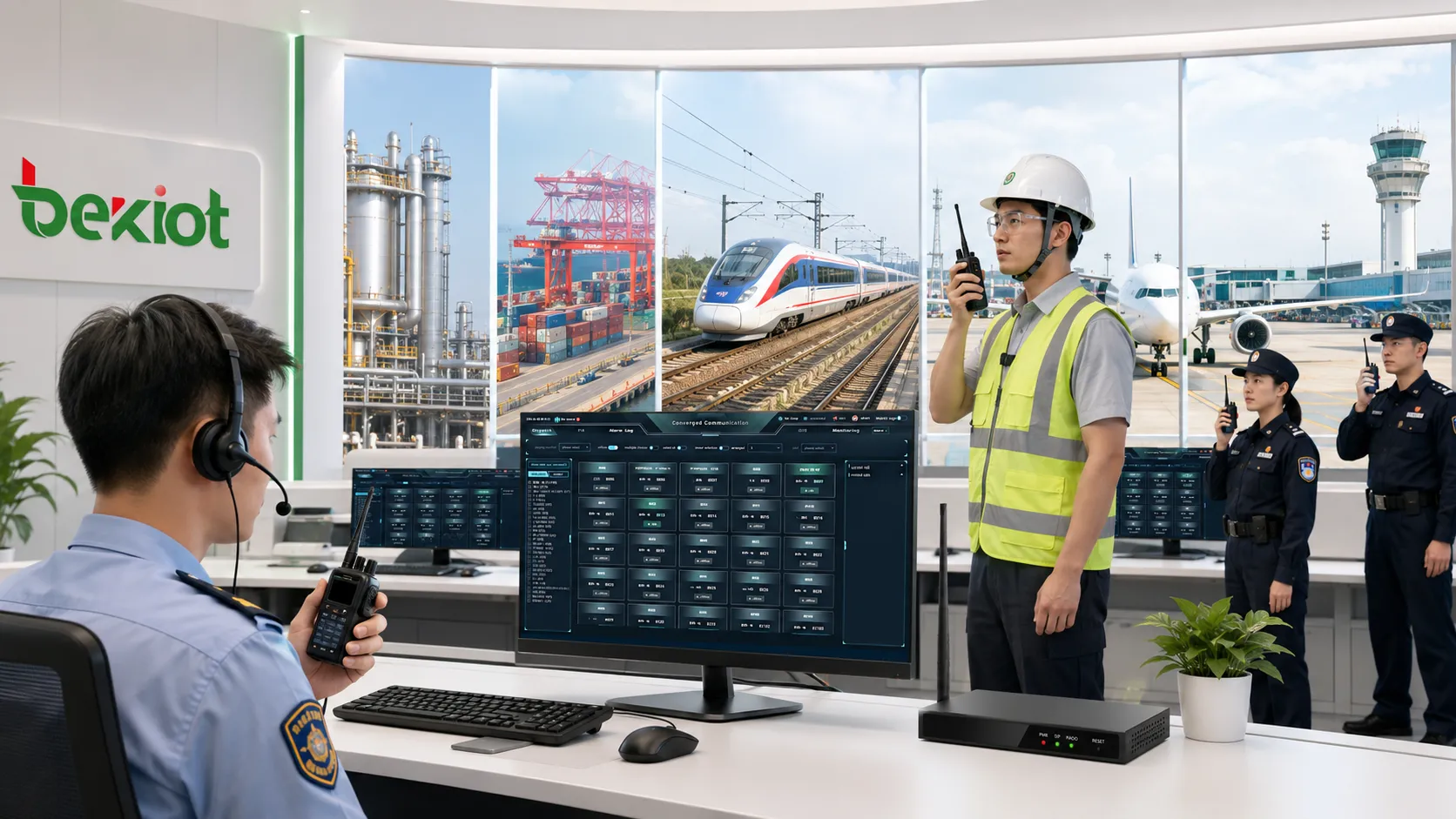
The Communication Gap in Modern Field Operations
Traditional two-way radios are simple, fast, and familiar. Users press the PTT button, speak, and other members in the same group listen. This is a typical half-duplex communication mode, which is different from the full-duplex mode used in ordinary phone calls.
However, many modern projects require more than voice. Dispatch centers may need voice calls, video calls, location tracking, emergency alarms, multimedia return, call recording, GIS display, and connection with command platforms. Narrowband radio systems are strong for mission-critical voice, but they are not designed to carry all these broadband services by themselves.
Public network PTT and private radio systems solve different parts of this problem. Public network PTT expands multimedia collaboration through mobile networks. Private radio systems provide dedicated, controlled, and reliable communication for important industries and critical sites.
How Public Network PTT Works in Real Projects
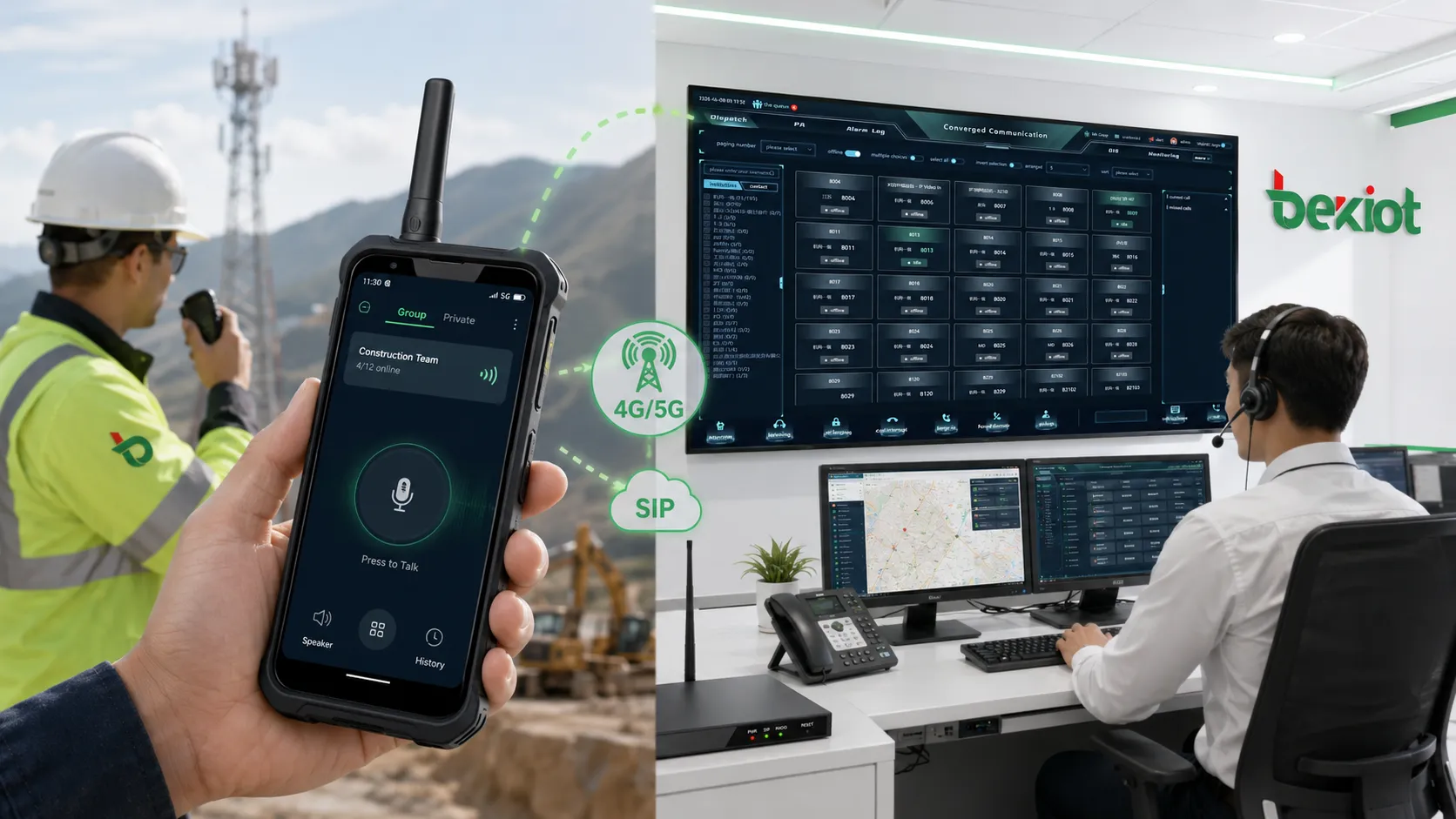
Public network PTT is often implemented through a smart application that simulates the “press to talk” function of a traditional radio. Users can run the app on rugged smartphones, smart terminals, or professional mobile devices. The terminal communicates with the platform through 4G, 5G, or other mobile data networks.
This model is also commonly known as PoC, or Push-to-talk over Cellular. Because it uses broadband mobile internet, it can support richer services than a traditional radio-only system. In addition to group voice, it may support video calls, personnel positioning, multimedia messages, video return, emergency buttons, dispatch maps, and history records.
Where it brings strong value
Public network PTT is useful when users are widely distributed, moving across cities, working in temporary sites, or operating outside the fixed coverage area of a private radio system. It reduces the need to build radio base stations for every location and allows fast deployment through existing carrier infrastructure.
It is also suitable for property management, logistics, urban services, field maintenance, school security, large events, patrol teams, retail chains, and enterprise mobile teams. For these users, flexibility and multimedia capability are often more important than owning a dedicated radio network.
Limitations that must be considered
Because public network PTT depends on telecom carrier coverage, its performance may be affected by signal quality, network congestion, data package cost, and local service availability. In some critical environments, a public network can be a useful supplement, but it should not always be the only communication layer.
Project teams should evaluate coverage, latency, voice continuity, terminal battery life, emergency priority, and data security before using public network PTT as the main field communication method.
Why Dedicated Radio Still Matters
Private network intercom is built for dedicated users and controlled environments. It is widely used in public safety, chemical parks, ports, rail transit, airports, energy facilities, industrial plants, large campuses, and mission-critical operation areas where communication availability is highly important.
Unlike public network PTT, private radio systems do not depend entirely on commercial mobile networks. Organizations can build their own digital trunked radio system, manage their own channels, define their own talk groups, and control the coverage area according to operational requirements.
Dedicated coverage and channel control
Traditional radios have limits in coverage distance and available communication channels. A digital trunked radio system improves this by using base stations, dispatch control, channel management, group calling, and system-level coordination.
Common private network radio standards include PDT, DMR, TETRA, and NXDN. These systems are supported by different manufacturers, industry alliances, and regional ecosystems. They remain widely used in professional radio communication markets because they provide a dedicated communication environment for critical operations.
Suitable scenarios for private deployment
Private radio is especially important where public network coverage may be unstable or where communication must continue during emergencies, major events, disasters, industrial incidents, or traffic control operations. It is also preferred when users need strict group management, dispatch priority, secure operation, and long-term system ownership.
In these scenarios, public network PTT can extend communication to mobile apps and remote users, while the private radio system continues to serve as the core professional communication network.
Why Many Projects Need Both Models
Public network PTT and private radio communication are not direct replacements for each other. Public network PTT offers flexibility, multimedia functions, and wide-area mobile access. Private radio provides dedicated control, professional dispatch, stable group voice, and industry-grade reliability.
Many projects now require public-private communication convergence. For example, a command center may need to talk with radio users on a private DMR or TETRA system, while also communicating with mobile app users on a PoC platform. Field teams may include both radio users and smartphone users. Dispatchers may need to manage both from one communication platform.
Without an interconnection layer, these users remain separated. Radio users can only talk inside the radio system, while PoC users stay inside the app platform. A gateway-based architecture solves this by connecting radio networks, SIP systems, and dispatch platforms into one operational workflow.
Gateway-Based Interconnection Architecture
A RoIP gateway is commonly used to connect radio communication systems with IP-based platforms. It can bridge analog or digital radio equipment with SIP dispatch systems, PoC platforms, recording servers, command software, and unified communication platforms.
In a converged architecture, the gateway can transfer voice between radio channels and IP networks. For SIP-based platforms, it can support PTT floor control, talk right request, talk right release, and related signaling logic. For private radio systems, it can connect through defined radio interfaces, control ports, audio interfaces, or professional connector wiring, depending on the equipment type.
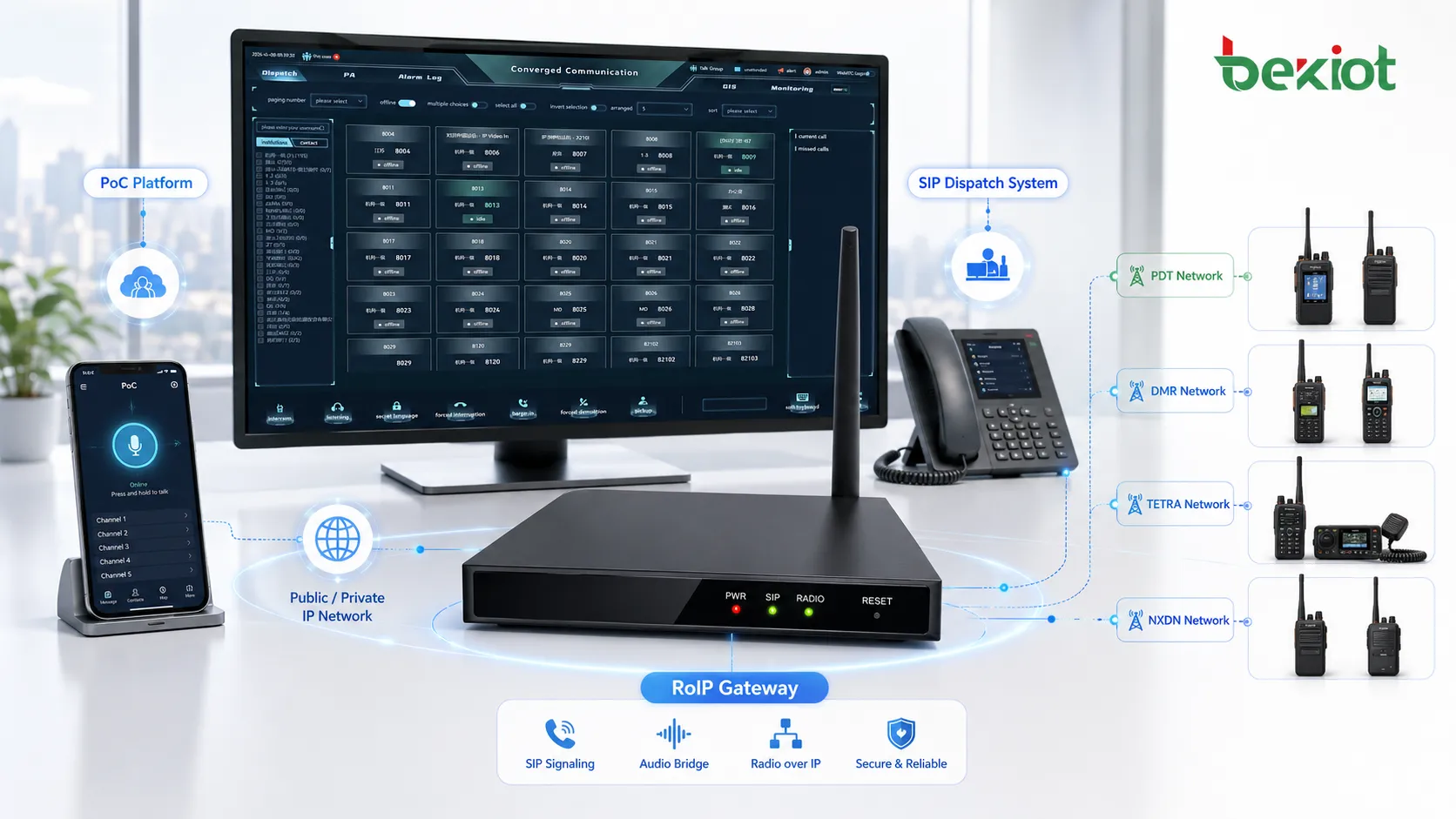
Connecting SIP platforms and radio systems
Many modern command and dispatch systems are based on SIP or IP communication. A RoIP gateway allows these platforms to communicate with traditional radio users without forcing the whole radio network to be replaced.
This is useful for phased upgrades. Existing radios, base stations, and field terminals can continue to work, while new SIP dispatch software, PoC apps, recording systems, and multimedia platforms are added step by step.
Interface planning for real equipment
In actual projects, radio integration may involve audio input and output, PTT control, carrier detect, serial control, GPIO, and special connectors. Some radio gateway projects use aviation plug interfaces, including 9-pin connector designs, to adapt to different radio brands and wiring definitions.
The exact wiring and control method should be confirmed through radio model testing. Different radio systems may have different requirements for audio level, impedance, PTT trigger, squelch detection, and talk group operation.
Recommended Solution Design
A practical public-private PTT integration solution can include PoC mobile terminals, rugged smartphones, private radios, base stations, RoIP gateways, SIP dispatch servers, recording platforms, GIS systems, alarm modules, and command center consoles.
The system should be designed around real workflows. Dispatchers need to know which users are on public network PTT, which users are on private radio, which groups should be bridged, and which emergency calls require priority. The architecture should avoid simply connecting everything together without permission control or group planning.
Group and talk right management
Push-to-talk communication depends on clear talk right control. When one user speaks, others listen. In a converged system, talk right logic must work across PoC users, radio users, and SIP dispatch users.
Gateway configuration should define how PTT is triggered, how talk right is released, how conflicts are handled, and how emergency interruption is managed. This is especially important when multiple networks and different device types share the same group.
Recording, positioning, and command linkage
Public network PTT can provide location information, video return, and mobile status. Private radio can provide stable group voice for critical teams. When both are connected to a dispatch platform, operators can see user status, call records, group activity, and emergency events in a more unified way.
For large projects, the solution can also be linked with GIS maps, video surveillance, alarm systems, access control, public address, and incident management workflows.
Where This Architecture Is Most Useful
Public-private PTT convergence is valuable in industries where mobile collaboration and critical radio communication must coexist. Typical applications include public safety, emergency response, chemical industrial parks, ports, rail transit, airports, mines, energy facilities, large factories, logistics parks, smart campuses, and major event security.
In a chemical park, for example, private radio may support on-site emergency teams, while PoC mobile terminals support management staff, contractors, and remote supervisors. In a port, radio users may handle field operations, while a dispatch center uses an IP platform to coordinate voice, location, alarm, and video information. In rail transit or airport operations, different teams may use different communication tools, but command staff still need unified coordination.
Related Product for Radio over IP Integration
For projects that need to connect PoC platforms, SIP dispatch systems, and professional radio networks, a RoIP solution can provide the bridge between IP communication and field radio users. It is especially suitable for system integrators building public-private intercom convergence, radio dispatch upgrades, and multi-network command systems.
Related product solution: Becke RoIP Gateway
When selecting a RoIP device, project teams should pay attention to radio interface compatibility, SIP platform support, PTT control, audio quality, channel capacity, deployment environment, and long-term maintainability.
Deployment Checks Before Project Delivery
Before handover, the system should be tested in real communication conditions. Engineers should verify radio audio quality, SIP registration, PTT trigger behavior, talk right release, group bridging, recording quality, mobile app communication, weak-signal behavior, and recovery after network interruption.
For sites with strict safety requirements, redundancy, backup power, secure remote access, operation logs, account permissions, and emergency priority rules should also be included in the acceptance plan.
Network and coverage verification
Public network users should be tested in the actual coverage area, not only in the office. Private radio users should be tested across key zones, underground areas, outdoor boundaries, machine rooms, control rooms, and emergency routes.
The final solution should make communication easier for users, not more complex. Device naming, group planning, shortcut keys, dispatch interface layout, and operating procedures should be designed for fast use under pressure.
Business Value for Integrators and Owners
A converged PTT solution protects existing radio investment while adding modern IP communication capability. It allows organizations to keep using professional radio systems where they are necessary, while extending communication to mobile apps, SIP dispatch platforms, remote users, and multimedia workflows.
For system integrators, RoIP-based convergence reduces repeated custom development and creates a clearer technical path for connecting PoC, SIP, and radio networks. For project owners, it improves field coordination, emergency response, command visibility, and long-term system scalability.
The most effective solution is not a single network. It is a layered communication architecture where public network PTT, private radio, SIP dispatch, recording, positioning, and command linkage work together according to operational priorities.
FAQ
Can public network PTT completely replace two-way radios?
Not in every project. Public network PTT is flexible and feature-rich, but private radios are still preferred in many critical environments where dedicated coverage, channel control, and operational independence are required.
What is the main purpose of a RoIP gateway?
A RoIP gateway converts radio communication into IP-based communication so that radios can interconnect with SIP platforms, dispatch systems, recording servers, and PoC users.
Do all private radio systems use the same interface?
No. Different radio brands and standards may use different audio, PTT, control, and connector definitions. Hardware testing and wiring confirmation are necessary before deployment.
Is PoC suitable for emergency response teams?
It can be useful as an extension layer, especially for mobile staff and remote coordination. For mission-critical response, it is often combined with private radio rather than used as the only communication method.
What should be considered when bridging multiple talk groups?
Project teams should define group permissions, talk right priority, emergency interruption rules, recording policy, user identity display, and operating procedures to avoid communication conflicts.







