


Zycoo SIP broadcast terminal series is designed for projects that need network-based audio endpoints instead of traditional passive speakers. It combines SIP communication, built-in amplification, PoE deployment, background music playback, ONVIF linkage, and outdoor speaker options into a product family that can be used across buildings, campuses, healthcare facilities, commercial spaces, warehouses, public venues, and security-managed sites.
The lineup includes SQ10-B, SQ10-T, SC10, SC15, SW15, SL30, SL50, SH10, and SH30. These models are not simply different shapes of the same speaker. Each one is aimed at a different acoustic space, mounting method, coverage distance, and system requirement. For integrators and project planners, the main value is that one SIP-based audio architecture can support indoor paging, two-way voice, high-definition music, outdoor alerts, and emergency broadcast without separating every function into an independent system.
A Product Family Designed Around Real Installation Points
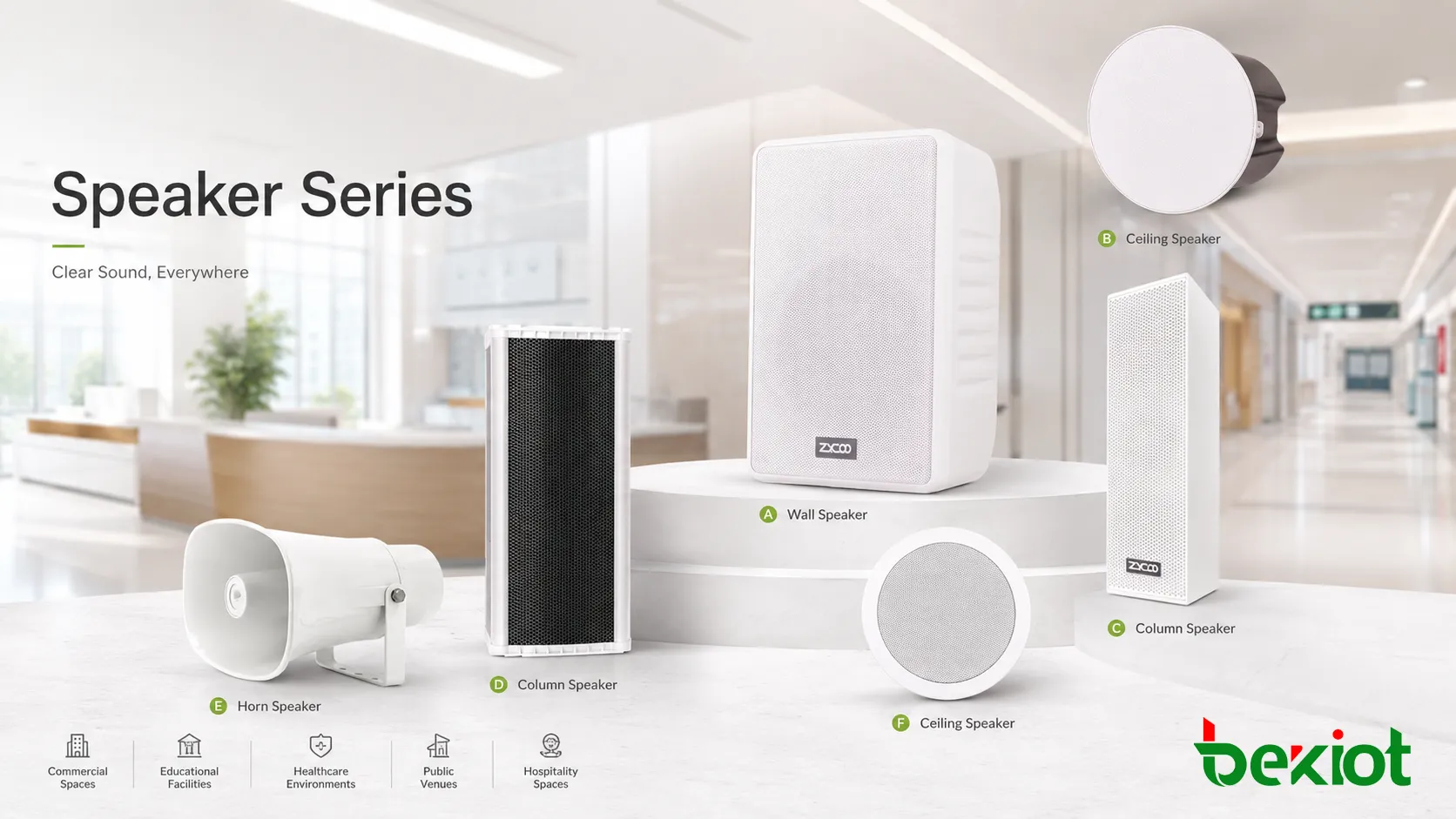
The series covers five major product forms: square SIP speakers, ceiling speakers, wall-mounted speakers, waterproof column speakers, and outdoor horn speakers. This range matters because audio endpoints are selected by space conditions, not only by rated power. A ceiling speaker fits a corridor or office ceiling. A wall speaker fits a shop, hallway, or public service area. A horn speaker is more suitable for outdoor spaces, entrances, yards, and noisy environments where voice projection is more important than music texture.
By offering several terminal types under the same SIP audio concept, the series allows designers to build a mixed system. Indoor areas can use ceiling or wall speakers for music and announcements, outdoor zones can use column or horn speakers for stronger coverage, and interactive points can use models with built-in microphones for two-way communication.
Model Differences at a Glance
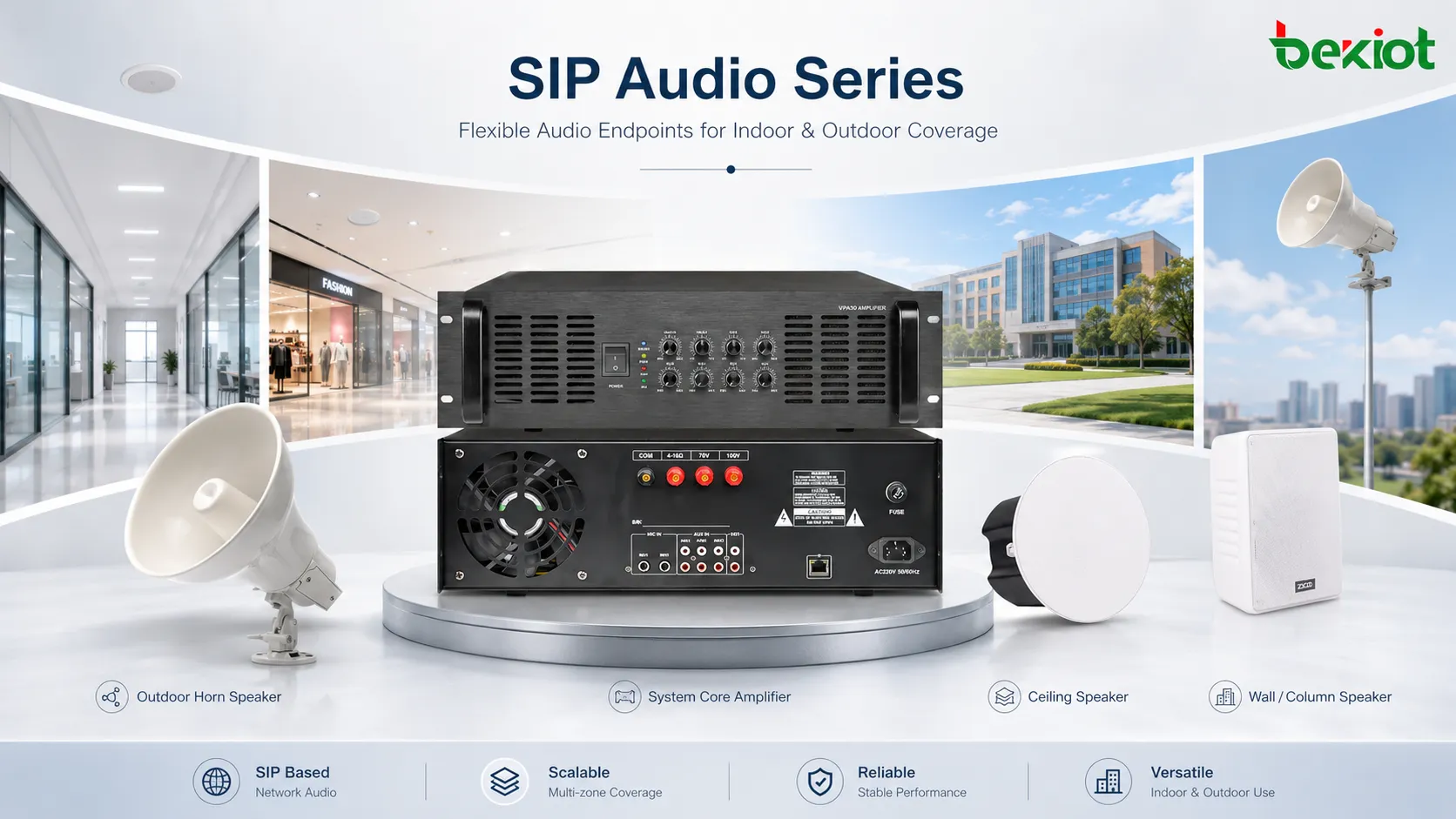
The model structure is clear when viewed from an engineering selection perspective. SQ10-B and SQ10-T are compact SIP speakers for indoor voice interaction. SC10 and SC15 are ceiling speakers for distributed indoor audio. SW15 is a wall-mounted network speaker. SL30 and SL50 are waterproof column speakers for outdoor or semi-outdoor spaces. SH10 and SH30 are horn speakers for louder and longer-distance broadcast.
| Model Group | Product Type | Typical Use | Key Technical Point |
|---|---|---|---|
| SQ10-B / SQ10-T | Square SIP speaker | Service points, classrooms, reception areas, healthcare stations | Built-in microphone; SQ10-T adds LCD display and visual message prompts |
| SC10 / SC15 | Ceiling SIP speaker | Offices, corridors, schools, hospitals, retail interiors | Ceiling installation for background music and paging coverage |
| SW15 | Wall-mounted SIP speaker | Commercial areas, hallways, public service zones | Wall installation where ceiling mounting is not suitable |
| SL30 / SL50 | Waterproof column speaker | Outdoor walkways, campuses, parks, semi-open public areas | IP65 protection; SL30 supports PoE+; SL50 supports 4G wireless module |
| SH10 / SH30 | Outdoor horn speaker | Stadiums, warehouses, yards, transport areas, amusement parks | High-output voice projection; 400Hz–8KHz response; up to 117dB SPL |
SQ10-B and SQ10-T: Compact Speakers with Two-Way Voice
SQ10-B and SQ10-T are positioned as compact SIP broadcast terminals for indoor spaces where audio output and voice return may both be required. The built-in microphone allows the speaker to support two-way communication, making it more than a one-way announcement device. It can be used for service calls, staff communication, local assistance, or emergency response points.
SQ10-T adds a programmable LCD screen. In normal operation, the display can show date and time. During scheduled messages or emergency events, it can show custom text and use a flashing visual prompt. This gives the terminal an extra communication layer in places where people may not immediately notice an audio message, such as classrooms, waiting areas, service counters, and corridors.
SC10, SC15, and SW15: Indoor Audio for Paging and Music
SC10 and SC15 are ceiling-mounted SIP speakers, while SW15 is a wall-mounted model. These products are more suitable for indoor environments that require regular paging, scheduled announcements, and background music. Their installation style is less intrusive than horn speakers and better matched to commercial interiors.
The indoor speaker group uses low-frequency and high-frequency dual speaker units. This design improves sound detail compared with narrowband paging speakers and helps the terminal handle both voice and music. For projects such as offices, hospitals, schools, shopping areas, hotels, and public service halls, this balance is important because the same speaker may play soft background music during normal hours and carry urgent voice messages when needed.
Volume can be adjusted locally or from the server side. This is practical after installation because real acoustic conditions are often different from drawings. Corridors, open halls, small rooms, and high-ceiling areas usually need different output levels, even when the same speaker model is used.
SL30 and SL50: Waterproof Column Speakers for Outdoor Coverage
SL30 and SL50 are designed for outdoor and semi-outdoor audio coverage. Their IP65 protection rating makes them more suitable for environments exposed to dust, rain, humidity, and changing weather. Compared with small indoor speakers, column speakers provide a more focused and organized sound field, which is helpful for walkways, entrances, campuses, parks, and open public areas.
SL30 supports PoE+, allowing power and network data to use the same Ethernet cable when suitable network infrastructure is available. SL50 can work with a 4G wireless module, which gives project teams another deployment option when Ethernet cabling is difficult or expensive. This is useful for temporary sites, remote zones, outdoor service points, and locations where network wiring would require additional civil work.
SH10 and SH30: Horn Speakers for Stronger Voice Projection
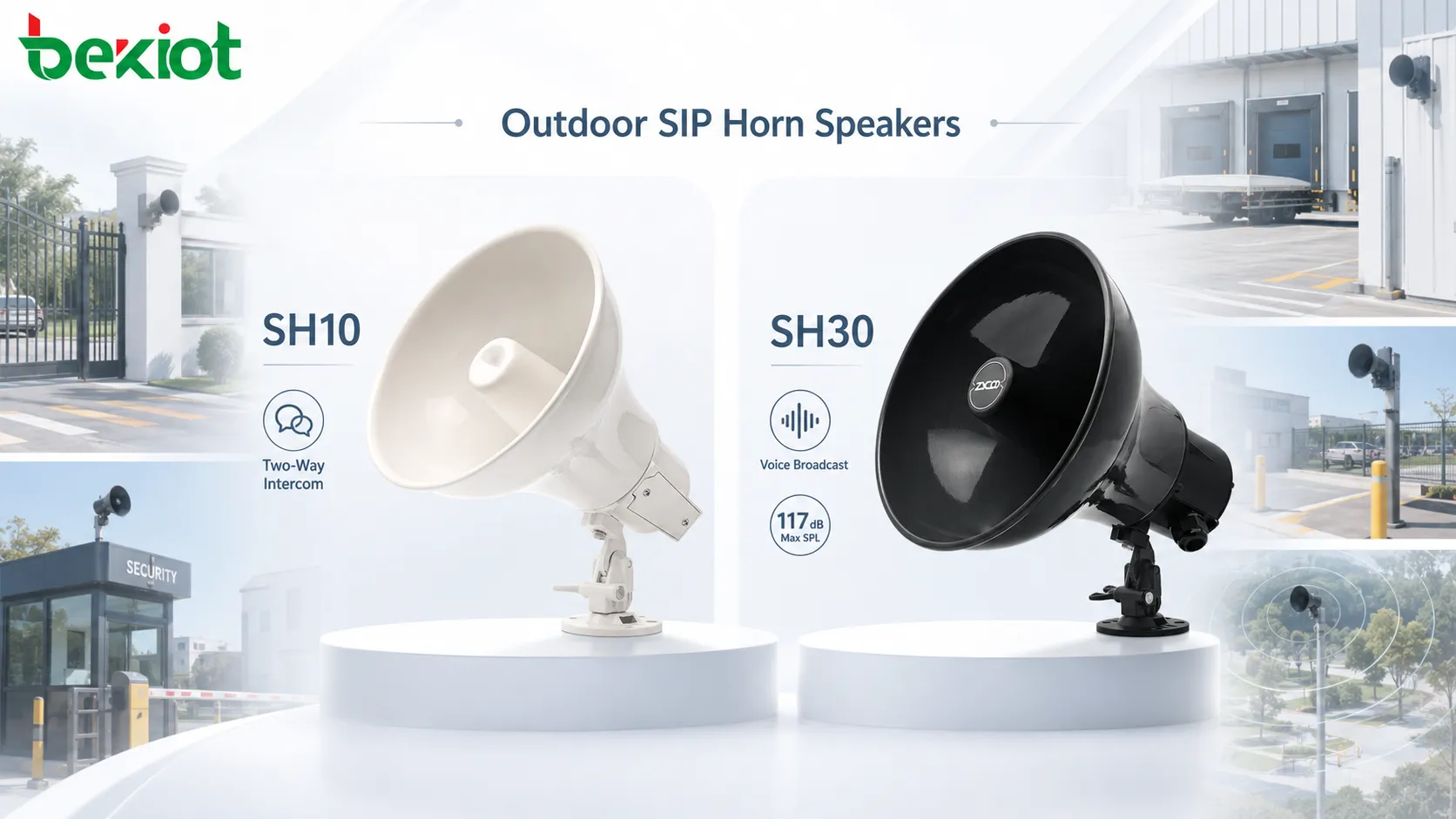
SH10 and SH30 are outdoor SIP horn speakers built for louder and more directional broadcast. Their frequency response range of 400Hz to 8KHz is focused on voice clarity rather than full-range music performance. The maximum sound pressure level reaches 117dB, making them suitable for noisy or open environments where ordinary ceiling or wall speakers would not be strong enough.
SH10 includes a built-in microphone and can work with an external button for two-way intercom. It also supports dry contact output, which allows linkage with external devices or local control workflows. In practical projects, this makes SH10 useful at gates, loading areas, industrial entrances, outdoor service points, and public safety locations where broadcast and voice interaction may both be needed.
SIP Compatibility and Audio Platform Integration
The series supports SIP communication and can work with an IP audio platform or a third-party SIP server. Once registered as SIP endpoints, the terminals can be assigned to extensions, paging groups, broadcast zones, or scheduled audio tasks. This makes the speaker system easier to integrate with existing VoIP communication infrastructure.
For projects that already use SIP phones, IP PBX systems, dispatch consoles, or softphones, SIP broadcast terminals help reduce system separation. Operators can manage calls, paging, and emergency announcements through a more unified workflow instead of maintaining a completely independent audio network.
G.722 wideband voice coding improves speech clarity when supported by the platform and network. In paging and emergency broadcast, intelligibility is more important than loudness alone. A message that is loud but unclear can still fail in a real incident. Wideband voice helps announcements sound cleaner, especially in indoor areas and controlled acoustic spaces.
Built-In Class D Amplifier and Network Audio Playback
The terminals use built-in Class D amplification. This reduces the need for separate amplifier channels and allows each speaker to operate as a more complete IP audio endpoint. In distributed buildings or multi-zone systems, built-in amplification can simplify cabling, reduce equipment-room pressure, and make expansion more flexible.
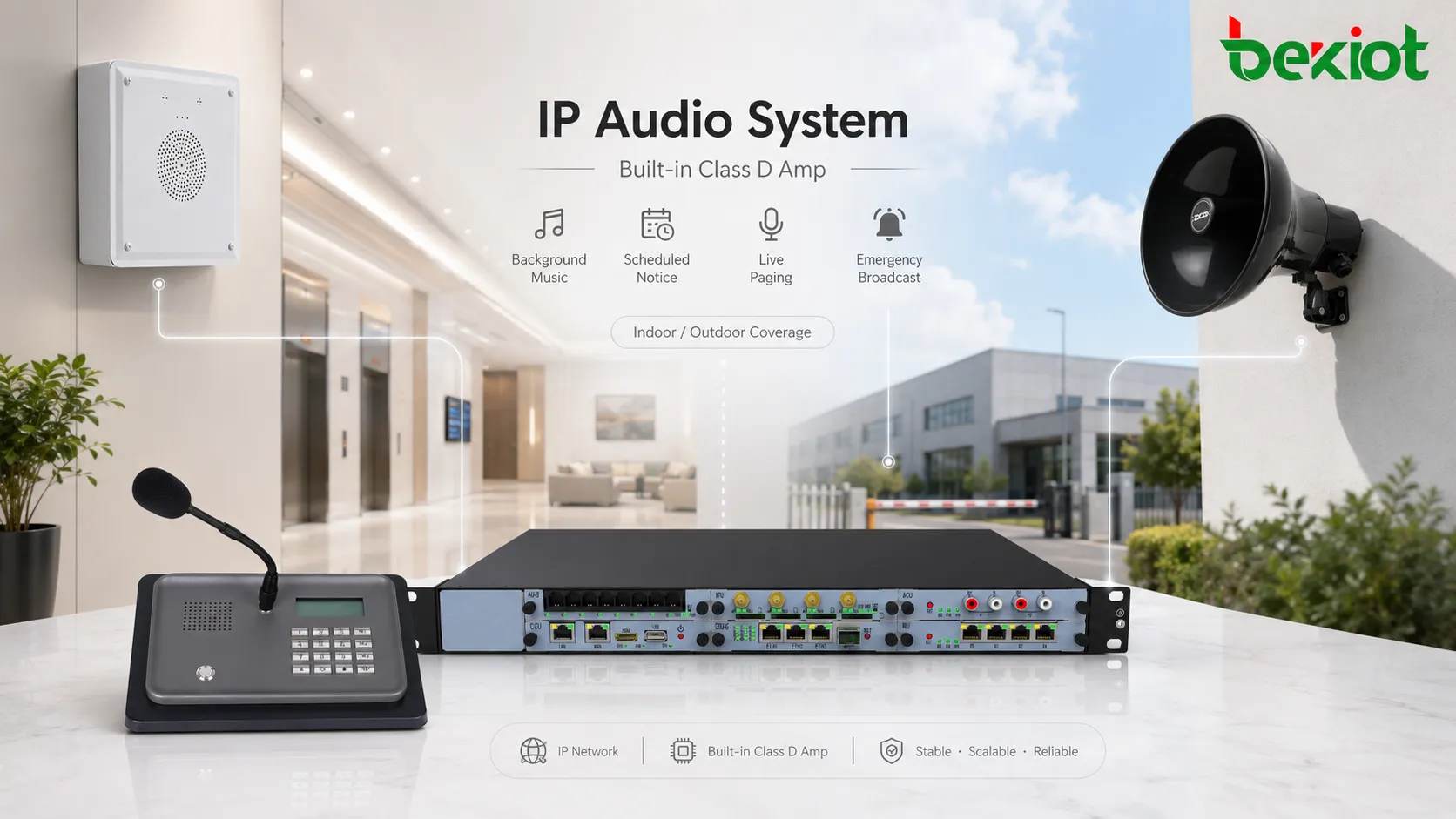
The series also supports high-definition MP3 music streaming through an IP audio management system. This means the same speaker network can be used for background music, scheduled notices, real-time paging, and emergency broadcast. For commercial and public environments, this avoids the need to build separate systems for music and voice announcements.
In product selection, this audio design makes the ceiling and wall-mounted models especially relevant for indoor spaces where sound quality and appearance both matter. For outdoor models, the priority shifts toward projection, protection, and voice coverage.
PoE Deployment and Field Power Planning
Several models support PoE based on IEEE 802.3at, which allows power and data to run through one Ethernet cable. This is one of the strongest installation advantages of IP audio terminals. It reduces separate power wiring and makes ceiling, wall, and outdoor network speaker deployment easier.
Power planning still needs careful calculation. Engineers should check the PoE switch budget, the number of endpoints, cable distance, backup power requirements, and whether the speaker needs PoE or PoE+. For emergency broadcast projects, the upstream switch and network path should be protected by UPS or another backup power method.
Outdoor models also require attention to waterproof connectors, grounding, surge protection, bracket strength, and maintenance access. IP65 protection improves environmental suitability, but reliable outdoor operation depends on both the device rating and the quality of installation.
ONVIF Linkage for Security Audio Scenarios
ONVIF support allows the terminals to connect with compatible video management systems. This enables a more practical security workflow: cameras provide visual awareness, while nearby SIP speakers provide immediate voice intervention.
In parking lots, school gates, warehouses, outdoor venues, and restricted areas, operators can view the scene and issue a warning, instruction, or emergency message through the closest speaker. This is more direct than relying only on visual monitoring, especially when staff cannot arrive at the location immediately.
Before deployment, ONVIF integration should be tested with the selected video platform. Device discovery, permissions, event linkage, audio trigger methods, and network segmentation may vary between systems.
Automatic Configuration for Multi-Device Projects
Automatic configuration is important when many speakers are installed across a building, campus, factory, hospital, or commercial complex. Manual setup can become slow and inconsistent when each terminal needs SIP account information, server address, zone assignment, volume level, and scheduled task settings.
With local or remote provisioning, standard configuration can be delivered more efficiently. If a terminal is replaced or reset, the correct settings can be restored without rebuilding every parameter manually. This improves maintenance efficiency and reduces long-term support cost.
Application Fit by Environment
In offices and commercial buildings, ceiling and wall-mounted SIP speakers are suitable for background music, service announcements, opening and closing notices, and emergency instructions. SQ10-T can be used where audio messages need additional visual support.
In schools and universities, the system can support class-change tones, campus paging, security alerts, dormitory notices, and outdoor public address. A centralized IP audio platform makes it easier to manage multiple buildings and outdoor zones.
In hospitals and senior care facilities, clear announcements and controlled zones are important for daily operation. SIP speakers can support public notices, staff coordination, and emergency guidance without relying on scattered standalone devices.
In warehouses, factories, logistics yards, stadiums, amusement parks, and transport areas, waterproof column speakers and horn speakers are more suitable. These spaces need stronger sound projection, weather protection, and reliable voice delivery under higher ambient noise.
Selection Notes for Project Engineers
The first selection point is the acoustic environment. Use ceiling or wall-mounted speakers for indoor spaces, column speakers for outdoor distributed coverage, and horn speakers for high-noise or long-distance broadcast. Use SQ10-B or SQ10-T when two-way communication is required at a compact wall-mounted point.
The second point is network and power design. Confirm SIP platform compatibility, PoE capacity, IP addressing, VLAN planning, codec support, and remote provisioning method before installation. For outdoor or remote areas, check whether wired Ethernet, PoE+, DC power, or 4G wireless access is more practical.
The third point is system workflow. A product may support paging, background music, ONVIF linkage, and emergency broadcast, but those functions must be configured into a clear operating process. Daily audio, scheduled tasks, security events, and emergency priority rules should be planned before commissioning.
Product-Level Technical Summary
Zycoo SIP broadcast terminal series is best understood as a flexible IP audio product family rather than a single speaker model. It covers indoor voice interaction, commercial music playback, ceiling paging, wall-mounted audio, outdoor column coverage, and high-output horn broadcast. Key technical features include SIP compatibility, G.722 wideband voice, built-in Class D amplification, PoE deployment, automatic configuration, ONVIF linkage, MP3 streaming, IP65 outdoor protection, 4G module compatibility, built-in microphone options, and dry contact output on selected models.
For projects that require both daily audio and emergency communication, the strongest advantage is product coverage. The same system architecture can include different speaker types for different areas, while keeping SIP registration, centralized management, and network-based audio control consistent across the project.
FAQ
Which model is better for indoor background music?
SC10, SC15, and SW15 are more suitable for indoor background music and general paging. Their ceiling or wall-mounted design fits commercial interiors better than outdoor horn speakers.
Which models are more suitable for outdoor broadcast?
SL30, SL50, SH10, and SH30 are more suitable for outdoor use. SL30 and SL50 are waterproof column speakers, while SH10 and SH30 are horn speakers for stronger voice projection.
When should a project choose a speaker with a built-in microphone?
A built-in microphone is useful when the speaker point also needs two-way communication, such as service assistance, entrance communication, help points, or outdoor intercom applications.







