


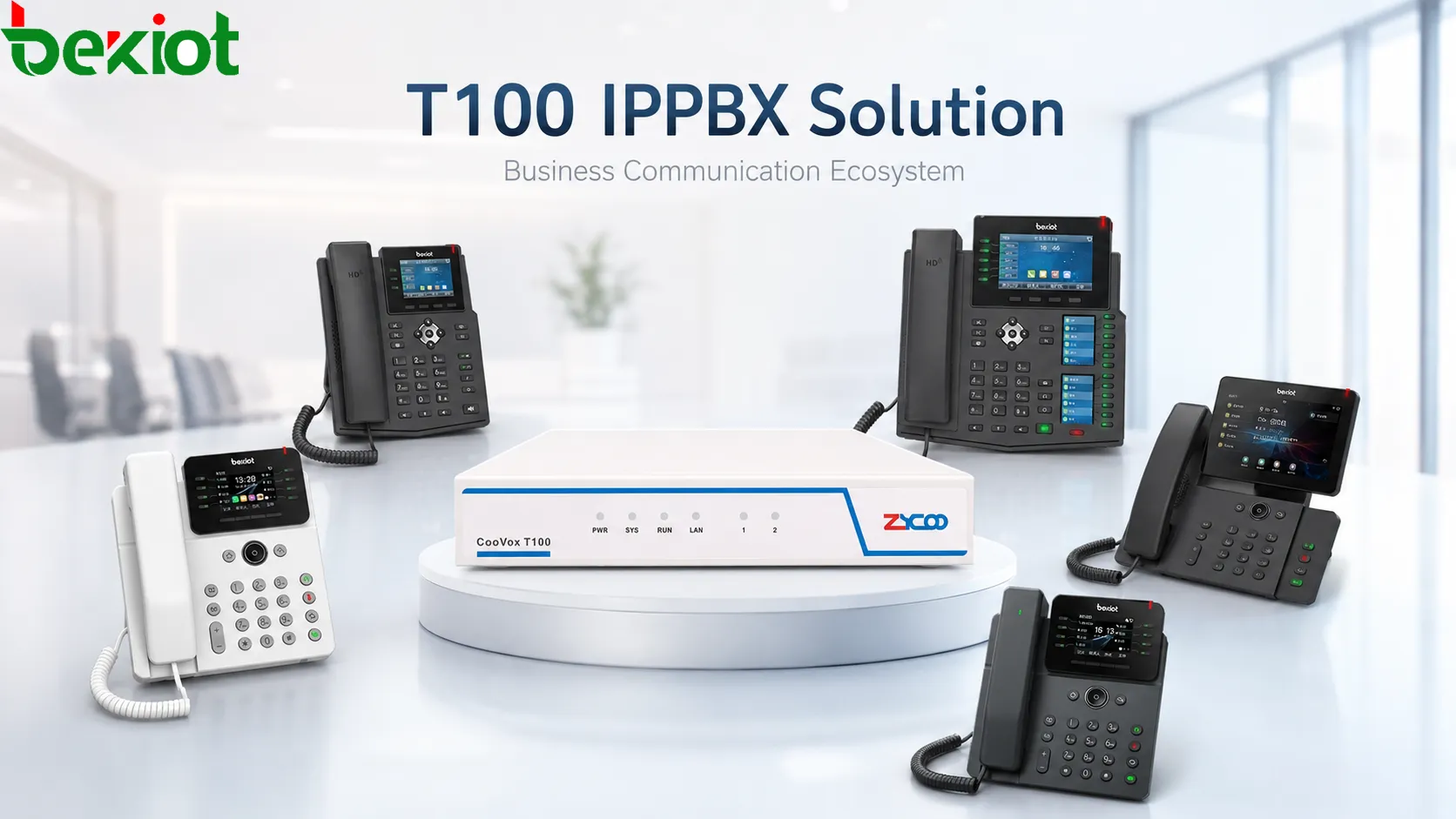
Zycoo T100 is a compact CooVox IPPBX hardware server built for small and medium-sized business communication. It supports 100 extensions, 50 concurrent calls, 2 FXS ports, and 2 FXO ports, giving offices, hotels, clinics, schools, retail branches, property management offices, and service teams a practical way to manage internal calling, analog line access, remote extensions, softphone users, billing, and daily voice operation from one platform.
The T100 is most suitable for organizations that need more structure than basic desk phones but do not yet require a large enterprise PBX. It provides enough user capacity for a growing team, keeps limited analog connectivity for legacy lines or analog endpoints, and supports Zycoo’s software ecosystem for remote access, operator handling, mobile extension use, billing, and service continuity planning.
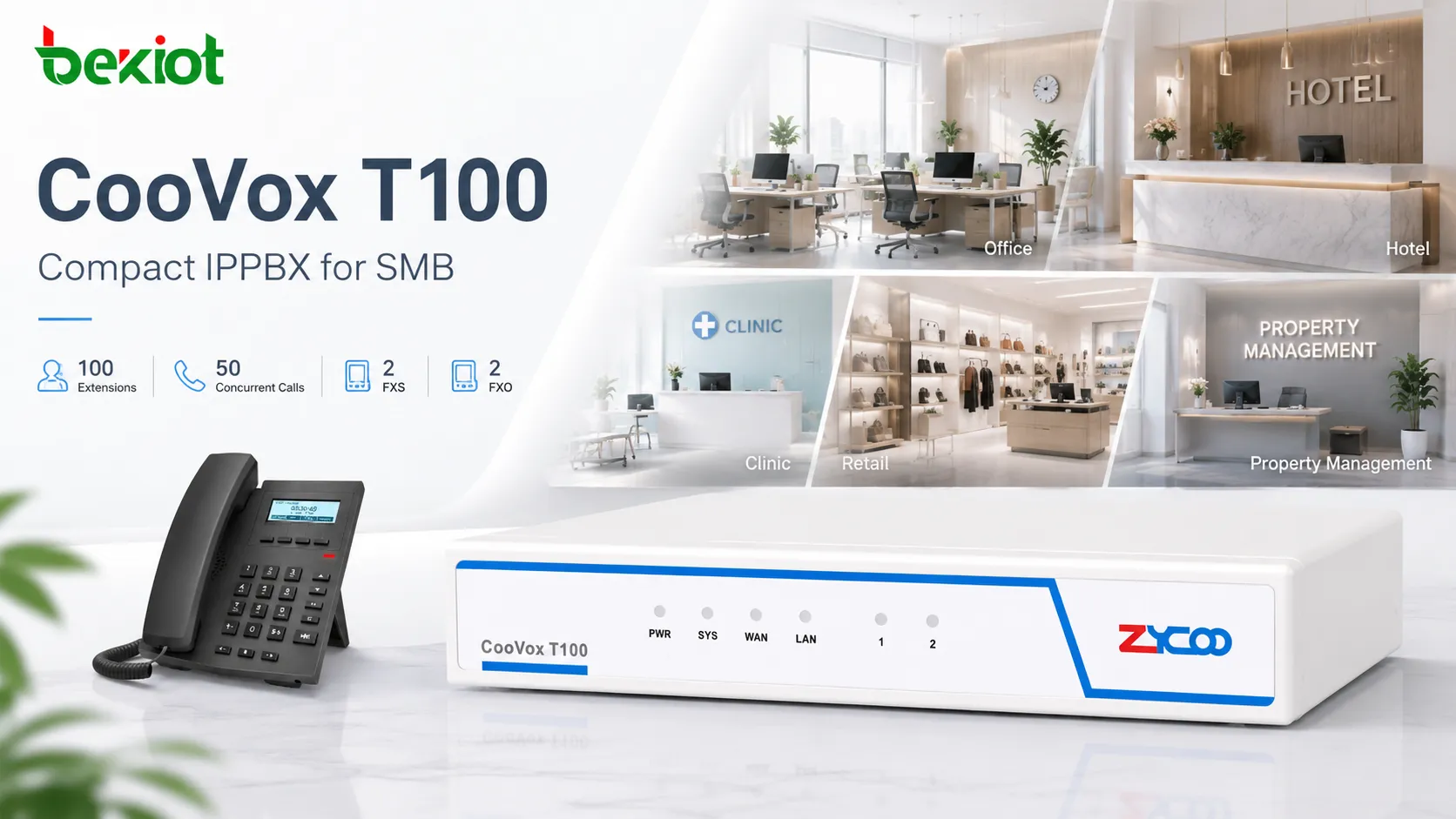
Product Role in an SMB Communication System
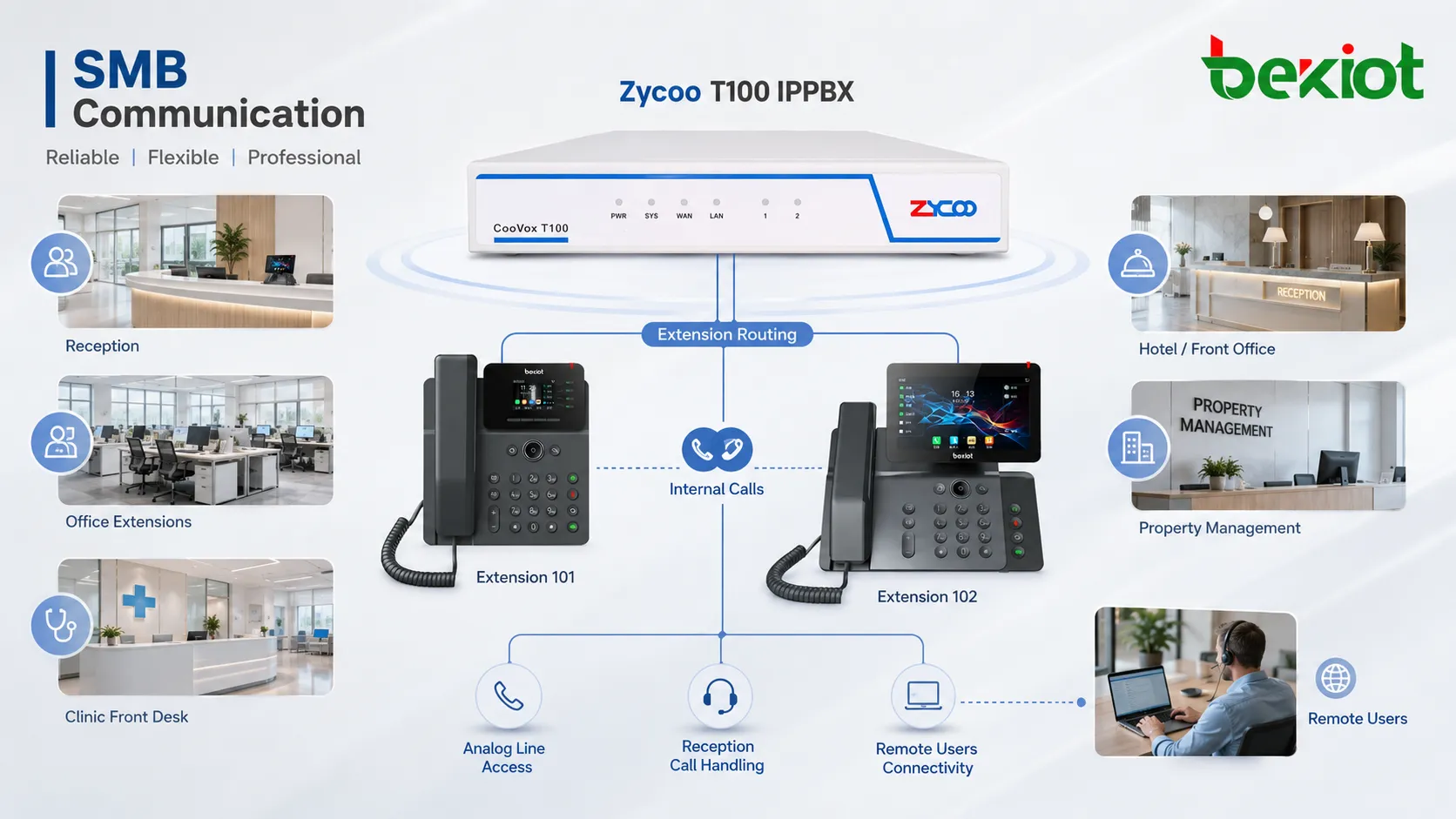
The T100 is designed as the central voice server for an SMB site. It can register IP phones, manage extension numbers, route inbound and outbound calls, connect selected analog resources, and support users who need to work from different locations. For a business with reception transfer, department extensions, service desks, remote users, or branch communication needs, this is a clear upgrade from scattered standalone phones.
Its 100-extension capacity gives room for desk phones, softphones, service extensions, public area phones, and future expansion. The 50 concurrent call capacity defines the real-time traffic level the system is intended to handle. In practice, this matters more than extension count alone because many businesses register more users than they have simultaneous conversations at any given moment.
T100 Model Specifications
For this model, the key specification is straightforward: 100 extensions, 50 concurrent calls, 2 FXS ports, and 2 FXO ports. The T100 does not include GSM or E1/T1 interfaces, so it should be selected for SMB voice projects that need SIP communication and limited analog connectivity rather than mobile trunk or digital trunk access.
| Item | Zycoo T100 | Project Meaning |
|---|---|---|
| Extensions | 100 | Suitable for SMB users, desk phones, softphones, service points, and internal numbering growth |
| Concurrent calls | 50 | Supports daily call traffic for reception, departments, remote users, and service teams |
| FXS ports | 2 | Allows analog phones, fax devices, or selected legacy endpoints to remain in use |
| FXO ports | 2 | Connects analog PSTN lines for inbound and outbound calling |
| GSM interface | Not supported on T100 | Mobile trunk access should be handled by another gateway or model if required |
| E1/T1 interface | Not supported on T100 | Digital trunk projects should consider a different model or external gateway |
Hybrid IP and Analog Connectivity
Many SMB sites still keep analog resources during a VoIP upgrade. A business may have existing PSTN lines, fax devices, analog phones, door phones, or service numbers that cannot be removed immediately. The T100 handles this transition with 2 FXS and 2 FXO ports.
The 2 FXS ports are used for analog endpoints. The 2 FXO ports connect traditional telephone lines. This makes the system useful for gradual migration: new users can move to SIP phones and softphones, while selected analog devices and PSTN lines remain available during the transition.
Call Routing and Reception Workflow
A business phone system is not only about making calls. It must decide where calls go, how departments are reached, how reception handles transfer, and how users communicate internally. The T100 gives SMB teams an organized extension structure, so staff can call each other by short numbers instead of relying on mobile phones or informal contact lists.
For reception desks, service counters, clinics, hotels, schools, and property management offices, call transfer and routing are everyday tasks. A structured IPPBX helps reduce missed calls, shortens handling time, and gives callers a more professional experience.
Operator Console and Daily Control
Zycoo’s CooVox ecosystem can work with an operator console for more visual call handling and communication control. In a T100 deployment, this is relevant for sites where reception staff or administrators need a clearer view of extensions, call status, paging tasks, or emergency communication actions.
For small command desks, school offices, hotel front desks, property management centers, and service teams, an operator console can reduce dependence on phone keypad operation. Staff can manage common communication tasks through a more direct interface while the T100 handles the PBX logic in the background.
CooCall Softphone for Mobile Extension Access
CooCall allows users to use an office extension through a software client. This is useful when staff move between desks, work remotely, or need to stay reachable outside the office while still using the company phone system.
For SMB teams, softphone access can reduce the need for every user to have a fixed desk phone. It also keeps business communication inside the IPPBX structure, so extension calling, inbound routing, and call records remain easier to manage.
Remote Proxy and Remote Management
Remote SIP registration can be difficult for SMB users, especially when the business does not have a fixed public IP address or does not want to configure complex firewall, DDNS, or VPN rules. Zycoo’s remote proxy service helps simplify remote extension registration and web-based access.
Remote management is also useful for administrators or service providers who maintain PBX systems across different sites. They can check authorized devices, review status, assist troubleshooting, and manage configuration without visiting the site for every adjustment. For security, this should be paired with strong permissions, controlled access, and regular configuration backups.
Billing and Call Usage Control
The T100 ecosystem supports billing-related functions without requiring a separate third-party billing platform. Supported modes include prepaid, postpaid, and credit limit models, along with rate rules, billing details, and statistical reports.
This can be useful in hotels, serviced offices, shared facilities, campus communication, managed voice services, and internal cost-control projects. Even when billing is not used for charging customers, call statistics can help administrators understand usage patterns and control communication costs.
Hot Standby for Higher Availability
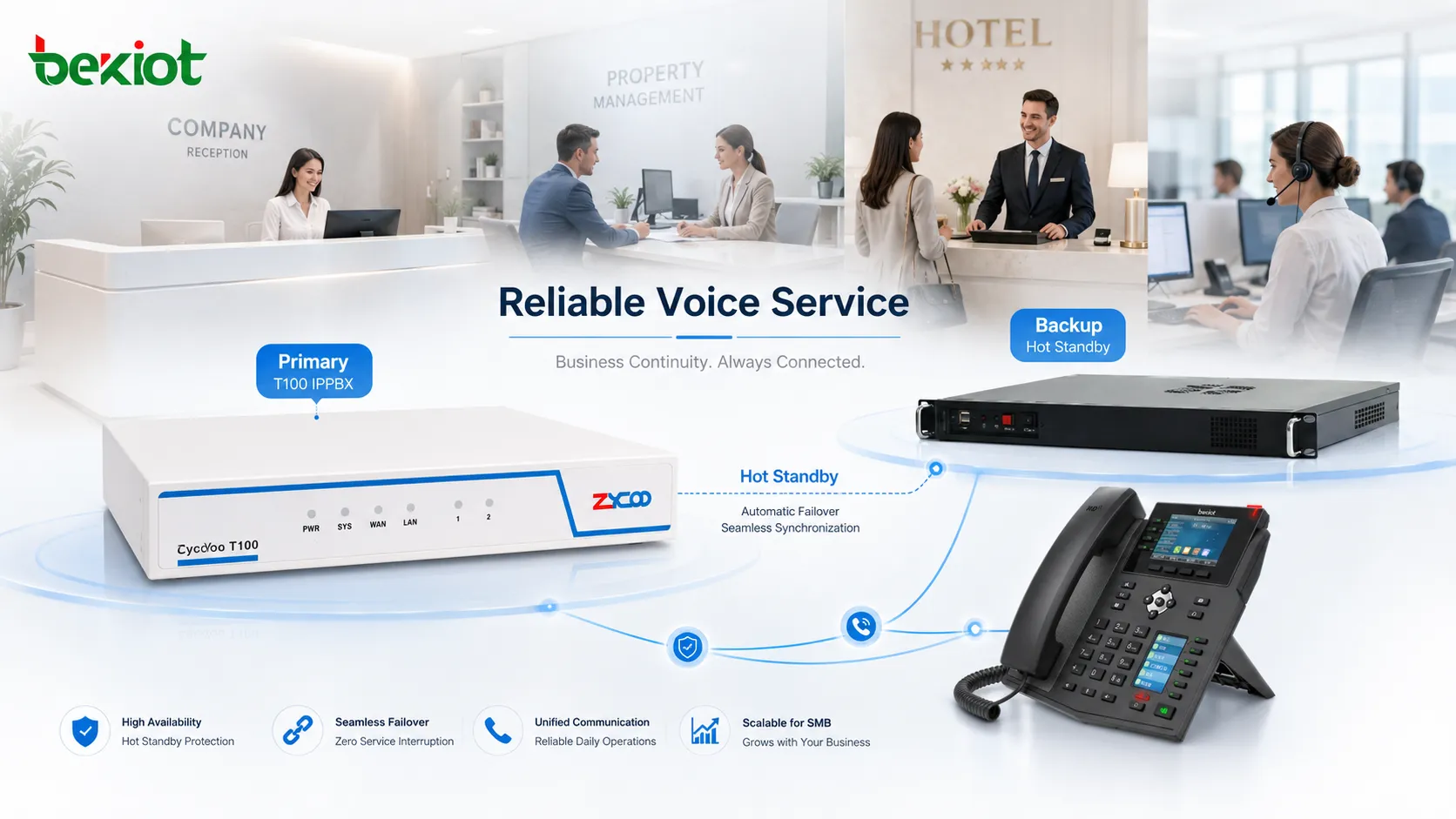
For sites where phone service is part of daily operations, downtime can affect customer service, reception, emergency contact, or property management. Hot standby planning allows two devices to run together so that a standby server can take over IP phone services when the primary server fails.
In a T100 project, hot standby should be considered when voice communication supports critical workflows. The design should include network path planning, power backup, data synchronization, failover testing, and clear recovery procedures. A standby device is valuable only when the whole environment is designed to support failover.
Best-Fit Project Scenarios
The T100 fits SMB environments that need a dedicated IPPBX with moderate capacity and limited analog access. Typical deployments include offices with several departments, hotels with front desk communication, clinics with reception and internal extensions, schools with administrative offices, retail branches with service counters, and property management sites with analog lines still in use.
It is also a practical choice for small industrial or logistics sites where the phone system must connect office users, service points, and a few legacy analog endpoints. The key is to match the product to the correct scale: up to 100 extensions, up to 50 concurrent calls, 2 analog endpoint ports, and 2 analog line ports.
Selection Notes for Engineers and Buyers
The T100 should be selected when the project needs a compact IPPBX for SIP phones, softphones, analog line access, and basic analog endpoint support. If the site requires GSM trunks, E1/T1 trunks, higher concurrent call capacity, or a larger extension base, another model or an external gateway should be evaluated.
Before deployment, project teams should confirm user quantity, peak call volume, analog line count, SIP trunk requirements, remote extension policy, billing needs, backup power, and whether hot standby is necessary. Network design also matters: voice VLAN, QoS, firewall rules, endpoint provisioning, and remote access policy all affect call quality and stability.
Product-Level Technical Summary
Zycoo T100 is a CooVox IPPBX hardware server for small and medium-sized business communication. Its model-level parameters are 100 extensions, 50 concurrent calls, 2 FXS ports, and 2 FXO ports, with no GSM or E1/T1 interface. This makes it suitable for SMB voice systems that need SIP communication, limited analog connectivity, and controlled daily operation.
Its practical value comes from the surrounding CooVox ecosystem: operator console support, CooCall softphone access, remote proxy service, remote management, billing functions, and hot standby planning. When used within the right scale, the T100 gives growing organizations a manageable way to build a professional IPPBX system without overbuying capacity they do not need.
FAQ
Is Zycoo T100 suitable for a company with fewer than 100 extensions?
Yes. The 100-extension capacity gives room for current users, softphones, service points, and future growth. A company does not need to use all extensions from the beginning.
Can Zycoo T100 keep existing analog telephone lines?
Yes. The T100 includes 2 FXO ports for analog PSTN lines and 2 FXS ports for analog endpoints, making it suitable for gradual migration from analog telephony to VoIP.
When is Zycoo T100 not the right choice?
It is not the best fit when a project requires GSM trunk ports, E1/T1 digital trunk access, more than 100 extensions, more than 50 concurrent calls, or a larger multi-site voice traffic load.







