


In many parks, factories, campuses, logistics hubs, mines, and large office zones, staff members do not stay at fixed desks. Security teams move between gates and patrol routes, maintenance teams work across workshops and equipment rooms, managers need to reach mobile personnel, and emergency teams must respond quickly when incidents occur. In these environments, a traditional wired telephone system alone cannot fully support daily operations.
Internal wireless voice communication is designed to solve this mobility problem. It allows users inside a defined site to communicate without relying only on desk phones or public mobile phones. Depending on the site scale, budget, radio environment, security requirements, and integration needs, organizations may choose Wi-Fi phones, DECT systems, two-way radio networks, private 4G/5G networks, or a mixed architecture.
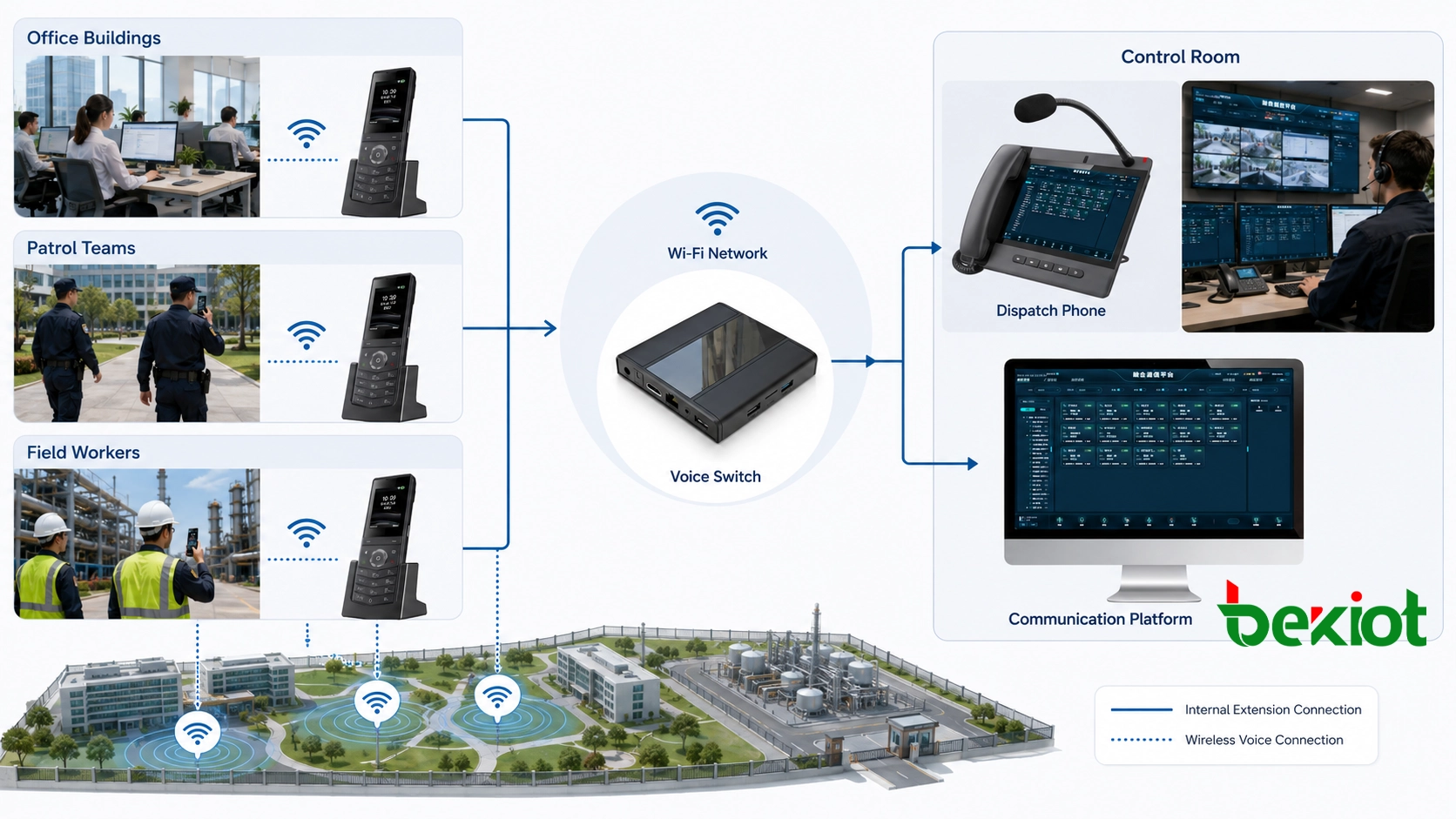
Why fixed-line communication is not enough
Many internal communication systems were originally built around fixed endpoints. These include analog PBX systems, IP PBX platforms, SIP phones, intercom terminals, paging devices, and control-room dispatch consoles. They are stable and easy to manage, but they usually depend on a fixed cable, fixed desk, or fixed installation point.
Wireless voice becomes necessary when communication must follow the user rather than the desk. A security guard may need to receive calls while patrolling a perimeter. A maintenance engineer may need to communicate from a machine room. A warehouse supervisor may need instant voice access while moving between loading zones. In these cases, a wired phone can only cover part of the workflow.
Some organizations try to use public mobile phones for this purpose. Although mobile phones are convenient, they may not be suitable for every site. Certain industrial parks, production areas, confidential facilities, or controlled zones may restrict personal mobile phone use. Public mobile networks also do not always integrate cleanly with internal extensions, dispatch systems, emergency procedures, recording platforms, or private numbering plans.
Key requirements before choosing a solution
A good internal wireless voice design should not begin with the terminal type. It should begin with the communication scenario. The same organization may need point-to-point calling, group calling, emergency broadcast, dispatch command, video communication, short-number dialing, recording, positioning, or integration with existing IP PBX and control-room systems.
Coverage is another major factor. Office buildings, underground spaces, steel structures, production workshops, tunnels, warehouses, and open outdoor areas all behave differently. A solution that works well in a small office may not perform well across a large factory, port, mining area, or multi-building campus.
The following requirements are usually evaluated during planning:
Whether the site already has reliable Wi-Fi coverage or communication infrastructure
Whether users need full-duplex calling, half-duplex push-to-talk, or both
Whether the system must connect with an existing IP PBX, SIP platform, dispatch system, or emergency communication platform
Whether public mobile phones are restricted or unsuitable for security reasons
Whether the site needs voice only, or also video, data, positioning, and multimedia dispatch
Whether the deployment must support private numbering and short internal extensions
Whether local radio regulations allow the selected wireless technology
Wi-Fi phones for simple SIP-based mobility
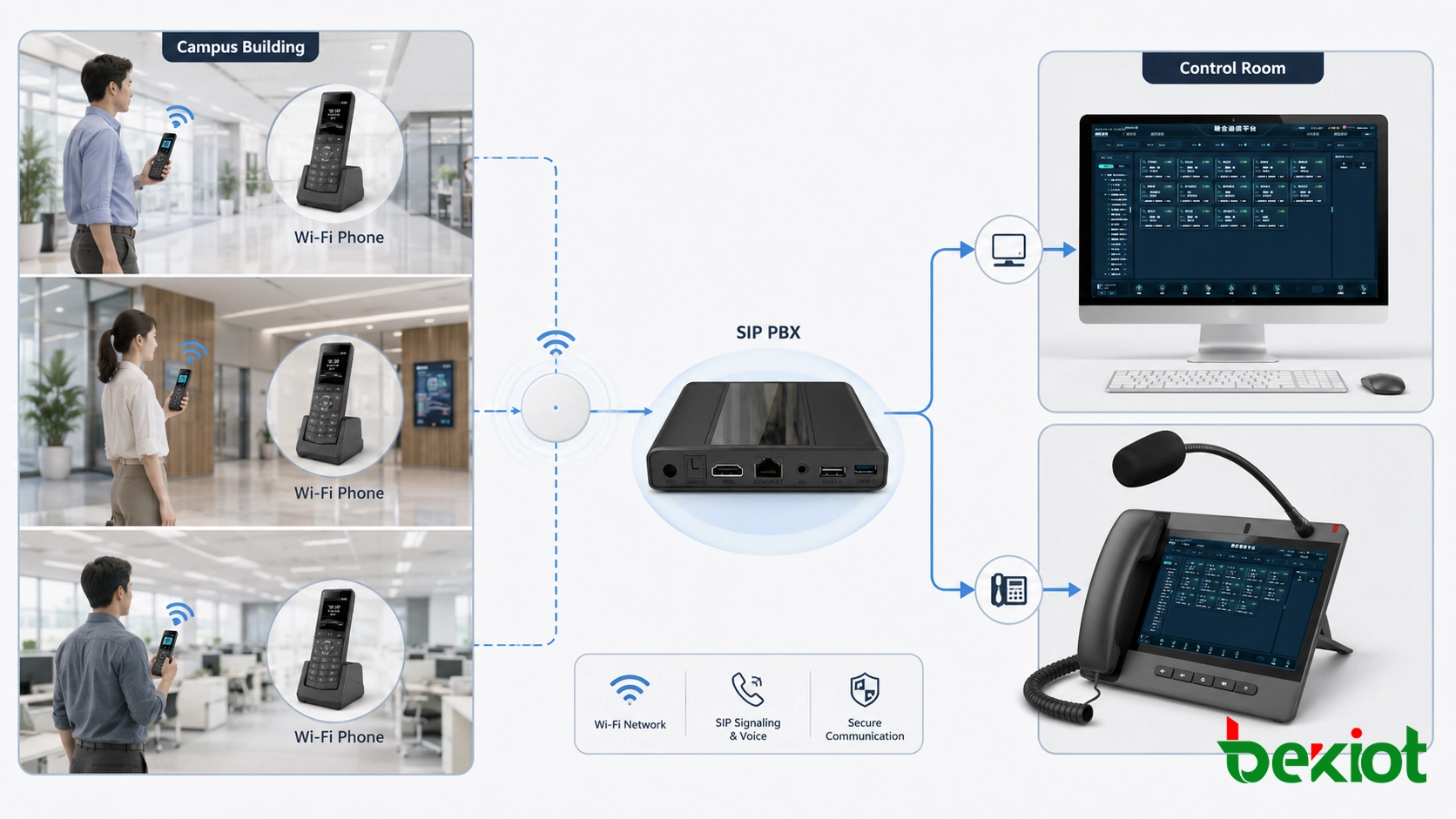
Wi-Fi phones are one of the simplest ways to add internal wireless voice capability to an existing IP communication environment. A Wi-Fi phone is usually a SIP endpoint. After being registered to an IP PBX, softswitch, or unified communication platform, it can work like a wireless extension inside the organization.
This approach is attractive when the site already has a mature office Wi-Fi network and an existing SIP-based telephone system. In many cases, users only need to configure extension numbers, authentication credentials, network access, and call rules. The Wi-Fi phone can then call desk phones, receive internal calls, and participate in the existing numbering plan.
The main advantage is cost efficiency. The organization can reuse existing LAN, Wi-Fi access points, IP PBX resources, and SIP routing logic. For offices, schools, hotels, hospitals, service centers, and small parks, Wi-Fi phones may be enough for general internal mobility.
However, Wi-Fi voice quality depends heavily on wireless coverage and roaming performance. Voice calls are more sensitive to packet loss, delay, and roaming interruption than ordinary data traffic. If users move between access points and the Wi-Fi network does not handle handover well, the call may experience jitter, delay, short audio dropouts, or even disconnection.
Best-fit scenarios
Wi-Fi phones are suitable for buildings or campuses where Wi-Fi coverage is already stable, user density is moderate, and internal communication mainly involves normal voice calls. They are especially useful when the site wants to extend an existing IP PBX system without building a separate radio network.
They are less suitable for harsh outdoor areas, large mobile patrol zones, high-interference workshops, emergency-critical communication, or sites where uninterrupted roaming is required across a wide area.
DECT systems for dedicated short-range voice
DECT is a wireless communication standard traditionally used for cordless voice communication. In many markets, DECT systems are deployed with dedicated base stations and cordless handsets. These systems can create a private voice network for offices, hotels, warehouses, hospitals, and campus buildings.
Compared with general Wi-Fi phones, DECT is usually more focused on voice service. It can provide predictable voice behavior within its coverage area when designed and deployed properly. For some environments, this makes DECT a practical option for internal mobility, especially where users need cordless extensions but not advanced multimedia functions.
The limitation is that DECT availability depends on local spectrum regulation and market support. In some regions, DECT may not be authorized, or the supported frequency band may differ. Before selecting a DECT solution, organizations should confirm regulatory compliance, equipment availability, coverage planning, and integration with the existing telephone system.
Best-fit scenarios
DECT can be considered for relatively controlled indoor environments, such as offices, hotels, hospitals, and buildings that need reliable cordless voice extensions. It is generally not the first choice for large outdoor sites, complex multimedia dispatch, or wide-area industrial mobility.
For projects in regions where DECT use is not permitted or not commercially practical, organizations should consider Wi-Fi voice, private cellular networks, or two-way radio systems instead.
Two-way radios for mature group communication
Two-way radio systems remain one of the most mature forms of internal wireless voice communication. They are widely used in parks, airports, ports, factories, logistics centers, security departments, construction sites, and public service environments. Their biggest advantage is instant group communication.
Unlike ordinary phone calls, two-way radios are usually built around push-to-talk operation. A user presses a button, speaks to a group, and multiple team members can hear the message immediately. This is useful for patrol coordination, field command, emergency response, loading operations, maintenance dispatch, and temporary work groups.
The limitation is that traditional two-way radio communication is mainly half-duplex. Due to channel design and user habits, it is not normally used like a full-duplex telephone call. This makes it excellent for command-style communication but less suitable for long conversational calls or office-style extension dialing.
Modern radio systems can be integrated into dispatch platforms, recording systems, gateways, and unified communication environments. For many industrial sites, two-way radio is not replaced by IP telephony; instead, it becomes one layer of a broader communication system.
Best-fit scenarios
Two-way radios are suitable for security patrols, field teams, emergency response groups, port operations, factory coordination, airport ground services, warehouse teams, and outdoor maintenance work. They are especially useful when users need fast group calling and simple operation under pressure.
They are less suitable when the main requirement is full-duplex private calling, video calls, broadband data, or deep integration with enterprise office communication workflows.
Private 4G/5G networks for converged voice, video, and data
Private 4G and 5G networks are increasingly used for internal communication in smart parks, industrial campuses, mines, energy sites, logistics hubs, ports, and large manufacturing zones. By deploying private cellular base stations and a dedicated core network or private network service, organizations can build an internal wireless communication environment with much broader service capability.
Compared with Wi-Fi phones or traditional two-way radios, private 4G/5G networks can support voice calling, video calling, push-to-talk, high-speed data transmission, mobile applications, positioning, command dispatch, and multimedia collaboration. This makes them suitable for sites that require more than voice.
Another important benefit is integration. Private cellular users can be assigned internal numbers or short numbers, and the system can be connected with existing communication platforms through mature interfaces. This allows mobile terminals, dispatch consoles, IP PBX systems, emergency platforms, and control-room applications to work together.
Private 4G/5G also provides stronger scalability for future services. A site may begin with internal voice communication, then expand to video patrol, mobile inspection, remote maintenance, industrial data collection, emergency command, and intelligent operation management.
Best-fit scenarios
Private 4G/5G is suitable for large parks, smart mines, industrial plants, ports, energy facilities, transportation hubs, and sites that need voice, video, data, and dispatch functions on one wireless network. It is also valuable when public mobile networks cannot meet security, reliability, coverage, or integration requirements.
The main challenge is deployment complexity. Planning may involve base station placement, spectrum or service model selection, network slicing or private core design, terminal management, security policy, integration interfaces, and operation maintenance. For this reason, private 4G/5G projects should be designed as communication infrastructure rather than as a simple handset purchase.
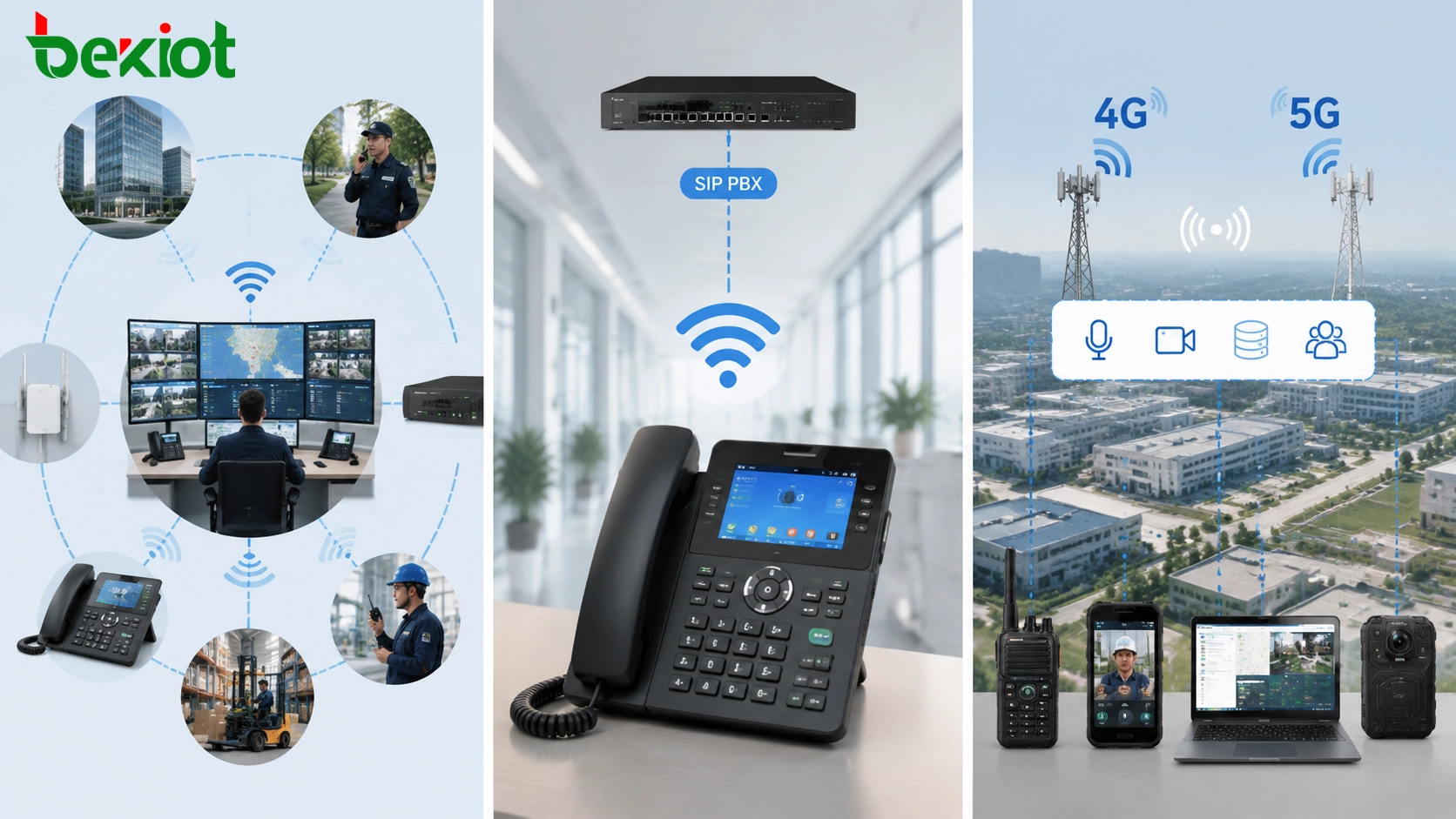
How to compare the main options
| Solution | Main strength | Typical limitation | Suitable environment |
|---|---|---|---|
| Wi-Fi phone | Low-cost SIP extension over existing WLAN | Voice quality depends on Wi-Fi coverage and roaming | Offices, buildings, small campuses, service areas |
| DECT | Dedicated cordless voice communication | Regulatory and market availability must be confirmed | Indoor buildings, hotels, hospitals, office zones |
| Two-way radio | Fast group communication and field coordination | Usually half-duplex and less suitable for phone-style calls | Security, logistics, factories, ports, airports, patrol teams |
| Private 4G/5G | Converged voice, video, data, and dispatch capability | Higher planning and deployment complexity | Large parks, mines, industrial sites, smart campuses |
Integration with existing communication systems
For many organizations, the most valuable solution is not an isolated wireless system. The real value appears when wireless users can communicate with fixed phones, control rooms, dispatch consoles, paging systems, emergency alarms, and management platforms.
For example, Wi-Fi phones can register as SIP extensions. Two-way radio networks can be connected through gateways or dispatch platforms. Private 4G/5G systems can support internal numbering, short-number dialing, multimedia dispatch, and integration with existing voice platforms. This turns wireless communication into part of the site’s overall operation system.
Integration planning should consider numbering, call routing, permissions, recording, emergency priority, user groups, device management, and system redundancy. Without these details, a wireless deployment may work technically but still fail to support real operational workflows.
Security and management considerations
Wireless voice communication must also be managed as part of the site’s security policy. Public mobile phones may create risks in controlled environments because they are difficult to manage, record, restrict, or integrate. Internal wireless systems can provide better control when designed properly.
Management functions may include user authorization, terminal registration, group permission, call recording, dispatch logs, emergency call priority, network access control, and centralized maintenance. For industrial and campus environments, these functions are often as important as the voice call itself.
When the system carries video or data in addition to voice, cybersecurity becomes more important. Network segmentation, encrypted access, device authentication, and controlled platform interfaces should be included in the design stage.
Recommended planning approach
A practical project should not select one technology only because it is popular. The correct approach is to map the communication scenario first, then match the wireless technology to the site requirements.
For a small office or building with good Wi-Fi, Wi-Fi phones may be the fastest path. For a hotel or hospital in a market where DECT is available, DECT may provide simple cordless voice coverage. For security patrols and field operations, two-way radio may still be the most efficient tool. For large industrial parks, smart mines, ports, and energy sites, private 4G/5G can provide a broader foundation for voice, video, data, and dispatch.
In many real projects, a hybrid design is the most effective. A site may use SIP phones for offices, Wi-Fi phones for indoor mobile staff, radios for patrol teams, and private 4G/5G terminals for multimedia dispatch. The key is to make these systems interoperable through a unified communication or dispatch architecture.
Conclusion
Internal wireless voice communication is becoming more important as organizations move toward mobile operations, smart parks, digital factories, and integrated emergency response. The goal is not simply to replace wired phones or public mobile phones. The goal is to build a controlled, secure, and integrated communication environment that follows people, supports field operations, and connects with existing systems.
Wi-Fi phones, DECT systems, two-way radios, and private 4G/5G networks all have practical value, but they solve different problems. A successful design depends on coverage, mobility, full-duplex or half-duplex requirements, regulatory conditions, integration depth, security policy, and future service expansion.
For modern parks and industrial sites, the most reliable strategy is to treat wireless voice as part of a complete communication solution. When voice, video, dispatch, numbering, management, and emergency workflows are planned together, the system can support daily coordination as well as critical response.
FAQ
Can Wi-Fi phones completely replace desk phones?
They can replace desk phones for some mobile users, but not always for fixed workstations, reception desks, control rooms, or emergency points. Many sites use Wi-Fi phones as an extension of the existing IP PBX rather than a full replacement.
Is a private 5G network necessary for every industrial park?
No. Private 5G is most valuable when the site needs wide-area mobility, multimedia communication, high-speed data, video, dispatch, or stronger network control. Smaller buildings with stable Wi-Fi may not need this level of infrastructure.
Why are two-way radios still used when smartphones are available?
Two-way radios provide fast push-to-talk group communication, simple operation, and strong field usability. In patrol, logistics, emergency, and industrial operations, this instant group communication model is often more efficient than ordinary phone calls.
What should be evaluated before deployment?
The main factors include site size, indoor and outdoor coverage, user movement patterns, integration with existing systems, security requirements, voice quality expectations, regulatory compliance, terminal management, and future expansion needs.







