In the communication industry, the terms incoming calls and outgoing calls are used far beyond their simple everyday meanings. They appear in PBX systems, IP PBX deployments, VoIP platforms, contact centers, SIP trunk environments, telecom billing records, and enterprise communication reports. While the basic distinction may seem obvious, the operational meaning of each term becomes more important when businesses need to route calls, measure performance, assign staff, and control communication costs.
An incoming call is generally a call received by a person, extension, team, or system, while an outgoing call is a call initiated by that person, extension, team, or system. In real communication environments, however, these two call types follow different service logic, routing rules, reporting methods, and business objectives. Understanding the difference helps readers interpret telecom terminology more accurately and build clearer communication workflows.
What Are Incoming Calls?
Basic Definition of Incoming Calls
Incoming calls are calls that arrive at a user, extension, business phone system, or communication platform from another caller. In the simplest sense, an incoming call is a received call. The caller may be external, such as a customer dialing a company number, or internal, such as one extension calling another within the same organization.
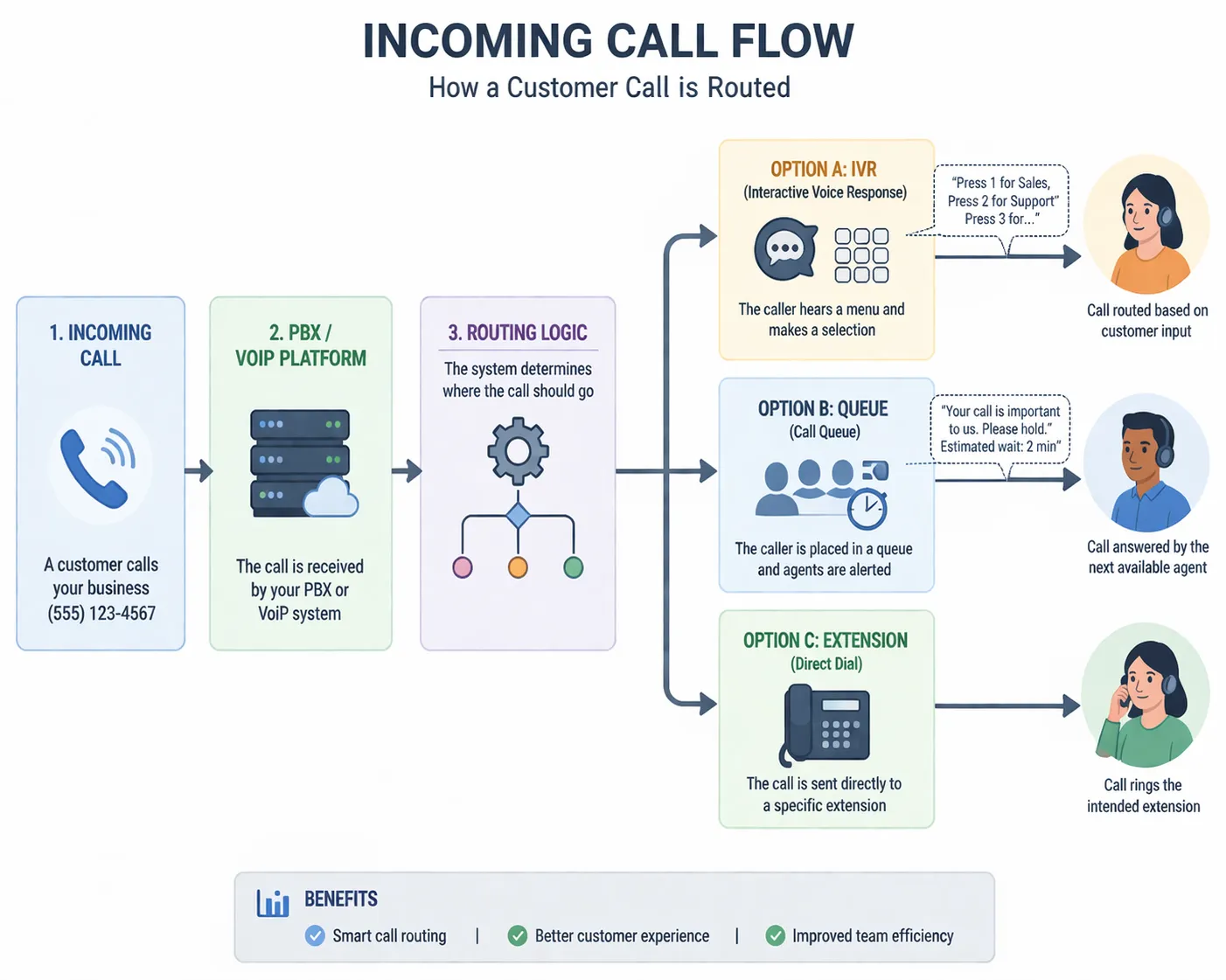
In business communication systems, the term is often used more specifically to describe calls entering a company through a public telephone number, SIP trunk, PSTN gateway, or direct inward dialing route. These calls are then delivered to a receptionist, ring group, IVR, queue, department, or individual extension based on the routing logic defined by the system.
Typical Uses of Incoming Calls
Incoming calls are usually associated with customer service, technical support, information requests, switchboard reception, complaint handling, appointment scheduling, emergency contact, and general inquiry management. In industrial or mission-critical environments, incoming calls may also come from help points, tunnel phones, roadside emergency terminals, control stations, or field communication endpoints.
Because incoming calls are often initiated by customers, visitors, passengers, workers, or members of the public, they are closely linked to service availability and response quality. For many organizations, the management of incoming calls is directly related to customer experience, incident response, and operational reliability.
In telecom reporting, incoming calls are often treated as service-driven interactions because the business is responding to a caller’s request, question, or incident.
What Are Outgoing Calls?
Basic Definition of Outgoing Calls
Outgoing calls are calls initiated by a user, extension, agent, communication platform, or operator console to another destination. In daily usage, an outgoing call is simply a placed call. In professional communication systems, it usually refers to a call made from an internal extension or business platform to an internal or external number.
Outgoing calls may be dialed manually by a user, automatically triggered by a platform, or initiated by an operator as part of a dispatching process. In enterprise and telecom environments, these calls are subject to dialing plans, permission settings, route selection rules, caller ID policies, and sometimes cost-control mechanisms.
Typical Uses of Outgoing Calls
Outgoing calls are commonly used for sales outreach, follow-up communication, appointment confirmation, callback service, notification delivery, dispatch operations, internal coordination, partner communication, and proactive customer contact. In industrial communication systems, outgoing calls may be initiated by a control room, dispatch console, operations center, or emergency management platform.
Compared with incoming calls, outgoing calls are usually more closely tied to initiative and task execution. The organization is not only receiving demand but actively starting communication for service delivery, coordination, or business expansion. That is why outgoing calls are often analyzed in relation to productivity, campaign activity, staffing efficiency, and telecom spend.
How Incoming Calls Work in a Business Communication System
Entry Path and System Access
A typical incoming call enters a business communication system through a DID number, SIP trunk, IP gateway, or PSTN connection. Once the call reaches the company’s communication platform, the system identifies the destination number, time condition, service policy, or customer service logic that should be applied.
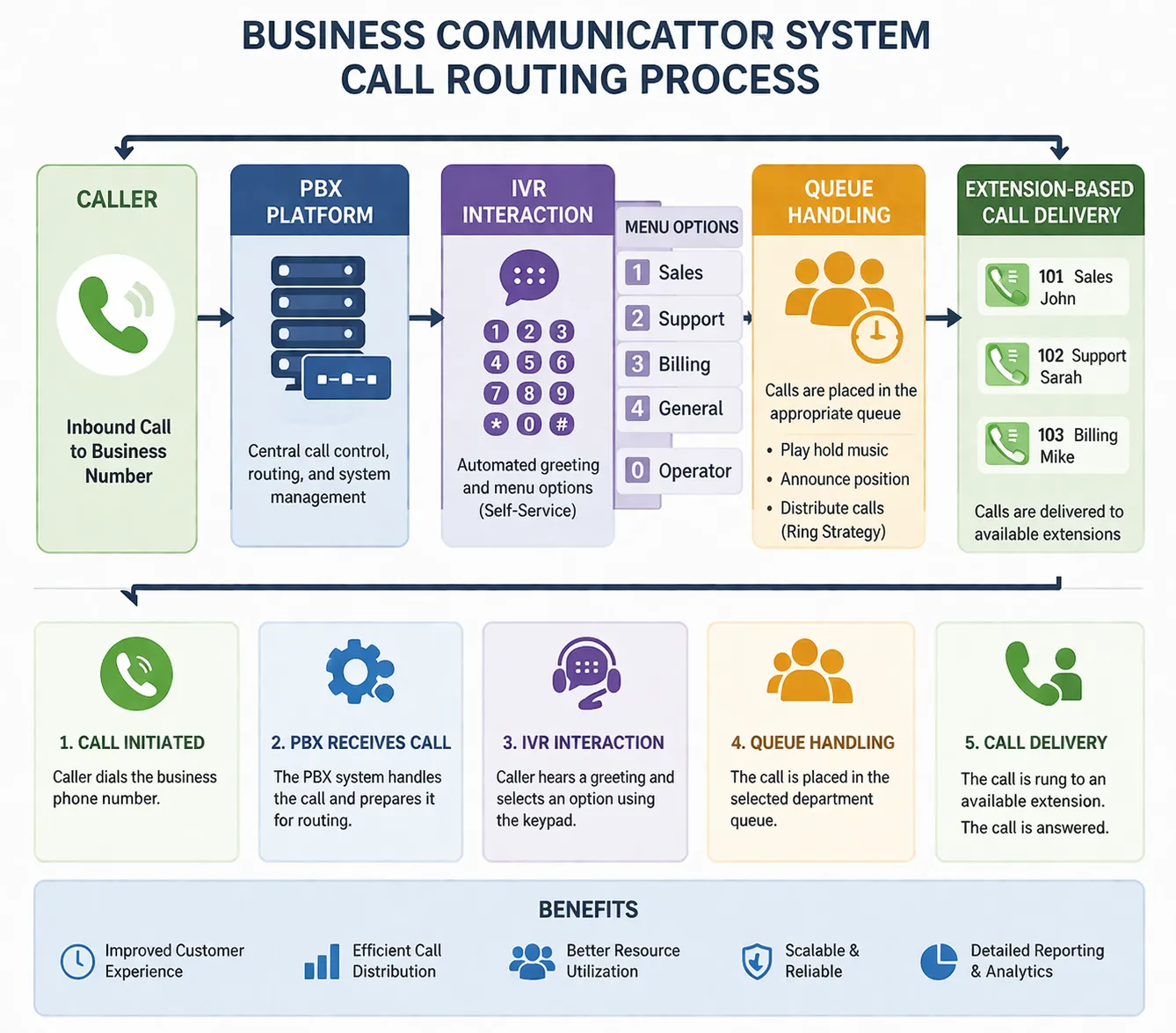
At this point, the incoming call may be sent to an IVR menu, a call queue, a ring group, an auto attendant, or a direct extension. In more advanced systems, call routing may also depend on business hours, regional rules, caller identity, language preference, or service priority. This means that incoming call handling is not only about receiving the call but also about deciding how the organization should respond.
Answering, Queueing, and Escalation
Many incoming calls require structured handling because several users or departments may be able to receive them. In customer service environments, calls are often queued and assigned to available agents. In office settings, they may ring a receptionist first and then transfer to the appropriate department. In emergency communication scenarios, incoming calls may trigger alarms, recording, event logging, and visual linkage to monitoring systems.
As a result, incoming calls are strongly connected with availability, wait time, missed-call control, and escalation rules. If the system cannot answer the call efficiently, the caller may abandon the attempt, experience service delay, or fail to get help in time. This is why inbound routing design is a major part of telecom and contact center planning.
How Outgoing Calls Work in a Business Communication System
Call Initiation and Dialing Rules
When a user places an outgoing call, the business communication platform checks whether the extension or agent has permission to call the target destination. The system may analyze the number format, apply digit manipulation rules, attach a caller ID, and choose a route based on internal policy or least-cost routing logic.
For example, one type of outgoing call may use a local SIP trunk, another may pass through a gateway connected to analog or digital lines, and another may be restricted entirely due to access control policy. In enterprise environments, outgoing calls are therefore tied to route governance as much as to user action.
Operational and Commercial Logic
Outgoing calls may be created for many reasons, but they almost always reflect an active workflow. A sales team may call potential customers, a support team may return missed calls, a hospital may send reminders, or an industrial dispatch center may initiate communications with field staff and operational units. Even when the technical process is simple, the business meaning of the call is usually tied to a specific task or result.
Because outgoing traffic is initiated by the organization, it is also more directly related to cost, compliance, and performance tracking. Managers may want to know how many attempts were made, how many calls were answered, how long conversations lasted, whether agents followed the right procedure, and whether the selected route remained efficient and reliable.
Outgoing calls are often analyzed as action-driven interactions because the business is initiating communication to achieve a defined operational, commercial, or service objective.
The Core Difference Between Incoming and Outgoing Calls
Direction of Call Initiation
The most basic difference is the direction of initiation. Incoming calls are received by the user or organization, while outgoing calls are initiated by the user or organization. This seems simple, but it forms the foundation for how the call is classified in telecom systems, reports, and operational dashboards.
In many PBX and VoIP platforms, this directional distinction determines which routing logic, permissions, and service rules apply. As a result, incoming and outgoing calls are often separated in dashboards, billing records, call detail records, and quality reports.
Business Purpose
Incoming calls are usually driven by the caller’s need. Someone is asking for support, requesting information, reporting an incident, or seeking assistance. Outgoing calls are usually driven by the organization’s intention. Someone is following up, informing, confirming, coordinating, or initiating service.
This difference matters because the expected handling method changes. Incoming call flows focus on response readiness, availability, and service access. Outgoing call flows focus on execution efficiency, policy control, and communication completion.
Routing Logic
Incoming calls often depend on IVR trees, queues, time conditions, ring groups, service level rules, and escalation paths. Their purpose is to guide an arriving call toward the correct person or department. Outgoing calls, by contrast, depend more on dialing permissions, route patterns, number normalization, caller presentation rules, and trunk selection logic.
In other words, incoming routing is more about intelligent reception, while outgoing routing is more about intelligent delivery. Both are important, but they solve different communication problems inside the same platform.
Cost and Control
Outgoing calls are usually more closely associated with cost management because the business is actively sending traffic through carrier trunks, gateways, or telecom services. Managers often optimize outgoing traffic using route selection, policy restrictions, time-based control, or cost analysis. Incoming calls may also involve cost, especially in toll-free or premium service structures, but the cost-control discussion is usually stronger on the outbound side.
From a governance perspective, outgoing calls also raise more questions about authorization. Not every user should be allowed to place international, mobile, or premium-rate calls. That is why enterprise systems often define extension class, dialing rights, and outbound route restrictions in a detailed way.
Incoming vs Outgoing Calls in Analytics and Reporting
How Incoming Calls Are Analyzed
Incoming call analysis usually focuses on accessibility and service response. Common indicators include total inbound volume, average answer time, queue waiting time, missed calls, abandoned calls, peak-hour traffic, first response efficiency, and service level compliance. These metrics help organizations understand whether they are available when callers need them.
For example, a support center may monitor how many incoming calls were received during business hours, how many were answered within a target time, and how many were lost before an agent picked up. In public safety or industrial settings, incoming call analysis may also examine alarm-linked events, incident handling speed, and call recording history.
How Outgoing Calls Are Analyzed
Outgoing call analysis usually focuses on productivity, connection success, and task completion. Common indicators include total outbound attempts, connected calls, average talk time, answer ratio, callback completion rate, agent activity, and route usage. In campaign environments, the analysis may also extend to conversion, follow-up rate, or appointment creation.
Because outgoing calls represent proactive communication, businesses often want to measure whether the calls created meaningful results. In an enterprise system, outbound reports can also be used to detect inefficient dialing behavior, unused trunk resources, or policy violations related to telecom usage.
Why the Separation Matters
If incoming and outgoing calls are mixed together without distinction, reporting becomes less meaningful. A service team may appear highly active, but that number could be based mainly on outbound callbacks rather than real inbound demand. A sales team may show high traffic volume, but that does not indicate how responsive the company is to customers trying to reach it.
Separating incoming and outgoing calls allows communication managers to understand two different operational realities: how well the business receives communication, and how effectively the business initiates communication. Both are important, but they should not be judged by the same metrics.
Why This Difference Matters in the Communication Industry
PBX, VoIP, and IP Telephony Context
In PBX and IP telephony environments, incoming and outgoing calls affect trunk design, dial plan architecture, extension permission settings, and call reporting structures. A company cannot build an efficient phone system without understanding which routes are designed for inbound access and which are designed for outbound delivery.
This difference is also important when configuring SIP trunks, gateways, auto attendants, recording policies, queue strategies, and operator consoles. Even when a platform supports both directions seamlessly, the internal logic behind those directions remains different.
Contact Center and Customer Experience Context
In contact centers, incoming calls are central to customer access and service quality, while outgoing calls are central to outreach and follow-up activity. A service desk, reservation center, support team, or public hotline may depend primarily on inbound traffic. By contrast, collections, telemarketing, callback teams, and proactive service desks may depend more heavily on outbound traffic.
Because the objectives are different, staffing models, performance goals, and reporting methods must also be different. Incoming traffic requires enough coverage to handle unpredictable demand. Outgoing traffic requires enough structure to ensure consistent task execution and measurable business outcomes.
Industrial and Dispatch Communication Context
In industrial communication systems, the distinction becomes even more practical. Incoming calls may come from emergency phones, help points, field stations, or production-area intercom terminals. Outgoing calls may be initiated by dispatchers, supervisors, control rooms, or security operators. The system must support both immediate response and proactive coordination.
This is why communication platforms in transportation, utilities, manufacturing, energy, and public safety often treat incoming and outgoing traffic as separate operational categories. The two directions may share the same infrastructure, but they serve different functions in daily operations and emergency workflows.
Common Misunderstandings About Incoming and Outgoing Calls
They Are Not Just Everyday Language Terms
Many readers assume incoming and outgoing calls are only casual phone terms. In reality, they are formal operational categories in communication systems. They influence system configuration, report design, call routing, access permission, and management analysis.
That is why communication engineers, PBX administrators, telecom analysts, and call center managers use these terms in a more structured way than ordinary users do. The terminology is simple, but the system meaning is more detailed.
An Incoming Call Is Not Always External
In some environments, an incoming call may simply mean a call received by a specific user or extension, even if it originated from another internal extension. However, in many business reports, incoming calls usually refer to calls entering the business system from outside. The exact definition depends on the reporting logic being used.
For this reason, analysts should always check how the platform defines inbound traffic before interpreting dashboards or call detail records. Terminology is consistent in concept, but reporting scope may differ from one system to another.
Outgoing Calls Are Not Only Sales Calls
Another common misunderstanding is that outgoing calls only belong to telemarketing or sales. In fact, outbound communication appears across many industries and departments. Support teams call customers back, hospitals confirm appointments, dispatchers contact field staff, schools notify families, and industrial operators communicate with remote sites.
The more accurate view is that outgoing calls represent proactive communication, not a single business department. Their role depends on the operational environment in which the communication platform is deployed.
Conclusion
The difference between incoming and outgoing calls begins with call direction, but in the communication industry it extends much further. Incoming calls are primarily about receiving and responding to communication requests, while outgoing calls are about initiating communication to complete a service, business, or operational task. Each call type follows different routing logic, performance indicators, management concerns, and reporting goals.
Whether the environment is a PBX system, VoIP deployment, contact center, or industrial dispatch network, understanding this distinction helps businesses design better call flows, interpret reports correctly, improve service quality, and manage communication resources more effectively. That is why incoming and outgoing calls remain essential terminology in professional communication analysis.
FAQ
Is an incoming call always from an external number?
No. In a broad sense, an incoming call is any call received by a user or extension. In many business reporting systems, however, the term often refers specifically to calls entering the organization from outside through a public number, trunk, or gateway.
Are outgoing calls always more expensive than incoming calls?
Not always, but outgoing calls are more frequently associated with telecom cost control because the organization actively places them through carrier resources, SIP trunks, or gateways. Pricing depends on the service model, destination type, and route used.
Why do communication systems report incoming and outgoing calls separately?
They are separated because they reflect different business activities. Incoming calls measure accessibility and responsiveness, while outgoing calls measure initiative, follow-up activity, and task execution. Mixing them together can make performance analysis less accurate.
Can the same PBX or VoIP platform handle both incoming and outgoing calls?
Yes. Modern PBX, IP PBX, and VoIP platforms are designed to manage both directions within one communication environment. Even so, they normally use different rules for routing, permissions, analytics, and call handling policies.
Why is this distinction important in industrial communication systems?
Because industrial systems often need to support both emergency reception and active dispatching. Incoming calls may come from field help points or emergency terminals, while outgoing calls may be initiated by a control center, supervisor, or dispatch console to coordinate response.