A video access gateway is often introduced as a tool for API-based video integration, but its value is not limited to software development. In many smart city, emergency response, industrial park, power, water conservancy, and command center projects, the gateway can also work as a ready-to-use media access device, streaming server, GB/T28181 platform, decoder companion, and converged communication bridge.
The core idea is simple: complex video processing is handled by the gateway, while the project team uses configuration, networking, protocol conversion, and media forwarding to connect different video resources. This reduces the need for deep custom development and helps system integrators deliver video functions faster in real project environments.
From Development Tool to Video Convergence Device
Why API development is only one part of the story
In a typical software integration project, a video access gateway can connect cameras, monitoring platforms, NVR systems, drones, recorders, and other video sources. The business platform then calls gateway APIs to display video, control resources, or build cross-platform video workflows. This is useful when the project needs customized functions.
However, not every project needs deep API development. Many field applications only require stable video access, protocol conversion, media forwarding, SIP integration, conference sharing, or video wall output. In these cases, the gateway can be deployed as an independent functional node and configured directly according to the project topology.
Where this approach is most useful
This no-code or low-code deployment model is especially valuable in projects where delivery speed, system stability, and multi-source compatibility are more important than building a new software platform from scratch. Examples include emergency command centers, mobile command vehicles, industrial monitoring rooms, traffic operation centers, smart campuses, and temporary event security systems.
By placing the gateway between field video sources and upper-level systems, integrators can simplify access to heterogeneous video resources. The gateway becomes a media processing layer that adapts different protocols, stream formats, and viewing terminals to the actual system requirements.
Command and Dispatch Integration
Unifying cameras, drones, recorders, and monitoring systems
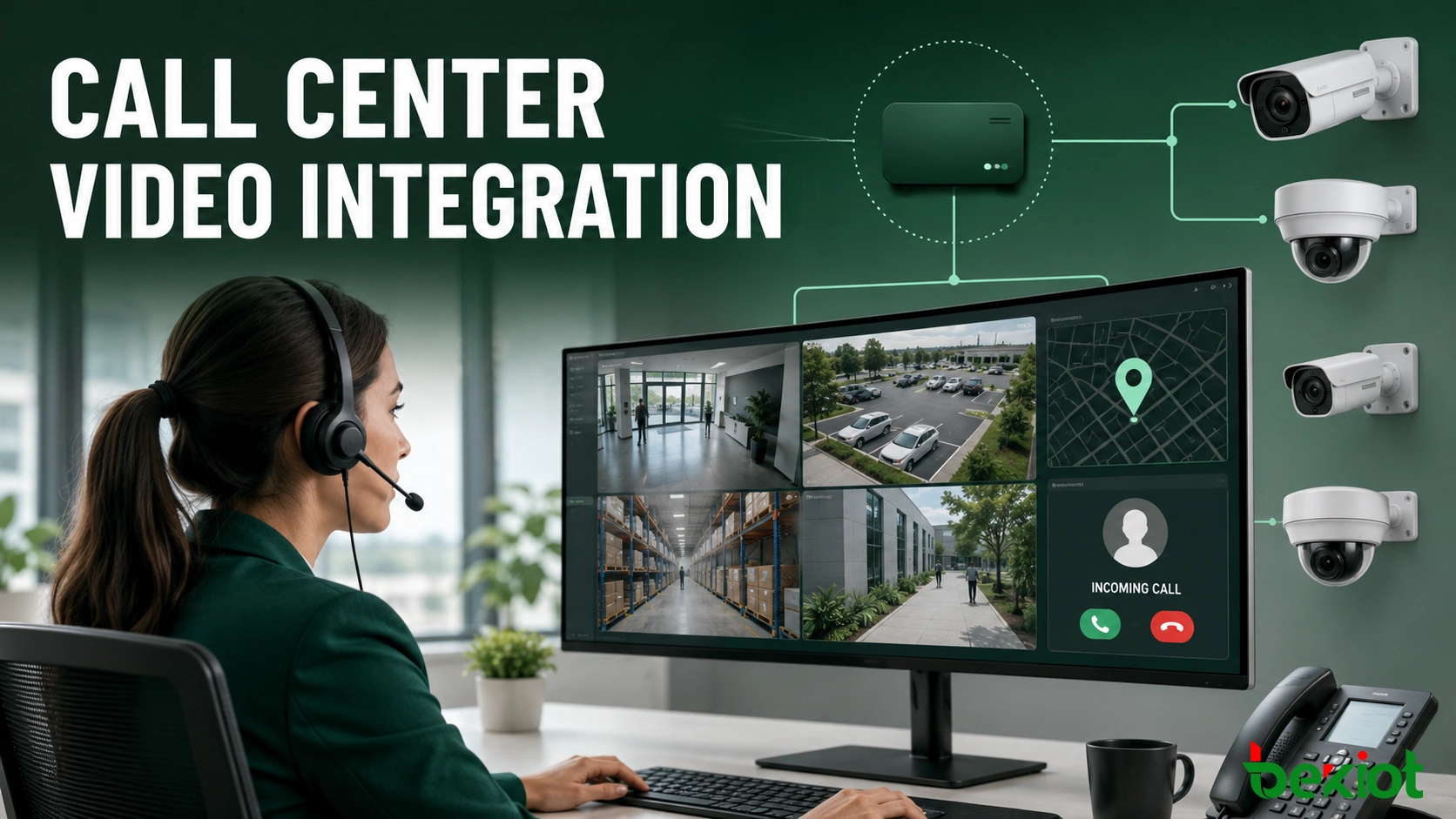
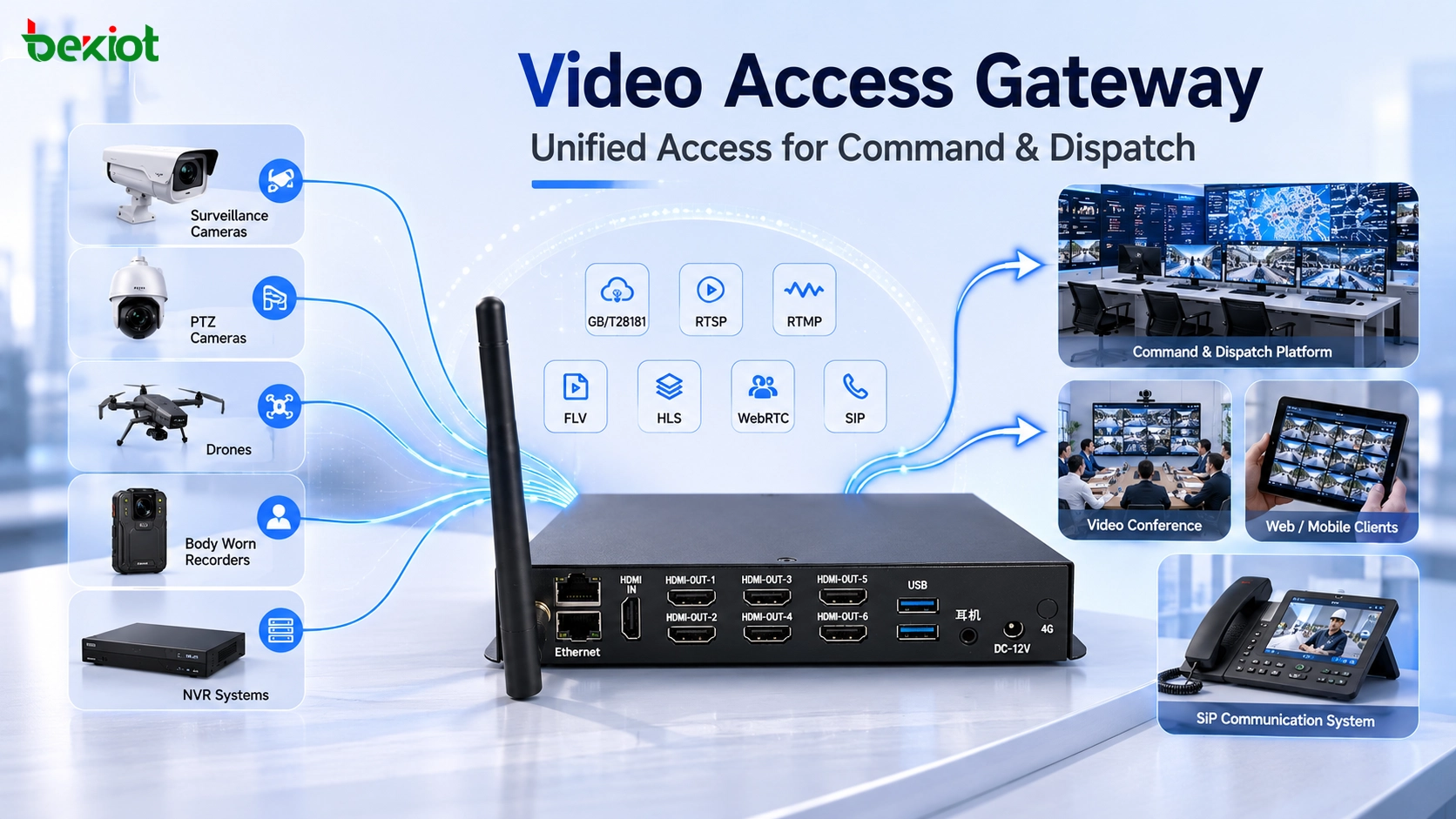
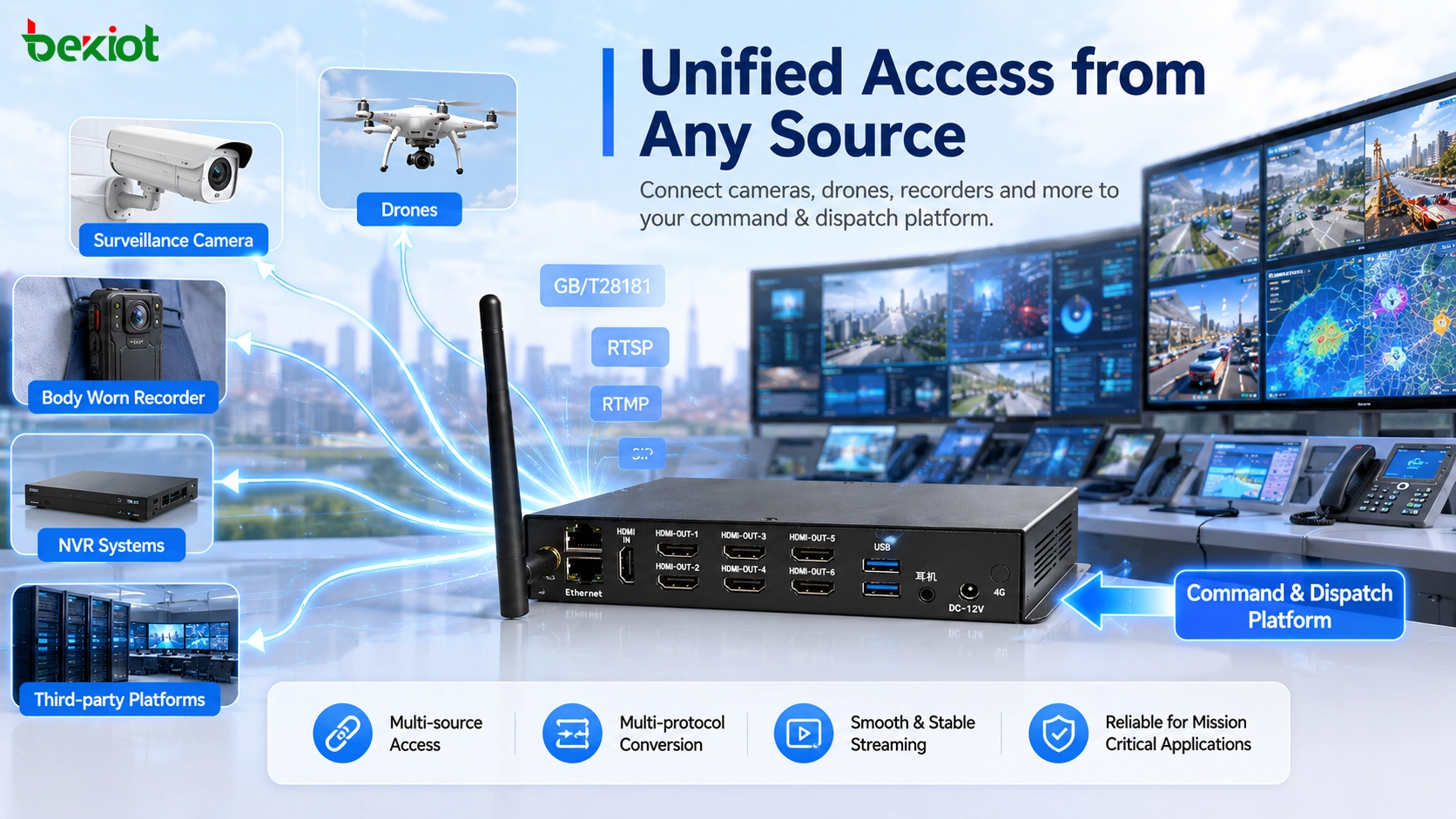
In command dispatch and emergency response projects, operators often need to access many types of video resources at the same time. These may include fixed surveillance cameras, portable monitoring balls, drones, body-worn recorders, vehicle cameras, NVRs, and third-party video platforms. Without a unified access layer, each source may require a separate integration method.
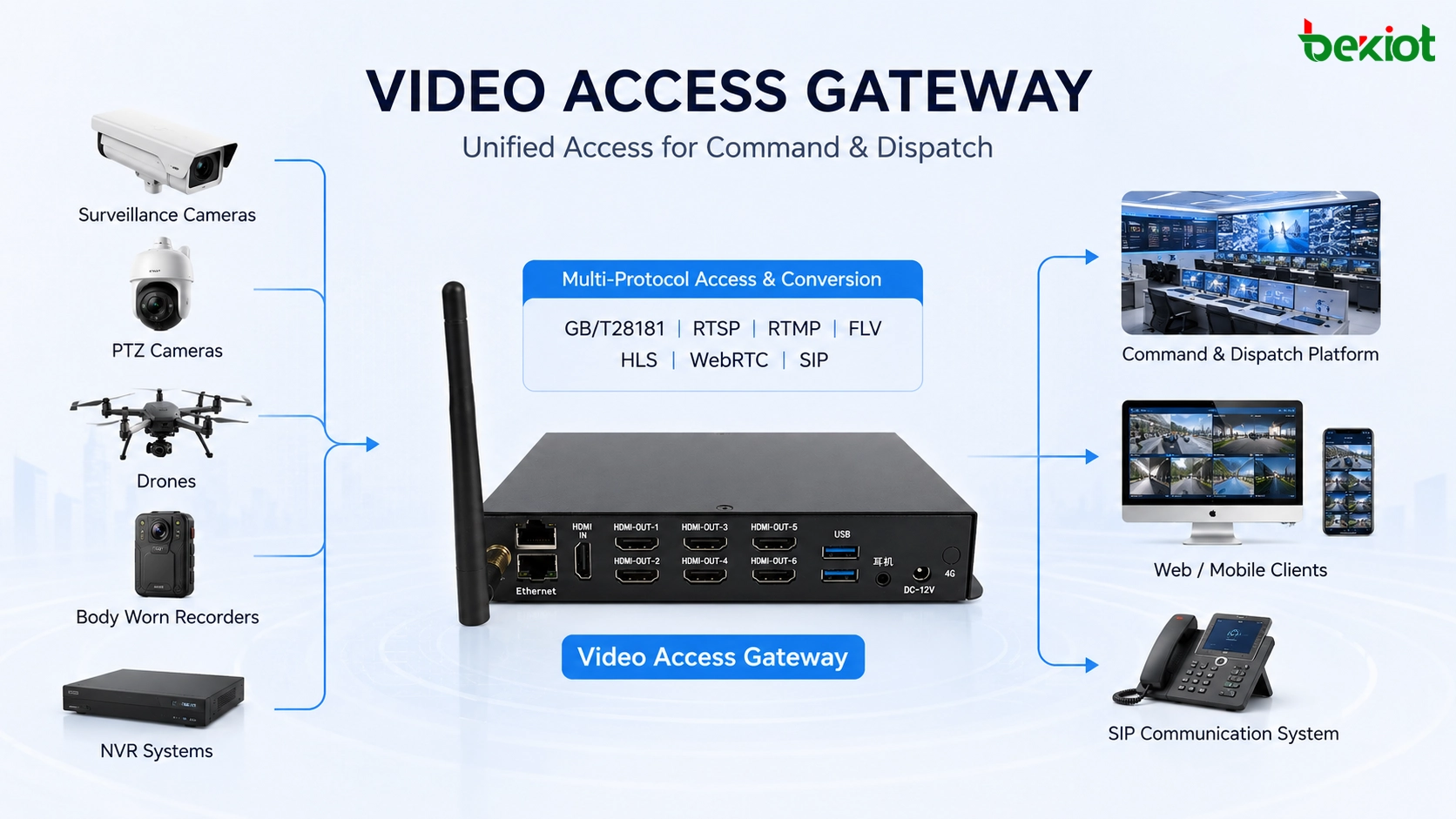
A video access gateway can bring these resources into one access framework. It can receive video from camera systems, recording platforms, drone controllers, ground stations, airport docks, and field devices, then forward or convert streams for the dispatch system. This allows the command center to see video sources from different locations and manufacturers in a more unified way.
Using SIP to support real-time coordination
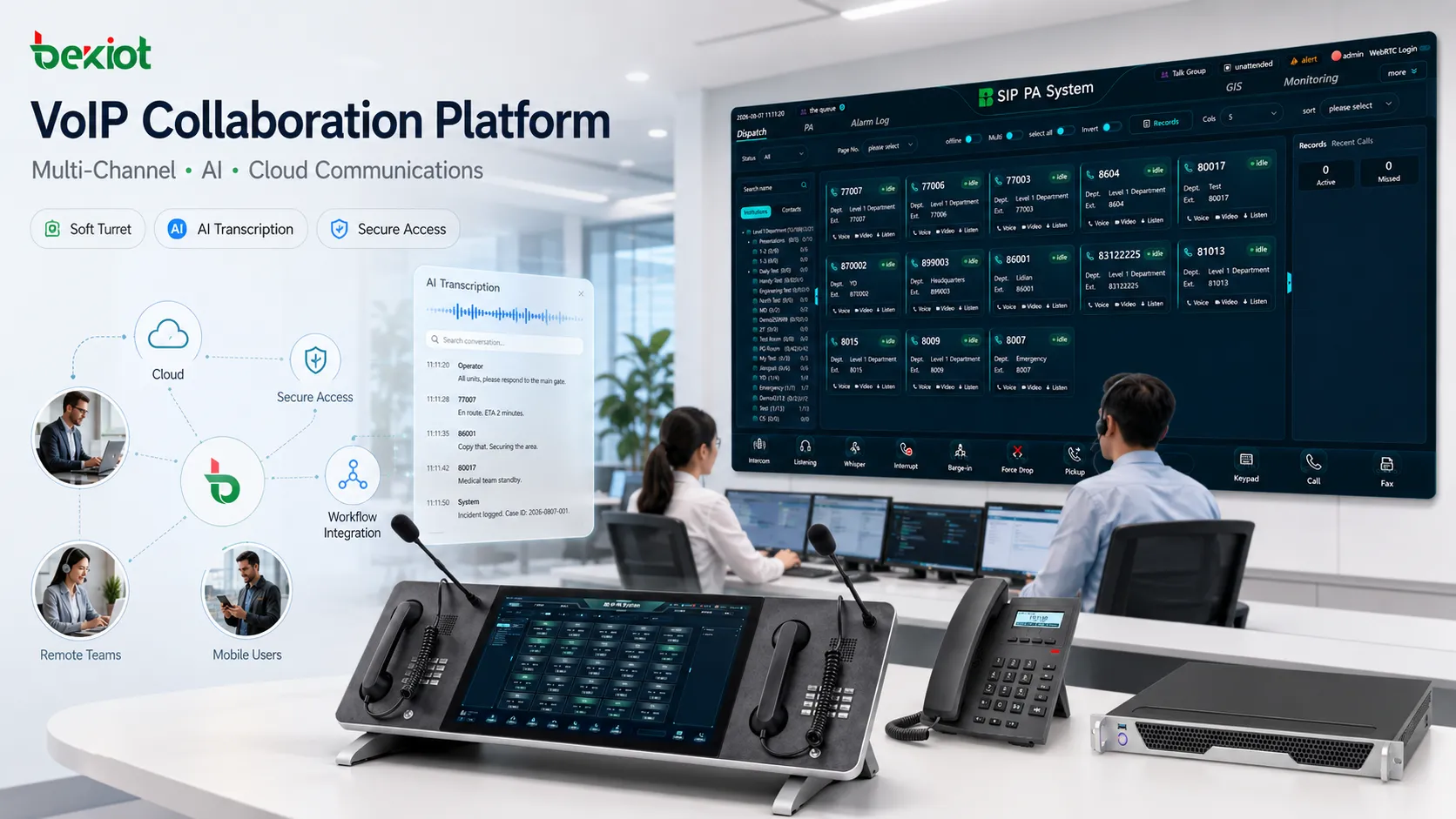
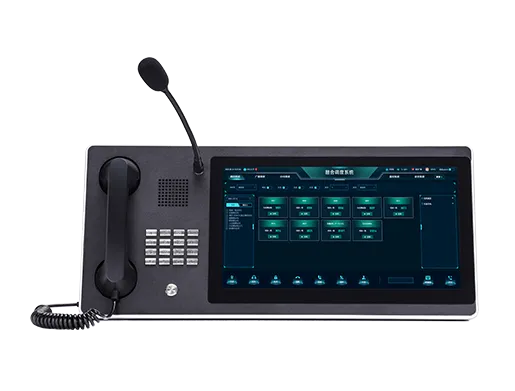
For dispatch projects that use SIP-based communication systems, the gateway can also convert or adapt video streams into a format suitable for audio-video dispatch. This makes it possible to connect video with voice communication, emergency calls, command terminals, conference rooms, and operator consoles.
Instead of building a new video integration layer through API development, the project team can complete many deployments through network configuration, SIP registration, stream mapping, and protocol adaptation. For Becke Telcom communication solutions, this type of gateway can be used as a practical video-side extension when voice dispatch, SIP terminals, field video, and emergency coordination need to work together.
Bringing Field Video into Meetings
Connecting surveillance and drone footage to video conferences
In many operational environments, decision makers need to bring field video directly into a video conference. For example, an emergency meeting may need live drone footage, a traffic center may need camera streams from an incident area, or an industrial plant may need to share real-time monitoring video during remote troubleshooting.
A video access gateway can convert and forward these video streams to a video conferencing environment. Once the stream is available through the gateway, users can pull video resources from the conference control platform and share them with meeting participants. This helps teams make decisions based on live visual information rather than separate screenshots or delayed reports.
Reducing the gap between monitoring and collaboration
Traditional video monitoring systems and meeting systems are often deployed separately. Monitoring platforms focus on camera access and recording, while conferencing systems focus on people-to-people communication. A gateway helps bridge these two worlds by turning video resources into shareable media streams.
This is useful for emergency consultation, remote expert support, on-site inspection, infrastructure maintenance, and multi-department command. The project can use existing cameras and conference resources instead of deploying a completely new video collaboration platform.
Drone Streaming and Multi-Source Media Access
Supporting different drone brands and transmission methods
Many organizations use drones from different manufacturers and models. Each drone may use a different video return method, such as RTMP, GB/T28181, RTSP, private media output, or platform-based stream forwarding. When multiple drone systems need to be integrated into one command workflow, a flexible streaming server becomes essential.
A video access gateway can serve as a drone media access server. It receives streams from different drone systems and converts them into formats that can be viewed, forwarded, recorded, or shared with other platforms. This gives the command center a more consistent way to manage drone video.
From drone feed to command screen, conference, or browser
After the gateway receives drone video, it can distribute the stream to different application systems. For example, RTMP, GB/T28181, and RTSP input streams can be converted or forwarded as FLV, HLS, WebRTC, or other browser-friendly formats. This allows drone video to be viewed on a command center screen, video conference system, dispatch platform, monitoring platform, or web client.
This capability is especially helpful in emergency response, fire rescue, traffic inspection, power line patrol, water conservancy monitoring, and large event security. The drone is no longer an isolated video source; it becomes part of the overall command and monitoring network.
Video Wall and Decoder Output
Using HDMI output for command centers and vehicles
Some projects need to display IP video streams on a large screen, video wall, command center display, vehicle display, or matrix system. In this situation, the gateway can work together with a decoder to convert network video resources into HDMI output.
For example, a drone may push an RTMP stream to the video access gateway. The gateway can then output an RTSP stream to a decoder, and the decoder can provide HDMI output to the video wall. This creates a practical and easy-to-configure workflow for putting field video on a command screen.
Why this matters in real deployments
In command rooms and vehicle-mounted applications, operators often need stable video display rather than a complex software interface. HDMI-based output is familiar, reliable, and easy to connect to existing display systems. The gateway and decoder combination can therefore help bridge IP video networks and traditional display infrastructure.
This approach also allows the same video source to be used in multiple ways. A stream can be displayed on a large screen, shared in a meeting, forwarded to a dispatch platform, or viewed through a browser depending on the project requirement.
GB/T28181 Platform Applications
Working as a lower-level or access-side platform
A video access gateway can also be used as a GB/T28181 platform node. On the access side, it can connect GB/T28181 cameras, recorders, lower-level platforms, and other standard video resources. On the upper side, it can register as a lower-level platform so that the superior platform can view resources connected through the gateway.
This is useful when a project needs to aggregate video resources from multiple sites or convert non-standard video streams into a GB/T28181-compliant access structure. It helps upper-level platforms see the gateway as a manageable video resource node instead of dealing with many independent source types.
Converting non-GB streams into standard platform resources
In many projects, not all video streams are originally GB/T28181 compliant. Some may be RTSP streams from cameras, RTMP streams from field devices, FLV streams from platforms, or other IP media sources. A gateway can receive these streams and deliver them upward through GB/T28181, making mixed resources easier to manage.
For viewing, the gateway may also support HTTP-FLV, WebSocket-FLV, M3U8, WebRTC, and other playback methods. These viewing options are useful for browser-based access, plugin-free playback, mobile viewing, and flexible video distribution. In some scenarios, H.265 video can also be viewed without relying on traditional client-side plug-ins.
Practical Selection Notes
Check input and output protocol coverage
Before selecting a video access gateway, the project team should list all video sources and target systems. Important protocols may include GB/T28181, RTSP, RTMP, FLV, HLS, WebRTC, SIP, and HDMI-related input or output. A gateway should match both the current system and the expected future expansion.
It is also important to confirm whether the gateway only forwards streams or can perform real conversion, transcoding, and distribution. Projects involving drones, command dispatch, conference sharing, and web playback usually need more than simple stream forwarding.
Evaluate deployment and operation requirements
A practical gateway should be easy to configure, stable under continuous operation, and suitable for the actual network environment. For multi-site projects, the team should also consider bandwidth, latency, device registration, remote maintenance, stream naming, user permission, and compatibility with existing command or monitoring platforms.
For system integrators, the biggest value of a video access gateway is not only the number of supported protocols. It is the ability to turn many scattered video resources into manageable, reusable, and deliverable project functions.
Conclusion
A video access gateway is more than an API development tool. It can support command dispatch, video conferencing, drone streaming, GB/T28181 platform access, video wall output, browser viewing, media forwarding, and protocol conversion. In many real-world projects, these no-code or low-code use cases are just as important as API integration.
When used properly, the gateway becomes a practical video convergence layer. It helps connect field cameras, drones, recorders, monitoring platforms, command centers, conference systems, and display equipment into one more flexible video architecture. For smart infrastructure, emergency communication, industrial monitoring, and multi-site command projects, this can significantly simplify delivery and improve system adaptability.
FAQ
Can a video access gateway work without a central video platform?
Yes. In some small or task-specific deployments, the gateway can directly receive streams, convert protocols, distribute video, or work with a decoder for display output. A central platform may still be needed for advanced storage, permissions, analytics, and large-scale device management.
Is a video access gateway suitable for temporary command projects?
Yes. Temporary security events, emergency rescue operations, mobile command vehicles, and short-term construction monitoring projects can benefit from gateway-based access because many functions can be completed through configuration rather than long software development cycles.
What is the difference between stream forwarding and transcoding?
Stream forwarding usually sends the original stream to another destination with limited changes. Transcoding may change codec, resolution, bitrate, frame rate, or container format. Projects that need mobile viewing, browser playback, or low-bandwidth transmission should confirm whether real transcoding is supported.
Can drone video and fixed camera video be managed together?
Yes. A gateway can receive different stream types from drones, cameras, recorders, and platforms, then output them in formats required by the command system, conference system, browser client, or upper-level video platform.
What should be prepared before deployment?
The project team should prepare the video source list, protocol types, stream addresses, network topology, bandwidth conditions, target platforms, display requirements, and user workflow. This makes configuration easier and reduces integration problems during delivery.