


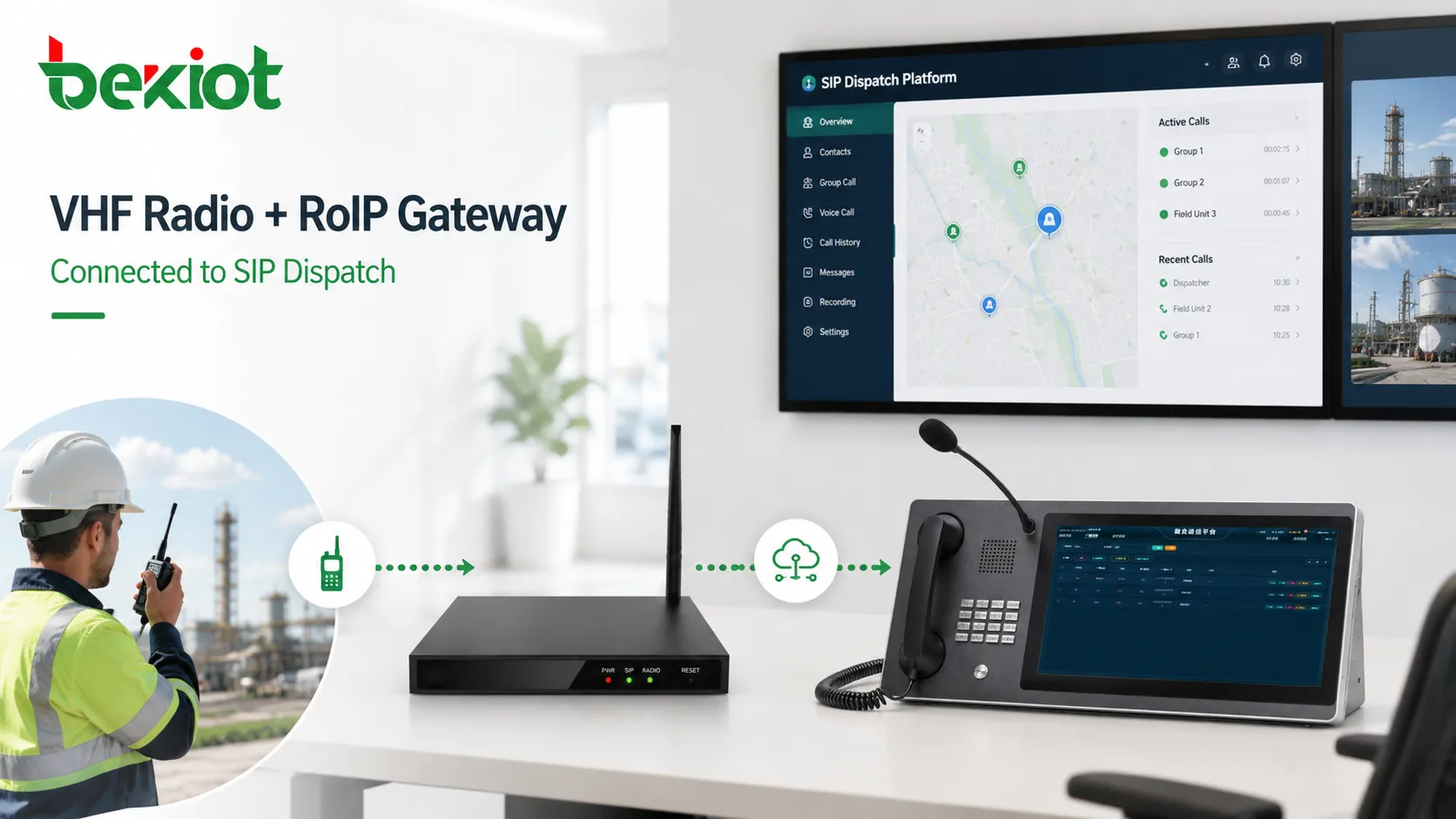
VHF radios are still widely used in aviation, marine communication, ports, factories, open-pit mining, forest fire prevention, field operations, and industrial dispatch environments. Although many organizations are upgrading to IP-based command platforms, existing VHF radio networks often remain valuable because they provide direct, reliable, and familiar push-to-talk communication across open areas. The practical question is not whether these radios should be replaced immediately, but how they can be connected to a modern command and dispatch system without losing their original advantages.
A well-designed integration solution uses a RoIP gateway, customized radio interface cables, SIP-based communication conversion, dispatch console access, recording, and optional broadband PTT interconnection. This allows existing VHF radios to become part of a larger communication environment where operators can dispatch radio users, IP terminals, SIP phones, broadband PTT users, and control room staff from one platform.
Related Product: Becke Command and Dispatch System
Why VHF Still Matters in Field Communication
VHF stands for Very High Frequency. It operates in the 30 MHz to 300 MHz frequency range and is widely used in television broadcasting, FM radio broadcasting, amateur radio, aviation, marine communication, and industrial two-way radio applications. In many outdoor and regional communication scenarios, VHF remains useful because its propagation characteristics are different from higher-frequency systems.
VHF radio signals usually travel in a line-of-sight pattern. Within visible or near-visible coverage areas, they can provide clear local communication for city-level, regional, industrial, and field service applications. Compared with higher-frequency signals such as UHF, VHF often performs better when passing through light obstacles such as trees, light structures, or low-density buildings. However, when the signal meets large obstacles, hills, dense buildings, or complex terrain, attenuation and reflection can still occur.
This makes VHF especially suitable for open and semi-open environments. Aviation, maritime operations, factory yards, ports, outdoor storage areas, open-pit mines, forest fire monitoring, emergency field work, and outdoor exploration teams often continue to rely on VHF because the radio network is simple, direct, and proven in long-term use.
Distance Advantage in Open Areas
One of the important reasons VHF radios are still used is communication distance. In open areas with limited obstacles, VHF radios may support communication from several dozen kilometers to more than one hundred kilometers, depending on antenna height, transmission power, terrain, radio configuration, and environmental conditions. When the signal path is clear, VHF can maintain stable long-distance voice communication more easily than many short-range wireless systems.
This does not mean VHF can solve every coverage problem. Mountains, dense buildings, tunnels, underground areas, large steel structures, and complex industrial facilities can reduce coverage. For this reason, command system integration should not only consider the radio itself, but also antenna placement, repeater design, gateway location, network backhaul, dispatch room access, and emergency fallback methods.
In practical projects, the goal is to keep the existing VHF coverage advantage while adding IP dispatch capability. The VHF radio continues to serve field users, while the command center gains centralized control, recording, remote access, and multi-system coordination.
The Problem with Isolated Radio Networks
Many VHF systems were built as independent radio networks. Field users can talk to each other, but the system may not be connected with the enterprise command platform, IP dispatch console, emergency communication system, video platform, broadband PTT network, or office communication system. This separation limits operational efficiency.
For example, a control room operator may need to use a physical radio microphone instead of a dispatch console. A remote management center may not be able to talk directly to VHF users. Radio voice may not be recorded with other dispatch records. Broadband PTT users may be unable to communicate with traditional VHF radio users. When an incident occurs, the team may need to switch between radio devices, phones, video systems, and dispatch software.
Connecting VHF radios to a command and dispatch system solves this fragmentation. The radio channel becomes an accessible communication resource in the dispatch platform. Operators can call, monitor, record, coordinate, and manage radio communication together with other voice and dispatch resources.
A Gateway-Based Method Is the Practical Path
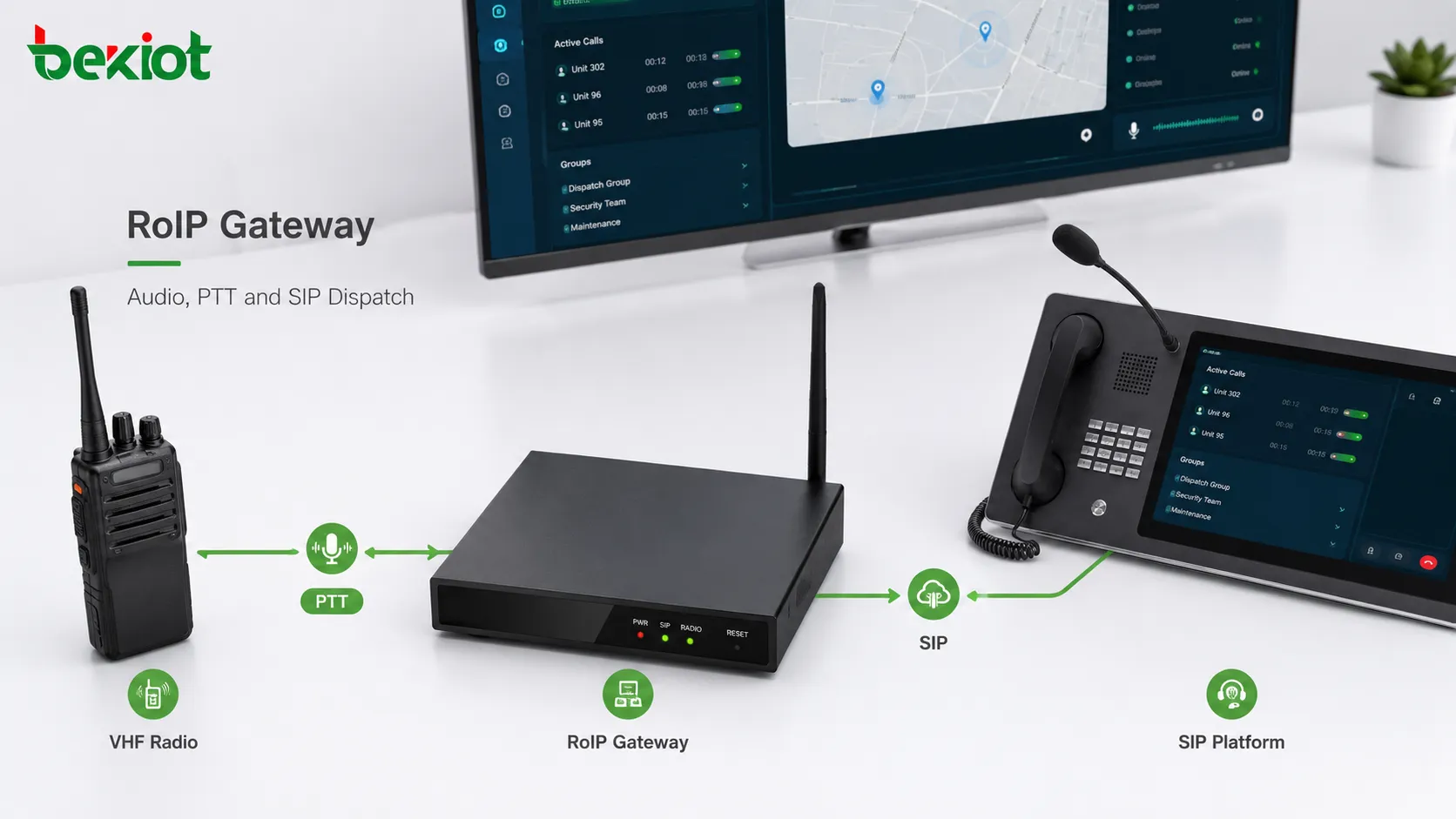
The most practical method is to use a RoIP gateway or PTT gateway between the VHF radio and the dispatch platform. The gateway connects to the radio through an audio and control interface, then converts the radio voice and PTT control into IP-based communication. In many deployments, the gateway converts the radio communication into SIP so it can interconnect with SIP dispatch platforms, IPPBX systems, converged communication systems, and dispatch consoles.
This approach avoids replacing the entire VHF network. Existing radios, antennas, repeaters, and field user habits can often remain unchanged. The gateway acts as a bridge between the traditional radio side and the IP dispatch side. For organizations that already have working VHF infrastructure, this is usually more economical and less disruptive than rebuilding the communication system from the beginning.
The gateway method is also flexible. One radio channel can be connected to one gateway port, while multi-channel projects can use multiple gateway channels or distributed gateway deployment. The design depends on the number of VHF channels, required dispatch groups, recording policy, remote site layout, and command center structure.
How the Radio Interface Works
VHF radios generally need a physical interface connection to the gateway. This connection may include audio input, audio output, PTT control, carrier detect or squelch signal, grounding, and sometimes additional control pins depending on the radio type. A customized cable is often required because different radio brands and models may use different connector definitions.
Once connected, the gateway receives audio from the VHF radio and sends it to the IP dispatch system. When the dispatcher speaks from the console, SIP terminal, or dispatch microphone, the gateway sends audio back to the radio and triggers PTT so the radio can transmit over the VHF channel. This creates two-way communication between IP dispatch users and VHF radio users.
Good interface design is important. Poor audio level matching may cause low volume, distortion, noise, or echo. Incorrect PTT timing may cause clipped speech at the beginning of transmission. Unstable carrier detection may create false activity or missed calls. Therefore, the integration should be tested with the actual radio equipment, actual cable, and real dispatch workflow.
Turning Radio Voice into SIP Communication
SIP conversion is a key part of the integration. SIP is widely used in IP telephony, dispatch platforms, intercom systems, gateways, and unified communication platforms. When the VHF radio channel is converted into SIP, it can be registered, routed, called, monitored, recorded, or grouped like other communication resources.
This allows dispatch operators to talk to a VHF channel from an IP dispatch console, SIP phone, softphone, or command platform. It also allows the radio channel to join broader workflows, such as emergency conferencing, multi-party dispatch, cross-system calling, and voice recording. The radio network no longer remains a standalone island.
SIP conversion does not change the wireless characteristics of VHF itself. Field radio users still communicate through their handheld, vehicle-mounted, or base station radios. The difference is that command center users can now access the same channel through the IP communication system, even when they are far away from the radio site.
Remote Extension Through RoIP
RoIP is especially valuable when the radio site and command center are far apart. In unmanned factories, remote ports, smart mines, forest monitoring sites, large campuses, or distributed industrial facilities, the VHF radio equipment may need to remain near the coverage area, while the control room or dispatch center may be located elsewhere.
With RoIP deployment, the gateway can be placed at the remote radio site. It connects locally to the VHF radio and sends communication traffic back to the dispatch center over an IP network. The dispatcher can then talk to the VHF channel from a command console, IP dispatch terminal, or centralized platform without being physically near the radio equipment.
This design improves flexibility. Organizations can keep radio equipment close to the antenna and coverage area while centralizing dispatch operations in a safer, more convenient, or more professional control room. It is also useful for multi-site management, where several radio sites are connected to one command center.
Connecting Narrowband Radio and Broadband PTT
Many organizations now use both traditional narrowband radio and broadband PTT systems. VHF radios are often used by legacy teams, field workers, vehicles, or outdoor users, while broadband PTT may be used by smartphones, rugged terminals, private LTE/5G users, or IP-based mobile teams. Without interconnection, these two groups cannot communicate efficiently.
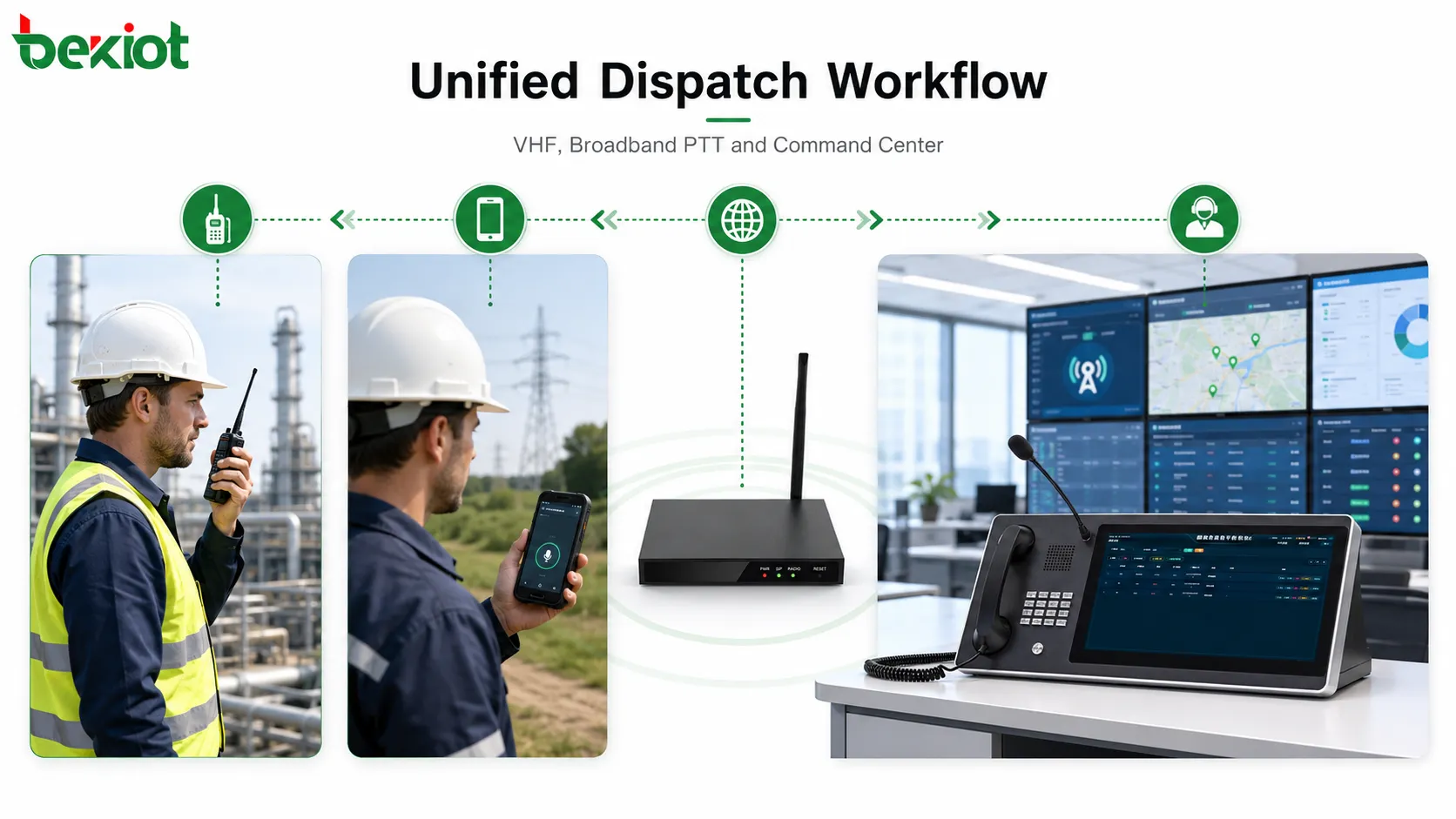
A command and dispatch platform can bridge these communication groups. Through the gateway, VHF radio users can communicate with broadband PTT users under controlled dispatch rules. This supports mixed networking, cross-team collaboration, and gradual system upgrade. The enterprise does not need to abandon VHF immediately, and broadband users can still join the radio communication workflow.
This is useful in ports, mines, energy facilities, transportation projects, emergency services, public utilities, and large industrial sites. Different teams may use different terminals, but the command center can coordinate them through one dispatch platform.
Recording Adds Traceability
Once the VHF channel is connected to the dispatch platform, radio communication can be recorded together with other dispatch voice resources. This is a major operational advantage. In traditional standalone radio use, recording may be unavailable, incomplete, or separated from other communication records.
Recording helps with incident review, responsibility confirmation, training, safety management, command evaluation, and compliance. For emergency response, industrial safety, public facility operation, and transportation management, the ability to replay dispatch communication can be very important.
The recording design should include channel identification, time stamps, user or group information where available, storage policy, access permissions, retention period, and retrieval method. If radio communication is used in sensitive or regulated environments, access to recordings should be controlled carefully.
Typical Application Scenarios
VHF radio integration is suitable for environments where radio coverage already exists and command coordination needs to be upgraded. In aviation-related ground support, marine service, port operations, factory dispatch, mining areas, forest fire prevention, outdoor rescue, emergency field support, and regional infrastructure maintenance, VHF remains practical because it supports direct field communication.
When these radio systems are connected to a command platform, the control center gains stronger coordination ability. Dispatchers can communicate with field radio users, connect radio channels with IP terminals, record radio traffic, manage multiple sites, and coordinate radio teams with other departments.
For smart projects, the integration also supports digital transformation. The radio system remains usable, while the dispatch platform adds centralized control, visual status, workflow linkage, data recording, and cross-system collaboration.
Recommended System Architecture
A practical architecture includes a VHF radio layer, a gateway access layer, an IP transport layer, and a command platform layer. The VHF radio layer includes handheld radios, vehicle radios, base stations, repeaters, antennas, and existing channel resources. The gateway access layer connects to the radio and converts audio, PTT, and channel activity into IP communication.
The IP transport layer carries SIP and media traffic between the radio site and the command center. This may use LAN, WAN, private fiber, VPN, industrial network, microwave backhaul, or a secure public network connection depending on the project. The command platform layer provides dispatch console operation, group calling, monitoring, recording, user management, event linkage, and integration with other communication resources.
For larger deployments, the system may also include redundant servers, multiple dispatch seats, centralized recording storage, GIS linkage, emergency plans, video surveillance linkage, alarm integration, and broadband PTT interconnection. The architecture should be selected according to the number of channels, coverage sites, dispatch users, and reliability requirements.
Network and Security Planning
RoIP and SIP-based dispatch rely on the IP network between the gateway and the command system. Network quality affects voice delay, packet loss, jitter, and reliability. Even though voice traffic requires less bandwidth than video, it still needs stable transmission and proper priority control. For mission-critical sites, QoS, private network routing, backup links, and monitoring should be considered.
Security is also important. Radio dispatch traffic may include operational instructions, emergency coordination, safety information, or sensitive field communication. The system should control who can access radio channels, who can monitor conversations, who can initiate transmission, and who can retrieve recordings. Network access, account permissions, device registration, and management interfaces should be protected.
When gateways are deployed at remote sites, physical security should also be considered. The gateway, radio, power supply, antenna line, and network equipment should be installed in a protected cabinet or equipment room, especially in industrial, outdoor, or unmanned environments.
Deployment Checklist
Radio Channel Survey
Confirm the number of VHF channels, current radio types, repeater structure, antenna location, coverage range, operating frequency plan, and user groups. The integration plan should respect the existing radio operation method.
Interface and Cable Matching
Check the radio connector, audio input and output pins, PTT control, carrier detect signal, grounding, and required cable definition. Real equipment testing is necessary because different radios may use different interface layouts.
Gateway and SIP Configuration
Plan SIP registration, codec selection, call routing, PTT behavior, channel naming, dispatch group mapping, and recording policy. The gateway should be configured according to the dispatch platform workflow.
Remote Site Installation
For RoIP deployment, confirm power supply, network availability, antenna placement, cabinet protection, lightning protection, grounding, and maintenance access at the remote radio site.
Acceptance Testing
Test two-way audio, PTT response, speech clipping, channel activity detection, dispatch console operation, recording playback, long-duration use, network interruption recovery, and multi-user dispatch scenarios before final acceptance.
Common Mistakes to Avoid
One common mistake is treating VHF integration as a simple audio connection. In reality, a successful project must handle audio levels, PTT timing, channel detection, SIP signaling, network reliability, recording, permissions, and dispatcher workflow. If these details are ignored, the system may connect but perform poorly in real operation.
Another mistake is placing the gateway only where it is convenient for the IT room, rather than where it is best for radio coverage. In many cases, the gateway should be close to the radio equipment and antenna system, while IP networking extends communication back to the dispatch center.
A third mistake is failing to test with actual field users. Bench testing can confirm basic communication, but it may not reveal coverage limitations, operational habits, background noise, incorrect microphone gain, or delayed PTT behavior. Acceptance testing should include dispatchers and real radio users whenever possible.
Final Review
Connecting VHF radios to a command and dispatch system is a practical way to modernize existing radio communication without discarding valuable field infrastructure. VHF radios provide proven coverage in aviation, marine, industrial, port, mining, forest, outdoor, and emergency environments. Their 30 MHz to 300 MHz operating range, line-of-sight propagation, and potential communication distance from several dozen kilometers to more than one hundred kilometers make them useful in many open-area applications.
The key to integration is the RoIP gateway. By connecting to the VHF radio through a proper audio and PTT interface, the gateway can convert radio communication into SIP-based dispatch resources. This enables remote dispatch, centralized control, broadband PTT interconnection, recording, multi-site access, and integration with modern command platforms.
A successful project should focus on real communication workflow, not only device connection. Radio interface design, SIP configuration, network quality, remote site deployment, recording policy, security control, and acceptance testing all affect the final result. With proper planning, VHF radio networks can become part of a unified command environment and continue to serve field communication needs while gaining the advantages of IP dispatch and centralized management.
FAQ
Can an existing VHF radio system be connected without replacing all radios?
Yes. In many projects, existing radios, repeaters, antennas, and field user terminals can remain in use. A RoIP gateway is added to bridge the radio channel with the IP dispatch platform.
Does VHF integration require a private network?
Not always. A private network is preferred for critical environments, but VPN, dedicated WAN, industrial Ethernet, or secure routed networks may also be used. The most important requirements are stable latency, low packet loss, and controlled access.
Can dispatchers talk to radio users from a remote control room?
Yes. If the gateway is installed at the radio site and connected to the dispatch platform through IP networking, dispatchers can communicate with VHF radio users from a remote command center or centralized dispatch room.
What should be checked if the first word of transmission is cut off?
This is often related to PTT timing, radio wake-up delay, audio threshold, or gateway configuration. The system should be tested and adjusted with the actual radio equipment to avoid speech clipping.
Can VHF radio calls be recorded after integration?
Yes. Once the radio channel is converted into the dispatch platform, voice traffic can usually be recorded, stored, searched, and replayed according to the platform’s recording policy and user permissions.







