


A smart mine project is not only a software platform or a monitoring screen. It is a large system engineering project that involves communication, dispatch, video surveillance, AI analysis, IoT sensing, emergency response, and daily production coordination. Among these systems, voice communication remains one of the most practical and frequently used capabilities on site.
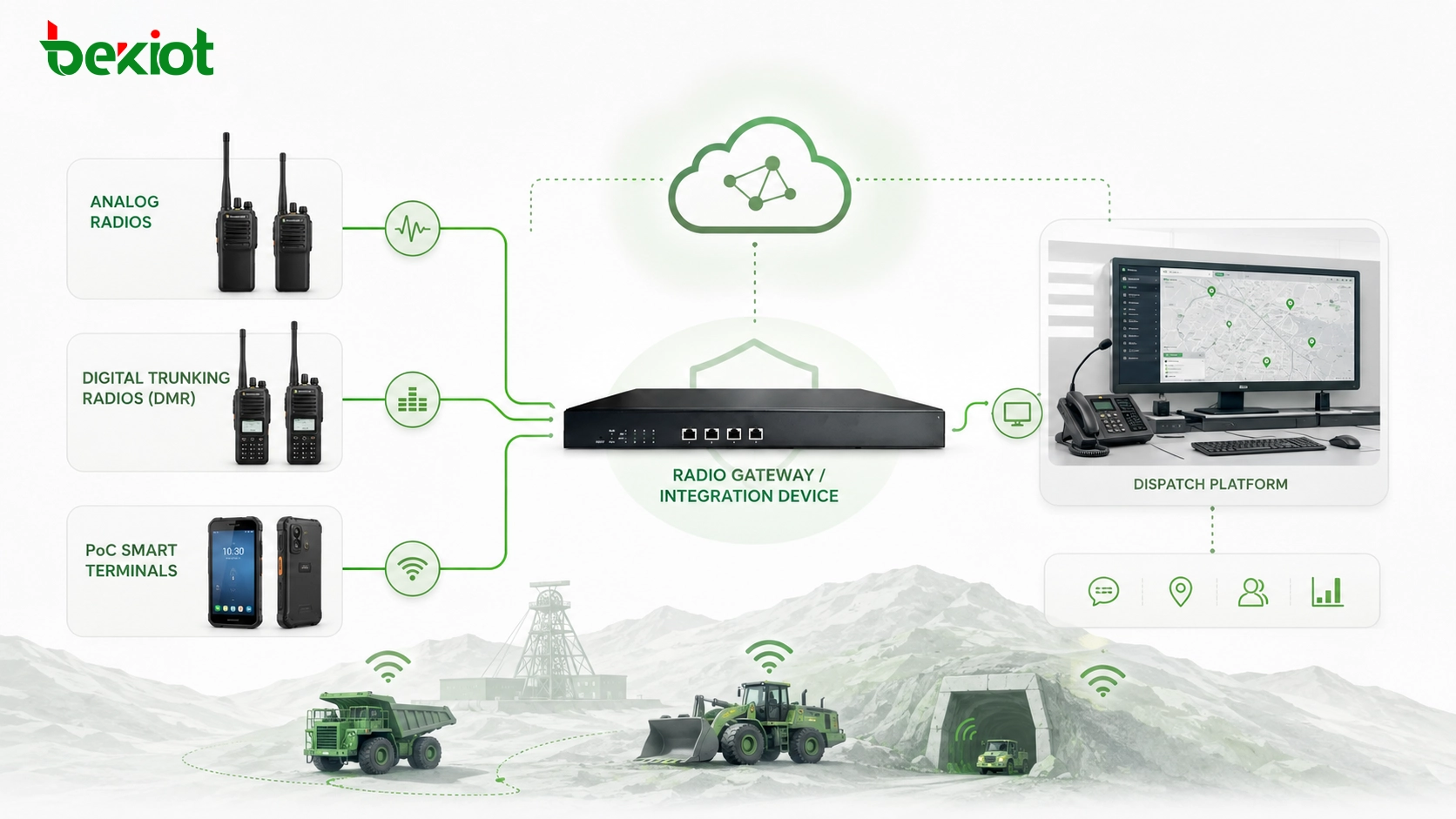
In many mining enterprises, different types of two-way radios are already in use before the smart mine platform is built. These may include analog radios, public-network PoC terminals, DMR digital trunking radios, B-TrunC systems, private LTE or 5G radio services, and other dispatch communication devices. If these existing systems cannot be connected into one unified communication architecture, the smart mine project will always have a weak point in field coordination and emergency response.
Why Radio Integration Matters in Mining Projects
Mining sites are complex operating environments. Workers, vehicles, equipment rooms, underground tunnels, open-pit areas, control centers, safety teams, and maintenance groups may all rely on different communication tools. Some departments may use traditional analog radios. Some teams may already use public-network PTT terminals. Production or emergency teams may use DMR, B-TrunC, or other digital trunking systems.
These systems often serve different purposes. Analog radios may still be used in local production areas because they are simple and familiar. Public-network PoC terminals are useful for wide-area communication and mobile workforce management. Digital trunking systems are often used where group communication, dispatch control, and stronger management features are required. In newer projects, 4G private networks, 5G private networks, and industrial IoT platforms may also be introduced.
The challenge is that these systems are usually isolated. A dispatcher may not be able to talk directly to all radio users. An alarm from an IoT platform may not reach field radio teams automatically. A private radio user may not communicate with a PoC user. This fragmentation reduces the practical value of a smart mine platform.
Start with a Full Communication Inventory
Before designing the integration solution, the project team should first make a complete inventory of the existing communication systems. This includes the type of radio system, the number of users, frequency planning, channels or talk groups, dispatch requirements, coverage areas, and whether each system is used for routine production, security patrol, maintenance, emergency rescue, or contractor coordination.
The inventory should also identify which systems must communicate with each other. For example, underground safety staff may need to talk with the command center. Vehicle teams may need to receive emergency broadcast messages. A central dispatcher may need to contact analog radio users, public-network PTT users, and digital trunking users from one dispatch platform.
This planning stage is important because smart mine communication is not simply about connecting devices. It is about defining who needs to talk to whom, under what conditions, and with what priority. Without this workflow analysis, the integration may become technically connected but operationally inefficient.
Use Gateways to Bridge Different Radio Systems
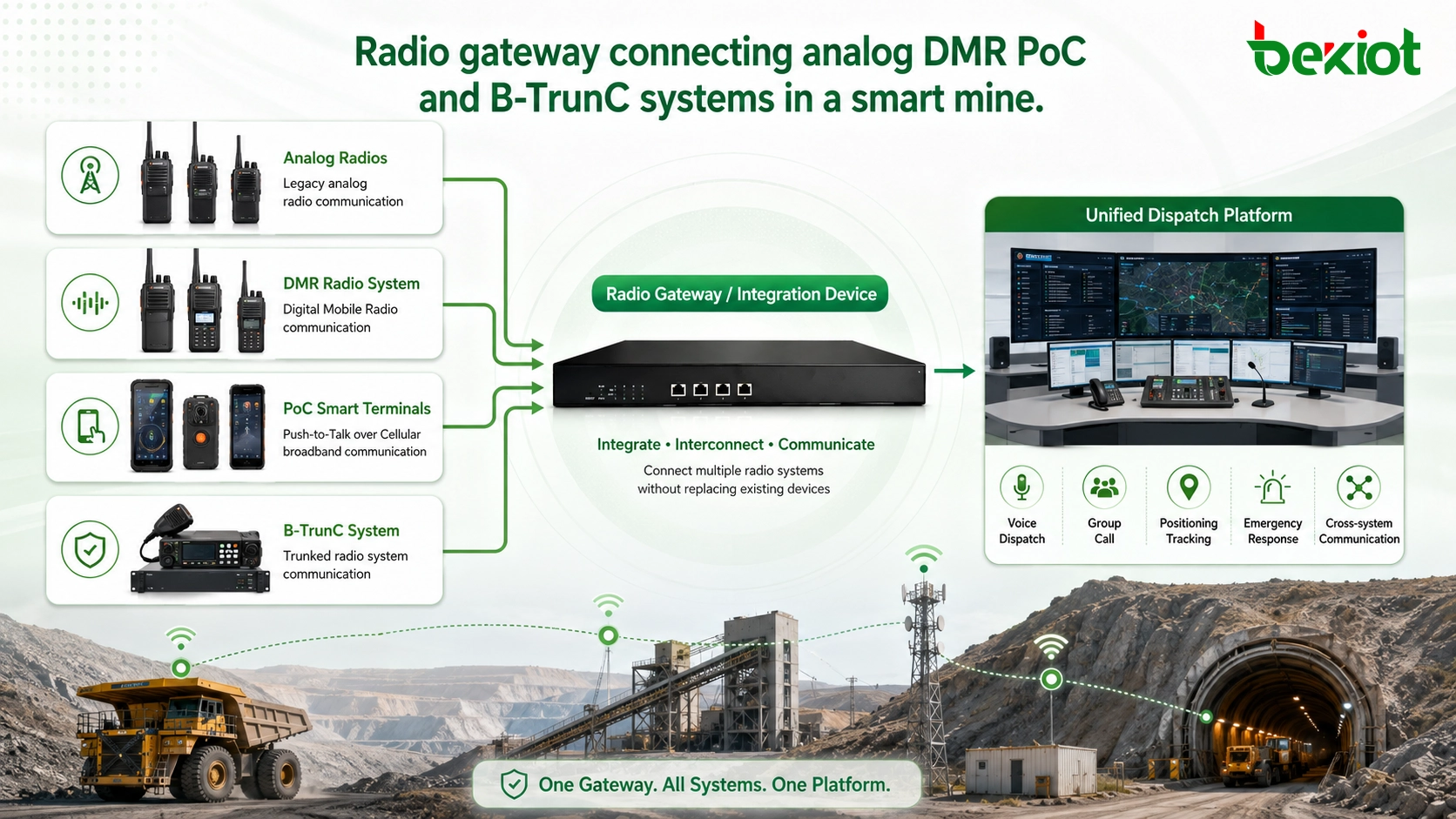
The most practical way to integrate different two-way radio systems is to use gateway devices. A gateway acts as a bridge between the existing radio network and the unified communication or dispatch platform. Instead of replacing all old radios at once, the project can connect different systems step by step.
For example, an analog radio channel can be connected through a radio gateway. A DMR system can be connected through a suitable digital trunking interface. A public-network PTT system can be connected through platform interconnection or SIP-based integration. B-TrunC or other trunking systems can also be connected through dedicated gateways or dispatch interconnection interfaces, depending on the system architecture.
In this model, each gateway port or channel can correspond to one radio system, one radio channel, or one dispatch group. After the gateway is connected to the smart mine communication platform, dispatchers can communicate across different radio systems through a unified interface.
For projects that need SIP interconnection, RoIP gateway access, dispatch console integration, or radio-to-platform convergence, Becke Telcom can be considered as a practical reference for gateway-based communication integration and command dispatch deployment.
Build Around SIP and Dispatch Platform Interconnection
A smart mine communication system should not be designed as a closed radio-only network. It should be designed as a converged communication architecture. SIP is often useful in this architecture because many dispatch platforms, IP PBX systems, SIP phones, paging systems, and communication gateways can use SIP for call control and interconnection.
When a radio gateway supports standard SIP protocol, it can register with a SIP server, IP PBX, or converged dispatch platform. This allows radio users to communicate with dispatch seats, SIP extensions, IP phones, paging consoles, emergency phones, and other communication endpoints.
This design gives the mine more flexibility. The command center can communicate with radio groups. Office extensions can call field teams when authorized. Emergency phones can trigger communication with a dispatcher. Broadcast systems can be linked with radio announcements. The radio network becomes part of a wider mine communication system rather than an isolated tool.
Connect Existing Radios Without Disrupting Operations
A major advantage of gateway integration is that it protects existing radio investments. Many mining companies already have a large number of radios, base stations, repeaters, vehicle radios, handheld radios, and dispatch resources. Replacing them all at once may be expensive, risky, and unnecessary.
By using gateway access, the project can keep the existing radio system running while adding unified dispatch capability. Analog radios can remain in use where they are still effective. Digital trunking systems can continue to serve their original user groups. Public-network PTT terminals can support wide-area mobile workers. The smart mine platform can then coordinate these systems through integration rather than forced replacement.
This phased approach is especially important for mines that cannot stop production for large-scale communication migration. Integration should be planned so that daily operations continue while new command, dispatch, and alarm linkage capabilities are added gradually.
Let IoT Alarms Reach Radio Users Automatically
Smart mine projects usually include many IoT and safety monitoring systems. These may monitor gas concentration, water levels, equipment status, conveyor operation, ventilation, personnel location, vehicle movement, power systems, and environmental conditions. If an abnormal event occurs, the alarm should not stay only on a screen.
Through gateway and platform integration, alarm information can be converted into voice notifications or dispatch actions. For example, when an IoT platform detects a high-risk alarm, the communication system can automatically broadcast a voice message to the relevant radio group, notify the command center, or trigger a predefined emergency communication process.
This is valuable because radio communication is still one of the fastest ways to reach field workers. A screen alarm may be missed by people outside the control room, but a voice announcement through the correct radio channel can reach operators, patrol teams, maintenance staff, and emergency responders more directly.
Combine Voice, Video, and AI Analysis
Modern smart mines often include video surveillance and AI analysis platforms. Cameras may be used for belt conveyor monitoring, entrance control, vehicle identification, unsafe behavior detection, perimeter protection, and production process supervision. AI systems may identify abnormal events and generate alerts automatically.
Communication integration makes these systems more useful. When AI analysis detects an event, the dispatch platform can notify the right radio group. When a dispatcher receives a radio report, the operator can check related video feeds. When a vehicle or worker alarm appears on the platform, the command center can contact the nearest team immediately.
This creates a closed-loop workflow: detection, notification, communication, confirmation, dispatch, and response. The value of smart mining is not only collecting data, but also turning that data into timely field action.
Design Talk Groups Around Real Mine Workflows
After different radio systems are connected, the next step is to organize communication groups properly. A smart mine may need production groups, safety groups, maintenance groups, transportation groups, electrical teams, ventilation teams, emergency rescue teams, contractor groups, and command-center groups.
Group design should match real work responsibilities. If groups are too broad, irrelevant users may hear too many messages. If groups are too narrow, emergency coordination may become slow. The dispatch platform should support flexible group calling, cross-group communication, emergency priority, and temporary command groups for incident response.
Permissions are also important. Not every user should be able to call every group or trigger emergency broadcasts. Dispatchers, supervisors, team leaders, and field workers should have different communication rights according to the mine’s management structure.
Emergency Communication Needs Priority Planning
Mining operations have strict safety requirements. Communication integration must therefore consider emergency priority from the beginning. Emergency calls, alarm broadcasts, rescue team communication, evacuation notices, and command instructions should have higher priority than routine production communication.
The system should define what happens when an emergency alarm is triggered. Which radio groups receive the message? Does the dispatcher receive a pop-up notification? Should the system record the call? Can the command center override normal communication? Can the message be repeated automatically until acknowledged?
These rules should be configured before the system goes live. A communication system that works well in daily operation may still fail in emergency conditions if priority, permissions, and alarm linkage are not designed clearly.
In smart mine projects, radio integration should not only solve cross-system talking. It should support faster command, safer response, alarm linkage, and coordinated field action.
What the Complete Architecture Includes
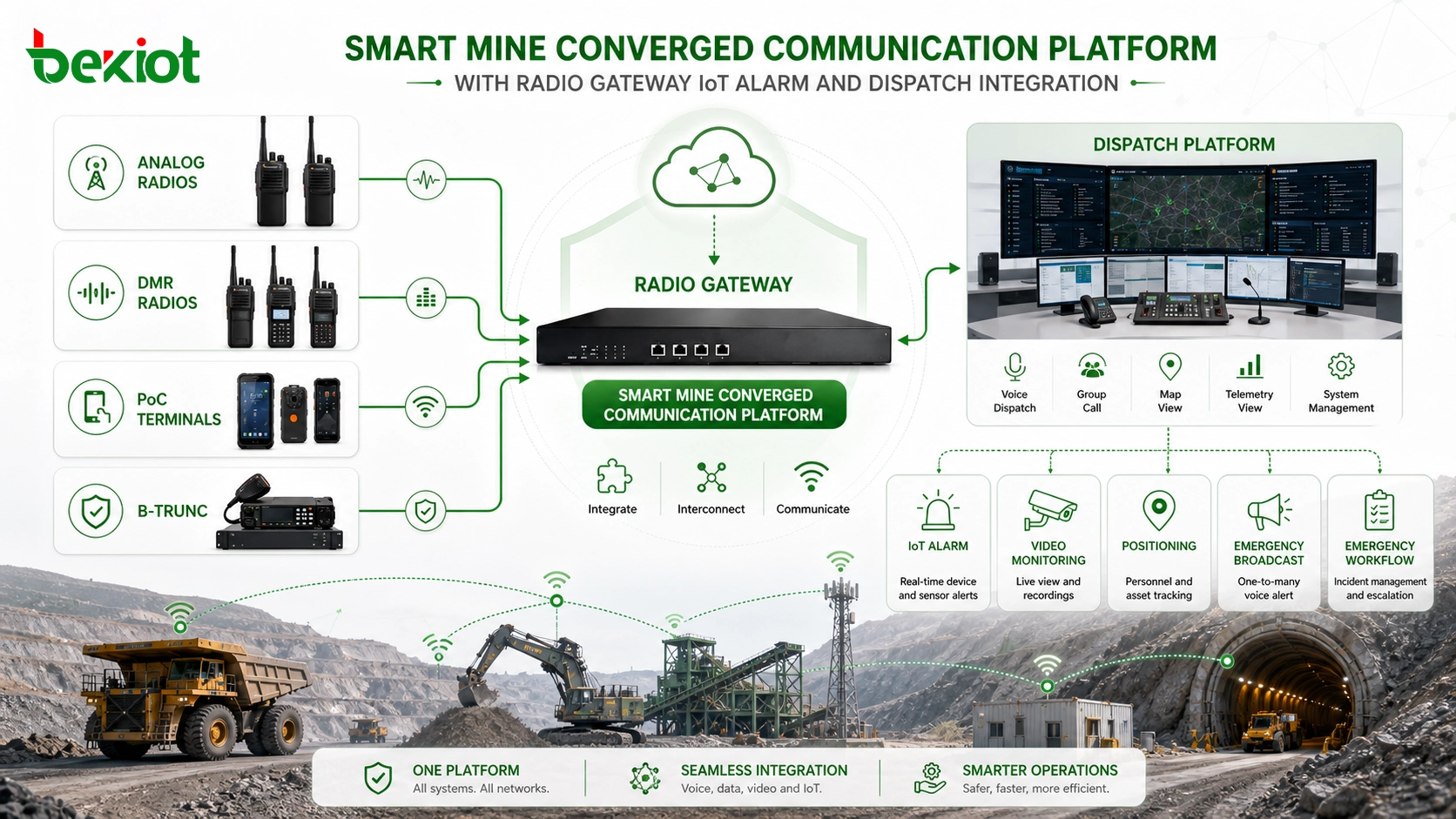
A complete smart mine radio integration architecture usually includes field radio systems, radio gateways, SIP or RoIP interconnection, dispatch servers, command consoles, monitoring systems, IoT alarm platforms, network infrastructure, and optional recording or management modules.
The field layer includes analog radios, DMR radios, B-TrunC terminals, public-network PoC devices, vehicle radios, handheld radios, and other communication endpoints. The gateway layer connects these systems to the platform. The dispatch layer provides user management, group calling, call recording, emergency handling, and cross-system communication.
The application layer may include GIS positioning, video surveillance, AI analysis, IoT alarm linkage, emergency broadcasting, and integration with the mine’s operation management platform. This layered architecture helps the mine expand gradually while keeping the system manageable.
Deployment Should Follow a Phased Strategy
For many mines, the best approach is not to integrate every system at once. A phased deployment is safer and easier to manage. The first phase can connect the most important radio channels to the dispatch platform. The second phase can add public-network PTT, SIP calling, and telephone interconnection. Later phases can add IoT alarms, video linkage, AI event notification, and emergency broadcast workflows.
This phased strategy reduces technical risk. It also allows the project team to test communication quality, operator habits, group settings, gateway stability, recording rules, and emergency processes before expanding the system to more departments.
Pilot testing is strongly recommended. A small number of representative radio channels and user groups can be connected first. After confirming voice quality, latency, permissions, and dispatch workflow, the system can be expanded to more devices and more mine areas.
Key Technical Points to Check
Several technical points should be reviewed during design and acceptance. The first is audio quality. Radio gateway audio levels, noise, delay, echo, and push-to-talk behavior must be tuned carefully. Poor audio quality will reduce user confidence even if the system is technically connected.
The second is protocol compatibility. The project team should confirm whether the gateway connects through SIP, analog audio, radio interface cables, IP protocols, platform APIs, or dedicated trunking interfaces. Different radio systems may require different access methods.
The third is reliability. Mines may have harsh environments, unstable networks, power interruptions, and high safety requirements. Gateway devices, servers, network switches, and dispatch clients should be deployed with suitable power protection, backup planning, and maintenance procedures.
Long-Term Operation and Maintenance
After deployment, the communication system needs regular operation and maintenance. Administrators should manage user accounts, update group structures, check gateway status, review call records, maintain terminal lists, and test emergency communication procedures.
If the mine continues to add new IoT systems, cameras, vehicles, radios, or departments, the communication platform should also be updated. A good integration architecture should support future expansion without requiring a complete redesign.
Training should not be ignored. Dispatchers need to understand cross-system calling, emergency priority, alarm linkage, recording search, and group management. Field workers need to know how their existing radios interact with the new smart mine platform, especially during emergency communication.
Practical Value for Smart Mine Construction
The purpose of integrating different radios is not to show system complexity. The real purpose is to improve safety, command efficiency, and practical communication coverage. When analog radios, digital trunking systems, PoC terminals, SIP systems, IoT alarms, and dispatch platforms work together, the mine can respond faster to abnormal events.
This also improves the value of existing systems. Old radios can continue to serve local teams. New broadband communication tools can support mobile and visual applications. The dispatch platform can coordinate different resources. IoT and AI systems can push alerts into communication workflows instead of remaining isolated.
For smart mine projects, communication convergence should be treated as a foundation capability. Without reliable cross-system communication, monitoring data and digital platforms cannot fully support field operations. With the right gateway-based design, existing radio systems can become part of a stronger, safer, and more intelligent mine communication network.
FAQ
Can old analog radios still be used in a smart mine project?
Yes. Analog radios can often be connected through radio gateways or audio interface devices. This allows the mine to keep existing radios while adding dispatch platform access and cross-system communication.
Does every radio system need a separate gateway?
Not always. It depends on the radio type, channel quantity, interface method, and integration goal. Some gateways can support multiple channels, while different systems may require separate access devices or dedicated interfaces.
Can radio alarms be linked with IoT sensor alarms?
Yes. When the IoT platform and communication platform are integrated, sensor alarms can trigger voice notifications, dispatch actions, or radio group broadcasts. The exact workflow depends on the platform interface and project configuration.
How should audio delay be controlled?
Delay should be tested across the full path, including radio interface, gateway, network, dispatch server, and terminal. Proper network planning, codec settings, gateway tuning, and server performance can help keep delay within an acceptable range.
What should be tested before final acceptance?
The project team should test cross-system calling, group communication, emergency priority, alarm broadcast, audio quality, gateway stability, dispatch operation, recording, network recovery, and user permission control before the system is accepted.







