


Modern meeting rooms are no longer used only for internal discussion. In government agencies, emergency command centers, industrial enterprises, transportation departments, public safety organizations, and mobile command vehicles, meeting participants often need to communicate with people who are not physically present in the room. These outside participants may be using telephones, trunked radios, handheld two-way radios, vehicle radios, or field communication terminals.
The challenge is that meeting room audio systems, telephone lines, and radio systems usually belong to different communication domains. A meeting room may have microphones, speakers, mixers, and conferencing equipment, while field teams rely on radios and remote users may join by phone. Without a dedicated audio gateway, these systems often remain separated, forcing operators to use manual relay, speakerphone workarounds, or separate communication devices.
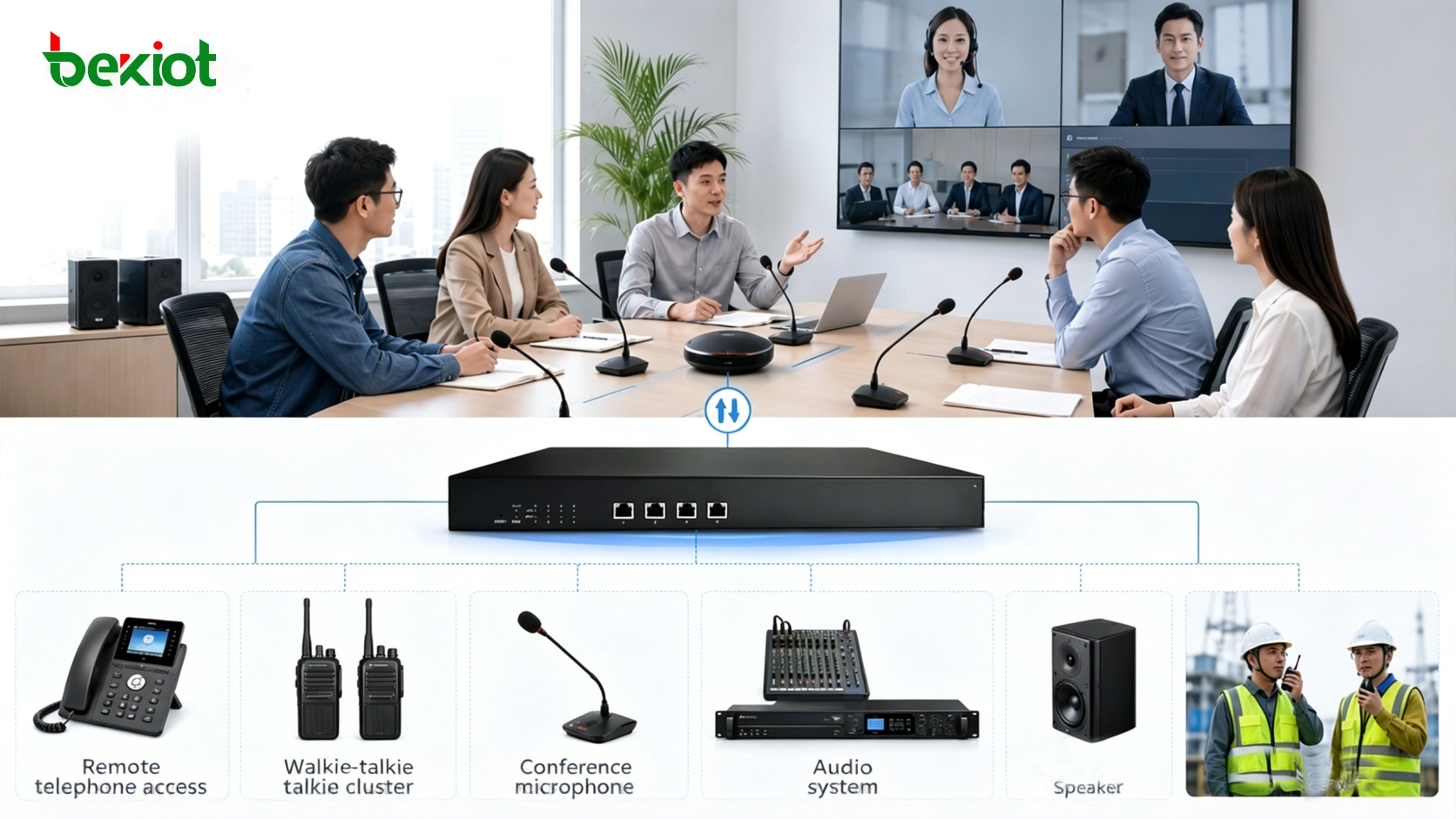
Why Meeting Rooms Need External Communication Access
In many organizations, meetings are part of real-time command and coordination. Leaders may need to speak directly with field personnel during an emergency response. A technical team may need to contact a maintenance crew while reviewing a fault report. A government or public safety meeting may need live updates from patrol teams, fire crews, traffic units, railway staff, or industrial site operators.
If the meeting room cannot directly access telephone and radio users, communication becomes inefficient. Someone may have to call a field team separately, place a phone next to a microphone, use a handheld radio inside the meeting room, or repeat information manually between the meeting and the radio network. These methods are unstable, noisy, and difficult to manage during urgent situations.
The purpose of a meeting room communication gateway is not only to add more audio devices. It is to make room participants, phone users, and radio teams speak in the same operational conversation.
The Practical Solution: A Meeting Room Audio Gateway
A meeting room audio gateway works as the bridge between room audio equipment, telephone access, and two-way radio communication. It can connect the microphone and speaker system in the meeting room to external voice channels, allowing meeting participants to call outside users and receive voice from field teams.
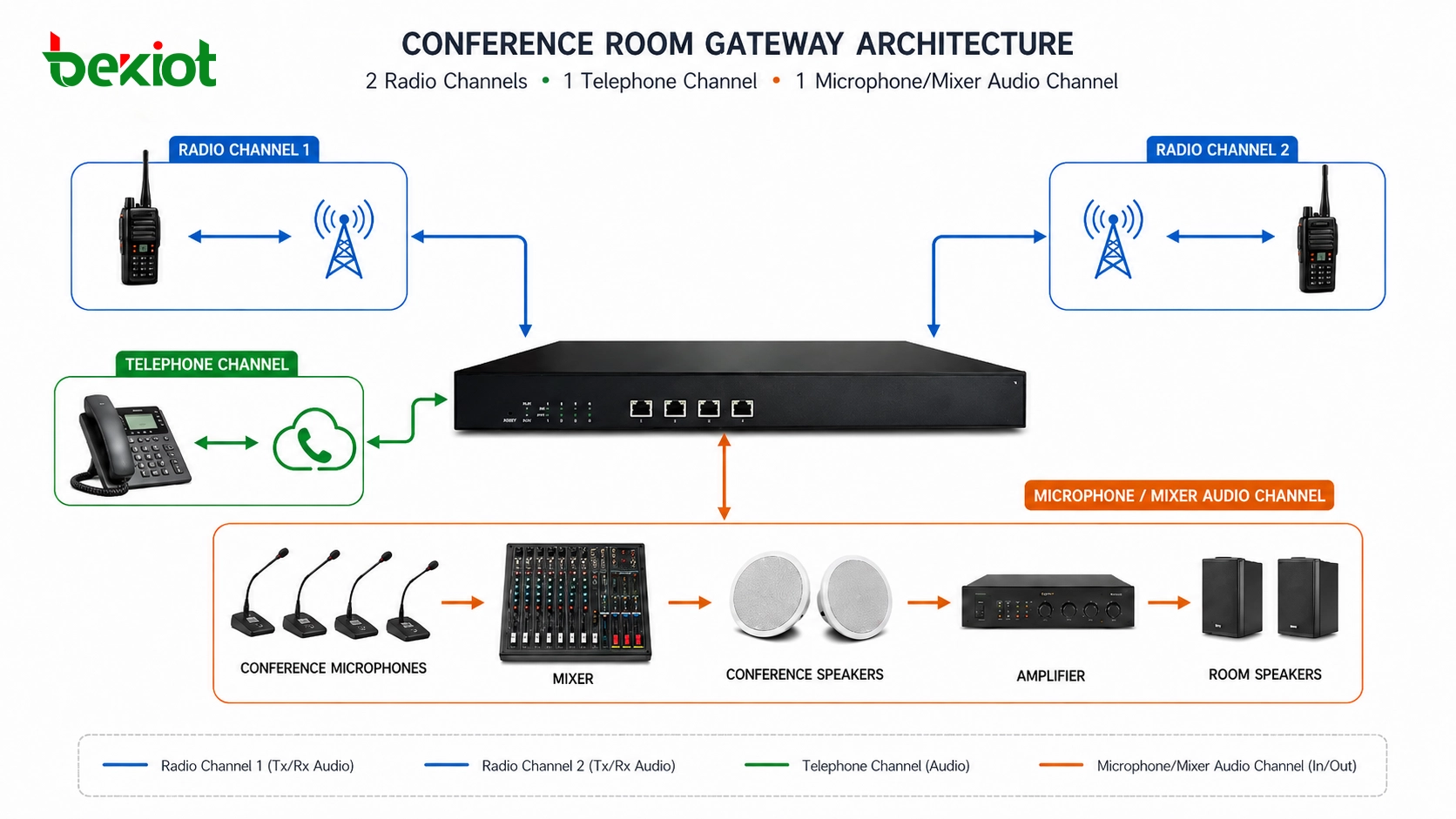
A typical design may provide multiple audio channels. For example, a four-channel gateway architecture can support two radio channels, one telephone channel, and one meeting room audio channel connected to a microphone, speaker system, or mixer. This allows the meeting room to communicate with radio users, telephone users, or both at the same time.
With the right configuration, the meeting room can call a telephone user, speak to a radio group, allow a telephone user to communicate with a radio channel, and support multi-party voice interaction between all connected participants. This turns the meeting room into a real-time communication hub rather than an isolated conference space.
How the System Architecture Works
The system usually includes four major parts: the meeting room audio system, the telephone interface, the radio interface, and the gateway device. The meeting room side may include conference microphones, ceiling speakers, powered speakers, audio processors, mixers, or a video conferencing audio system. The telephone side may include an analog telephone line, a telephone terminal, or another voice access device depending on the project.
The radio side connects to trunked radios, two-way radios, vehicle radios, radio base stations, or other field communication terminals. The gateway receives and routes audio between these systems, so that voice from the meeting room can be sent to radio users, voice from radios can be heard in the meeting room, and telephone users can join the same communication workflow.
In some deployments, the gateway can be installed without connecting to a PBX system or an IP network, depending on the required interface design. This is useful for command vehicles, temporary meeting rooms, field conference sites, and fast-deployment emergency communication projects where simple installation and local audio interconnection are more important than complex network integration.
Common Communication Scenarios
One common scenario is meeting room to telephone communication. Meeting participants can speak through the room microphone system, and the remote telephone user can hear the meeting room audio. This is useful when an off-site expert, manager, or duty officer needs to join a live discussion without using a video meeting platform.
Another scenario is meeting room to radio group communication. Participants in the room can speak directly to field radio users, such as patrol teams, emergency responders, maintenance crews, plant operators, railway staff, traffic teams, or security personnel. Field users can respond by radio, and their voices can be played through the meeting room speakers.
A third scenario is telephone to radio communication. A telephone user can talk to radio users through the gateway, allowing someone outside the radio network to communicate with field teams. This is helpful when a command leader, remote expert, or duty manager needs to speak with a radio group from a normal phone.
The most complete scenario is multi-party communication. The meeting room, telephone user, and radio channels can participate in the same real-time voice workflow, helping decision-makers, field teams, and remote users share information faster.
Value for Emergency Command and Industrial Coordination
In emergency command, communication speed is critical. A meeting room may be used as a command center where leaders analyze information, review video, coordinate departments, and issue instructions. If the room can directly access radio users and telephone users, decisions can be communicated faster and with fewer manual relay steps.
In industrial operations, the same capability is useful for maintenance coordination, shutdown planning, safety meetings, production dispatch, and incident handling. A plant control room or conference room can communicate with field technicians through radio while also keeping remote managers or technical experts connected by phone.
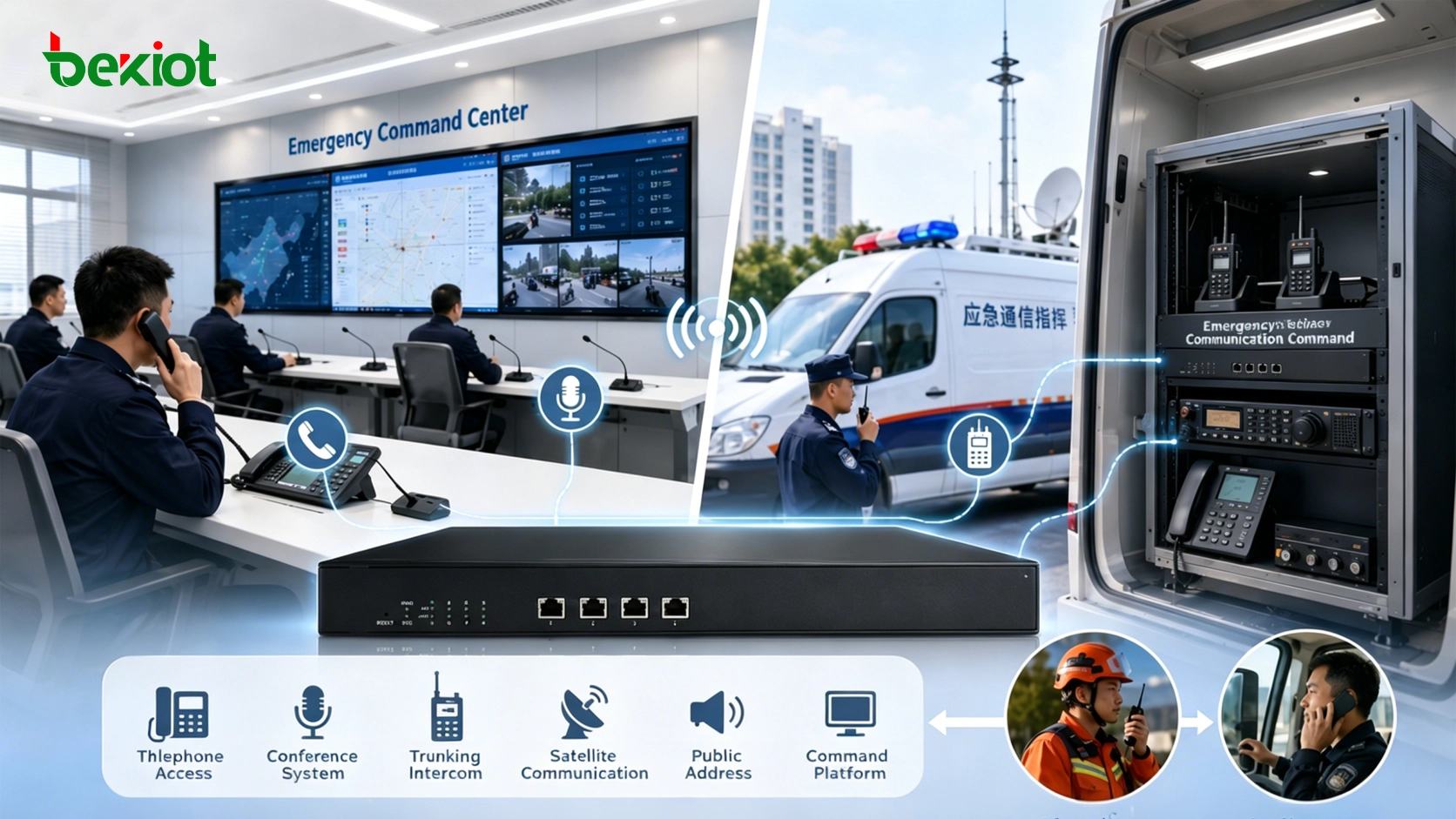
For mobile command vehicles and emergency communication vehicles, a compact gateway is especially useful. It can connect vehicle-mounted radios, field radios, room microphones, speakers, and telephone access into a deployable communication environment for disaster response, public safety, traffic control, energy repair, railway emergency handling, and large event security.
Design Considerations for Real Projects
The first consideration is channel planning. The project team should define how many radio channels, telephone channels, and room audio channels are required. A small room may need only one radio channel and one telephone access point, while a command room may require multiple radio groups and independent audio routing.
The second consideration is audio quality. Meeting rooms usually use microphones, mixers, echo control, speakers, and sometimes video conferencing systems. Radio systems may have push-to-talk behavior, different audio levels, background noise, and half-duplex communication rules. The gateway should support proper audio level matching and stable voice routing.
The third consideration is installation form. A 1U rack-mounted design is suitable for equipment rooms, command centers, control rooms, and mobile command vehicles. Desktop installation may be suitable for smaller meeting rooms or temporary conference setups. Vehicle-mounted installation should consider power supply, vibration, cable management, and quick maintenance.
The fourth consideration is operational simplicity. Meeting participants should not need to understand the technical details of radio channels, telephone interfaces, or audio routing. The system should make calling, listening, speaking, and switching channels as simple as possible for operators.
Where This Type of Gateway Is Most Useful
Public safety agencies can use this architecture to connect command meetings with patrol teams, rescue units, fire crews, traffic officers, and field responders. During incidents, leaders in the meeting room can communicate directly with radio users instead of waiting for message relay.
Industrial enterprises such as chemical plants, power stations, factories, and energy facilities can use it to connect meeting rooms with control rooms, maintenance teams, field operators, and safety personnel. This is valuable for shutdown coordination, emergency response, inspection review, and equipment fault analysis.
Transportation, railway, port, and logistics organizations can use meeting room radio access to coordinate field dispatch, vehicle teams, station staff, security teams, and remote command users. It supports faster information exchange between fixed command locations and mobile field teams.
Government departments, military-related facilities, and emergency management organizations can also use this system in conference rooms, emergency operation centers, communication vehicles, and temporary command posts where telephone, radio, and meeting audio must be integrated quickly.
From Separate Devices to Unified Voice Collaboration
A meeting room radio and telephone gateway helps transform scattered communication tools into a unified voice collaboration system. Instead of placing radios, phones, speakers, and microphones side by side without real integration, the gateway provides controlled audio routing between them.
This reduces manual relay, improves real-time communication, and gives meeting participants direct access to field communication resources. It also makes conference rooms more useful in emergency response, operational dispatch, and cross-department coordination.
For projects that need to connect meeting rooms, telephones, two-way radios, dispatch platforms, and field communication systems, Becke Telcom can be considered as a lightweight solution reference. Its industrial communication experience can support practical integration of room audio, radio access, SIP communication, and command workflows without turning the article into a product-only discussion.
FAQ
Can a meeting room directly talk to two-way radios?
Yes, if a suitable audio gateway or radio interconnection gateway is used. The gateway connects the meeting room microphone and speaker system with radio channels, allowing room participants and radio users to communicate through a controlled voice path.
Can telephone users talk to radio users through the same system?
Yes. A properly configured gateway can route telephone audio to radio channels and send radio audio back to the telephone side. This allows remote managers, experts, or duty officers to communicate with field teams by phone.
Does this type of solution require a PBX or network connection?
Not always. Some gateway designs can work through direct audio and telephone interfaces without connecting to a PBX or IP network. Other projects may use SIP, IP PBX, or dispatch platforms depending on the required system architecture.
What should be checked before deployment?
The project should confirm the number of radio channels, telephone access method, room audio equipment type, mixer interface, speaker system, push-to-talk behavior, audio level matching, installation location, and whether recording or dispatch platform integration is required.
Is this solution useful only for emergency command rooms?
No. It is also useful for industrial meetings, government coordination rooms, railway and transportation dispatch, public safety meetings, maintenance coordination, mobile command vehicles, and temporary field conference systems.







