In factories, industrial parks, energy stations, logistics bases, campuses, and critical facilities, emergency events often happen suddenly, leave a short response window, and occur across scattered field locations. Fixed interactive terminals such as IP access control intercoms, entrance voice terminals, and emergency help points are usually installed at specific locations, while security guards, maintenance teams, and field operators rely on two-way radios for daily communication.
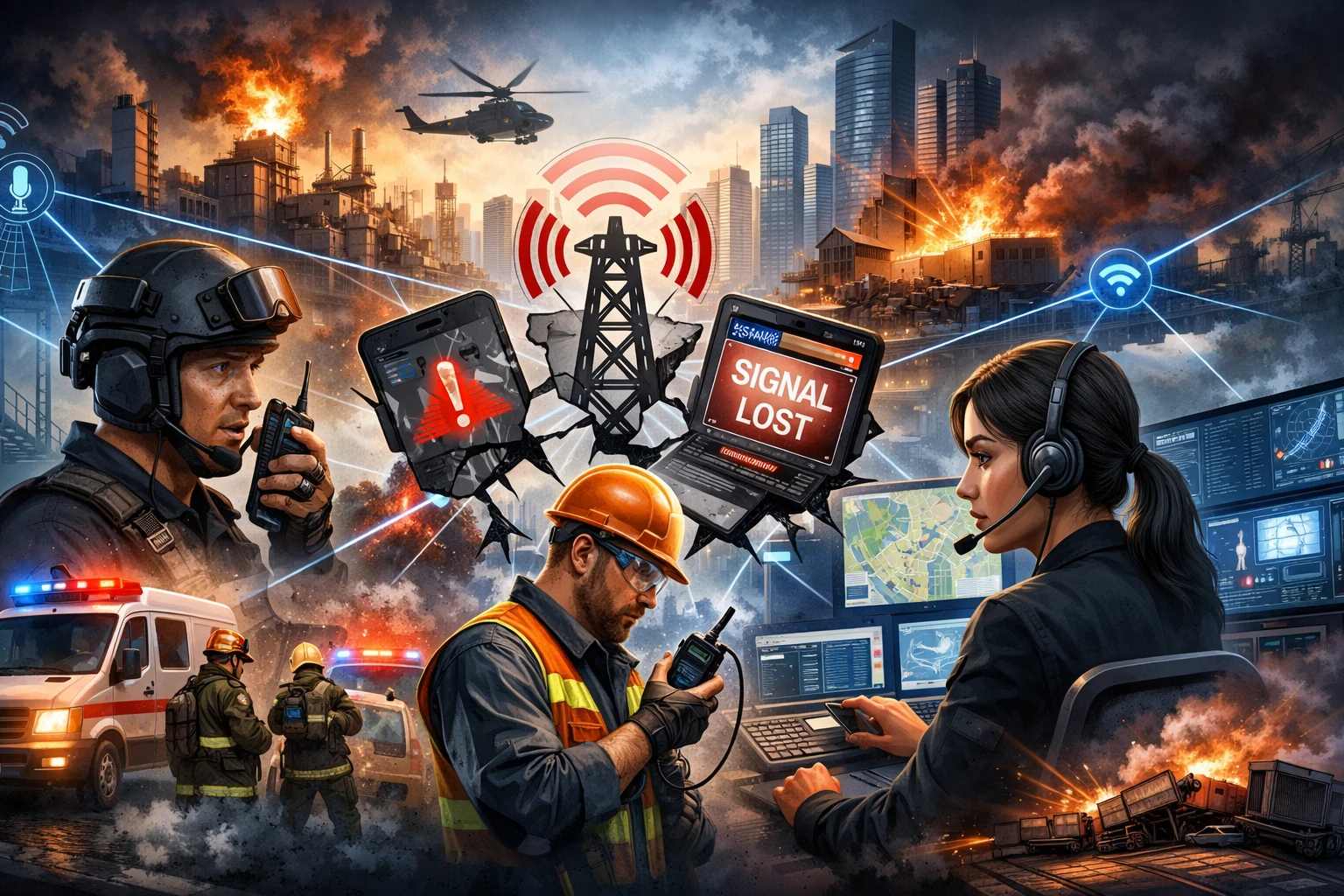
When these two systems are isolated, an emergency voice request may need to pass through several steps: a terminal call reaches a platform, an operator receives the message, the operator manually notifies the radio team, and then field personnel respond. This process can work in normal situations, but it increases delay and uncertainty when an urgent incident requires immediate nearby response.
Why Field Response Slows Down
Many sites already have both interactive terminals and two-way radio systems, but they are often built as separate communication islands. IP access control terminals are mainly used for entry requests, identity confirmation, visitor communication, and abnormal access reporting. Emergency help terminals are used for distress calls, incident reporting, and fixed-point assistance. Two-way radios, on the other hand, are the daily working tool for mobile security and operations teams.
The problem appears when a fixed terminal generates an urgent voice event but cannot directly reach the people who are closest to the scene. The message may stay on a management platform or inside a control room until someone manually transfers it to a radio group. In fast-moving incidents, this gap can reduce response efficiency.
A more practical design is to make the fixed terminal voice event enter the field communication network automatically. Instead of only reporting upward to a platform, the event should also be pushed outward to the right radio group, allowing nearby personnel to hear it, understand it, and respond immediately.
Turning Fixed-Point Calls Into Field-Aware Events
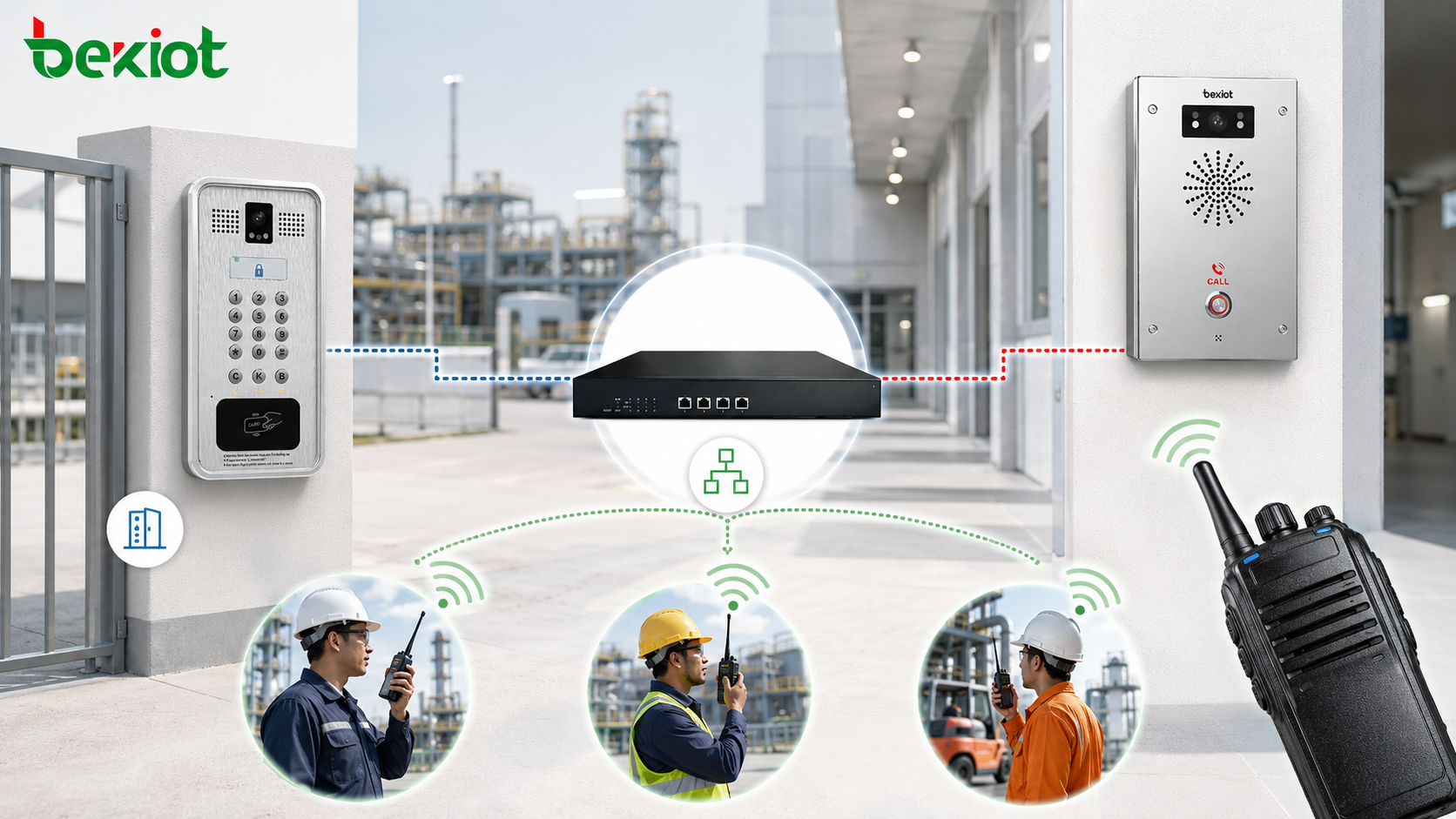
A RoIP gateway works as the voice linkage layer between interactive terminals and two-way radio systems. It receives voice from IP-based terminals or communication platforms, converts or routes the audio into the radio communication side, and pushes the event to a designated group of handheld radio users.
This changes the logic of emergency communication. A fixed terminal is no longer only a single-point call device. It becomes a trigger point for a wider field response workflow. When someone presses an emergency help button, speaks through an entrance intercom, or reports an abnormal situation from a fixed terminal, the voice can be sent directly to the corresponding radio group.
The core value is simple: the people who can respond nearby should hear the event as early as possible. This reduces dependence on manual relay and helps build a more direct connection between the incident location and mobile field teams.
How the Linkage Architecture Works
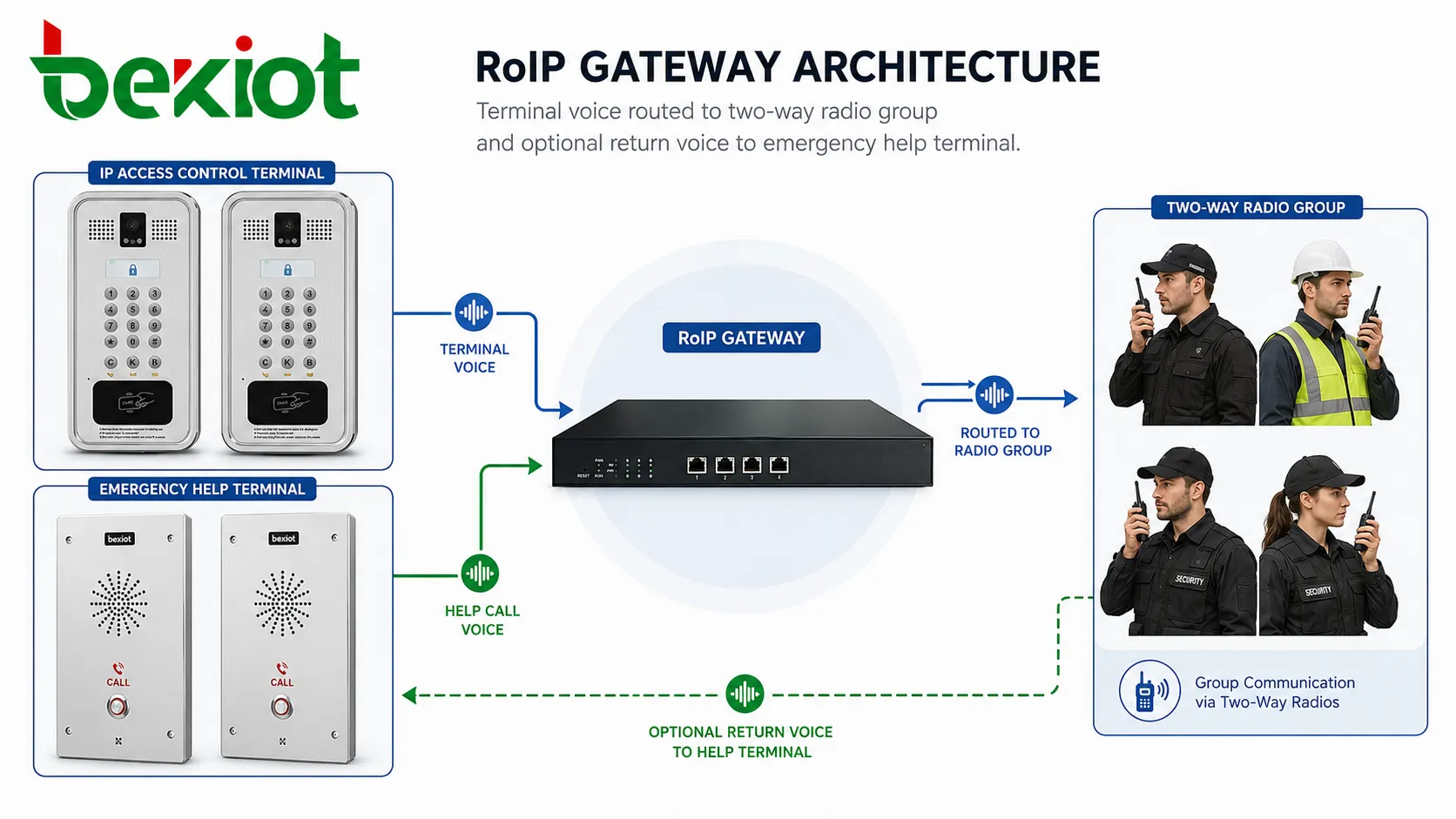
The architecture usually includes three main parts: the interactive terminal layer, the RoIP gateway layer, and the radio communication layer. The terminal layer may include IP access control intercoms, emergency help points, SOS terminals, entrance voice panels, guard station terminals, and other fixed communication devices.
The RoIP gateway sits between the terminal system and the two-way radio system. It maps voice sessions, terminal events, and linkage rules into corresponding radio groups. The radio communication layer then delivers the voice to handheld radios used by security guards, maintenance staff, patrol teams, or emergency responders.
A typical one-way linkage path is: interactive terminal voice to RoIP gateway, then RoIP gateway to radio group broadcast or group call. In some projects, two-way voice can also be enabled, allowing radio users to speak back and send voice to the terminal side for reassurance, confirmation, or instruction.
Voice Workflow from Trigger to Response
The workflow begins when a person uses an interactive terminal to start a voice request, access request, or emergency call. This may happen at a factory entrance, an equipment room, a warehouse gate, a remote patrol point, a restricted area, or a help point in a low-traffic location.
After the event is triggered, the terminal voice enters the RoIP gateway. The gateway identifies the terminal source, applies the configured linkage rule, and converts the voice session into a radio-side group call, notification, or push-to-talk communication event.
The designated radio group then receives the voice in real time. Nearby security or maintenance personnel can hear the event directly on their handheld radios and move toward the location. If two-way linkage is configured, field personnel can speak through the radio and send voice back to the terminal side, allowing them to comfort the caller, confirm the situation, or provide immediate instructions.
Operational Benefits for Security and Maintenance Teams
The first benefit is a shorter emergency response chain. The event no longer needs to follow the long path of terminal to platform, platform to operator, operator to radio, and radio to field staff. Instead, the voice event can enter the field radio network directly through the RoIP gateway.
The second benefit is that existing work habits can be preserved. Field personnel do not need to replace handheld radios or change their daily communication method. Interactive terminals also remain in their fixed-point roles. The gateway completes the linkage in the middle, reducing training pressure and deployment resistance.
The third benefit is flexible routing. Different terminal points can be linked to different radio groups according to location, time period, event type, department, or response priority. For example, an entrance terminal may call the security group, while an equipment room help point may call the maintenance group.
The fourth benefit is stronger response certainty. A platform message may be missed if operators are busy, but a radio group voice notification is much easier for mobile teams to notice during patrol, maintenance, and field operation. In emergency communication, “someone has called” should quickly become “the right people have heard it.”
Typical Sites and Use Cases
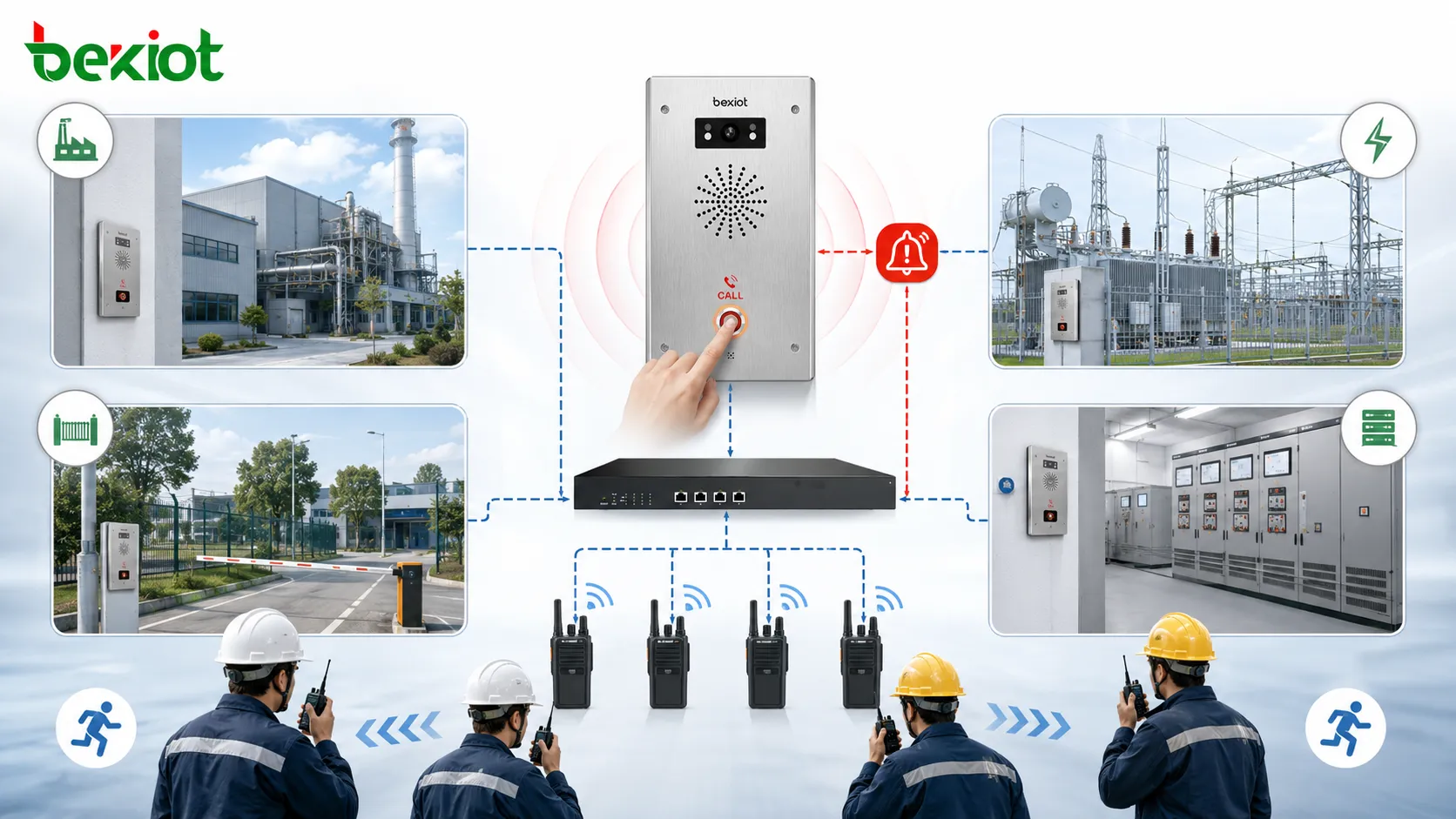
At factory entrances, a visitor, contractor, or worker may trigger an abnormal access request from an IP access control terminal. By linking the terminal voice to the security radio group, guards can receive the request immediately and go to the entrance without waiting for a control room relay.
In industrial parks, help terminals may be installed in parking areas, warehouses, remote corridors, perimeter zones, or night-shift locations. When fewer staff are on duty, direct linkage to radio users helps reduce the risk that a help request stays unnoticed on a platform screen.
In energy stations, substations, equipment rooms, and other high-security areas, emergency terminals can be connected to operation or maintenance radio groups. If a fault, access issue, personal safety event, or abnormal situation occurs, the responsible team can receive voice information quickly and respond with clearer context.
In emergency response scenarios, the same architecture can support coordination between fixed terminals, radio users, a command center, and on-site response teams. Voice becomes part of a faster operational chain rather than a message waiting for manual transfer.
Design Details for Reliable Deployment
A successful deployment should begin with point mapping. Each interactive terminal should be associated with a physical location, responsible team, and response priority. Clear naming helps dispatchers and field personnel understand where the event comes from and which team should handle it.
The second design point is group strategy. Not every terminal should call the same radio group. A gate terminal, emergency help point, equipment room terminal, and restricted-area intercom may need different linkage policies. Rules can be configured by point, time period, department, or event type.
The third design point is audio reliability. Emergency voice should be clear enough for field personnel to understand the location, situation, and required action. Network quality, audio codec settings, radio interface configuration, and gateway stability all influence the final communication experience.
The fourth design point is permission and control. Some terminals may trigger only notification, while others may support full two-way voice. Some events may call one radio group, while higher-priority events may call multiple groups or reach a command platform at the same time.
A Practical Upgrade Path for Existing Sites
The value of this solution is that it does not require a complete replacement of existing terminal systems or radio systems. Many factories, parks, and energy facilities already have IP access control terminals, emergency call points, and two-way radios. The missing layer is often the voice linkage between them.
By adding a RoIP gateway, these existing systems can be connected into a more responsive emergency communication workflow. The terminal keeps its fixed-point interaction role, the radio system continues to serve mobile field teams, and the gateway makes the event flow between them more direct.
For projects that require lightweight integration between fixed terminals, field radios, and emergency communication workflows, Becke Telcom / 贝克通信 can be considered as a practical solution reference. The BK-4-Channel RoIP Gateway may be used in suitable projects where radio voice needs to interconnect with IP-based communication systems, dispatch platforms, or emergency terminals.
The goal is not only to send a call to a platform. The goal is to make an urgent voice event reach the people who can respond on site.
FAQ
Can a RoIP gateway connect every type of interactive terminal?
It depends on the terminal interface, voice protocol, network architecture, and integration method. Before deployment, the project team should confirm whether the terminal supports SIP, IP audio, relay triggering, platform forwarding, or other compatible access methods.
Does this solution require replacing existing handheld radios?
In many cases, the existing radio system can continue to be used. The RoIP gateway is added as an interconnection layer between IP-side voice systems and radio-side communication. Actual compatibility should still be checked according to radio type, interface, and system configuration.
Can different help points call different radio groups?
Yes. A practical deployment should support flexible linkage rules. Terminals can be mapped to different groups according to area, department, duty schedule, incident type, or response priority.
Is two-way voice always necessary?
Not always. Some scenarios only need one-way emergency notification from the terminal to the radio group. Other scenarios require radio users to speak back to the terminal for reassurance, verification, or instruction. The choice depends on the operational workflow.
What should be checked before using this architecture?
The project should check terminal protocols, radio interfaces, group communication rules, audio quality requirements, network reliability, emergency workflow, permission control, and whether the command platform also needs to receive the event at the same time.