


Microphone sensitivity is a technical parameter that describes how much electrical output a microphone produces when it receives a defined level of sound pressure. In simple terms, it indicates how strongly a microphone responds to sound. A more sensitive microphone produces a higher output signal under the same acoustic input, while a less sensitive one produces a lower output signal.
This parameter is important in voice communication, recording, conferencing, broadcasting, intercoms, hearing devices, surveillance audio, smart speakers, industrial terminals, and measurement systems. It affects gain setting, pickup distance, background noise behavior, overload margin, speech clarity, and the overall design of the audio signal chain.
Why This Parameter Matters in Real Audio Systems
When users compare microphones, they often focus on appearance, connector type, frequency response, or noise cancellation. However, the output level created by the capsule is one of the first factors that determines whether the rest of the audio system can work comfortably.
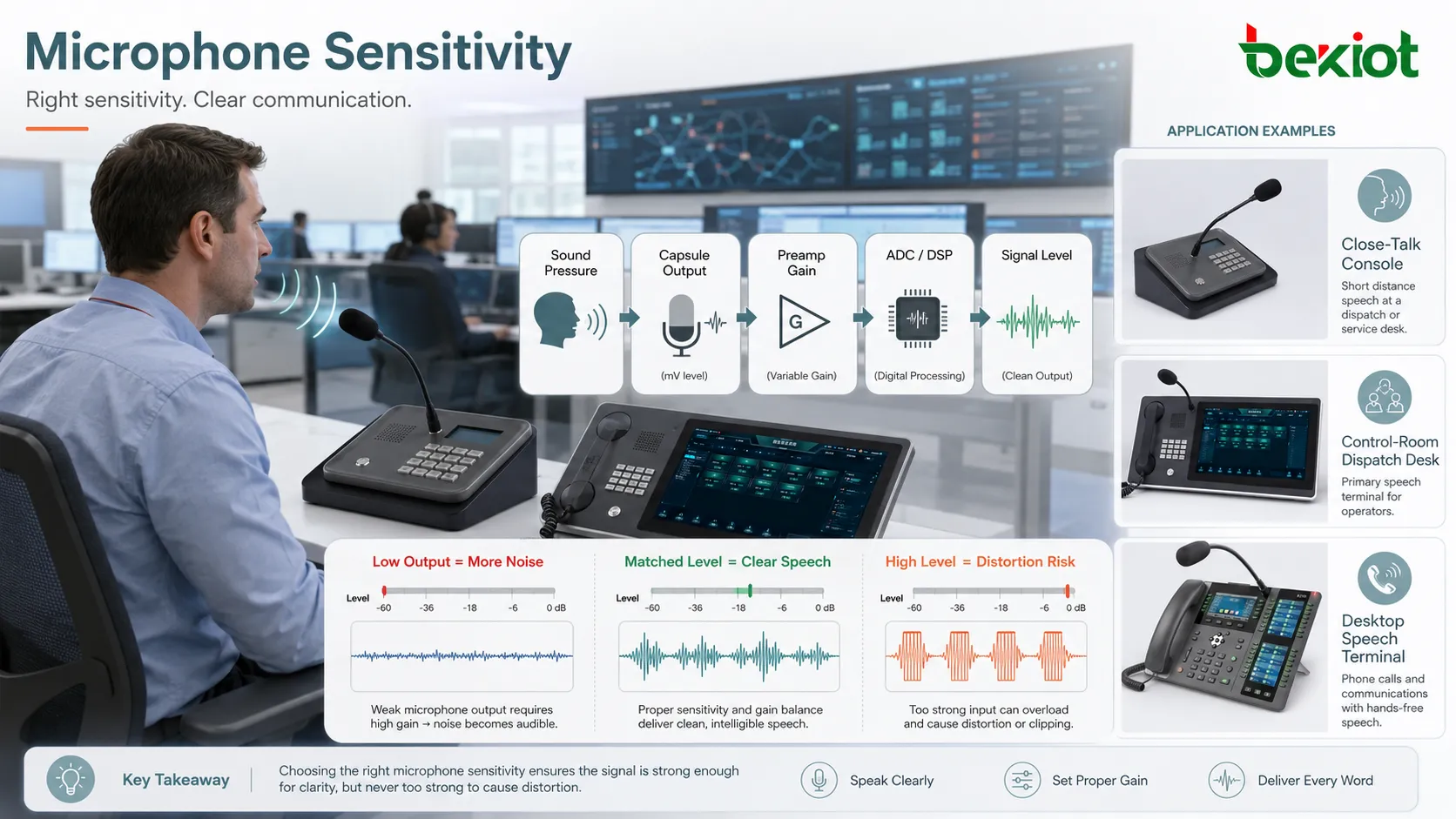
If the output is too weak, the preamplifier must add more gain. This can raise the noise floor and make the final signal sound hissy or unclear. If the output is too strong, loud sound may overload the input stage and create distortion. A good design needs the microphone, preamp, codec, analog-to-digital converter, software gain, and acoustic environment to match each other.
For speech products, the goal is not always to choose the highest possible value. The right value depends on speaking distance, ambient noise, enclosure design, expected sound pressure level, and whether the device is used near the mouth, on a table, mounted on a wall, or installed in a noisy field environment.
How the Value Is Expressed
Output Voltage Format
One common way to express the parameter is millivolts per pascal, written as mV/Pa. A pascal is a unit of sound pressure. If a microphone is rated at 10 mV/Pa, it produces 10 millivolts of output when exposed to a specified sound pressure level, often measured with a 1 kHz test tone.
This format is easy to understand because higher mV/Pa means higher electrical output for the same sound pressure. It is commonly seen in datasheets for condenser microphones, electret capsules, MEMS microphones, and measurement microphones.
Decibel Format
Another common format uses decibels, such as dBV/Pa or dB re 1 V/Pa. In this format, the value is usually negative because most microphones produce less than 1 volt for 1 pascal of sound pressure.
For example, a microphone listed at -40 dBV/Pa is more sensitive than one listed at -50 dBV/Pa. Because decibel values are logarithmic, a difference of several decibels can significantly affect gain planning.
Test Conditions
The value must be read together with test conditions. Frequency, sound pressure level, load impedance, supply voltage, measurement distance, and tolerance can all affect the result. Two microphones may appear similar on paper but behave differently if their datasheets use different measurement references.
For careful comparison, the same unit, reference, frequency, and operating condition should be used.
| Specification Format | What It Means | How to Read It Carefully |
|---|---|---|
| mV/Pa | Output voltage generated at a defined sound pressure. | Higher value means stronger output under the same test condition. |
| dBV/Pa | Output level relative to 1 volt per pascal. | Less negative value means stronger output, such as -38 dBV being higher than -45 dBV. |
| Tolerance | Allowed production variation between units. | Large tolerance may affect consistency in microphone arrays or multi-device products. |
| Test Frequency | Usually measured at a reference frequency such as 1 kHz. | It does not describe the full frequency response by itself. |
Relationship with Gain and Noise
The microphone output becomes useful only after it passes through the rest of the audio chain. A weak capsule output requires higher preamp gain. If the preamp is noisy, this extra gain can make background hiss more noticeable.
A higher output capsule can improve the signal-to-noise ratio at the input stage because the useful speech signal arrives stronger. However, this advantage has limits. If the environment is noisy, the microphone may also pick up more unwanted sound unless directionality, placement, or processing is well designed.
Good audio design balances capsule output, electronic noise, acoustic noise, and gain structure. The best result usually comes from selecting the right microphone for the environment rather than simply increasing software gain after installation.
Pickup Distance and Placement
Near-Field Speech
In headsets, handheld radios, close-talk intercoms, and lavalier microphones, the speaker is close to the microphone. In these cases, a very high output may not be necessary because the speech signal is already strong.
Too much sensitivity in a close-talk design may cause breath noise, plosive sounds, clipping, or excessive pickup of mouth movement and handling noise.
Tabletop and Room Pickup
Conference devices, smart speakers, meeting microphones, and tabletop audio terminals often need to capture voices from farther away. A suitable output level helps the device capture speech without pushing the preamp too hard.
However, distant pickup also increases room noise and reverberation. Sensitivity alone cannot solve distance problems. Microphone array processing, beamforming, echo cancellation, and room acoustics may be needed.
Wall-Mounted or Outdoor Positions
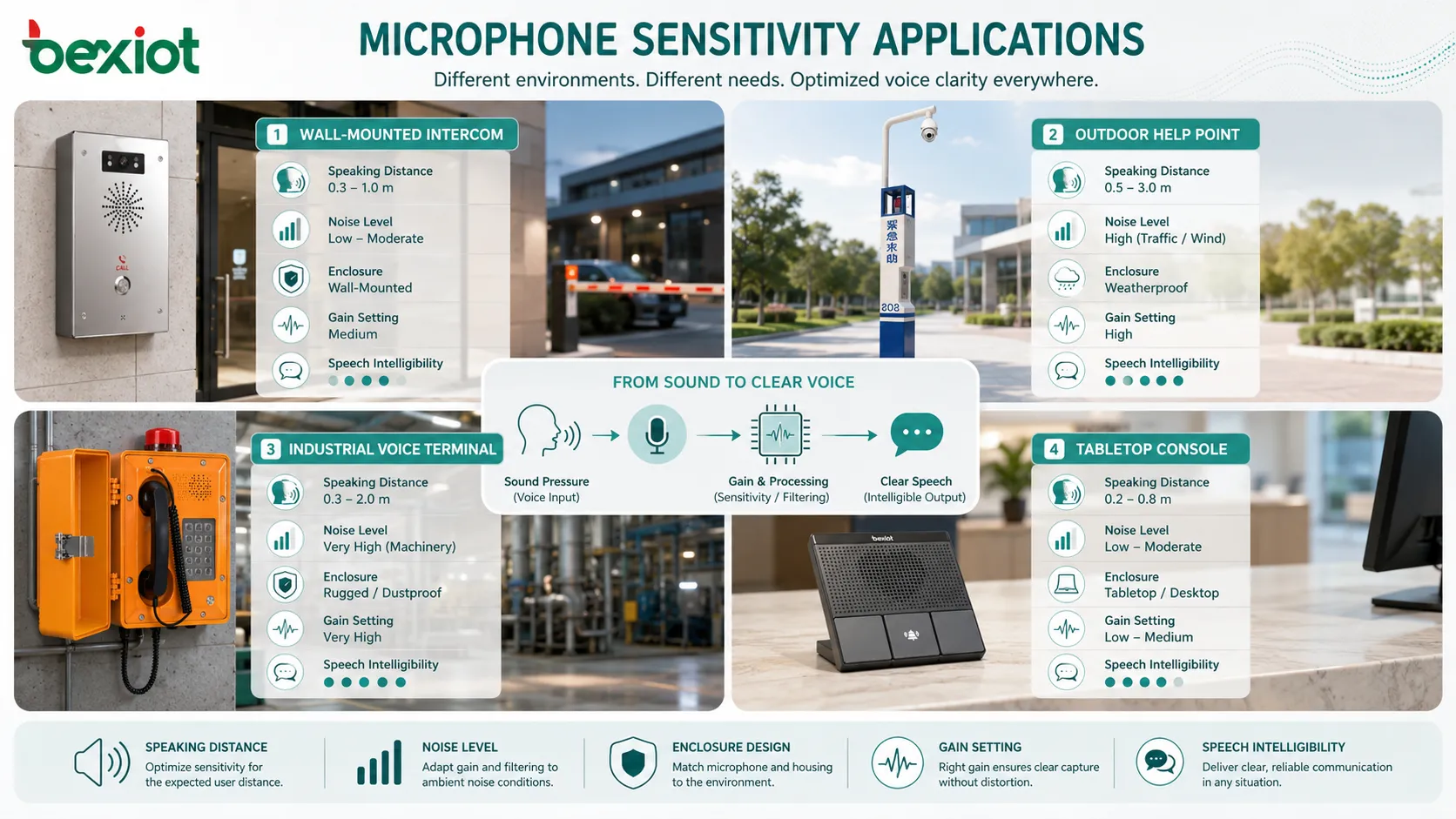
Wall-mounted intercoms, access terminals, emergency call points, kiosks, outdoor help stations, and industrial communication devices face more unpredictable speaking distances. Users may stand close, turn away, speak softly, or talk in wind and machinery noise.
These applications require careful testing because sensitivity, microphone opening design, wind protection, enclosure structure, and digital processing all influence intelligibility.
Frequency Response Is a Separate Issue
Sensitivity describes output at a specified test condition, but it does not fully describe tonal balance. A microphone may have high output at 1 kHz but weaker response at low or high frequencies. Another microphone may have lower overall output but better speech-band balance.
Frequency response shows how the microphone responds across a range of frequencies. For speech clarity, the mid-frequency range is especially important because it carries much of the intelligibility information.
When selecting a microphone, sensitivity should be considered together with frequency response, noise level, maximum sound pressure level, directionality, distortion, and environmental protection.
Maximum Sound Level and Overload Margin
A microphone must not only hear quiet speech; it must also handle loud sounds without distortion. Maximum sound pressure level indicates how loud a sound the microphone can accept before distortion exceeds a defined limit.
If the design uses a highly sensitive capsule in a loud environment, the downstream input may overload. This can happen in public address consoles, industrial communication points, vehicle cabins, broadcast systems, or emergency devices near alarms and sirens.
Overload margin is therefore an important design detail. The system should capture normal speech clearly while still tolerating loud speech, shouting, impact noise, or nearby equipment noise.
Capsule Type and Design Differences
Electret Condenser Capsules
Electret microphones are widely used in communication products, consumer electronics, intercoms, headsets, and embedded devices. They are compact, cost-effective, and capable of good speech pickup when properly biased and mounted.
Their output level depends on capsule design, internal FET characteristics, supply condition, acoustic port, and enclosure integration.
MEMS Microphones
MEMS microphones are common in smartphones, laptops, smart speakers, wearables, and microphone arrays. They offer small size, batch consistency, digital or analog output options, and good integration with signal processing platforms.
For arrays, sensitivity matching between channels is important. If microphone units vary too much, direction estimation and beamforming may become less accurate.
Dynamic Microphones
Dynamic microphones are often used in stage, broadcast, handheld, and rugged applications. They usually have lower output than condenser types and may require more preamp gain.
Their advantages include durability, no need for capsule bias power, and good handling of loud sound sources.
Measurement Microphones
Measurement microphones are designed for calibrated acoustic measurement rather than ordinary voice pickup. Their sensitivity is often specified with tight accuracy and traceable calibration.
They are used in laboratories, product testing, noise assessment, speaker tuning, and acoustic certification work.
Applications in Communication and Audio Systems
Conference and Collaboration Devices
Conference devices require clear voice pickup across tables, small rooms, and sometimes large meeting spaces. Sensitivity must support comfortable pickup distance without making room noise too dominant.
Because far-end audio may play from the same device, echo cancellation and gain control must be tuned together with microphone output.
Voice Recognition and AI Terminals
Voice recognition systems need stable input levels. If speech is too weak, recognition accuracy may fall. If the input clips, the system may misread commands. Microphone output, automatic gain control, noise suppression, and wake-word processing should be designed as one chain.
For far-field use, sensitivity must be matched with array geometry and algorithm design.
Intercoms and Access Control
Door stations, help points, elevator phones, parking terminals, and access panels must capture speech from users who may stand at different distances or speak in noisy environments.
In these systems, the microphone opening, waterproof membrane, dust screen, enclosure cavity, and acoustic path can affect the final response as much as the capsule specification.
Broadcast and Recording
Recording microphones are selected according to voice type, sound source distance, room acoustics, preamp quality, and desired tonal character. High sensitivity can be useful for quiet sources, but may be less suitable near loud instruments or untreated rooms.
Professional recording usually relies on proper gain staging rather than sensitivity alone.
Industrial and Outdoor Audio
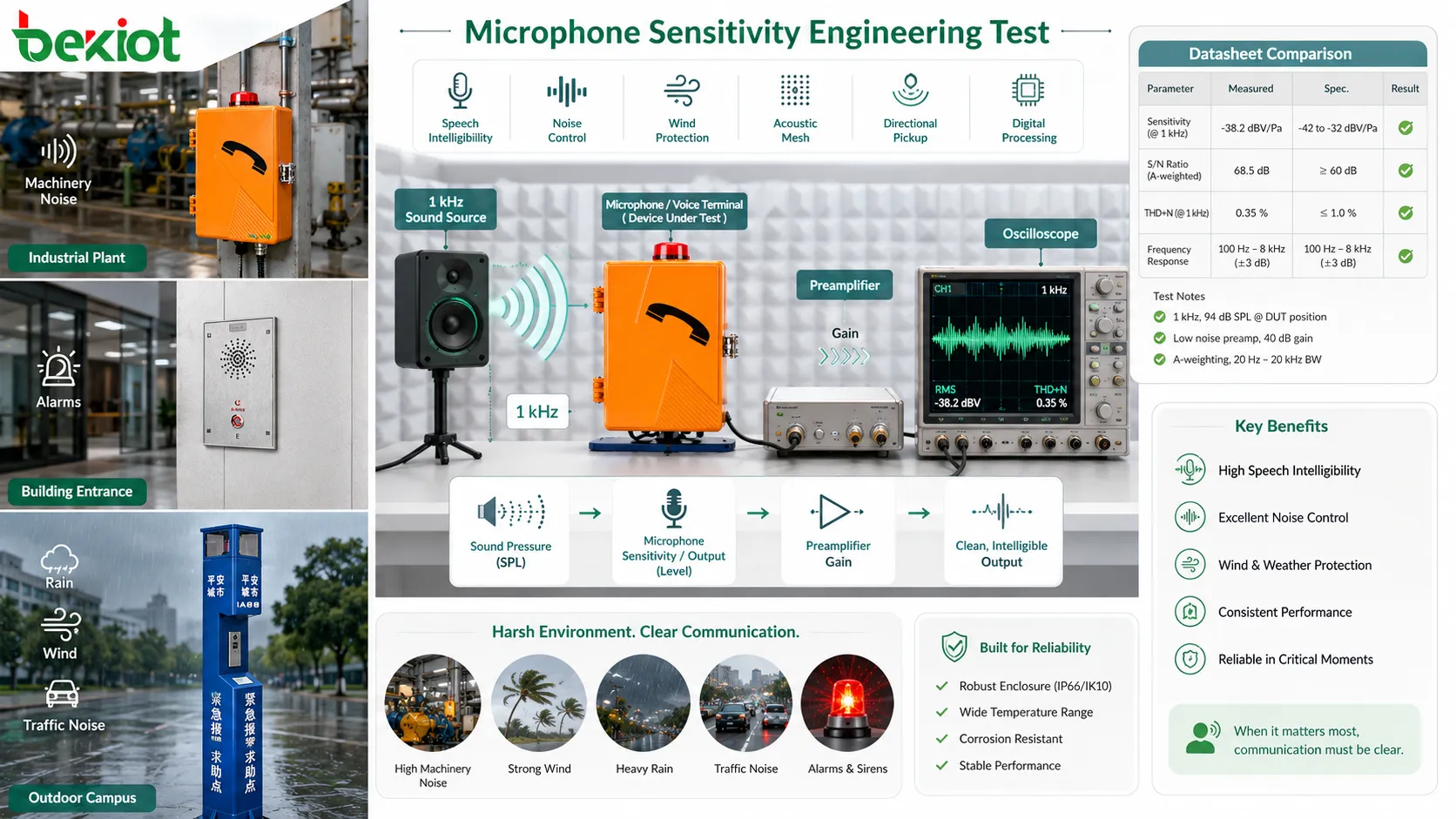
Industrial terminals, control panels, outdoor emergency points, and field devices may need to capture speech near machinery, wind, traffic, rain, or alarms. In these cases, environmental protection and noise control are as important as capsule output.
Designers may use wind screens, acoustic mesh, directional pickup, automatic gain control, or digital noise reduction to improve speech intelligibility.
Selection Logic for Product Design
Start with the expected sound source distance. A close-talk product, table microphone, wall terminal, and far-field voice assistant require different acoustic assumptions.
Next, review the ambient noise level. A quiet office, car cabin, outdoor gate, factory floor, and machine room will produce very different background conditions. A highly sensitive microphone in a noisy space may capture more unwanted sound unless other controls are used.
Then match the electronic chain. The microphone output should work well with the preamp input range, codec, ADC, bias voltage, power supply, impedance, and software gain. A mismatch can cause noise, clipping, or inconsistent volume.
Finally, test the assembled product rather than only the loose microphone capsule. Enclosure holes, membranes, mesh, gaskets, mounting position, vibration, water protection, and internal resonance can change the acoustic result.
Common Misunderstandings
Higher Value Does Not Always Mean Better Sound
A more sensitive microphone is not automatically better. It may make quiet speech easier to capture, but it may also increase the risk of overload, room noise pickup, wind noise, or handling noise if the design is not suitable.
Software Gain Cannot Fully Replace Proper Hardware Matching
Increasing digital gain after the signal has already entered the system can also amplify noise. Proper capsule selection and preamp design are more effective than relying only on software boost.
Datasheet Values Do Not Guarantee Final Product Performance
The final result depends on the entire product structure. A good microphone can perform poorly if the acoustic port is blocked, the enclosure causes resonance, or the microphone is placed near a vibration source.
Noise Cancellation Is Not the Same Parameter
Noise cancellation is a processing or design function, while sensitivity is an output response parameter. They interact, but they are not the same specification.
Testing and Maintenance Considerations
During product validation, engineers should test speech at different distances, angles, speaking volumes, and noise conditions. Real-world tests are essential because a laboratory value may not reveal how users actually speak into the device.
For deployed systems, microphone openings should remain clean and unobstructed. Dust, water films, tape, paint, protective films, insects, or damaged mesh can reduce pickup level and change frequency response.
In multi-microphone systems, channel balance should be checked when audio localization or beamforming performance becomes unstable. A failed or blocked microphone can degrade the whole array.
Microphone sensitivity should be treated as one part of the audio system design, not as a single number that determines sound quality by itself.
FAQ
Why does a microphone with high sensitivity still sound unclear?
Clarity may be limited by background noise, poor frequency response, enclosure blockage, echo, weak processing, incorrect gain, or bad placement rather than output level alone.
Can two microphones with the same sensitivity sound different?
Yes. Frequency response, noise level, directionality, distortion, capsule type, acoustic mounting, and processing can make them sound very different.
What happens if the input gain is set too high?
The audio may clip, distort, amplify noise, or trigger unstable automatic gain behavior. Gain should be adjusted according to real speech level and system headroom.
Is sensitivity more important for far-field pickup?
It is important, but far-field pickup also depends on microphone array design, room acoustics, noise reduction, beamforming, echo control, and speaker distance.
How should microphones be checked after long-term use?
Check for blocked openings, dust, moisture, loose wiring, damaged mesh, reduced level, noise increase, channel imbalance, and changes in speech clarity during real calls or recordings.







