In communication, security, video surveillance, emergency response, and smart facility projects, different devices and software platforms often need to work together. Cameras, intercom terminals, gateways, recording systems, dispatch platforms, phone systems, video management platforms, and business applications may come from different manufacturers. Without a common protocol, every connection becomes a custom interface, and every new project may require repeated development.
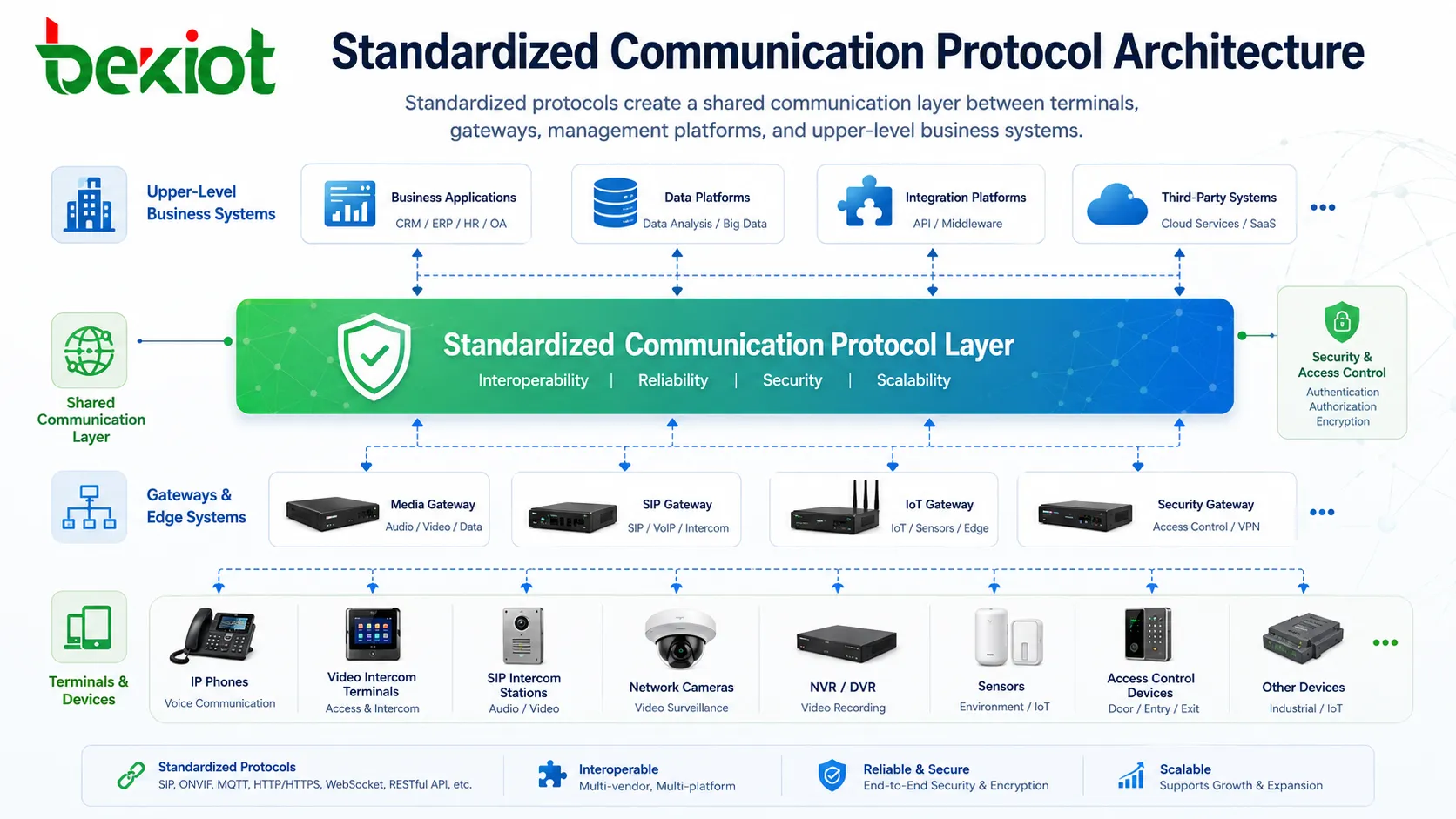
Standardized communication protocols solve this problem by giving devices and systems a shared language. When each side follows the same protocol rules, data transmission, signaling control, media exchange, device registration, and platform interaction become easier to manage. This is why protocols such as SIP and GB/T28181 are important not only for product compatibility, but also for long-term project scalability.
Integration Becomes Difficult When Every Vendor Uses Its Own Rules
Many devices are produced by different vendors, and each vendor may prefer to build its own private interface, data format, control logic, or software development kit. This may help the vendor protect its own ecosystem, but it creates obvious difficulties for project integrators and final users.
When a system depends heavily on private protocols or closed SDKs, every third-party platform must develop additional interfaces to connect with it. If the project later changes a device brand, adds a new subsystem, or connects to an upper-level platform, the original integration work may need to be modified again.
This creates several practical problems: higher development cost, longer debugging time, more uncertain delivery schedules, limited device replacement options, and more pressure on after-sales maintenance. For smart building, smart park, public safety, transportation, energy, industrial, and emergency command projects, these problems can directly affect project delivery and future expansion.
A Shared Language for Devices and Platforms
A communication protocol is a set of agreed rules. It defines how two or more systems exchange information, how a session is established, how data is transmitted, how control commands are sent, and how devices respond to each other.
When a protocol becomes widely accepted, it allows equipment from different manufacturers to work together under the same technical framework. A terminal can register to a system, a gateway can forward media streams, a platform can control a device, and an upper-level application can obtain the required information without rebuilding a different interface for each brand.
This is the real value of protocol standardization. It does not simply make a device easier to connect; it makes the whole project architecture more predictable. The project team can select equipment according to actual site requirements instead of being locked into a single closed ecosystem.
How SIP Changed Unified Communications
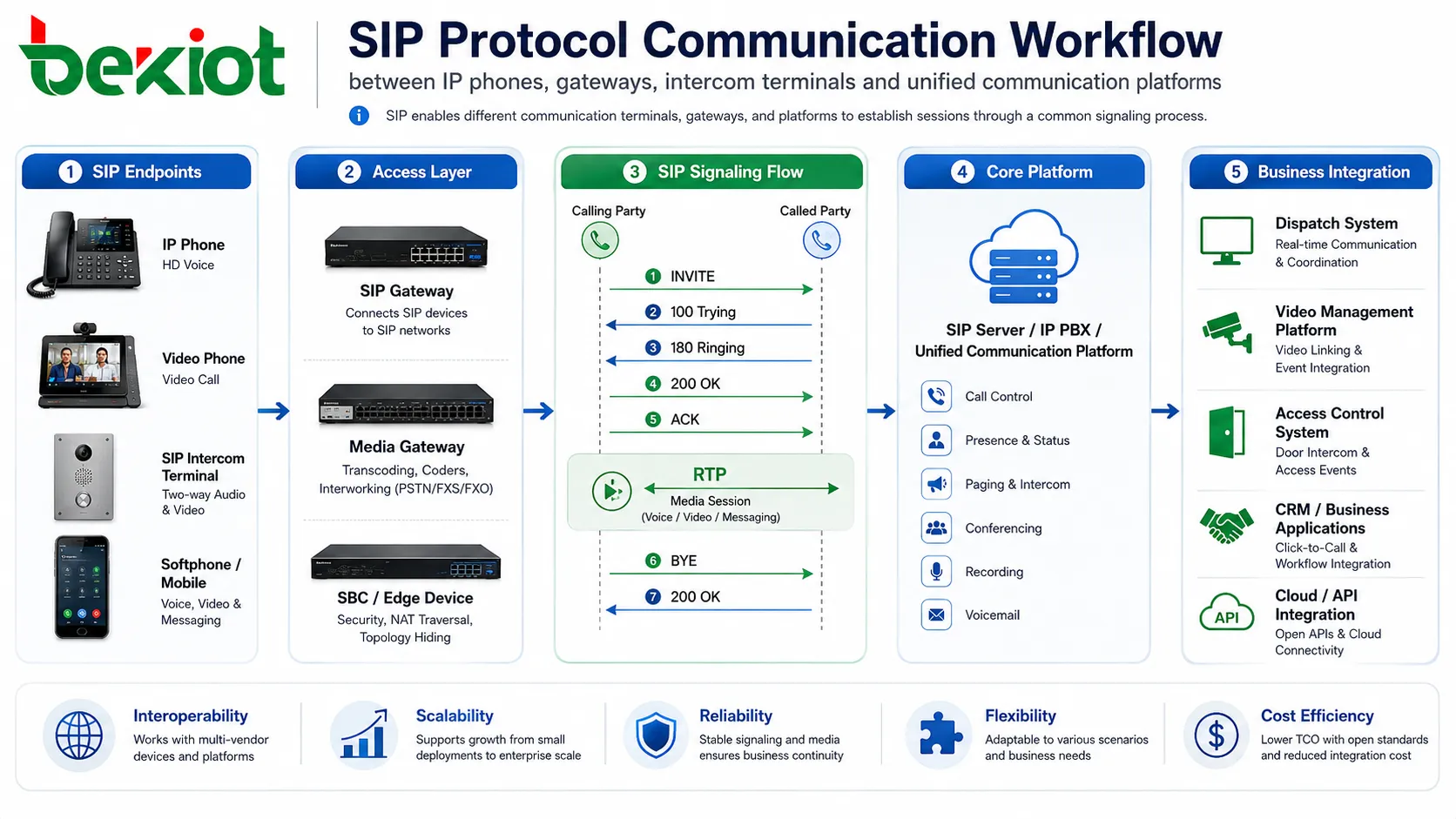
SIP, or Session Initiation Protocol, is one of the most successful standardized protocols in the communication field. It is a text-based and lightweight signaling protocol used to control multimedia communication sessions, including VoIP calls, video conferencing, instant messaging, presence, and other real-time communication services.
SIP was developed by the IETF and published as part of the RFC 3261 standard. Because it is open, flexible, and widely supported, SIP has become a key foundation for IP phone systems, SIP intercom terminals, voice gateways, dispatch systems, conference systems, and many other communication products.
In a SIP-based unified communication project, terminals, gateways, servers, and platforms from different manufacturers can often interconnect under the same signaling framework. This greatly simplifies project integration. A SIP phone can call another SIP endpoint. A SIP gateway can connect analog or broadcast resources to an IP system. A SIP intercom terminal can register to an IP PBX or dispatch platform and become part of a larger communication workflow.
This openness has helped the unified communication market grow rapidly. Instead of forcing every project to use a closed product family, SIP allows system designers to combine phones, intercoms, gateways, dispatch consoles, recording systems, and platform software more flexibly.
Video Surveillance Is Moving in the Same Direction
A similar trend is becoming more obvious in the video surveillance field. In the past, many video integration projects depended on private SDKs provided by camera or video platform manufacturers. This method could work in a single-vendor environment, but it often became difficult when multiple brands, multiple platforms, or upper-level business systems needed to be connected.
GB/T28181 addresses this challenge by providing a standardized technical framework for public security video surveillance networking systems. It is widely used for video access, transmission, exchange, control, and platform interconnection. Its design borrows important ideas from SIP, especially in device registration, signaling interaction, and platform-to-platform communication.
With GB/T28181, cameras, recorders, video platforms, gateways, and upper-level systems can communicate through a more open and standardized method. This reduces dependence on private SDKs and makes video resources easier to connect to smart city platforms, smart park systems, emergency command centers, smart campus platforms, smart water systems, smart power systems, and other business applications.
Why the 2022 Version Is Important
The GB/T28181-2022 version has already been released and applied in video networking projects. Compared with earlier versions, it further improves video management and video coding capabilities, and provides more detailed definitions and descriptions for video surveillance functions.
This is important because video integration is no longer limited to watching live images. Modern projects often require live viewing, recording retrieval, platform cascading, device control, media forwarding, alarm linkage, stream conversion, and interaction with business systems. A clearer standard helps these functions become easier to define, test, and deliver.
As the standard continues to be adopted, the space for purely private SDK integration will become narrower. Project owners and integrators will increasingly prefer solutions that follow standard protocols because they are easier to expand, easier to maintain, and less dependent on one manufacturer.
Gateways Help Connect Old and New Systems
In real projects, it is not always possible to replace every device at once. A site may already have cameras, recorders, monitoring platforms, intercom terminals, audio systems, or third-party business platforms. Some devices may support standard protocols directly, while others may require protocol conversion or media adaptation.
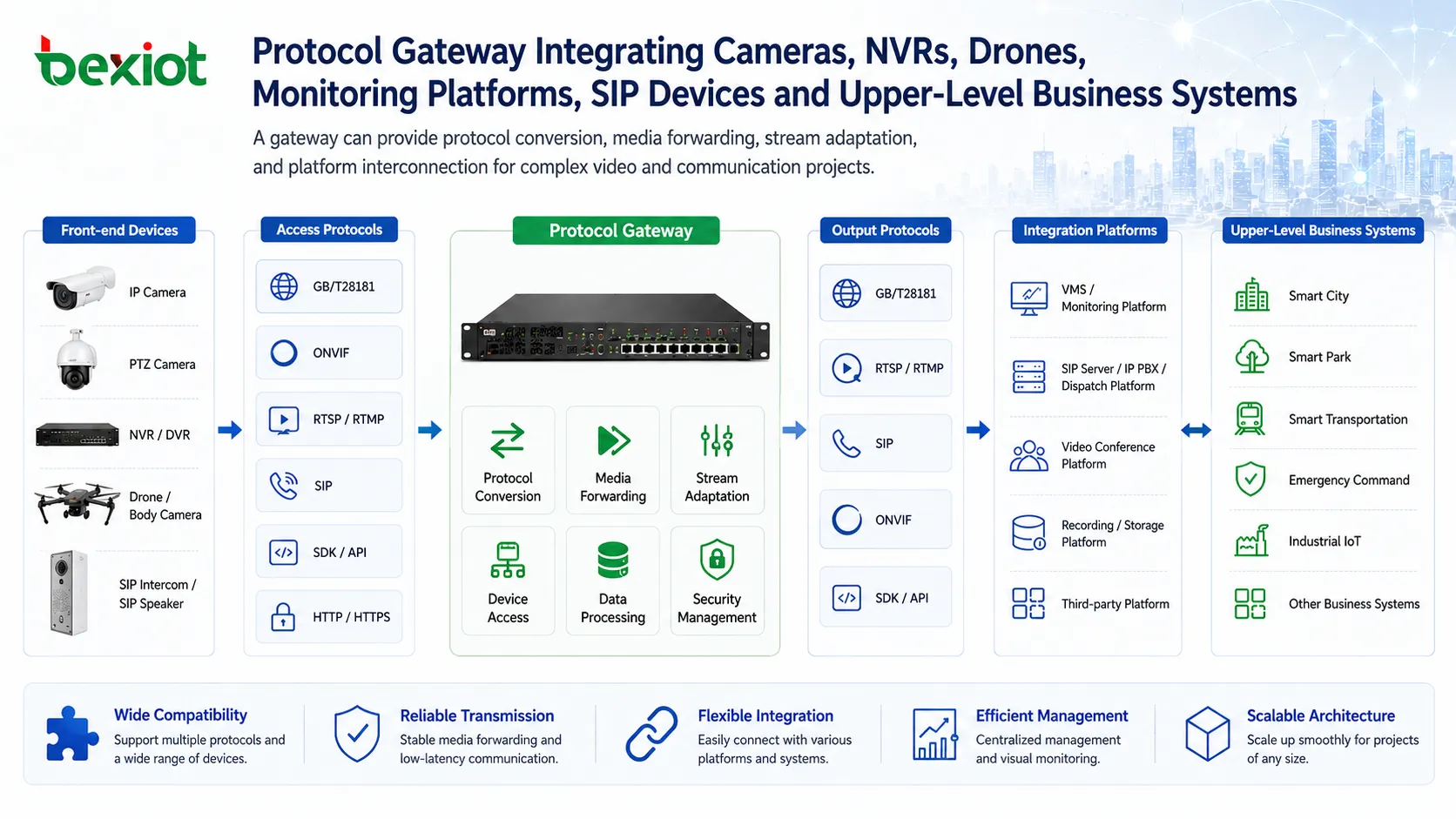
This is where a gateway becomes useful. A protocol gateway can connect different access devices and convert signaling, media streams, or platform interfaces when needed. In video projects, a gateway may support GB/T28181, ONVIF, RTSP, RTMP, SIP, WebRTC, FLV, HLS, SDK access, media forwarding, transcoding, and protocol conversion depending on the system design.
By using a gateway layer, video resources and communication resources can be integrated into one manageable architecture. Cameras, NVRs, vehicle-mounted devices, recorders, drones, monitoring platforms, intercom terminals, and upper-level applications can be connected more efficiently. The project team can avoid developing a completely new interface for every device type.
Reducing Delivery Risk in Smart Projects
Smart projects usually involve many subsystems. A smart park may include video surveillance, access control, visitor management, intercom, broadcasting, emergency alarms, IoT sensors, parking, and operation dashboards. A smart building may include security, elevators, fire systems, energy management, communication systems, and command platforms.
If every subsystem uses a private interface, integration becomes a long chain of custom development. Any device replacement or version upgrade may affect the whole project. This increases project risk and makes future maintenance more expensive.
Standardized protocols reduce this risk. They allow different systems to communicate through widely accepted rules. They also make project acceptance easier because functions such as registration, stream access, call control, playback, device status, and platform interconnection can be tested according to clearer technical expectations.
Better Scalability for Future Expansion
A project should not only meet today’s requirements. It should also leave room for future system expansion. New cameras may be added. More intercom terminals may be installed. A higher-level command platform may need access to existing video resources. A business system may need to obtain live streams or alarm information.
When the original architecture follows standard protocols, these future changes become easier. The system can add compatible devices, connect to new platforms, and expand to more sites with less repeated development. This improves the total value of the project over its full life cycle.
For final users, this also means more freedom in equipment selection. They are not forced to rely on a single brand for every future upgrade. They can choose devices and platforms based on performance, price, project requirements, and service capability, as long as the selected products follow the required standards.
What to Consider During Early Planning
Standard protocol compatibility should be considered at the beginning of the project, not after the system has already been built. During design, the project team should confirm which protocols are required, which functions must be supported, and which systems need to communicate with each other.
For communication projects, SIP compatibility, account registration, call routing, codec support, recording, dispatch integration, and platform interconnection should be reviewed. For video projects, GB/T28181, ONVIF, RTSP, stream format, playback, PTZ control, alarm upload, cascading, and media forwarding should be checked carefully.
The team should also confirm whether the system only needs basic access or requires deeper business integration. Basic access may only require live video or voice calls. Advanced projects may require API interaction, event linkage, GIS display, command scheduling, data reporting, and multi-platform coordination.
Conclusion
Standardized communication protocols are important bridges between devices, systems, and platforms. They reduce dependence on private interfaces, lower integration difficulty, shorten project delivery cycles, and improve long-term scalability.
SIP has already proved the value of standardization in unified communications. GB/T28181 is playing a similar role in video surveillance networking and smart video integration. Together with protocol gateways, media conversion, and platform interconnection, these standards help build more open, flexible, and future-ready system architectures.
For smart building, smart park, smart fire protection, emergency command, public safety, industrial communication, and digital transformation projects, choosing standard-compatible devices and platforms from the early planning stage is not only a technical decision. It is a way to protect project investment and keep the system ready for future expansion.
FAQ
Can a project use both standard protocols and private SDKs?
Yes. Some projects may still need private SDKs for special functions. However, basic access and core interconnection should preferably rely on standard protocols to reduce long-term integration risk.
Does protocol compatibility guarantee full function compatibility?
Not always. A device may support a protocol but only implement part of its functions. Project testing should confirm registration, media access, control commands, playback, alarm reporting, and other required features.
Why do many platforms still keep private interfaces?
Private interfaces may support vendor-specific functions, advanced configuration, or special business logic. They can be useful, but they should not replace standard protocol support in open integration projects.
How should a project team verify protocol support?
The team should review technical documents, check protocol versions, test real device registration, verify media streams, confirm command response, and complete platform-to-platform connection tests before final acceptance.
Are standardized protocols only useful for large projects?
No. Even small projects benefit from standard protocols because they make device replacement, system expansion, troubleshooting, and future upgrades easier.