


Emergency communication is not supported by a single technology. In real disaster response, field rescue, public safety, industrial emergency, and command dispatch scenarios, communication resources are usually built across three working environments: space, air, and ground. Each layer has different physical conditions, equipment types, coverage capabilities, and deployment value.
A practical emergency communication solution should not simply list devices. It should explain which network layer is used, what type of communication capability it provides, and how it supports voice, data, video, positioning, command, and coordination when normal infrastructure is damaged, congested, or unavailable.
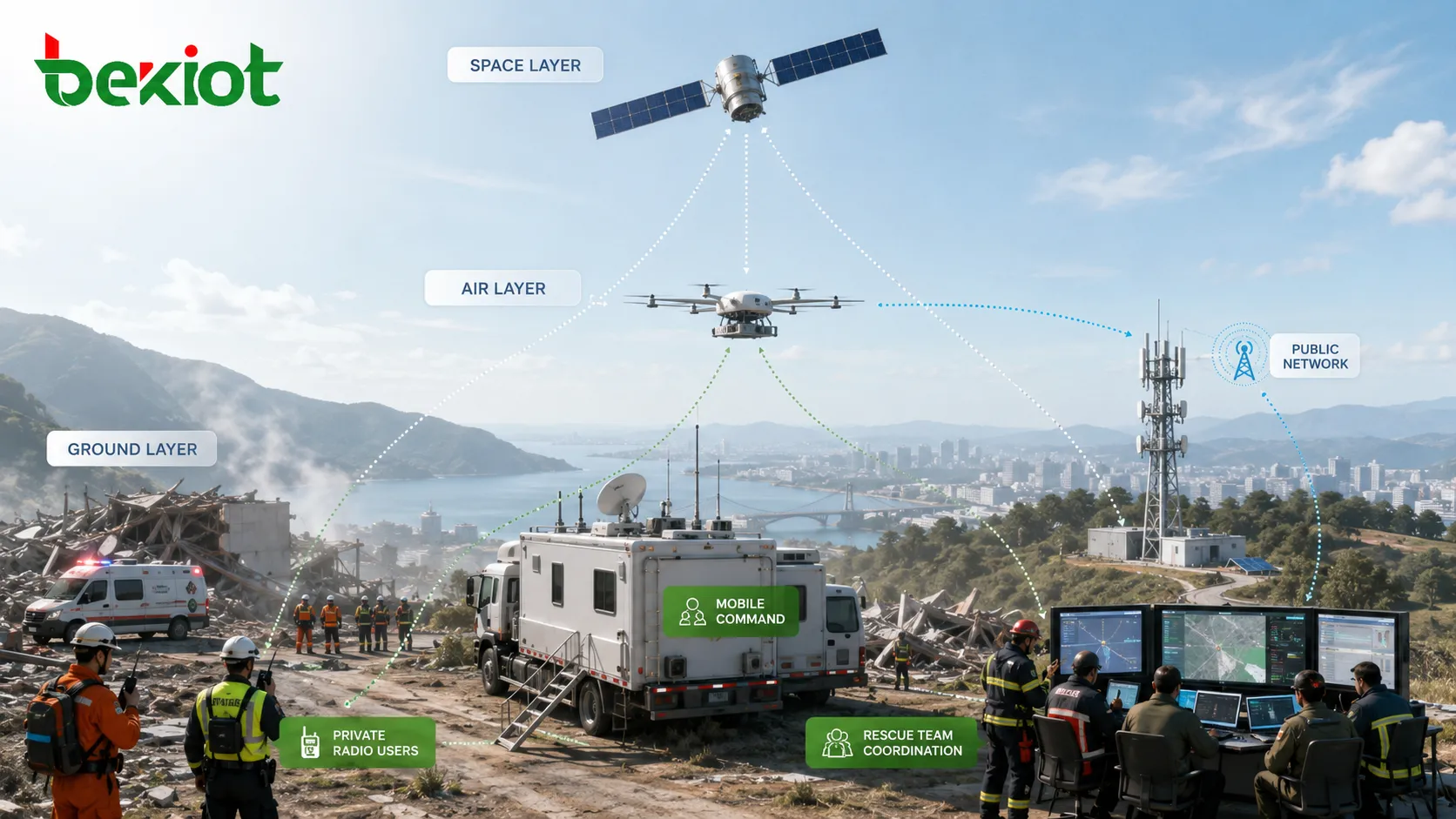
A Layered View of Emergency Networks
The space-air-ground model divides emergency communication resources according to their operating environment. The space layer refers to communication resources outside the earth’s atmosphere, mainly satellite communication systems. The air layer refers to communication equipment carried by aircraft, drones, helicopters, airships, or balloons inside the atmosphere. The ground layer includes fixed, mobile, wired, and wireless equipment operating on the earth’s surface.
This layered view is useful because emergency sites are unpredictable. A flood may interrupt fiber. An earthquake may damage base stations. A forest fire may occur far away from public network coverage. A tunnel, mine, or underground facility may block ordinary radio signals. No single system can solve all these situations.
By understanding the role of each layer, project teams can choose the right combination of satellite terminals, airborne communication nodes, mobile command vehicles, private radio systems, broadband mesh devices, fiber access, public networks, sensors, and dispatch platforms.
Space-Based Links for Baseline Connectivity
In emergency communication, the space layer mainly refers to satellite communication. Satellite systems are valuable because they are less affected by ground disasters. When terrestrial networks are damaged or unavailable, satellite communication can provide a basic connection for voice calls, internet access, command reporting, and data transmission.
Typical satellite resources include satellite phones, high-throughput satellite terminals, and low-earth-orbit satellite internet systems. Satellite phones are mainly used for voice communication and basic messaging. High-throughput satellite terminals can provide stronger data access for emergency command vehicles, temporary sites, rescue camps, and field headquarters. Low-earth-orbit satellite systems are increasingly used for faster and more flexible broadband access in remote areas.
For example, a field rescue team may use satellite phones for basic voice backup, a vehicle-mounted satellite terminal for command center internet access, and a portable satellite broadband device for data sharing and video return. These systems do not replace ground networks, but they provide an important “last guarantee” when other links fail.
Airborne Coverage for Rapid Restoration
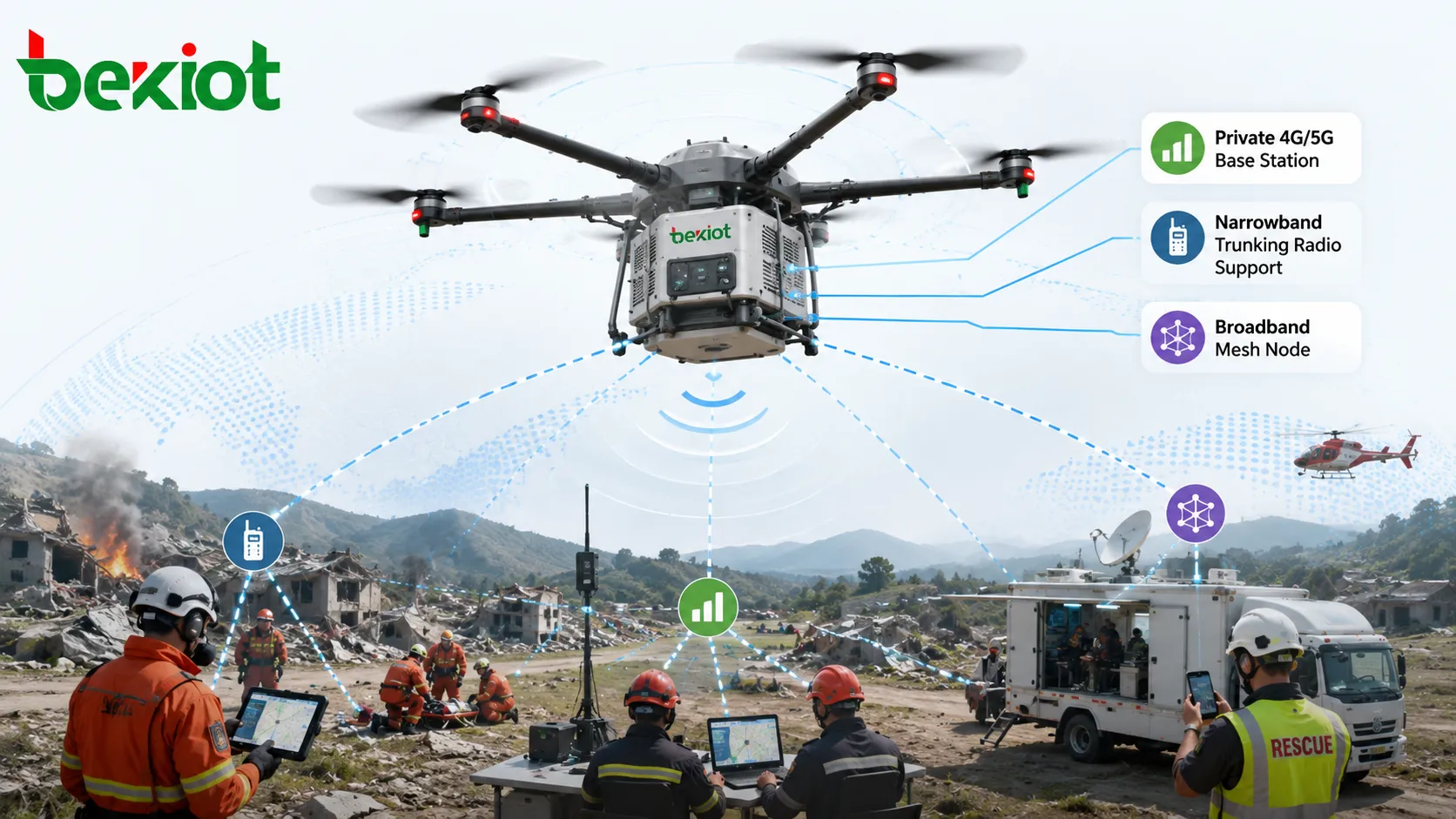
The air layer uses aircraft-based platforms to carry communication payloads. Drones, helicopters, airships, and tethered balloons can lift communication equipment above obstacles and provide wider temporary coverage. This is especially useful when ground infrastructure is damaged or when the rescue area has complex terrain.
Common applications include drones carrying private 4G or 5G base stations, drones carrying narrowband trunking base stations, and drones carrying broadband mesh communication devices. These systems can quickly restore field communication for rescue teams, mobile command posts, temporary shelters, disaster zones, and large outdoor emergency sites.
Airborne communication has a clear technical advantage: height improves coverage. Wireless communication is affected by transmit power, terrain blocking, building obstruction, antenna height, and propagation conditions. When communication equipment is lifted into the air, the line-of-sight condition improves and the coverage area can expand significantly.
Ground Systems for Daily Operation and Field Response
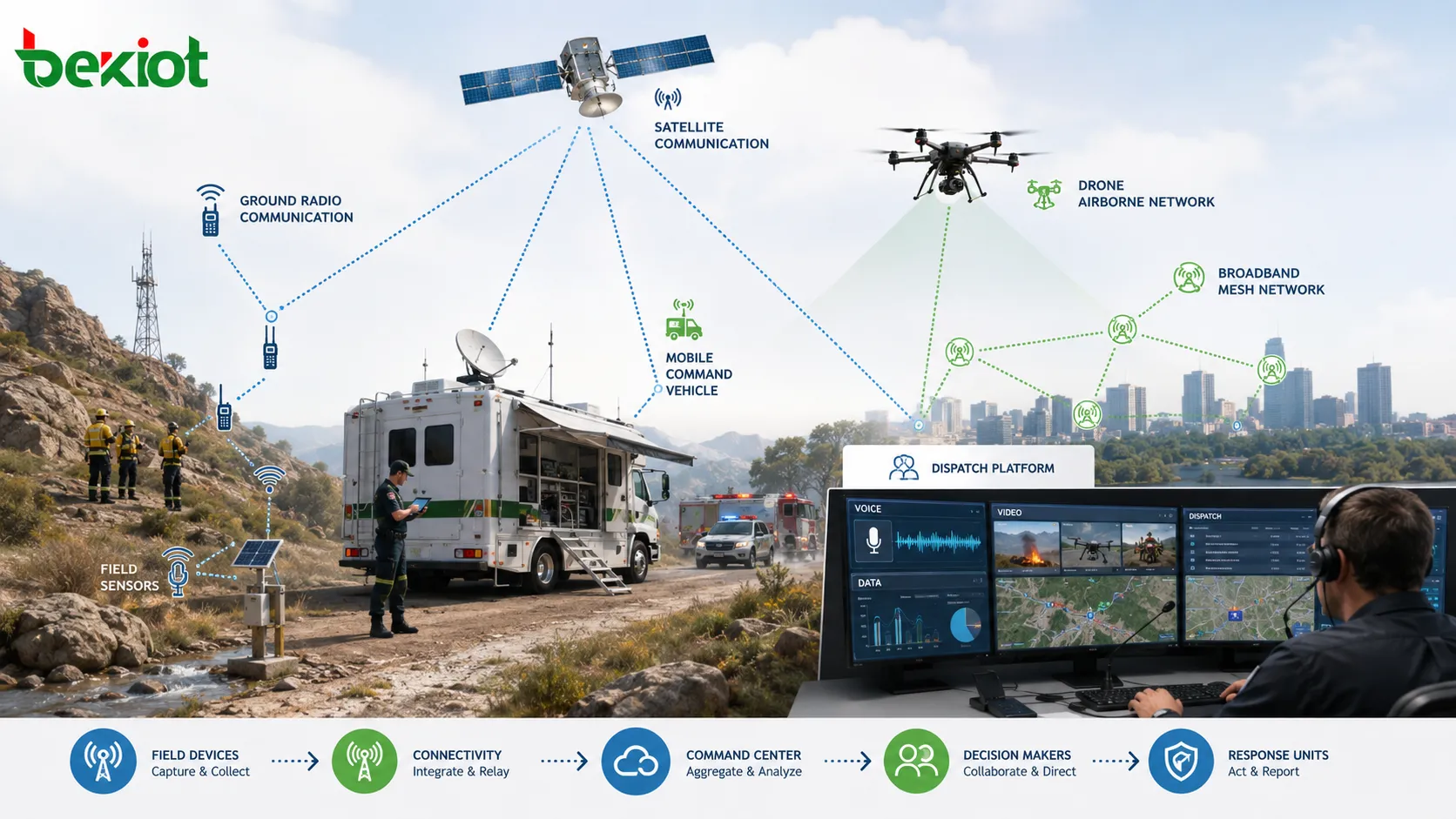
The ground layer contains the largest number of emergency communication devices. It includes public telephone networks, mobile public networks, private 5G networks, narrowband trunking radio, shortwave communication, microwave links, broadband mesh networks, optical fiber, wireless IoT sensors, emergency command vehicles, and emergency communication vehicles.
Although many wireless signals travel through the air as electromagnetic waves, the main equipment is still installed or operated on the ground. Therefore, these resources are usually treated as ground-layer systems in emergency communication planning.
Ground systems are the foundation of most emergency communication projects. They support routine communication, local command, mobile response, radio dispatch, video transmission, sensor data collection, and connection with government, enterprise, industrial, transportation, and public safety platforms.
Broadband and Narrowband Planning
Ground-layer equipment can often be divided into broadband and narrowband communication resources. Broadband systems are selected when the project needs video return, map sharing, data access, file transfer, remote monitoring, image transmission, or command platform interaction. Narrowband systems are selected when the main requirement is reliable voice communication, group calling, dispatch talkback, or low-rate signaling.
For example, broadband mesh equipment may be used for emergency video backhaul, temporary site networking, mobile command vehicle access, and drone video return. Narrowband trunking radio or VHF/UHF systems may be used for field voice coordination, patrol communication, rescue team grouping, and dispatch command.
In many real projects, both types are needed. Broadband supports visualized command and information sharing, while narrowband supports stable voice coordination. A balanced solution should not choose only one side unless the application is very simple.
| Network Layer | Typical Technologies | Main Capability | Common Use Cases |
|---|---|---|---|
| Space layer | Satellite phone, high-throughput satellite, low-earth-orbit satellite internet | Backup voice, internet access, long-distance emergency connectivity | Remote rescue, disaster backup, field command, isolated area communication |
| Air layer | Drone base station, airborne private 4G/5G, narrowband trunking payload, airborne mesh node | Rapid temporary coverage and area communication restoration | Earthquake site, flood rescue, forest fire, large outdoor emergency scene |
| Ground layer | Public network, private radio, private 5G, shortwave, microwave, fiber, mesh, command vehicle | Routine operation, field dispatch, video return, sensor access, command coordination | Command center, mobile response, industrial site, urban emergency, transport hub |
Special Environments Below the Surface
Emergency communication may also involve underwater and underground environments. These scenarios are technically difficult because electromagnetic waves face severe attenuation, reflection, refraction, absorption, and interference in water, soil, rock, tunnels, and mine structures.
Underwater communication may require acoustic communication, special cable systems, underwater sensors, or dedicated low-frequency methods. Underground communication may require leaky feeder systems, mine communication systems, through-the-earth communication, wired backup links, or carefully designed radio relay networks.
These special environments should not be treated as ordinary ground communication scenarios. Engineers need to evaluate the medium, distance, obstruction, safety requirements, power supply, and emergency workflow before selecting equipment.
How to Build a Practical Solution
A complete emergency communication plan should start from the operating environment. The first question is where the emergency may occur: open field, city area, mountain, forest, tunnel, underground space, industrial plant, coastal area, or remote site. The second question is what must be transmitted: voice, video, data, location, alarm, sensor information, or command instructions.
After these requirements are clear, the solution can combine multiple layers. Satellite communication can provide backup connectivity. Drone-based systems can restore temporary coverage. Ground systems can support local dispatch, broadband access, radio communication, video backhaul, and command vehicle operation.
Becke Telcom can be lightly considered in projects that require converged communication, SIP dispatch, radio integration, emergency call points, broadcast linkage, and command platform connectivity. The main design principle is to connect different communication resources into a usable emergency workflow rather than deploying isolated devices.
Deployment Considerations for Engineers
Engineers should evaluate coverage range, terrain conditions, backhaul path, power supply, equipment mobility, environmental protection, antenna height, spectrum resources, network security, and compatibility with existing command platforms. Emergency communication is not only a device procurement task. It is a system engineering task.
Power backup is especially important. Communication equipment may work in areas where the power grid is damaged. Portable batteries, vehicle power, generator power, solar backup, and power management should be considered during planning.
Interoperability is also critical. Satellite terminals, radio systems, broadband mesh nodes, private 5G, public networks, command vehicles, sensors, and dispatch platforms should be connected through proper gateways, protocols, and operating procedures. Otherwise, each subsystem may work alone but fail to support coordinated command.
Application Scenarios
Space-air-ground emergency communication is suitable for earthquake rescue, flood control, forest fire response, urban emergency management, chemical park emergency response, transportation accidents, power grid repair, border and remote area support, maritime rescue, mining rescue, and large-scale public events.
Different scenarios require different priorities. Forest fire operations may need airborne coverage, satellite backup, and narrowband voice dispatch. Urban disaster response may need command vehicles, public network fallback, video access, and temporary broadband mesh. Remote mountain rescue may rely heavily on satellite communication and portable field networking.
The solution should therefore be modular. Teams can choose space-based, air-based, and ground-based resources according to the mission instead of building one fixed structure for all emergencies.
Conclusion
Emergency communication under a space-air-ground model is a multi-layer communication system. The space layer provides satellite-based backup and long-distance connectivity. The air layer uses drones, helicopters, airships, and balloons to quickly restore coverage. The ground layer provides the widest range of daily and field communication resources, including public networks, private radio, broadband mesh, shortwave, microwave, fiber, sensors, and command vehicles.
The most effective emergency communication solution is not built from one technology alone. It should match the real environment, select suitable broadband and narrowband resources, prepare backup links, and connect all communication tools into a coordinated command workflow. Only then can the system support reliable voice, video, data, and dispatch communication when ordinary infrastructure is unavailable.
FAQ
How should emergency teams decide which communication layer to use first?
The first choice should depend on the site condition. If ground infrastructure is available, ground systems are usually the fastest to use. If ground networks are damaged or unavailable, satellite links and airborne coverage should be added quickly to restore command connectivity.
Can drone communication replace satellite communication?
No. Drone systems are useful for temporary regional coverage, but they still need backhaul, power, payload capacity, and flight management. Satellite communication is better for long-distance backup connectivity when no ground or airborne backhaul is available.
Why are narrowband systems still important when broadband networks are available?
Narrowband systems are often more suitable for simple, stable, group-based voice dispatch. They usually require less bandwidth and can be easier to operate in field response. Broadband is stronger for video and data, but voice coordination still needs a reliable narrowband or voice-priority channel.
What should be prepared for long-duration emergency communication?
Long-duration response requires spare batteries, vehicle power, charging stations, generators, backup antennas, replacement cables, equipment protection cases, user training, and clear frequency or network management procedures.
How can different emergency communication systems work together?
Different systems can be connected through dispatch platforms, radio gateways, SIP gateways, video access gateways, data interfaces, and unified operating procedures. The goal is to avoid isolated islands and let field users, command centers, vehicles, sensors, and external agencies exchange information through a coordinated platform.







