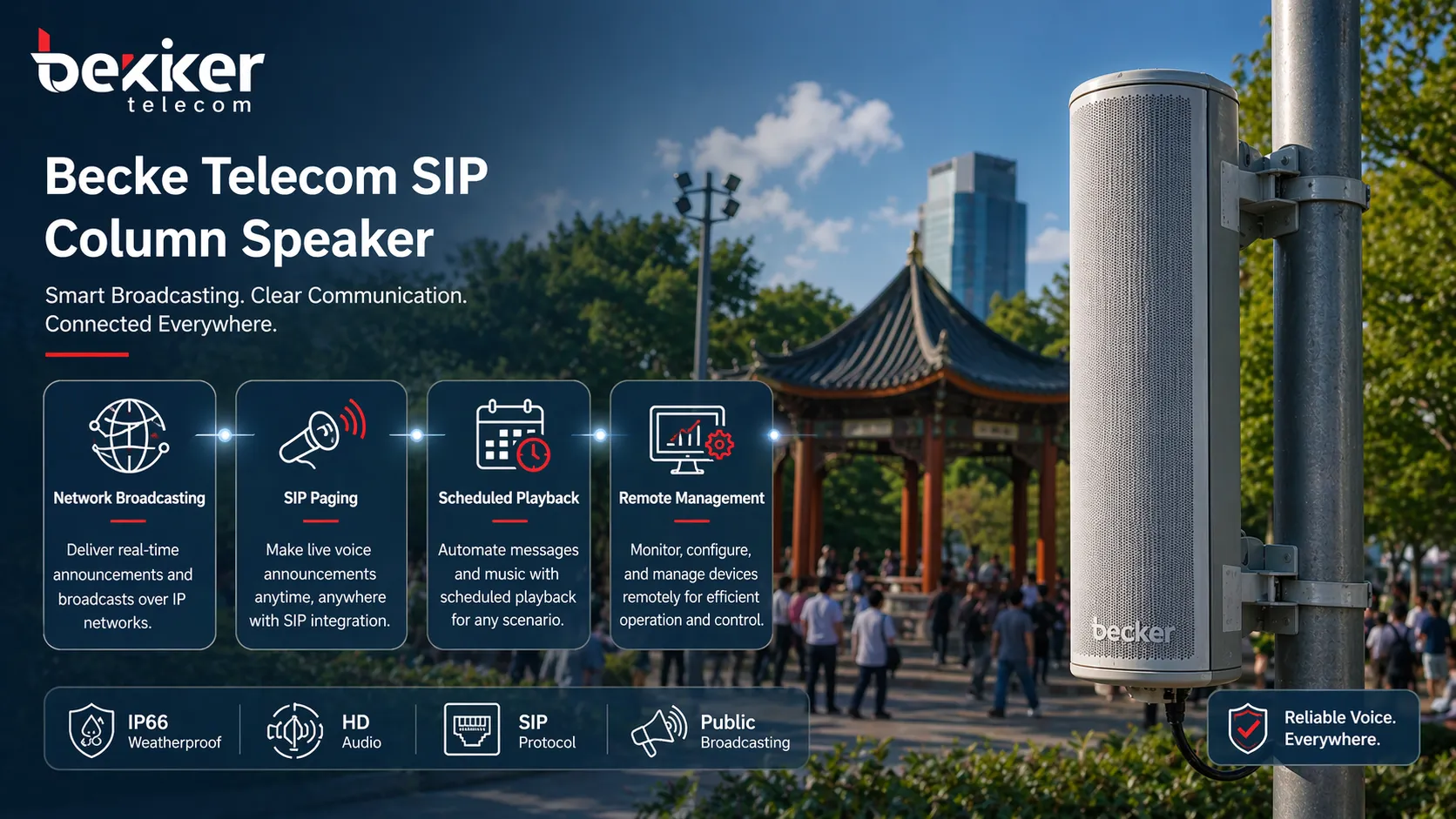
A SIP column speaker is an IP-based audio endpoint designed to receive audio over the network and deliver clear, amplified sound in real time. At Becke Telcom, we position the SIP column speaker as more than a simple broadcast device. It is a practical part of a modern communication infrastructure that connects paging, public address, scheduling, safety notification, and operational coordination on one IP network.
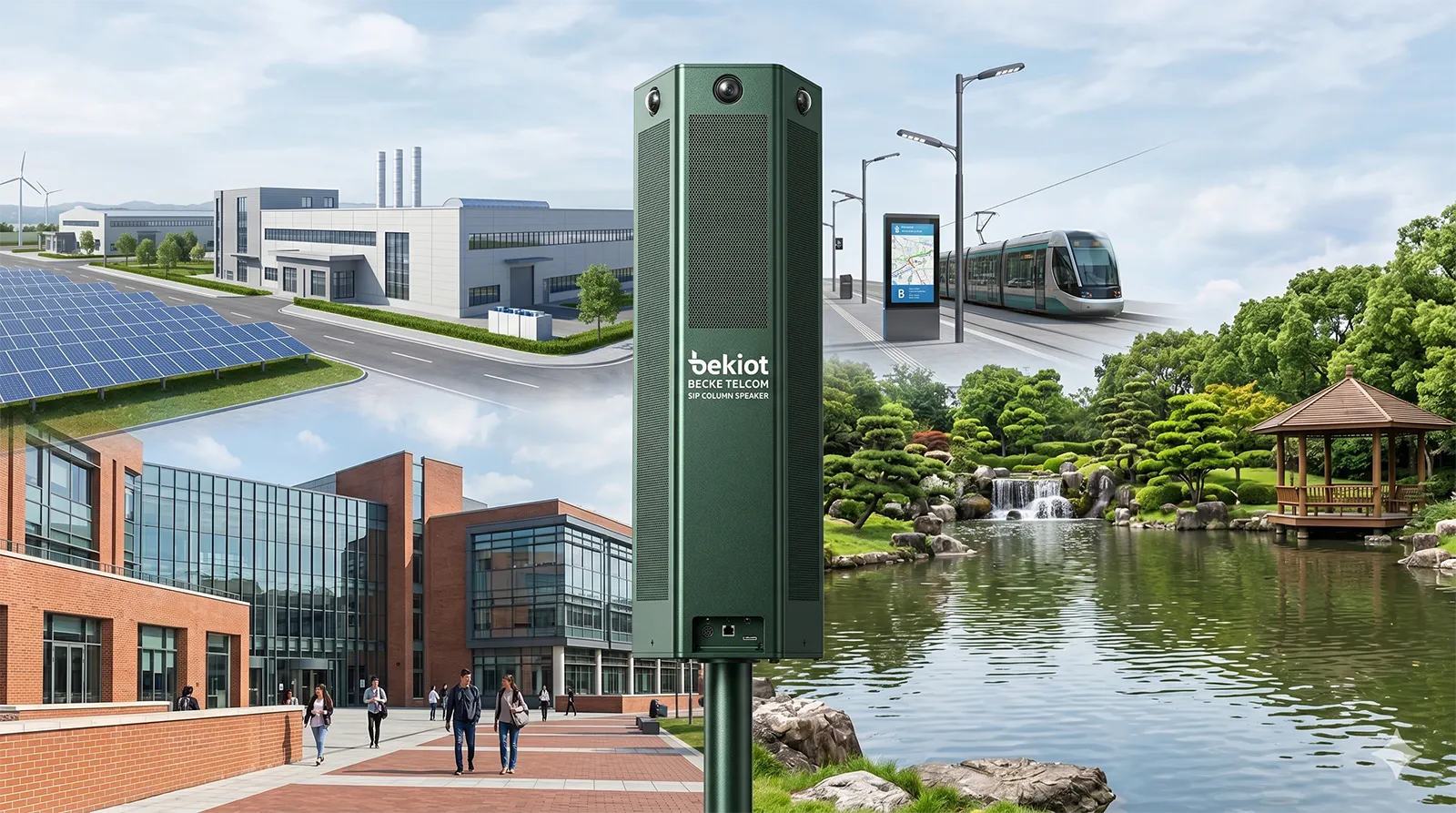
Built on the standard SIP protocol, Becke Telcom SIP column speaker solutions can work with SIP servers, IP PBX platforms, visual paging consoles, dispatch systems, intercom devices, and other IP audio endpoints. The result is a flexible and scalable broadcast architecture for smart campuses, public spaces, scenic areas, industrial sites, office parks, and smart city applications.
What Is a SIP Column Speaker?
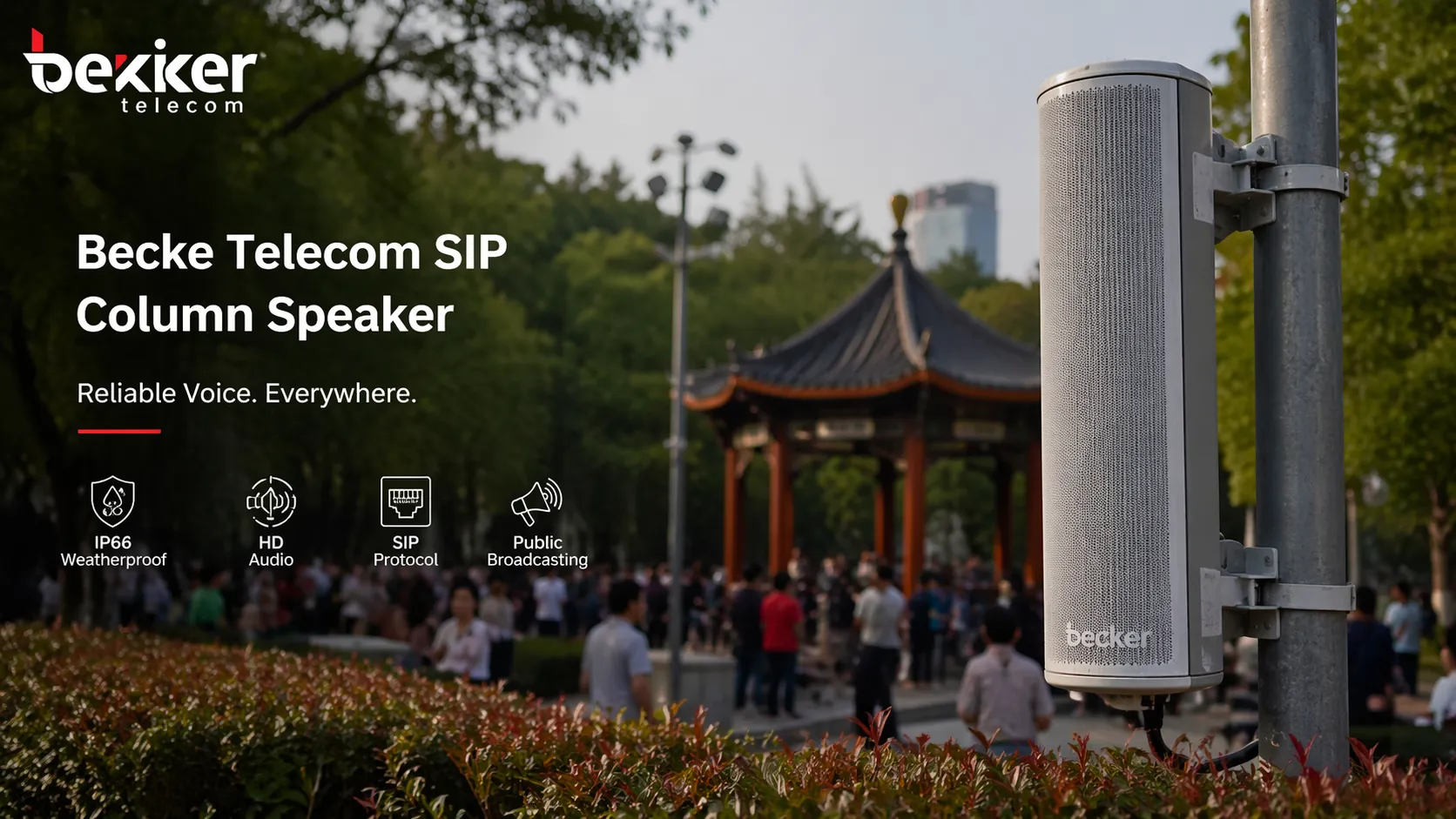
A SIP column speaker is a network audio device that registers to a SIP platform and plays live or scheduled audio through its built-in amplifier and speaker system. Unlike conventional analog broadcasting equipment, it can be integrated into a broader IP communication environment, making deployment more flexible and long-term management more efficient.
In real projects, SIP column speakers are commonly used for background music, routine announcements, zone paging, timed broadcasts, warning messages, and emergency instructions. Because they are part of an IP architecture, they can also be managed together with intercom, telephony, video, and dispatch resources.
At Becke Telcom, we see the SIP column speaker as an important bridge between voice communication and public audio delivery. It allows customers to move from isolated audio playback to a more connected, controllable, and service-oriented broadcast platform.
Becke Telcom SIP column speakers are designed to turn everyday audio delivery into a reliable part of your communication, safety, and operations strategy.
Core Functions of a Becke Telcom SIP Column Speaker
IP Audio Playback Over the Network
The core function of a SIP column speaker is network audio playback. Audio streams can be delivered from a SIP server, IP PBX, paging terminal, dispatch console, or broadcast management platform to one endpoint, a selected group, or a full network of speakers.
This makes the device suitable for routine announcements, public information, scheduled messages, operational notices, and background audio. Compared with traditional analog public address systems, network-based delivery provides greater deployment freedom and supports expansion without the same level of cabling limitations.
SIP Paging, One-Way Intercom, and Multicast Broadcasting
Becke Telcom SIP column speaker solutions support SIP paging and multicast audio distribution when integrated with compatible SIP platforms and terminals. This gives operators a practical way to deliver voice messages quickly to a single zone or multiple areas at the same time.
For projects that require frequent live announcements, such as campuses, parks, factories, or commercial properties, this function improves communication speed and simplifies operations. Multicast support is also valuable for large-area synchronized broadcasting where the same message must reach many endpoints efficiently.
Built-In Amplification for Simplified Deployment
A SIP column speaker typically includes a built-in amplifier, allowing the device to receive network audio and output sound directly without relying on a separate external amplifier in many standard deployments. This helps reduce system complexity and makes installation more straightforward.
For customers planning distributed audio coverage across multiple buildings or outdoor zones, this kind of integrated design can reduce wiring requirements, improve deployment speed, and simplify maintenance over time.
Remote and Local Volume Adjustment
Volume control is an essential part of practical broadcast management. Becke Telcom SIP column speaker systems can support remote adjustment from the platform side, allowing operators to manage output levels according to time, area, event type, or operational need.
This is useful in environments where broadcast needs change throughout the day. A lower level may be used for routine background music, while higher priority output may be required for emergency notifications, shift changes, or operational alerts.
Flexible Connectivity, Including 4G in Some Deployments
In some projects, especially those in remote or infrastructure-limited environments, flexible network access is critical. Advanced SIP broadcast deployments may support 4G connectivity in addition to wired Ethernet access, giving users more options for outdoor or temporary installations.
This is especially valuable in scenic areas, open public zones, roadside applications, project sites, and other locations where fixed cabling is difficult or expensive. Becke Telcom focuses on practical deployment logic, helping customers choose the right architecture for both permanent and evolving environments.
Device Identification and Easier Maintenance
Features such as IP address voice prompts and clear device naming help simplify installation and maintenance. In larger projects with many distributed endpoints, technicians need efficient ways to identify, confirm, and manage field devices without confusion.
This may sound like a small feature, but in real deployment work it improves commissioning speed, reduces setup errors, and makes long-term maintenance more efficient.
Outdoor-Ready Design for Harsh Environments
Many SIP column speaker applications are not limited to indoor use. Parks, public squares, scenic spots, campuses, industrial yards, and road-adjacent areas often require audio endpoints that can operate in more challenging conditions.
This is why outdoor durability matters. Becke Telcom focuses on solutions that are built for real operating environments, where weather resistance, dependable performance, and consistent audio projection are all part of long-term system value.
Where SIP Column Speakers Are Commonly Used
Commercial Buildings, Malls, and Hotels
In commercial environments, SIP column speakers are used for background music, public information, promotional messages, and operational notifications. They can help properties create a more professional visitor experience while also giving staff a practical communication tool.
When integrated with SIP phones or control terminals, managers can send live announcements to specific areas, deliver time-based messages, or handle urgent communication without needing a separate legacy paging infrastructure.
Schools and Educational Campuses
Education is one of the most practical use cases for SIP column speakers. Schools often need a mix of routine and urgent audio functions, including class bells, public announcements, listening exercises, event notices, and emergency instructions.
Because devices can be grouped by building, floor, grade, or function area, campus staff can manage broadcasts with much greater precision. This supports both daily campus operation and emergency response planning.
Office Parks and Enterprise Campuses
In office and industrial park settings, SIP column speakers can be used to deliver notices, safety guidance, visitor information, and daily operational communication. They also support a more unified communication experience when integrated into a broader SIP system that may include phones, intercoms, paging consoles, and dispatch software.
Becke Telcom emphasizes unified communication value, and the SIP column speaker fits naturally into that strategy by extending network-based voice communication into public and semi-public audio zones.
Parks, Scenic Areas, and Outdoor Attractions
Scenic areas and public recreational spaces often need reliable, centrally managed audio coverage across outdoor paths, entrances, open plazas, and visitor service zones. SIP column speakers are well suited for these scenarios because they combine network flexibility with strong site-wide message delivery.
They can be used for background music, attraction introductions, public notices, safety reminders, route guidance, seasonal messages, and emergency alerts. For smart scenic area projects, they can also work as part of a broader IP-based visitor service and security framework.
Factories, Warehouses, and Industrial Facilities
Industrial environments require fast and reliable audio communication for shift notices, process coordination, safety instructions, and emergency evacuation guidance. SIP column speakers support these needs by providing IP-based audio endpoints that can be centrally managed and integrated into broader site communication systems.
For Becke Telcom customers, this is especially important because many industrial communication projects require not just playback, but operational integration with intercom, broadcast, telephony, and incident response workflows.
Smart City and Public Infrastructure Projects
In smart city projects, SIP column speakers can support public information delivery, area broadcasting, guidance announcements, and emergency communication. Their value grows when they are deployed as part of a unified IP architecture connected to monitoring, dispatch, help points, and control center resources.
Becke Telcom solutions are designed around this idea of communication convergence. Audio should not remain isolated. It should work together with the wider operational platform.
How a SIP Column Speaker Is Configured and Managed
Network Setup
The first step is to configure the device with the correct IP address, subnet mask, gateway, and network parameters. Once connected to the network, the speaker becomes part of the customer's IP audio environment and can be discovered, grouped, and managed.
In many projects, static addressing is preferred because it makes maintenance and endpoint identification easier, especially in distributed or security-sensitive environments.
SIP Registration
SIP settings usually include the server address, user account, authentication password, and related communication parameters. Once the device is successfully registered, it can receive SIP paging calls, multicast streams, and other platform-controlled audio tasks.
This registration process is what turns the speaker into a managed communication endpoint rather than just a passive playback device.
Grouping and Access Control
Becke Telcom recommends logical grouping during deployment. Devices can be grouped by building, site, floor, zone, function area, or project phase. This makes daily operation much more efficient, especially when users need to deliver different messages to different areas.
Access control and password protection are also important. A well-managed broadcast system should allow authorized operators to make changes while protecting the system from unauthorized modifications.
Typical Use After Deployment
Once online, the SIP column speaker can be used for scheduled playback, routine notices, live paging, emergency messages, and event-triggered audio tasks. In schools, this may mean timed bells and notices. In public sites, it may mean guidance and service messages. In industrial projects, it may mean operational notices and safety alerts.
This is where the value of Becke Telcom becomes clear. We do not view the device in isolation. We view it as part of a complete communication workflow that supports day-to-day efficiency as well as urgent response requirements.

Why SIP Column Speakers Are Better Than Traditional Broadcast Systems
Digital and IP-Based by Design
Traditional public address systems are often limited by analog transmission paths and fixed wiring models. SIP column speakers move audio onto the IP network, enabling a more digital, flexible, and scalable deployment model.
For modern projects, this is a major advantage because it aligns with broader trends in smart buildings, smart campuses, industrial digitalization, and connected public infrastructure.
Flexible Expansion Across the Network
A SIP column speaker can be deployed wherever the network can reach. This means expansion is no longer tied only to the constraints of analog audio wiring. New zones, new buildings, and new sites can often be added with less disruption.
At Becke Telcom, we focus on practical long-term value. Customers are not only building for today. They are preparing for future growth, broader coverage, and more connected operations.
Richer Integration with Voice and Operations Platforms
A SIP column speaker works naturally with SIP phones, IP PBX systems, paging consoles, dispatch software, and unified communication platforms. It can also be linked to broader operational tools depending on the project design.
This makes it much more capable than a legacy speaker-only solution. It becomes an active element in communication, coordination, and incident handling.
Better Control and Long-Term Efficiency
Because the device is managed over the network, administrators can change settings, adjust groups, schedule content, monitor status, and maintain endpoints more efficiently than in many legacy public address systems.
This improves long-term service efficiency, especially for multi-building campuses, large outdoor areas, industrial facilities, and distributed infrastructure projects.
Higher Value for Modern Projects
The true value of a SIP column speaker is not just audio output. It is the ability to support smarter communication workflows with centralized management, easier integration, and stronger operational responsiveness.
That is exactly why Becke Telcom continues to promote SIP-based audio solutions as part of a more unified communication strategy.
Traditional broadcast systems play sound. Becke Telcom SIP column speaker solutions help organizations manage communication more intelligently.
Remote Control and Centralized Management
One of the biggest strengths of the SIP column speaker is remote management. Through a software platform, web interface, or centralized control system, operators can launch live announcements, adjust volume, schedule playback, manage device groups, check endpoint status, and maintain distributed speakers without visiting each site.
In larger projects, this can include batch deployment, configuration updates, remote restart, task scheduling, and routine maintenance workflows. For customers managing campuses, scenic areas, parks, industrial facilities, or public infrastructure, this level of control can significantly improve operating efficiency.
Becke Telcom places strong value on practical deployment and maintainability. A solution should not only work on the day it is installed. It should remain manageable, scalable, and cost-effective throughout its service life.
Future Direction of SIP Column Speaker Solutions
The future of SIP column speakers is closely tied to the wider development of IP communication, smart infrastructure, and IoT-enabled operations. These devices are expected to become even more capable, with stronger platform integration, better remote management, wider protocol compatibility, and smarter automation.
At Becke Telcom, we believe the future of public audio lies in convergence. Broadcasting should work together with telephony, intercom, dispatch, video, and operational management rather than remaining a separate legacy subsystem. SIP column speakers are an important step toward that goal.
Why Choose Becke Telcom for SIP Audio Solutions?
Becke Telcom focuses on practical IP communication and broadcast solutions for real-world applications. We understand that customers are not simply buying speakers. They are building systems for communication efficiency, public service, safety management, and long-term operational control.
That is why our approach goes beyond the endpoint itself. We focus on how SIP column speakers fit into a complete architecture that may include SIP intercom, IP PBX, visual paging, zone broadcasting, mobile response, and platform-based management.
Whether you are planning a smart campus, public safety broadcasting network, industrial paging solution, or outdoor area communication upgrade, Becke Telcom can help you create a more connected and more manageable IP audio environment.
FAQ
What does a SIP column speaker do?
A SIP column speaker receives audio over the IP network and plays it through its built-in amplifier and speaker system. It is commonly used for paging, announcements, scheduled playback, and emergency broadcasting.
Can a SIP column speaker work with a SIP server or IP PBX?
Yes. This is one of its main advantages. A SIP column speaker can register to compatible SIP platforms and work with SIP servers, IP PBX systems, paging terminals, and other SIP-based devices.
Is a SIP column speaker suitable for outdoor use?
Yes. Many deployments are designed for outdoor environments such as parks, scenic areas, squares, industrial yards, and other exposed locations where durability and stable audio coverage are important.
Can multiple SIP column speakers be managed together?
Yes. Devices can be grouped and managed centrally, allowing users to perform zone-based broadcasting, scheduled playback, and remote maintenance across multiple areas.
Why is a SIP column speaker better for modern projects?
Because it combines IP networking, centralized management, flexible expansion, and integration with broader communication platforms. It is a better fit for modern campuses, public spaces, industrial sites, and smart infrastructure projects.