


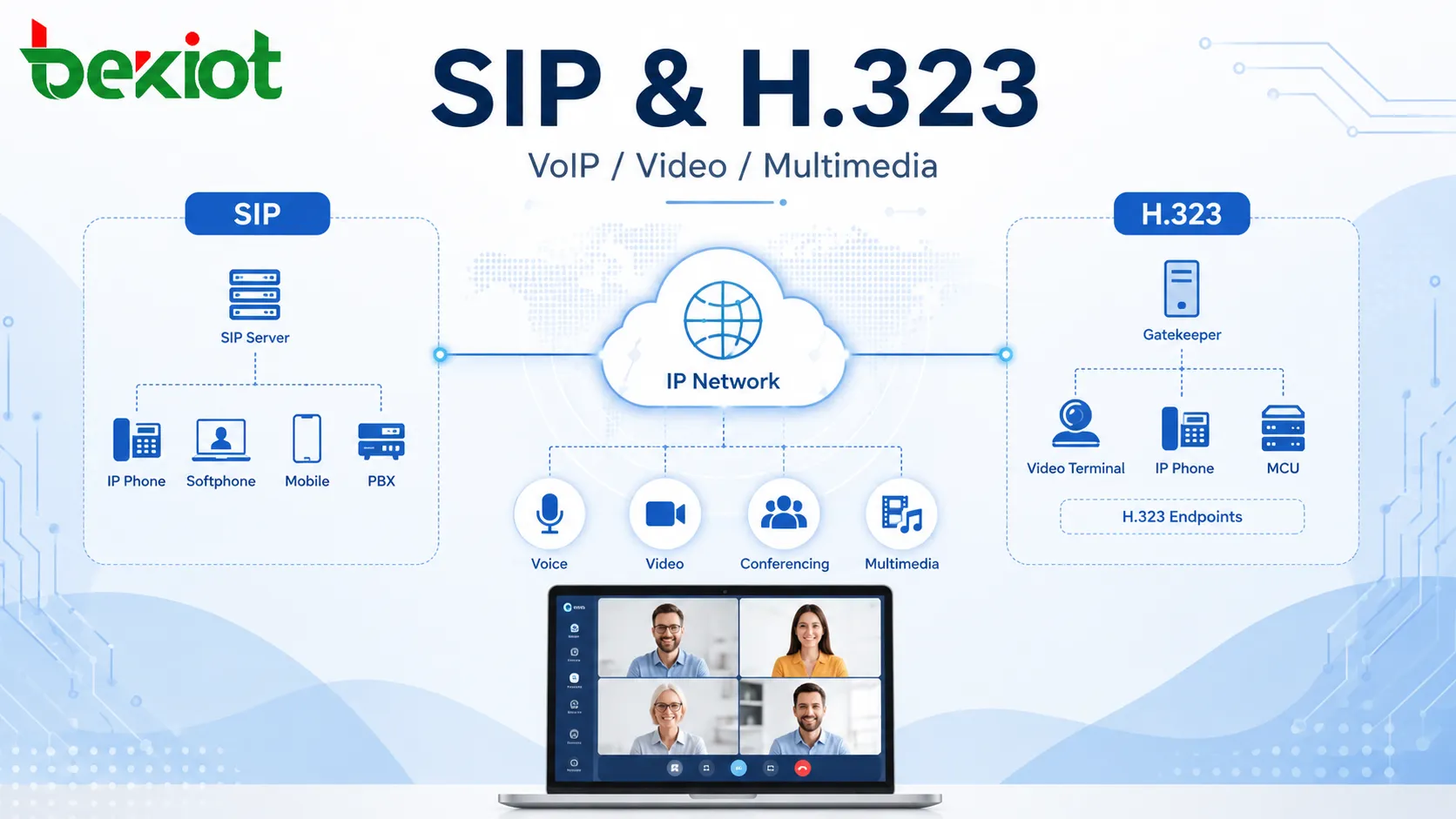
SIP and H.323 are both communication protocols used to support multimedia sessions over IP networks. They are commonly found in VoIP systems, video conferencing platforms, command centers, enterprise communication networks, and integrated audio-video projects. Both protocols are designed to help systems establish, modify, manage, and terminate multimedia sessions, but they follow very different technical ideas.
In modern communication projects, the question is usually not whether SIP or H.323 can support voice and video. Both can. The real question is which protocol is easier to integrate, expand, maintain, and connect with today’s IP-based communication platforms. For most new deployments, SIP has become the preferred option because of its simpler structure, internet-style design, and better adaptability to cloud, mobile, and unified communication environments.
Two Standards with the Same Communication Goal
SIP stands for Session Initiation Protocol. It is mainly used to initiate, maintain, modify, and terminate real-time communication sessions. These sessions may include voice calls, video calls, instant messaging, conferencing, online collaboration, and other multimedia services.
H.323 is a protocol suite developed by the International Telecommunication Union. It was created to support audio, video, and data communication over packet-based networks. In the early development of VoIP and video conferencing, H.323 played an important role and became a dominant standard in many enterprise-level video systems.
From a high-level view, SIP and H.323 solve similar problems. They both help communication endpoints find each other, negotiate session parameters, control call setup, and manage media communication. However, the way they organize signaling, system components, compatibility, and expansion is significantly different.
Different Design Logic Behind the Protocols
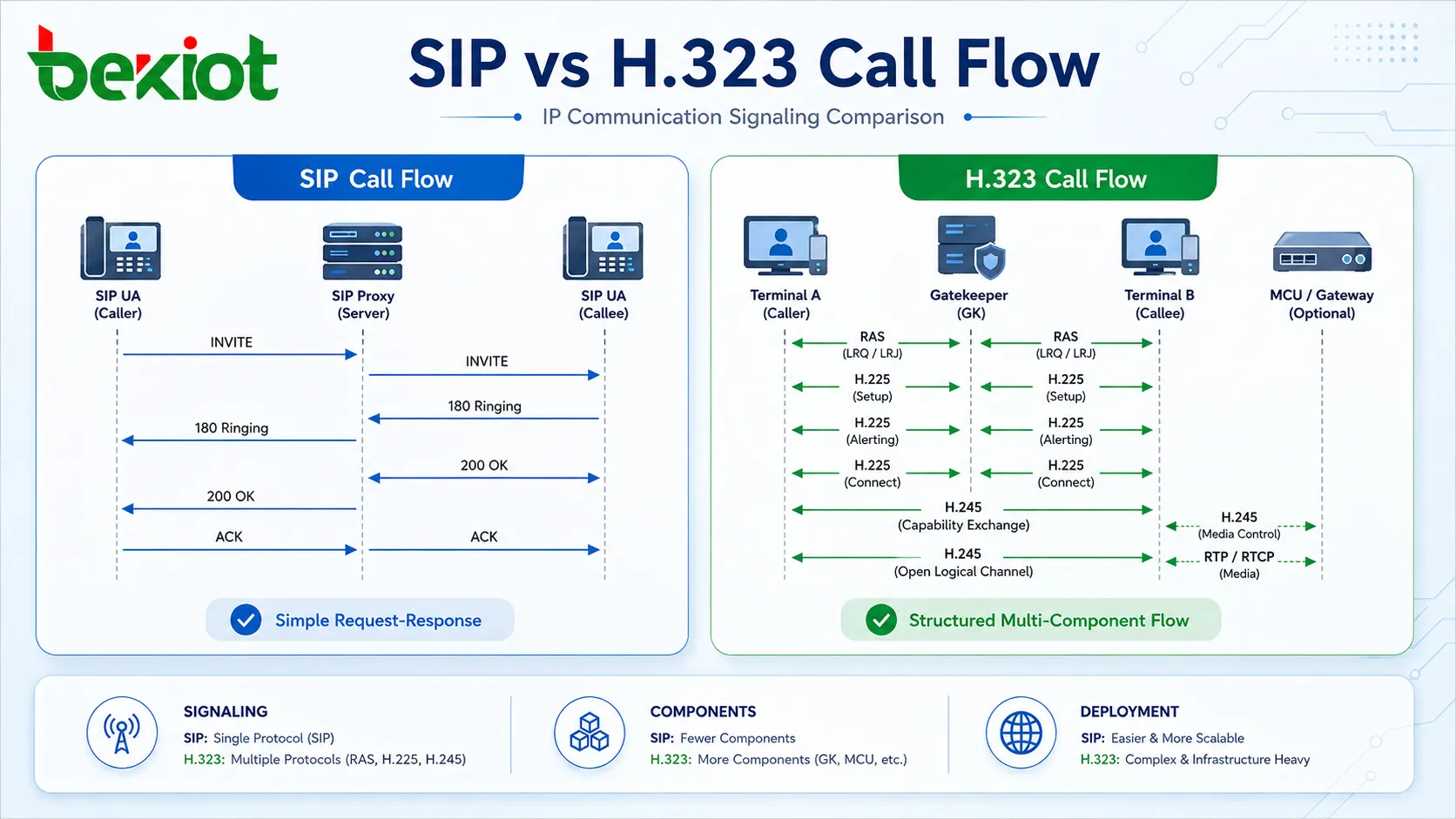
SIP was designed with internet communication principles in mind. Its request and response model is similar to HTTP, which makes it easier for developers and system integrators to understand. SIP messages are text-based, readable, and relatively simple to debug during system deployment.
H.323 follows a more traditional telecommunication design. It is a comprehensive protocol suite that defines multiple components, including terminals, gateways, gatekeepers, multipoint control units, call control mechanisms, multimedia management, and bandwidth control. This structure gives H.323 strong system-level capability, but it also increases deployment complexity.
In practical projects, SIP is often easier to implement in flexible IP environments, while H.323 may require more careful planning around system roles, protocol behavior, compatibility, and gateway configuration. This is one of the reasons why SIP has gained wider acceptance in modern VoIP and real-time communication platforms.
Architecture and System Components
SIP architecture is relatively lightweight. A typical SIP system may include SIP user agents, proxy servers, registrar servers, redirect servers, SIP trunks, IP phones, softphones, media servers, and IPPBX platforms. These elements can be combined in different ways depending on the communication scenario.
H.323 architecture is more formal and component-based. A typical H.323 system may include terminals, gateways, gatekeepers, and multipoint control units. Each component has a defined role. For example, a gatekeeper can manage address translation, admission control, bandwidth management, and call routing within an H.323 zone.
This difference affects how projects are designed. SIP is suitable for systems that need flexible routing, cloud connection, mobile access, and easy integration with web-based services. H.323 is often found in legacy video conferencing systems, older enterprise platforms, and some dedicated multimedia communication networks.
Flexibility and Interoperability in Real Projects
SIP provides strong flexibility because it uses a text-based signaling format and works well with many internet technologies. Its message structure is easier to read, analyze, and extend. For developers, engineers, and system integrators, this makes troubleshooting more direct.
SIP also integrates well with common communication platforms such as IPPBX systems, VoIP gateways, SIP trunks, video conferencing platforms, dispatch systems, recording systems, and unified communication servers. This makes it suitable for modern projects where multiple subsystems need to work together.
H.323 uses binary encoding and has a more complex protocol structure. This does not mean it is weak, but it does mean that implementation, debugging, and integration may require more specialized knowledge. In projects that involve old video conferencing equipment or legacy communication platforms, H.323 support may still be necessary.
Protocol Complexity and Maintenance Cost
H.323 is generally more complex than SIP. It includes several protocol elements and a broader standard framework. This complexity can be useful in controlled telecommunication-style environments, but it may increase engineering workload when the system needs to connect with modern IP-based platforms.
SIP has a simpler signaling model and is easier to extend. This makes it more suitable for communication systems that need frequent upgrades, third-party integration, cloud connection, or flexible service expansion. SIP is also easier to combine with new applications such as mobile softphones, web communication tools, video intercom systems, and command dispatch platforms.
For operation and maintenance teams, protocol simplicity matters. Easier packet analysis, clearer call flow, better vendor support, and wider tool availability can reduce troubleshooting time. In many new projects, these practical factors are just as important as protocol capability itself.
Application Range and Deployment Direction
SIP is not limited to VoIP calling. It can be used to control many types of real-time sessions, including voice, video, messaging, conferencing, collaboration, and other multimedia applications. This makes SIP suitable for enterprise communication, call centers, emergency dispatch, industrial communication, video intercom, cloud telephony, and unified communication systems.
H.323 is more closely associated with traditional VoIP and enterprise video conferencing. It is still used in some existing systems, especially where older video conference endpoints, MCU platforms, or dedicated enterprise communication systems remain in operation.
In new system planning, SIP is usually the more future-oriented choice. It supports easier integration with cloud services, mobile terminals, SIP-based gateways, IP dispatch systems, and software communication platforms. H.323 is more often handled as a compatibility requirement when older systems need to be retained.
Why SIP Is More Common in New Communication Systems
The communication market has gradually moved toward SIP because SIP is easier to deploy, easier to scale, and easier to integrate with modern IP services. It matches the development direction of cloud communication, mobile communication, software-based dispatch, and unified communication platforms.
SIP also benefits from a broad ecosystem. Many IP phones, softswitch platforms, VoIP gateways, SIP servers, dispatch consoles, recording systems, and communication applications support SIP by default. This helps reduce integration barriers and gives project teams more choices when designing a system.
H.323 has not disappeared, but its role has changed. It is more commonly seen in legacy environments, older video conferencing systems, and specific enterprise networks where existing equipment still depends on H.323 signaling. For new deployments, SIP is normally easier to align with long-term system development.
Handling Legacy Video Conference Platforms
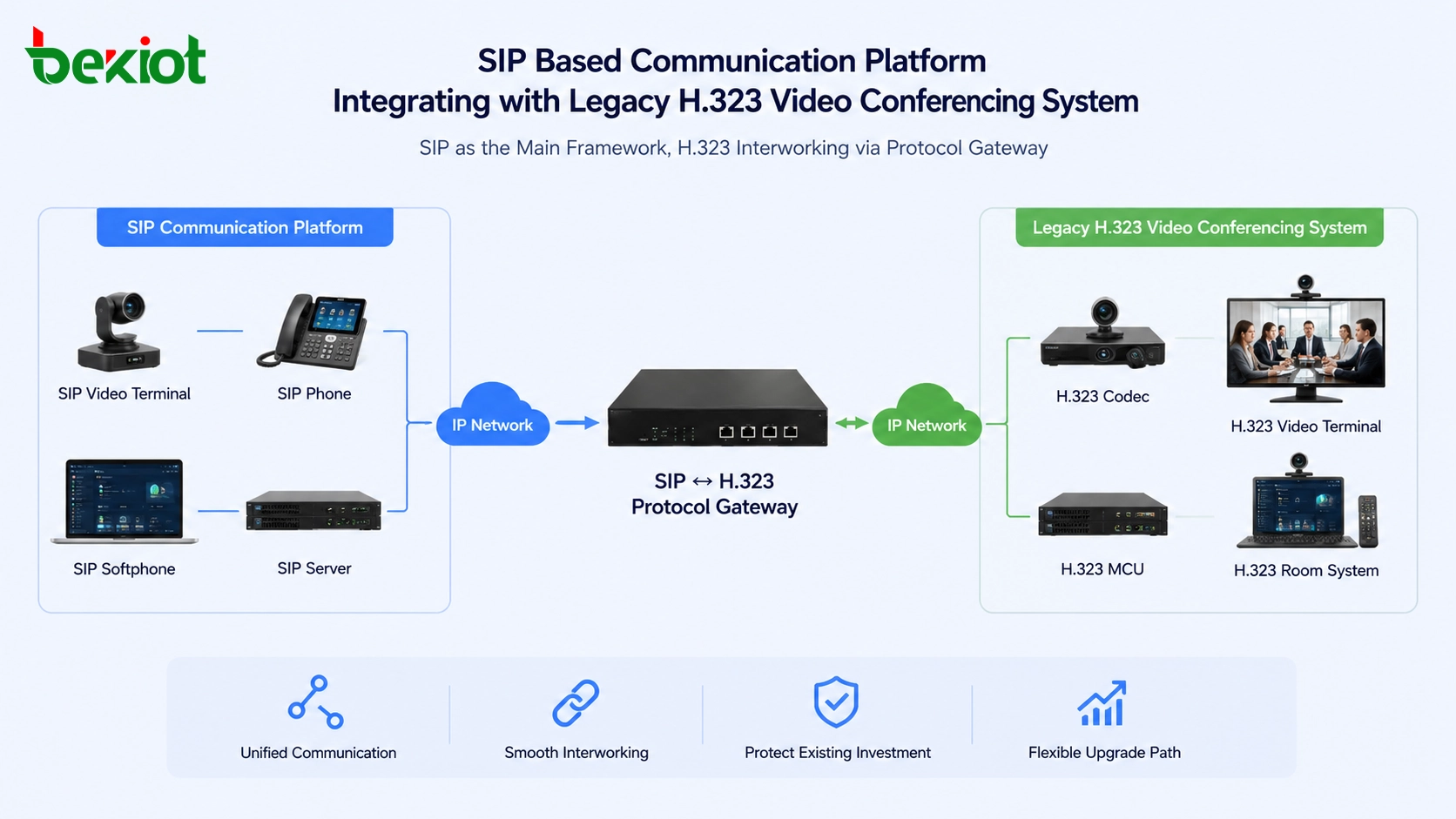
Many organizations still have H.323-based video conferencing equipment in service. These systems may continue to work reliably, but they can become difficult to connect with newer SIP-based communication platforms. Replacing the entire system at once may not be practical.
In this situation, a migration or integration plan is often more reasonable. SIP can be used as the main protocol for new endpoints, soft clients, dispatch systems, and cloud communication services, while H.323 systems can be connected through compatible gateways or platform-level interworking solutions.
This approach protects existing investment while allowing the communication system to move toward a more flexible IP architecture. It is especially useful for government, education, healthcare, transportation, energy, and enterprise projects that already have older video meeting infrastructure.
Planning a Protocol Strategy for Unified Communication
When planning a VoIP or video communication system, protocol selection should not be based only on technical preference. The project team should evaluate existing equipment, future expansion needs, platform compatibility, network design, maintenance capability, security requirements, and user scenarios.
If the system is newly built and needs to connect with IP phones, SIP trunks, cloud communication services, video intercoms, dispatch platforms, recording systems, and mobile clients, SIP is usually the better foundation. It offers stronger ecosystem support and easier long-term scalability.
If the system must connect with older video conferencing terminals or existing H.323 infrastructure, H.323 compatibility should be considered during the design phase. The best solution may be a hybrid architecture, where SIP handles new service expansion and H.323 is retained for legacy access.
Practical Selection Guide
SIP is generally more suitable when the project requires flexible integration, easy debugging, cloud access, mobile compatibility, SIP trunk connection, IPPBX deployment, or unified communication expansion.
H.323 may still be required when the project needs to connect with existing enterprise video conference systems, older multimedia endpoints, or legacy platforms that cannot be upgraded immediately.
For most modern communication projects, SIP should be treated as the primary direction, while H.323 should be managed as a compatibility layer. This helps the system remain open to future services without abandoning existing infrastructure too quickly.
Conclusion
SIP and H.323 are both important protocols for multimedia communication over IP networks. H.323 provided a complete and powerful framework for early VoIP and video conferencing systems, while SIP introduced a simpler, more flexible, and more internet-friendly approach.
In today’s communication environment, SIP is more widely adopted in new VoIP, video, dispatch, cloud communication, and unified communication systems. H.323 still has value in legacy video conferencing and specific enterprise environments, but new development and system expansion are more likely to follow SIP-based architecture.
A practical communication solution should not simply reject one protocol and choose the other. The better approach is to use SIP as the main framework for future expansion, while providing H.323 compatibility where existing systems still need to be connected.
FAQ
Is SIP only used for voice calls?
No. SIP can be used for voice, video, messaging, conferencing, and other real-time communication sessions.
Why do some organizations still keep H.323 systems?
Many older video conferencing platforms and enterprise communication systems were built on H.323, so keeping them can reduce replacement cost during phased upgrades.
Can SIP and H.323 work in the same project?
Yes. A hybrid system can use SIP for new communication services while connecting H.323 systems through gateways or compatible platforms.
Which protocol is easier to troubleshoot?
SIP is usually easier to troubleshoot because its signaling messages are text-based and easier to read during packet analysis.
Which protocol is better for cloud communication?
SIP is generally better suited for cloud communication because it is widely supported by modern IPPBX, SIP trunk, softphone, and unified communication platforms.







