


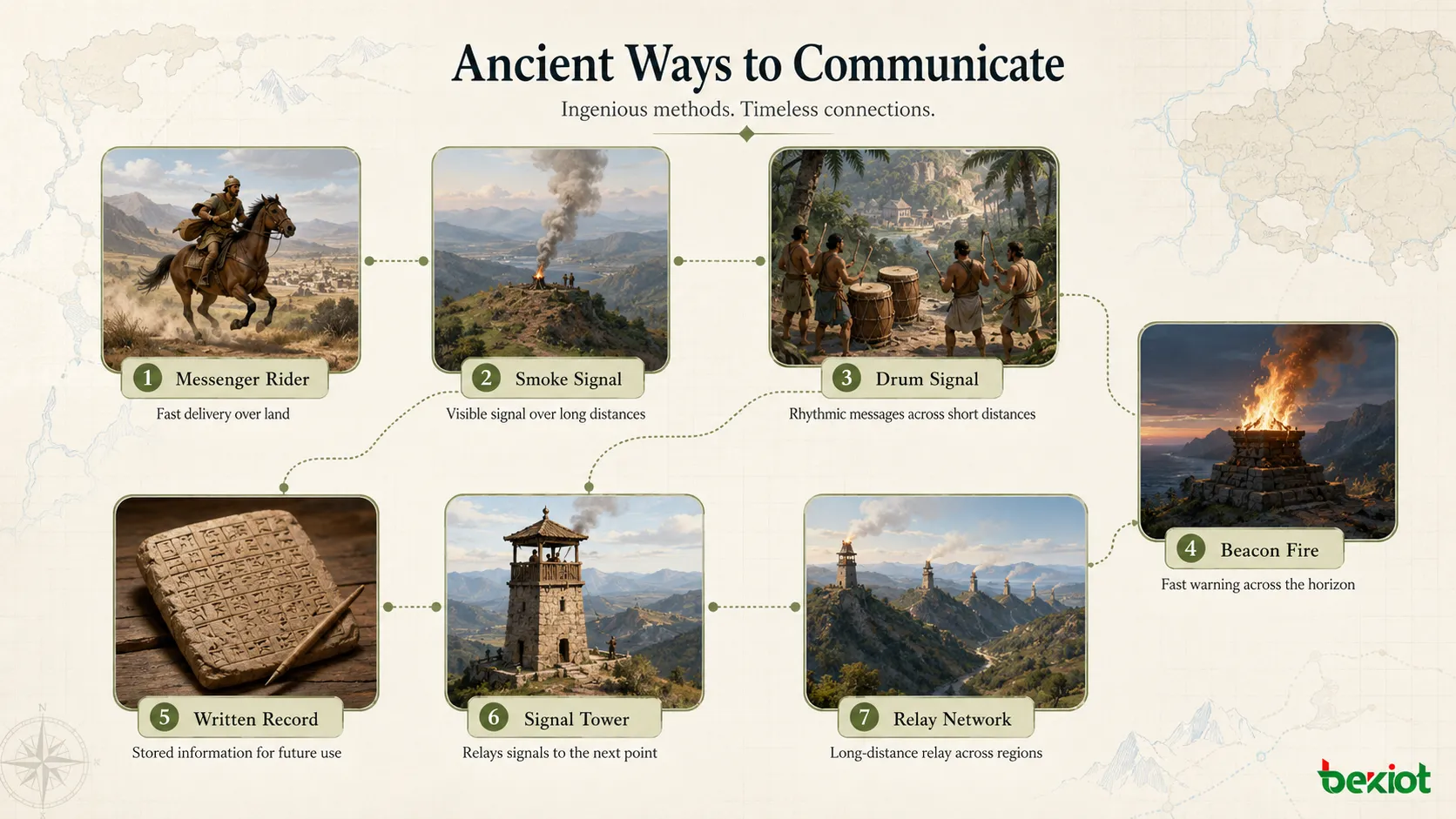
Ancient communication methods were the practical systems people used to exchange information before telegraphy, telephony, radio, satellites, and the internet existed. They included oral messages, written records, smoke signals, drums, horns, flags, fire beacons, messenger routes, carved symbols, signal towers, carrier animals, and early postal networks. These methods may seem simple compared with modern networks, but many of them already contained the basic logic of transmission, coding, routing, authentication, delay control, and information storage.
Human societies needed communication for trade, warfare, governance, religion, navigation, agriculture, disaster warning, diplomacy, law, and daily community life. The available technology depended on materials, geography, political organization, literacy level, transport routes, and the urgency of the message. A village could rely on spoken announcements, while an empire needed relay stations and official messengers. A coastal society could use signal fires or flags, while a nomadic group might depend more on riders, drums, or oral tradition.
The history of communication is not only a story about tools. It is also a story about system design. Every method had to solve several questions: how to create a recognizable signal, how to carry it across distance, how to preserve meaning, how to reduce misunderstanding, how to confirm authority, and how to reach the correct audience. These questions are still important in modern communication engineering.
Information Exchange Before Electronic Networks
Before electrical communication, information moved at the speed of human travel, animal movement, visibility, sound propagation, or physical transport. This created a direct relationship between geography and message speed. A mountain line could support visible fire signals over long distance, but a forest or valley could block them. A river route could carry written messages faster than a rough land path. A horse relay could move official messages quickly, but it required roads, stations, food, riders, and administration.
Ancient systems therefore used a mix of media. Short urgent warnings could use sound or light. Detailed instructions required writing or trained messengers. Public announcements could be spoken in markets, temples, town squares, or assembly places. Long-term records were carved, painted, written on clay, bamboo, papyrus, parchment, palm leaves, silk, stone, or metal.
From a technical viewpoint, the main constraint was not only distance. It was information capacity. A drum pattern or smoke signal could send a limited set of meanings. A written message could carry complex detail, but it needed a carrier and a literate sender and receiver. Each method balanced speed, accuracy, range, secrecy, cost, and complexity differently.
Oral Transmission and Human Messengers
Spoken Messages
Oral communication was the most natural and universal method. It required no special tools beyond language, memory, and social trust. Families, tribes, markets, armies, and rulers all used spoken messages for instruction, negotiation, teaching, and warning.
The strength of oral transmission was immediacy. A leader could speak directly to a group, and a messenger could deliver a verbal order quickly. The weakness was distortion. Memory errors, intentional changes, accents, emotional interpretation, and repeated retelling could alter the meaning.
To reduce errors, societies used formulas, repeated phrases, songs, poetry, ceremonial wording, and trained messengers. In some cultures, oral tradition became a disciplined method for preserving history, law, genealogy, and moral codes.
Courier Systems
Human messengers extended communication beyond face-to-face distance. A courier could carry spoken or written messages between villages, cities, military camps, courts, and trade centers. This method was flexible because the messenger could adapt to routes, weather, obstacles, and local conditions.
However, courier communication depended on physical travel. Speed was limited by walking, running, horseback riding, sailing, or caravan movement. Reliability depended on the messenger’s loyalty, health, route knowledge, and protection from theft or attack.
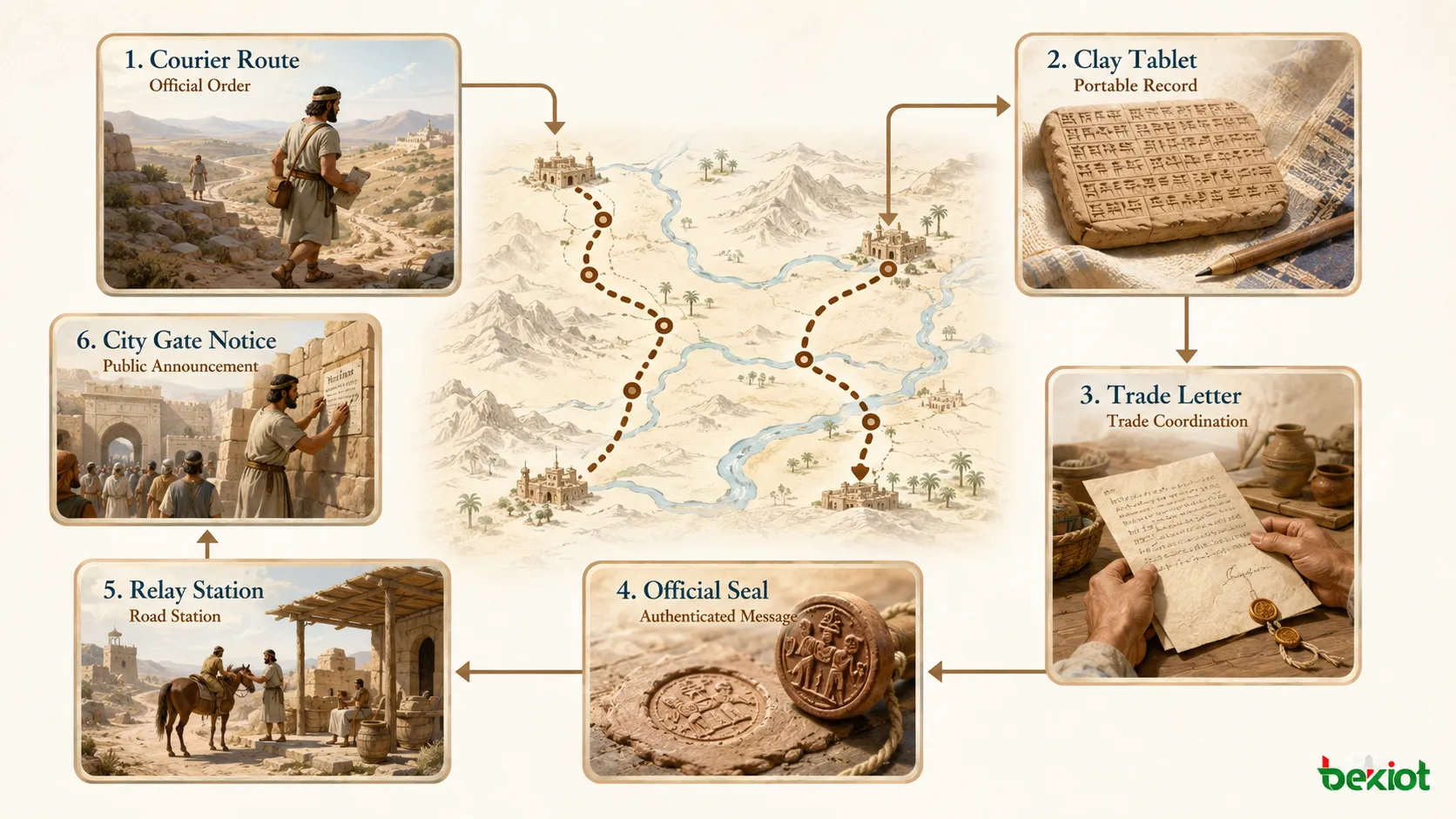
Large states improved courier systems by building roads, relay posts, official seals, guard stations, and administrative procedures. In this sense, messenger networks were early communication infrastructure, not just individual travel.
Written Records and Portable Media
Writing transformed communication because it allowed information to be preserved beyond memory and transmitted beyond the presence of the speaker. Written messages could carry laws, contracts, military orders, tax records, trade agreements, religious texts, maps, and administrative instructions.
Different regions used different materials. Clay tablets were durable but heavy. Papyrus was lighter and easier to transport. Parchment could be strong and reusable. Bamboo slips, wooden tablets, silk, palm leaves, stone inscriptions, and metal plates served different needs depending on local resources and purpose.
The key advantage of writing was precision and permanence. The same message could be read later, copied, archived, or used as evidence. The main limitations were literacy, production cost, storage difficulty, vulnerability to damage, and the need for physical delivery.
Marks, Symbols, and Visual Codes
Carved and Painted Signs
Long before complex writing systems became widespread, people used marks, symbols, drawings, and patterns to communicate meaning. Rock art, boundary stones, ownership marks, tally sticks, seals, pictorial records, and symbolic carvings could represent events, property, authority, or ritual meaning.
These signs were useful because they could remain in place. A boundary marker did not need a messenger to repeat the message every day. A seal could identify ownership or authority. A tally mark could record quantity or obligation.
The limitation was interpretation. Symbols require shared understanding. A sign that is clear to one group may be meaningless to outsiders. This is why stable communities and administrative systems often developed standard symbols over time.
Knotted and Object-Based Messages
Some societies used objects as information carriers. Knotted cords, marked sticks, shells, tokens, beads, or arranged objects could represent numbers, agreements, identities, or ritual messages. The meaning was often tied to cultural rules rather than universal symbols.
Object-based methods could be durable and portable. They also helped count goods, record obligations, or represent status. However, they usually required trained interpretation and were less flexible than full writing systems for complex narrative messages.
Smoke, Fire, and Light Signals
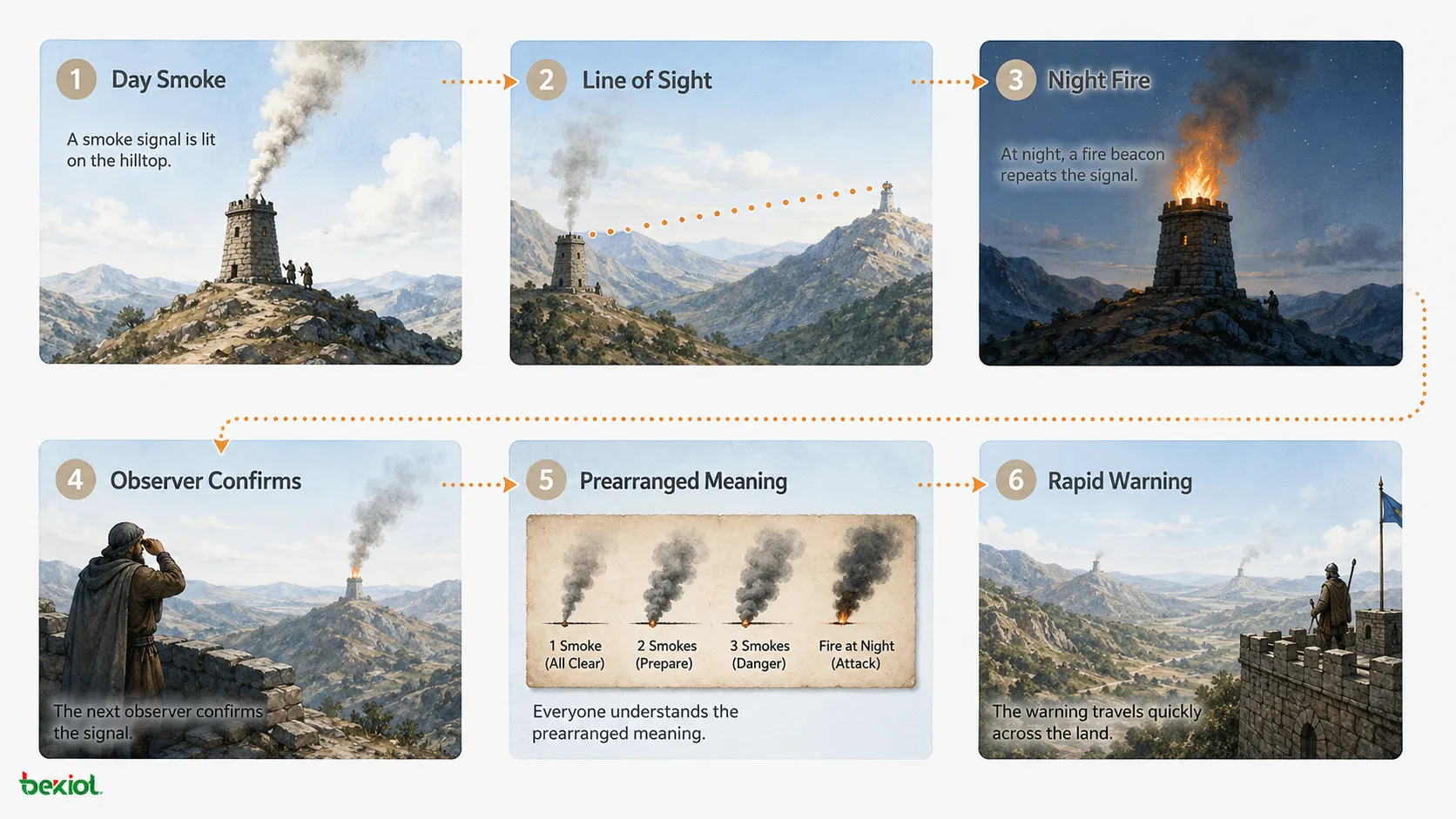
Visible signals were effective when speed mattered and the message did not need much detail. Smoke by day and fire by night could send warnings across hills, towers, coastlines, border posts, and military routes. These signals could travel faster than a runner because light can be seen at a distance almost instantly.
The simplest form was binary: signal present or absent. For example, a fire on a hill could mean danger, invasion, arrival, or a prearranged event. More advanced systems used number, position, timing, color, or sequence to encode different meanings.
The technical strength was speed over line-of-sight distance. The weakness was dependence on visibility. Weather, fog, rain, daylight, smoke conditions, terrain, and observer readiness could all affect reliability. Light signals also required prearranged meaning; otherwise, the receiver might see the signal but not understand it.
Drums, Horns, Bells, and Sound Patterns
Sound signals were powerful in local and regional communication. Drums, horns, bells, gongs, conch shells, whistles, and shouting systems could announce danger, summon people, mark time, guide movement, or send coded messages across communities.
The advantage of sound was that it did not require direct eye contact. A bell could be heard from streets, fields, or surrounding buildings. A drum pattern could travel through forest or across villages better than a visible signal in some environments. Horns could coordinate hunting, military movement, or maritime activity.
The limitation was range and interference. Wind, terrain, rain, urban noise, and distance could distort sound. Message capacity varied. A simple bell might only mean alarm or gathering, while complex drum language could transmit richer patterns in societies trained to understand them.
Flags, Banners, and Motion-Based Signals
Flags, banners, shields, torches, and body gestures were widely used where visual coordination was needed. Armies used standards and banners to identify units, rally troops, transmit formation changes, or show command presence. Ships used flags and lanterns for identification and instruction. Ceremonial societies used banners to show rank, affiliation, or authority.
Motion-based signaling could carry more detail than a single fire. The position, movement, color, or sequence of a flag could represent different instructions. In later historical periods, more formal semaphore systems built on this principle by turning visual positions into coded symbols.
The main requirement was visibility and trained interpretation. A signal that works well on an open battlefield or coastline may fail in dense city streets, forests, fog, or nighttime without light support.
Relay Networks and Organized Routes
One of the most important system-level innovations was the relay network. Instead of one messenger traveling the full distance, a message could pass through a chain of stations, riders, runners, ships, or signal points. This improved speed and reduced fatigue.
Relay systems required administration. Stations needed staff, animals, food, security, and scheduling. Roads needed maintenance. Messages needed authentication so that official information could be trusted. In some cases, official seals or tokens proved that a courier had authority.
This structure shows an early form of network engineering. The route was divided into segments, each segment had a transmission responsibility, and the whole chain worked only if every node performed correctly.
Navigation and Maritime Communication
Coastal and maritime societies used lights, fires, flags, horns, landmarks, pilot signals, and later more formal signal codes to guide ships and coordinate harbor activity. Communication at sea was difficult because distance, weather, waves, and movement limited both speech and visibility.
Coastal beacons could warn ships of dangerous areas or help them identify land. Harbor signals could coordinate docking, sailing, loading, or defense. Flags and lanterns helped identify friendly or hostile vessels and communicate basic instructions.
The technical challenge was reliability under changing conditions. A signal had to be visible from moving ships, distinguishable from natural lights, and understandable by crews from different regions. This pushed maritime communication toward more standardized codes over time.
Military Command and Early Warning
Warfare created strong demand for fast communication. Armies needed to coordinate movement, warn of attack, call reinforcements, transmit orders, and maintain contact across distance. Methods included runners, riders, drums, horns, banners, fire signals, signal towers, and written dispatches.
Each method served a different need. A banner could guide nearby troops. A rider could carry detailed orders. A beacon chain could warn a capital of invasion. A drum could coordinate movement or alarm. Combining methods increased reliability.
Military communication also required security. Captured messengers, visible signals, and intercepted written orders could reveal plans. To reduce risk, societies used trusted couriers, seals, coded wording, symbolic signals, or limited-message systems where only insiders knew the meaning.
Administrative and Commercial Uses
States and merchants needed communication for taxes, trade, law, contracts, inventory, border control, diplomacy, and market coordination. Written records became essential because economic and legal information required detail and evidence.
Trade networks carried messages along with goods. Caravans, ships, inns, temples, guilds, and administrative posts all became information nodes. Merchants exchanged price information, credit instructions, delivery notices, and letters of agreement.
Administrative communication also supported political control. A ruler could send orders to distant governors, collect reports, announce laws, and maintain records. The larger the state, the more important organized communication became.
Technical Characteristics Across Different Methods
Ancient systems can be compared by range, speed, capacity, reliability, cost, secrecy, and infrastructure requirement. No single method was best for every situation. A smoke signal was fast but limited in detail. A written letter was detailed but slow. A drum could reach a community quickly but could not always transmit complex information. A courier could adapt to changing conditions but could be delayed or intercepted.
Message capacity was one of the biggest differences. Sound and light systems often used predefined meanings. Writing could carry open-ended information. Oral messengers could explain context but might alter details. Relay systems improved speed but required many resources.
The most successful societies combined multiple methods. For example, an early warning fire could alert a region, while a rider followed with detailed written instructions. A bell could gather citizens, and a public reader could announce the written order. This layered approach is similar to modern multi-channel communication.
Accuracy, Trust, and Authentication
Communication is not useful if the receiver cannot trust it. Ancient systems developed many ways to increase trust. Official seals, recognizable messengers, known signal locations, repeated wording, witnessed delivery, public reading, and ceremonial authority all helped prove that a message was genuine.
Accuracy was equally important. A messenger might forget details. A written tablet might break. A fire signal might be misread. A drum pattern might be misunderstood. To reduce these risks, societies used standard formats, repeated confirmation, known routes, and trained specialists.
Authentication and accuracy were often more important than speed. A fast message that was false, corrupted, or unauthorized could create danger. This principle remains true in modern communication security.
Coverage and Environmental Limits
Ancient communication range depended strongly on environment. Open plains, deserts, coastlines, and mountain ridges supported long-distance visibility. Dense forests, storms, fog, valleys, and urban structures reduced signal effectiveness. Rivers and roads improved messenger speed, while mountains and hostile territory slowed travel.
Season also mattered. Snow could block routes. Monsoon rains could delay couriers. Dry conditions could improve fire visibility but increase wildfire risk. Wind could distort smoke, sound, or torch flame.
These environmental limits forced communication systems to adapt locally. The best method in one region might be ineffective in another region.
Cost and Infrastructure
Some methods were low-cost. A shout, drum, horn, or local signal fire required limited infrastructure. Other systems were expensive. Roads, relay stations, towers, trained couriers, writing materials, official archives, and protected routes required organized resources.
Large-scale communication therefore reflected social organization. Empires could maintain official courier roads and station networks. Smaller communities relied more on local oral, sound, or visual methods. Merchant networks developed their own channels through trade routes and trusted agents.
Infrastructure also shaped reliability. A well-maintained relay network could outperform a single messenger over long distance. A chain of signal towers could transmit warnings quickly, but only if observers were alert and stations were positioned correctly.
Secrecy and Message Protection
Ancient communication often faced interception risks. A visible fire could be seen by enemies. A messenger could be captured. A written message could be stolen. A public announcement could be overheard.
To protect information, societies used trusted couriers, hidden routes, coded language, sealed containers, symbolic wording, memorized messages, and limited-distribution instructions. Some messages were intentionally vague unless the receiver already knew the context.
Secrecy was difficult because many methods were physically exposed. The more urgent and visible a signal was, the harder it was to keep private. This created a trade-off between speed and confidentiality.
Comparison With Modern Communication Logic
Modern communication uses electricity, digital coding, satellites, fiber optics, packet networks, encryption, and automated routing. Yet the underlying problems are familiar. A sender still needs a channel. A receiver still needs a way to decode meaning. A network still needs routing and reliability. A system still needs authentication and protection from interference.
Smoke signals and beacon fires are early examples of low-capacity broadcast signaling. Messenger routes are early examples of store-and-forward delivery. Official seals resemble authentication mechanisms. Relay stations resemble network nodes. Repeated bell signals resemble alert broadcasting. Written archives resemble persistent storage.
Understanding ancient methods helps explain why modern systems are built around redundancy, coding, standardization, addressing, security, and infrastructure planning.
Key Lessons From Early Systems
The first lesson is that communication design must match the message type. Urgent warnings, detailed laws, trade contracts, military commands, and public announcements require different media. Using the wrong method can cause delay, confusion, or loss of meaning.
The second lesson is that infrastructure matters. Roads, towers, stations, trained messengers, writing materials, and observation points can be as important as the message itself.
The third lesson is that meaning must be shared in advance. A signal has no value if the receiver does not know what it means. Standard codes, training, and context are essential.
The fourth lesson is that trust must be designed into the system. The receiver must know whether the message is authentic, complete, and intended for them.
Historical Value in Communication Development
Ancient communication methods built the foundation for later telecommunication. They introduced concepts such as signal range, message encoding, relay routing, priority dispatch, public broadcasting, written storage, authority verification, and multi-channel communication.
They also show that communication progress is not only about faster transmission. It is about matching technology with social needs. A simple bell could be more effective than a written notice during an emergency. A written order could be more useful than a fire signal when detail mattered. A relay network could be more powerful than a single fast rider.
This practical balance between speed, detail, trust, and coverage remains central to communication system design today.
Ancient communication methods were not primitive in purpose; they were carefully adapted systems that used available materials, geography, human organization, and shared codes to move information across distance.
FAQ
Why did many societies use more than one communication method?
Different methods solved different problems. A warning signal could be fast, while a written message could provide detail. Combining methods improved reliability and reduced misunderstanding.
Were ancient long-distance messages always slow?
Not always. Beacon chains, signal fires, drums, and relay riders could transmit urgent information relatively quickly, especially when routes and meanings were prepared in advance.
How did people prevent fake messages?
They used official seals, trusted couriers, known routes, recognizable symbols, witnesses, ceremonial authority, and sometimes coded wording to prove authenticity.
Why was writing such an important breakthrough?
Writing allowed information to be stored, copied, transported, reviewed, and used as evidence. It made complex administration, law, trade, and history more reliable.
What is the biggest limitation of visible signals?
They require line of sight and clear conditions. Fog, rain, mountains, forests, buildings, darkness, or daylight conditions can reduce visibility or cause misinterpretation.







