


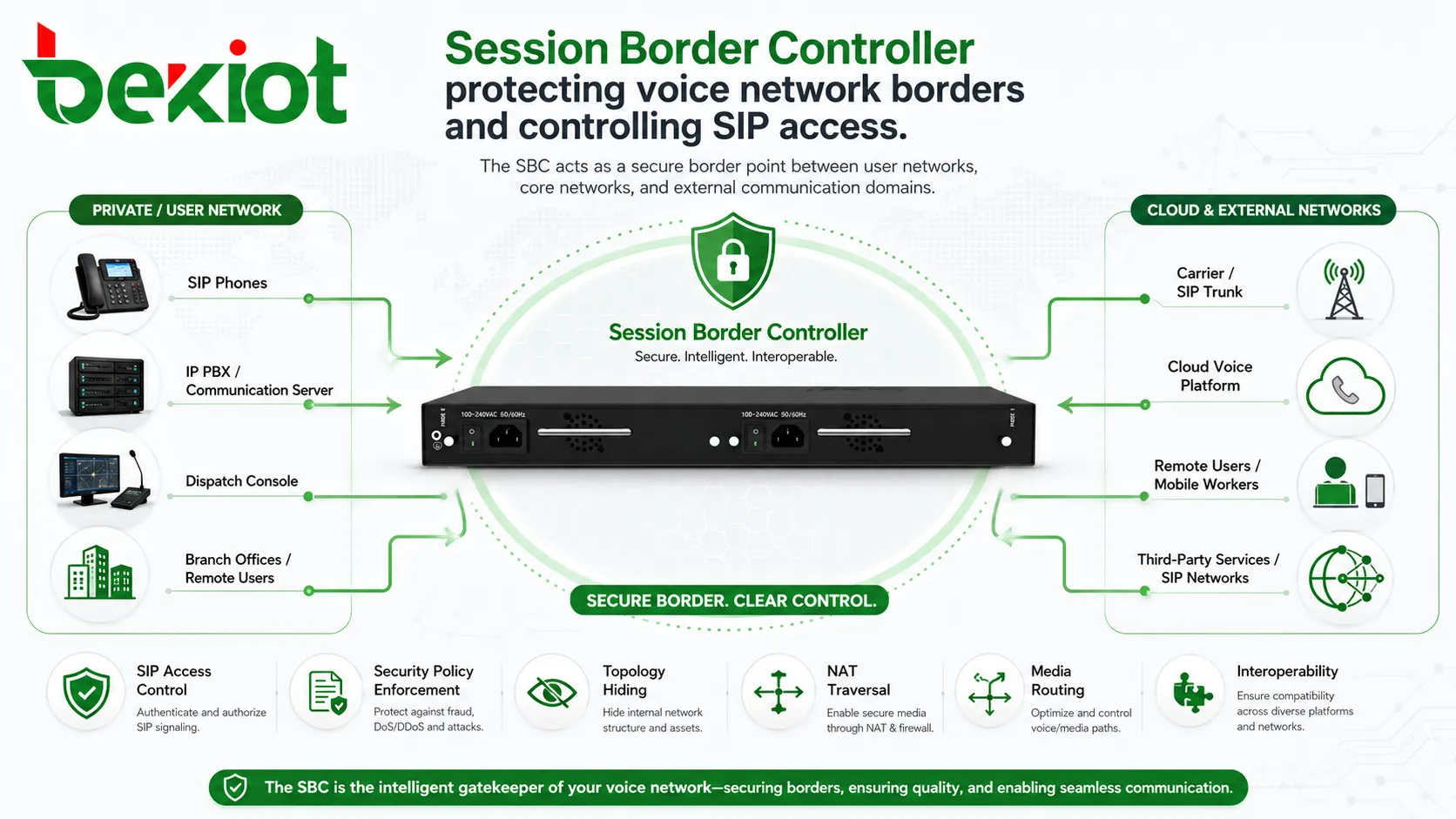
A Session Border Controller, commonly known as an SBC, is a network-edge device used to control, protect, and manage real-time communication sessions. In modern VoIP, SIP trunking, carrier interconnection, enterprise voice, and mobile core networks, the SBC works like a trusted gatekeeper between different domains. It allows legitimate traffic to pass, blocks unsafe or abnormal behavior, and helps voice services remain stable when networks become larger, faster, and more open.
As communication networks evolved from 2G, 3G, and 4G toward 5G, voice networks faced higher capacity, higher speed, broader interconnection, and more complex security requirements. SBC deployment is no longer only about connecting two networks. It has become a practical solution for access control, topology protection, media resource management, QoS assurance, and secure domain interworking.
Why Network Borders Need Intelligent Control
Different operator networks, enterprise voice platforms, SIP trunks, hosted PBX systems, and communication domains often need to interconnect. Without a dedicated border control layer, sensitive network information may be exposed, unauthorized endpoints may attempt registration, and abnormal traffic may affect existing voice services.
The SBC solves this problem by sitting at the boundary of the network. It checks whether users, sessions, calls, and messages should be allowed, then applies policies before forwarding traffic. This creates a controlled interconnection environment where communication can remain open without leaving the core network unprotected.
In simple terms, “Session” refers to communication activities such as registration, voice calls, video calls, and messaging. “Border” refers to the edge between different networks or domains. “Controller” means the device applies rules for traffic, security, routing, and service behavior. Together, these three ideas explain the role of an SBC: it controls communication sessions at the network border.
Related SBC Solution: Sbc Gateway
Access and Interconnection Scenarios
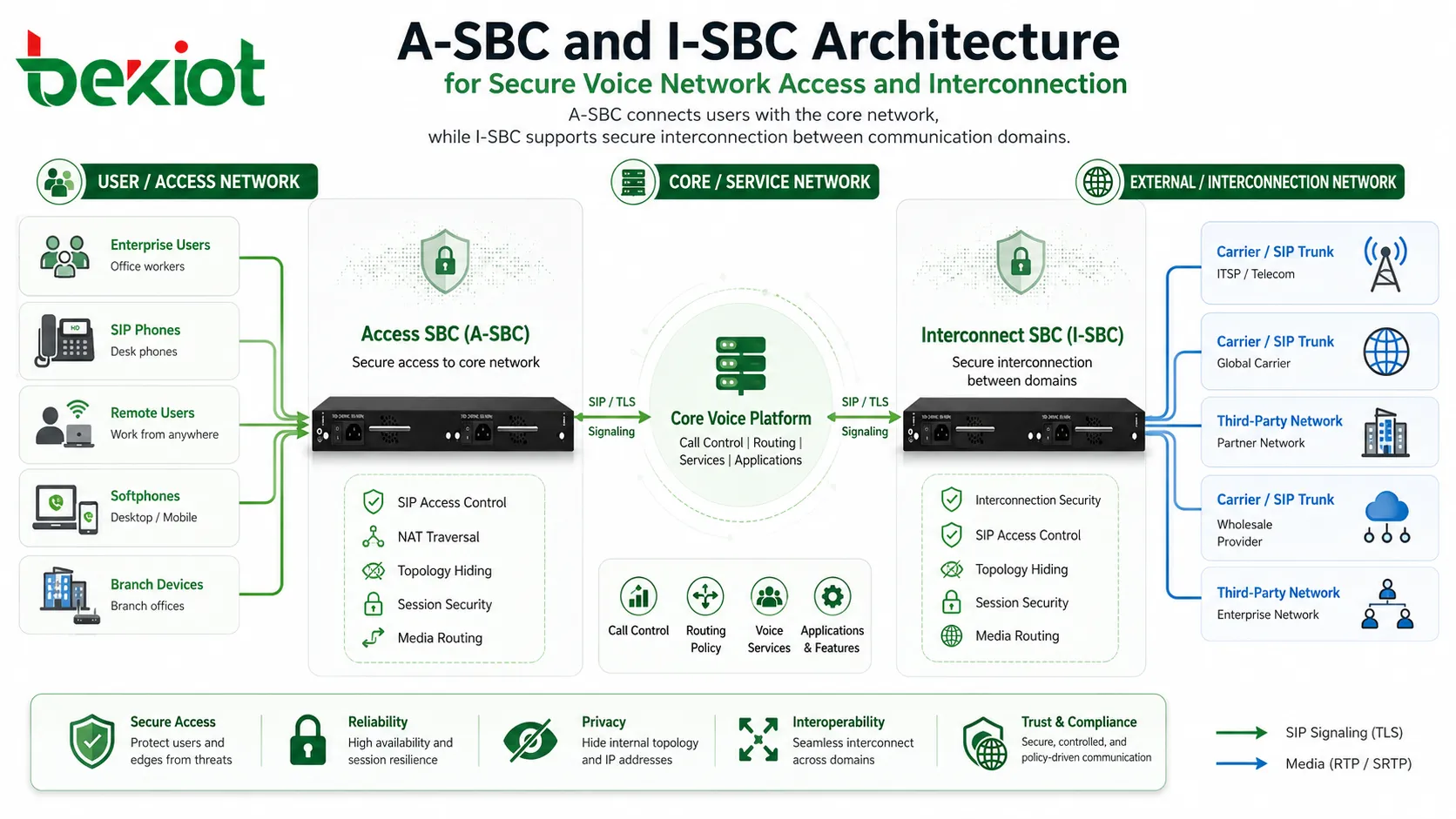
SBCs are often deployed in two major positions. An Access Session Border Controller is placed between endpoints or access networks and the core voice network. Its role is to support secure terminal access, registration control, NAT traversal, and protection for user-side traffic.
An Interconnection Session Border Controller is placed between two core networks or service domains. It supports domain-to-domain communication, carrier interconnection, SIP trunking, and controlled routing between independent networks. This is especially important when different networks use different addressing plans, SIP behaviors, codec policies, or security requirements.
For organizations migrating from traditional voice systems to IP-based communications, this border-layer architecture reduces interconnection risk. It allows legacy systems, SIP platforms, mobile core networks, and third-party communication services to work together without exposing internal structures directly to the outside.
Policy-Based Admission for Stable Services
Call Admission Control is one of the most important SBC capabilities. CAC allows the SBC to decide whether a new registration, call, or message should be accepted according to current network conditions and configured policies. This prevents new service requests from damaging services that are already running.
Registration-based CAC can limit whether additional users are allowed to register when a configured threshold is reached. Call-based CAC can decide whether new calls should be accepted based on the number of active sessions or available resources. Message-based CAC can control whether users are allowed to continue sending messages when the current message load becomes too high.
This type of policy control supports QoS by keeping the network from becoming overloaded. In busy environments, the SBC helps protect active calls, avoid uncontrolled signaling growth, and maintain predictable service quality for voice, video, and messaging applications.
Topology Protection for Core Network Security
Topology hiding is another key reason to deploy an SBC. When signaling messages are sent to untrusted devices or external networks, they may contain domain names, IP addresses, routing paths, and other details that reveal the internal structure of the network. If this information is exposed, attackers or unauthorized parties may gain a clearer view of the core network.
With topology hiding enabled, the SBC masks or rewrites sensitive header information before forwarding signaling messages. When the response traffic returns, the SBC restores the required fields according to its internal processing logic. In this way, the external side receives only the information it needs, while the internal network topology remains protected.
This function is valuable for operators, service providers, and enterprises because network topology is often highly confidential. Protecting it reduces the risk of targeted attacks, unauthorized scanning, routing abuse, and exposure of internal voice infrastructure.
Media Bandwidth Control and Abuse Prevention
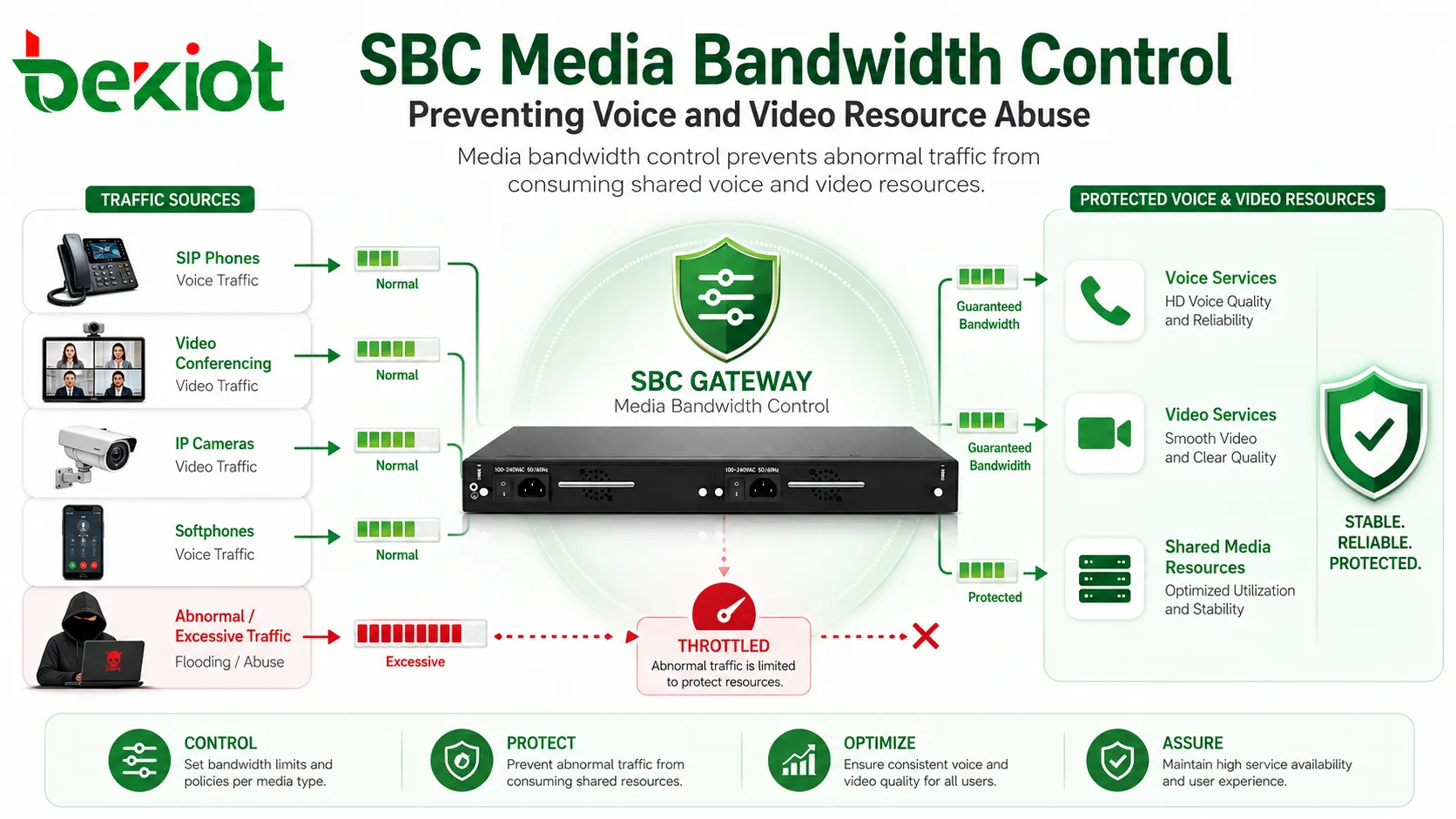
Media bandwidth abuse is a common risk in voice and video networks. Some users or endpoints may attempt to consume more bandwidth than allowed, which can affect other users, occupy shared network resources, and make service conditions harder to understand or manage.
An SBC can apply media bandwidth control policies according to codec type, audio or video format, user profile, user group, or service class. If traffic exceeds an allowed threshold, the SBC can reject or discard the related packets. This helps stop malicious behavior, reduce unfair resource usage, and protect the commercial value of network bandwidth.
Bandwidth policies are also useful for service planning. Different users, sites, departments, or customer groups may require different media priorities. By controlling bandwidth at the border, the network can support more predictable performance and fairer resource allocation.
Multi-Layer Defense for Real-Time Communication
SBC security is not limited to one function. A complete SBC solution can help defend against risks at the IP layer, signaling layer, and media layer. These protections may include access filtering, SIP message validation, rate limiting, traffic normalization, topology hiding, session control, and media policy enforcement.
The goal is to build a 360-degree protection layer around real-time communication services. While no network security system can remove every possible risk, the SBC provides a practical and necessary defense point between trusted and untrusted networks.
For voice networks, this is especially important because communication services are sensitive to delay, packet loss, abnormal signaling, and sudden traffic growth. The SBC must therefore support both security and service continuity at the same time.
Preparing Voice Networks for 5G and Beyond
In the 2G, 3G, and 4G era, the SBC already played the role of a network gatekeeper. In the 5G era, the task becomes more demanding. Higher capacity, faster service delivery, cloud-based deployment, multi-domain interconnection, and wider endpoint access all increase the need for stronger session border control.
A future-ready SBC solution should not only forward calls. It should support secure access, controlled interconnection, flexible policy management, media handling, signaling protection, and scalable deployment. For service providers and enterprises, this makes the SBC a long-term infrastructure component rather than a simple edge device.
When planned properly, an SBC helps networks stay open enough for business communication while remaining controlled enough for security, reliability, and service quality.
Typical Value of an SBC Solution
Secure SIP Trunking and Carrier Interconnection
SBC deployment provides a controlled border between internal voice systems and external SIP trunk providers. It protects internal addresses, normalizes SIP signaling, and applies call policies before traffic reaches the core platform.
This reduces interconnection complexity and helps different networks communicate even when they use different routing rules, codec preferences, or signaling behaviors.
Enterprise Voice Protection
For enterprises, an SBC can protect IP PBX systems, unified communications platforms, contact centers, and remote extensions. It controls access from branch offices, remote workers, third-party networks, and cloud services.
This is useful when organizations need voice flexibility but do not want to expose their internal voice infrastructure directly to the public network.
Service Quality and Resource Governance
By combining CAC, bandwidth limitation, signaling control, and media policy enforcement, the SBC helps voice services remain predictable. It prevents uncontrolled growth in sessions, protects existing calls, and supports more reliable communication under heavy load.
For operators and large organizations, this improves both technical stability and operational control.
FAQ
Is an SBC only used by telecom operators?
No. Telecom operators use SBCs for large-scale access and interconnection, but enterprises also deploy them for SIP trunking, remote extension security, contact center connectivity, and unified communications protection.
Can an SBC replace a firewall?
An SBC and a firewall serve different purposes. A firewall controls general network traffic, while an SBC understands SIP sessions, media streams, call behavior, registration, and voice-specific policies. In many deployments, both are used together.
Does an SBC help with NAT traversal?
Yes. Many SBCs help endpoints behind private networks communicate with external SIP platforms by managing signaling and media address translation. This is one reason SBCs are widely used in remote access and SIP trunking scenarios.
Why is topology hiding important for voice networks?
Voice signaling may expose internal IP addresses, domains, routing information, or platform structure. Topology hiding reduces this exposure and makes it harder for external parties to understand or target the internal network.
What should be considered before deploying an SBC?
Important factors include concurrent session capacity, SIP compatibility, codec requirements, security policies, media handling, redundancy design, routing rules, monitoring needs, and whether the deployment is for access, interconnection, or both.







