


A RoIP gateway, also known as a Radio over IP gateway, radio gateway, two-way radio gateway, or push-to-talk gateway, is used to connect traditional radio communication systems with IP-based voice platforms. In many projects, it converts radio audio and control signals into SIP or IP communication, allowing two-way radios, dispatch systems, softswitch platforms, SIP phones, public network PTT platforms, and command centers to communicate within one system.
When selecting a RoIP gateway, many users focus on protocol support, network connection, audio codec, or dispatch platform compatibility. However, the physical interface on the radio side is just as important. The interface determines whether the gateway can correctly connect to handheld radios, vehicle radios, base stations, analog repeaters, digital radio systems, and mixed radio environments. A suitable interface design can improve audio quality, reduce delay, enhance electromagnetic shielding, and simplify field integration.
Interface Selection Starts from the Radio Environment
A RoIP gateway does not work alone. It is usually connected to different types of radio equipment through a dedicated cable. The connected device may be a handheld radio, vehicle-mounted radio, base station, repeater, or professional mobile radio terminal. Different radio brands and different communication systems often have different audio levels, control pin definitions, grounding methods, and trigger logic.
This is why the interface and cable design have a major impact on the actual performance of a RoIP gateway. A gateway may look simple from the outside, but stable radio integration requires correct signal matching, electromagnetic protection, control logic adaptation, and audio level adjustment. If the cable and interface are not suitable, the system may have low volume, noise, delayed transmission, failed PTT control, unstable triggering, or poor compatibility with certain radios.
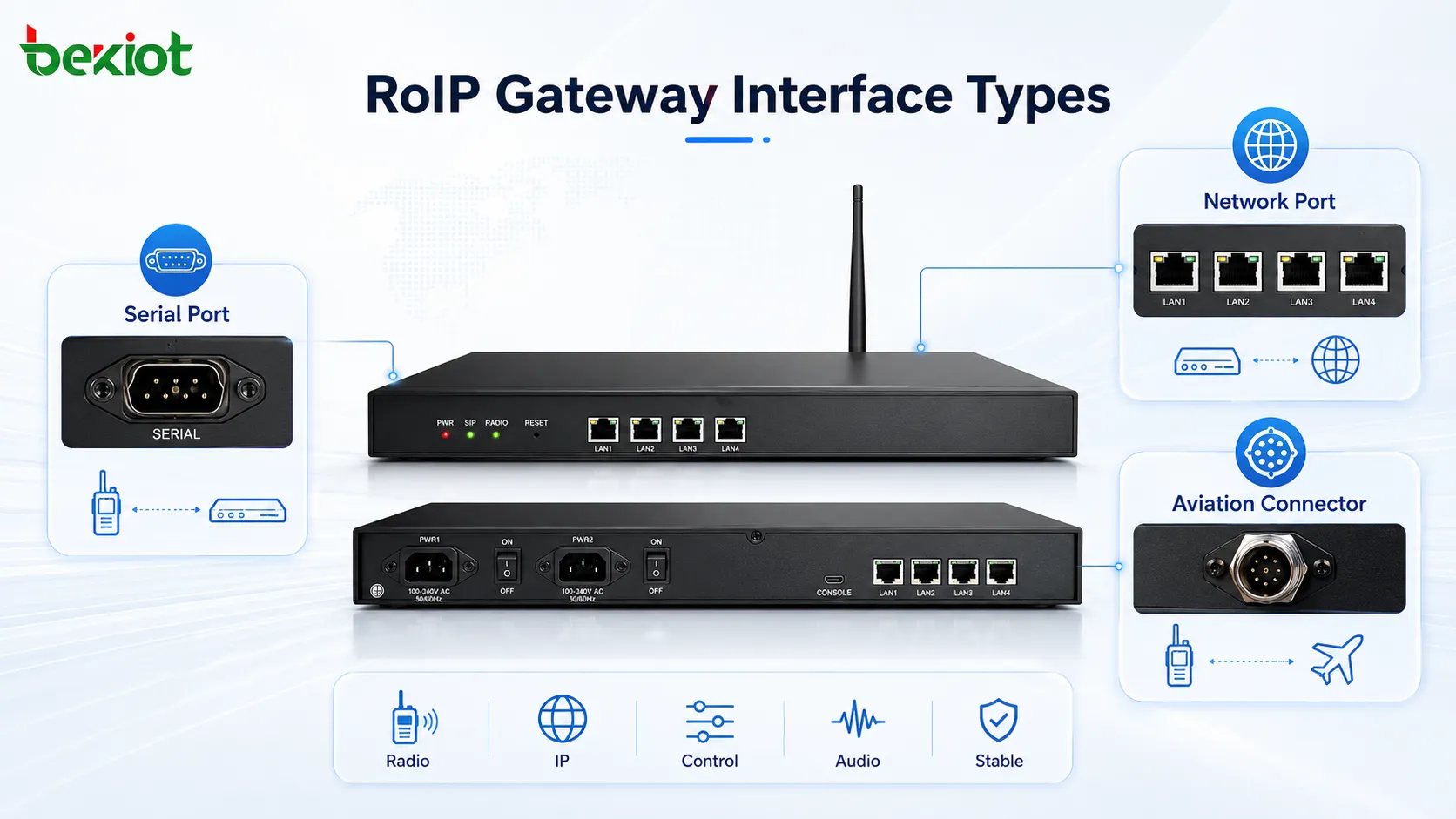
In real deployments, RoIP gateway interfaces are commonly divided into several types: serial interface connection, network interface connection, and aviation connector connection. Aviation connectors may also use different pin structures, such as 5-pin, 6-pin, or 9-pin designs. Each interface type has its own use case, and the best choice depends on the radio device, field environment, required functions, and integration depth.
Serial Ports for Control and Device Adaptation
Serial ports are often used for control signal interaction, configuration, or device-level communication. In some radio gateway applications, a serial interface can help the gateway exchange status information with external devices or provide a control path for radio operation. It may also be used in systems where the radio equipment exposes certain functions through serial communication.
The advantage of serial interfaces is that they are relatively common in industrial and communication equipment. They can support simple control logic, device commands, or status feedback in certain integration projects. For engineers familiar with radio control systems, serial communication may be useful when the project requires structured control rather than only audio transmission.
However, serial ports are usually not enough to complete the entire radio gateway function by themselves. A RoIP gateway still needs audio input, audio output, PTT control, grounding, and sometimes COR or other detection signals. In high-power radio environments, cable shielding and connector reliability must also be considered. Therefore, serial ports are more suitable as auxiliary interfaces or control interfaces rather than the only radio-side connection method.
Ethernet Ports for IP Networking and Platform Access
The network port is the core interface on the IP side of a RoIP gateway. Through Ethernet, the gateway can connect to a LAN, WAN, private network, VPN, dispatch platform, SIP server, IPPBX, softswitch system, recording platform, or public network PTT system. This is the interface that allows traditional radio communication to enter the IP communication environment.
In SIP-based deployments, the network port allows the radio channel to be registered or connected as an IP communication resource. A command center can then use dispatch software, SIP phones, softphones, or unified communication systems to communicate with radio users. This makes the radio channel easier to manage, record, route, monitor, and integrate with other systems.
The network interface is also important for cross-site communication. A radio channel at one site can be connected to a gateway, transmitted over IP, and then linked with another radio channel, dispatch platform, or communication center in another location. This is one of the most common reasons for using RoIP in industrial parks, mines, transportation networks, energy facilities, campuses, ports, emergency command systems, and public safety projects.
Aviation Connectors for Stable Field Wiring
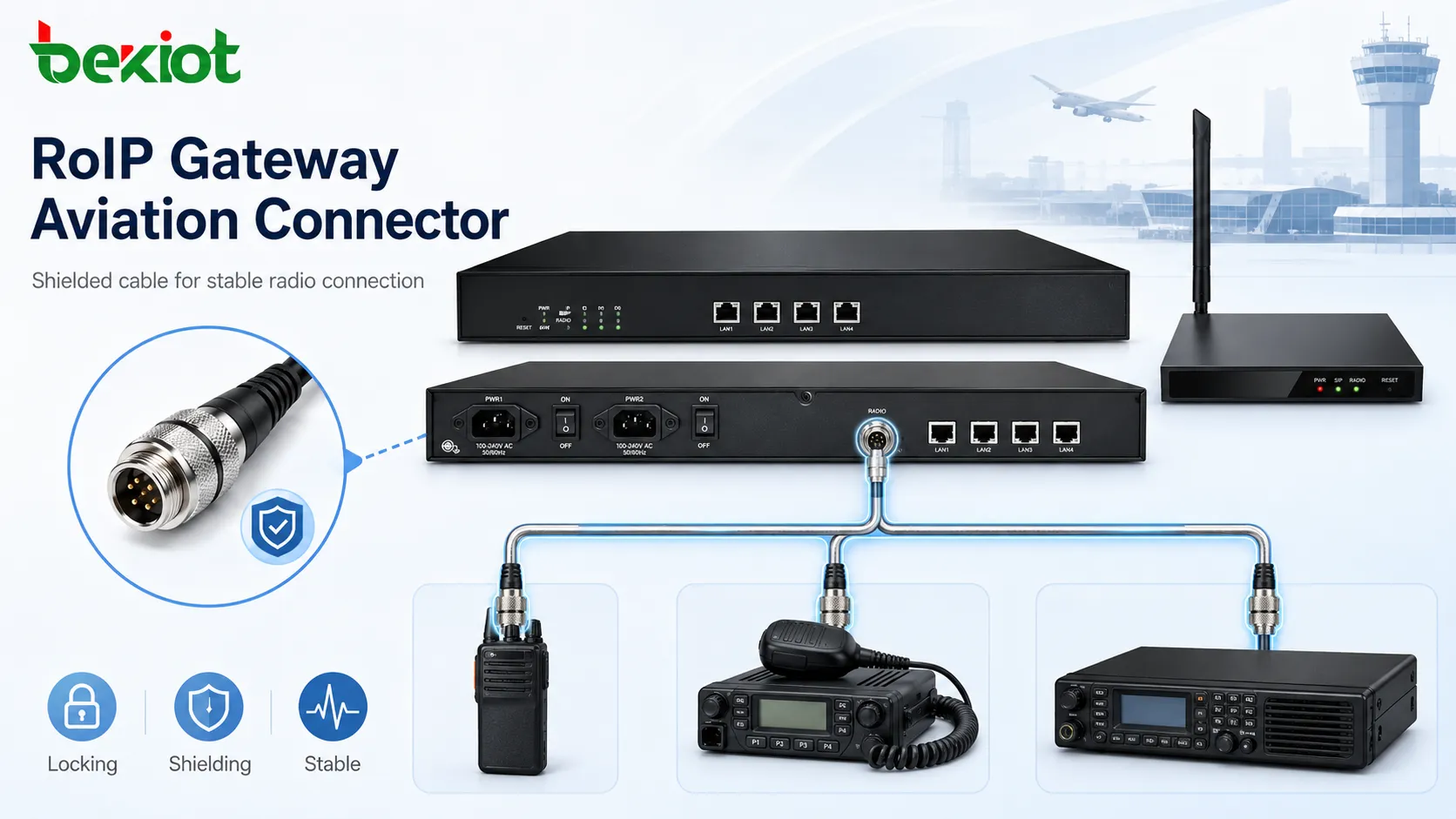
Aviation connectors are widely used on the radio side of RoIP gateways because they provide a stronger and more stable physical connection. Compared with common loose cable interfaces, aviation connectors usually offer better mechanical locking, more reliable contact, and better support for shielded cables. This is especially useful in industrial environments, mobile command vehicles, control rooms, equipment cabinets, and high-interference radio installations.
Radio equipment can generate strong electromagnetic interference during transmission. Common handheld radios may transmit at 2W or 5W, while vehicle radios and base stations may transmit at 10W or higher. Some radio systems can even reach tens of watts of transmit power. If the gateway cable is not properly shielded, the transmitted RF energy may interfere with the gateway itself, causing noise, unstable triggering, poor audio quality, or communication failure.
A shielded aviation connector, combined with a suitable shielded cable, can reduce interference on the cable segment and improve connection reliability. This is one reason why aviation connectors are often preferred in professional RoIP gateway deployments where the gateway must connect to high-power vehicle radios, VHF/UHF radio systems, or complex communication environments.
Why Pin Count Changes the Available Functions
Aviation connectors are not all the same. A connector may use 5 pins, 6 pins, 9 pins, or other structures depending on the gateway design and the required signal definitions. The number of pins directly affects how many audio, control, and detection signals can be supported.
For basic radio connection, four signal definitions are usually required: audio input, audio output, ground, and PTT control. With these four lines, the gateway can send audio to the radio, receive audio from the radio, provide a common ground reference, and trigger push-to-talk transmission.
However, a basic four-signal design may not deliver the best result in every project. Some radios, especially vehicle radios or higher-end radio terminals, can provide more complete signal definitions. If the gateway interface does not expose these signals, the system may lose useful functions such as faster receiving detection, more accurate trigger control, better audio balance, or improved noise performance.
PTT Control and the Need for Accurate Triggering
PTT, or Push-to-Talk, is one of the most important control signals in a RoIP gateway. When the IP side needs to transmit voice to the radio side, the gateway must trigger the radio into transmit mode. If PTT timing is not handled properly, the first part of the speech may be clipped, delayed, or lost.
This is why many RoIP gateway systems need proper PTT buffering and trigger control. Voice may need to be buffered for a short time before transmission starts, so the radio has enough time to enter transmit state. Without this design, users may hear incomplete speech, especially when dispatch operators speak immediately after pressing a talk button.
PTT wiring must be matched with the radio’s electrical requirements. Different radios may use different trigger logic, grounding methods, and interface definitions. A flexible gateway interface and well-designed cable can make adaptation easier and reduce project debugging time.
COR Signals Improve Response and Detection
COR, often understood as Carrier Operated Relay or carrier detection signal, is useful when connecting RoIP gateways to vehicle radios, base stations, or radio systems that provide receiving status output. COR allows the gateway to know more accurately when the radio is receiving a valid signal.
Compared with relying only on VOX voice activation, COR triggering can reduce delay and improve control accuracy. VOX depends on detecting audio energy, so it may be affected by noise, weak voice, background sound, or sensitivity settings. COR provides a clearer electrical status signal from the radio, making the gateway response more predictable.
In applications such as command dispatch, emergency communication, industrial coordination, and public network PTT interconnection, reduced delay and accurate channel detection are important. This is why a connector with enough pins to support COR signals can be more suitable for professional RoIP integration.
Balanced Audio Lines Help Improve Sound Quality
In simple radio connections, audio input and output may only use single-ended signal definitions. This can work for some devices, but it may not be ideal for higher-end radios or environments with strong interference. Some professional radios provide positive and negative audio signal lines for microphone input and speaker output.
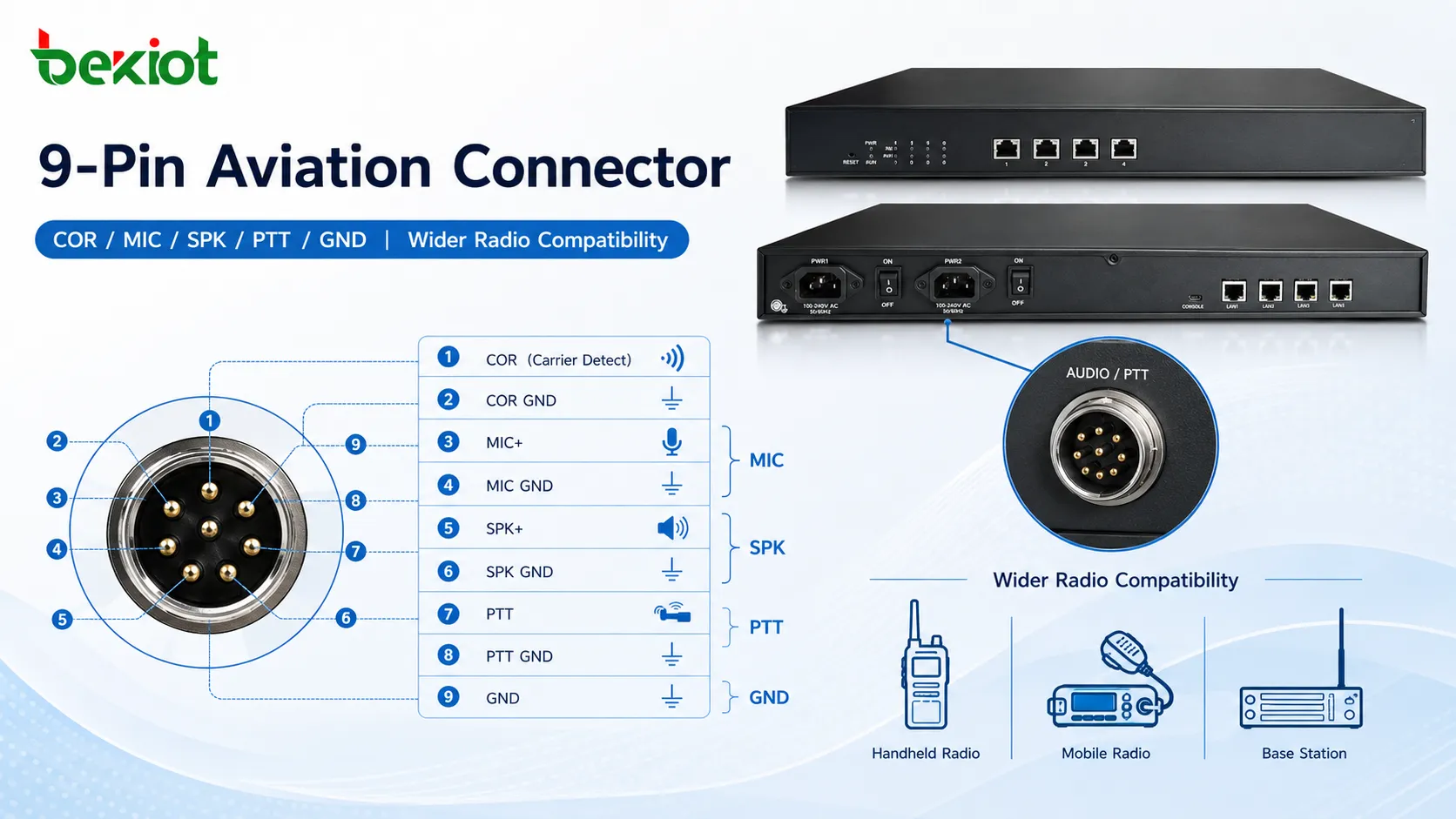
A 9-pin aviation connector design can provide more complete signal definitions, such as COR+, COR-, MIC+, MIC-, SPK+, SPK-, PTT, and ground. These definitions allow the gateway to adapt to more radio types and support better audio wiring. They also help reduce the risk of low volume, poor sound quality, unstable audio level, or failed connection with certain professional radios.
If a gateway only provides a simpler 5-pin or 6-pin connector without negative audio signal definitions, some radios may still work, but the result may not be ideal. In some cases, the radio may have low output volume, distorted audio, high noise, or incomplete compatibility. For projects involving multiple radio brands or high-end terminals, a richer pin definition can make integration more reliable.
Comparing Common Interface Options
| Interface Type | Main Function | Typical Use | Key Consideration |
|---|---|---|---|
| Serial Port | Control communication or device-level interaction | Special radio control, external equipment connection, configuration-related applications | Usually needs to work with audio and PTT wiring |
| Ethernet Port | IP networking and SIP platform access | Dispatch system, IPPBX, softswitch, public network PTT, recording, remote access | Network latency, packet loss, routing, VPN, and security policy affect voice quality |
| 5-pin or 6-pin Aviation Connector | Basic radio audio and PTT connection | Simple radio gateway connection with limited signal requirements | May not support complete audio negative lines or COR functions |
| 9-pin Aviation Connector | More complete radio audio, PTT, COR, and ground wiring | Vehicle radio, high-power radio, professional radio integration, multi-brand radio adaptation | Requires correct cable definition and signal matching for each radio model |
Matching Interfaces with Project Scenarios
The best interface type depends on the actual deployment scenario. If the project only needs a simple connection to a basic handheld radio, a simpler connector may be enough. If the project needs to connect vehicle radios, high-power radio stations, or multiple radio models, a more complete aviation connector interface is often more practical.
If the goal is to connect radio users with SIP phones, dispatch consoles, IP intercom terminals, or public network PTT platforms, the Ethernet and SIP side must also be planned carefully. The gateway should support stable IP communication, clear audio processing, proper signaling conversion, and reliable channel management.
If the system needs to support multiple radio ports, cross-port interconnection, talk groups, remote dispatch, monitoring platform access, or multicast communication, interface selection should be considered together with the software platform. A good RoIP solution is not only about one connector; it is about matching radio wiring, network transmission, dispatch logic, and operation workflow.
Audio Adjustment and Field Debugging Matter
Different radios often have different microphone input levels, speaker output levels, impedance characteristics, and grounding methods. Even when the connector pin definition is correct, the audio may still need adjustment. Input gain, output gain, VOX sensitivity, trigger threshold, and PTT buffer time can all affect final communication quality.
In professional RoIP deployment, the gateway should support flexible audio tuning. Adjustable gain helps solve problems such as low voice, excessive volume, distortion, or background noise. VOX sensitivity adjustment can help the system identify speech more accurately when COR is not available. PTT voice buffering can reduce speech clipping at the beginning of transmission.
Field testing is necessary before final delivery. Engineers should test receiving audio, transmitting audio, PTT timing, COR detection, delay, noise level, cable shielding, and long-term stability. For projects involving emergency dispatch or industrial safety communication, this testing process is especially important.
Integration with SIP and Wider Communication Systems
On the platform side, many RoIP gateways use SIP to connect radio channels with IP communication systems. SIP support allows radio users to communicate with SIP phones, IP dispatch consoles, IPPBX systems, softswitch platforms, and recording servers. It also makes the radio channel easier to include in a unified communication architecture.
In some projects, RoIP gateways also need to support DTMF signaling, multicast, monitoring platform integration, web management, status display, and audio test tools. These functions help the gateway become more than a simple audio converter. It can become a controlled communication node inside a larger dispatch or command system.
This is useful when radio communication must be connected with video monitoring, alarm systems, industrial control rooms, public network intercom platforms, or emergency command centers. The gateway interface determines whether the radio can be physically connected, while the protocol and software functions determine whether the system can be managed efficiently.
Practical Selection Principles
When choosing a RoIP gateway interface, the first step is to confirm the radio type. Handheld radios, vehicle radios, base stations, analog repeaters, and digital radio systems may require different cables and signal definitions. The second step is to check whether the project needs only basic audio and PTT, or whether it also needs COR, balanced audio lines, insertion detection, or advanced trigger control.
The third step is to evaluate the electromagnetic environment. If the radio uses higher transmit power, such as 10W or above, or if the equipment is installed near RF devices, industrial power systems, or long cable runs, shielded aviation connectors are usually safer than loose or poorly shielded wiring.
The final step is to consider future expansion. A project may start with one radio channel, but later require more radio ports, SIP integration, public network PTT access, recording, monitoring, or command dispatch. Choosing an interface design with richer signal support can reduce later replacement and re-engineering cost.
Conclusion
RoIP gateway interface types include serial ports, Ethernet ports, and aviation connector interfaces. Serial ports are mainly used for control or auxiliary communication. Ethernet ports connect the gateway to IP networks, SIP systems, dispatch platforms, and public network PTT services. Aviation connectors are commonly used for radio-side wiring because they provide stronger physical connection, better shielding, and more complete signal definitions.
For basic radio connection, audio input, audio output, ground, and PTT may be enough. For professional radio integration, especially with vehicle radios, base stations, high-power radios, or multiple radio brands, COR signals and balanced audio definitions can greatly improve compatibility, response speed, and audio quality.
In practical projects, the interface should not be selected only by appearance or pin count. The right choice depends on radio type, transmit power, electromagnetic environment, required control signals, SIP integration, dispatch workflow, and future expansion needs. A well-designed RoIP gateway interface helps traditional radio systems become stable, manageable, and ready for IP-based communication.
FAQ
Can one RoIP gateway interface fit all radios?
No. Different radios may use different audio levels, pin definitions, trigger logic, and grounding methods. Dedicated cables or interface adaptation are often required.
Is VOX enough for all radio gateway applications?
VOX can work in simple scenarios, but it may be affected by background noise or sensitivity settings. For professional systems, COR triggering is often more accurate.
Why does cable quality affect RoIP performance?
The cable carries audio and control signals between the radio and gateway. Poor shielding, wrong wiring, or unstable contact can cause noise, delay, low volume, or failed transmission.
Do RoIP gateways need audio gain adjustment?
Yes. Different radios output different audio levels. Input and output gain adjustment helps match volume, reduce distortion, and improve speech clarity.
Should the interface be selected before or after choosing the dispatch platform?
Both should be considered together. The radio-side interface must match the radio equipment, while the IP-side protocol and platform connection must match the dispatch or communication system.







