


IoT projects usually begin with one basic question: how should field devices connect to the network? Wi-Fi, LoRa, NB-IoT, 4G, and 5G can all be used in different scenarios, but they are not designed for the same type of device or the same data workload. For public cellular IoT deployment, NB-IoT and 4G/5G are two common choices, yet their strengths are very different.
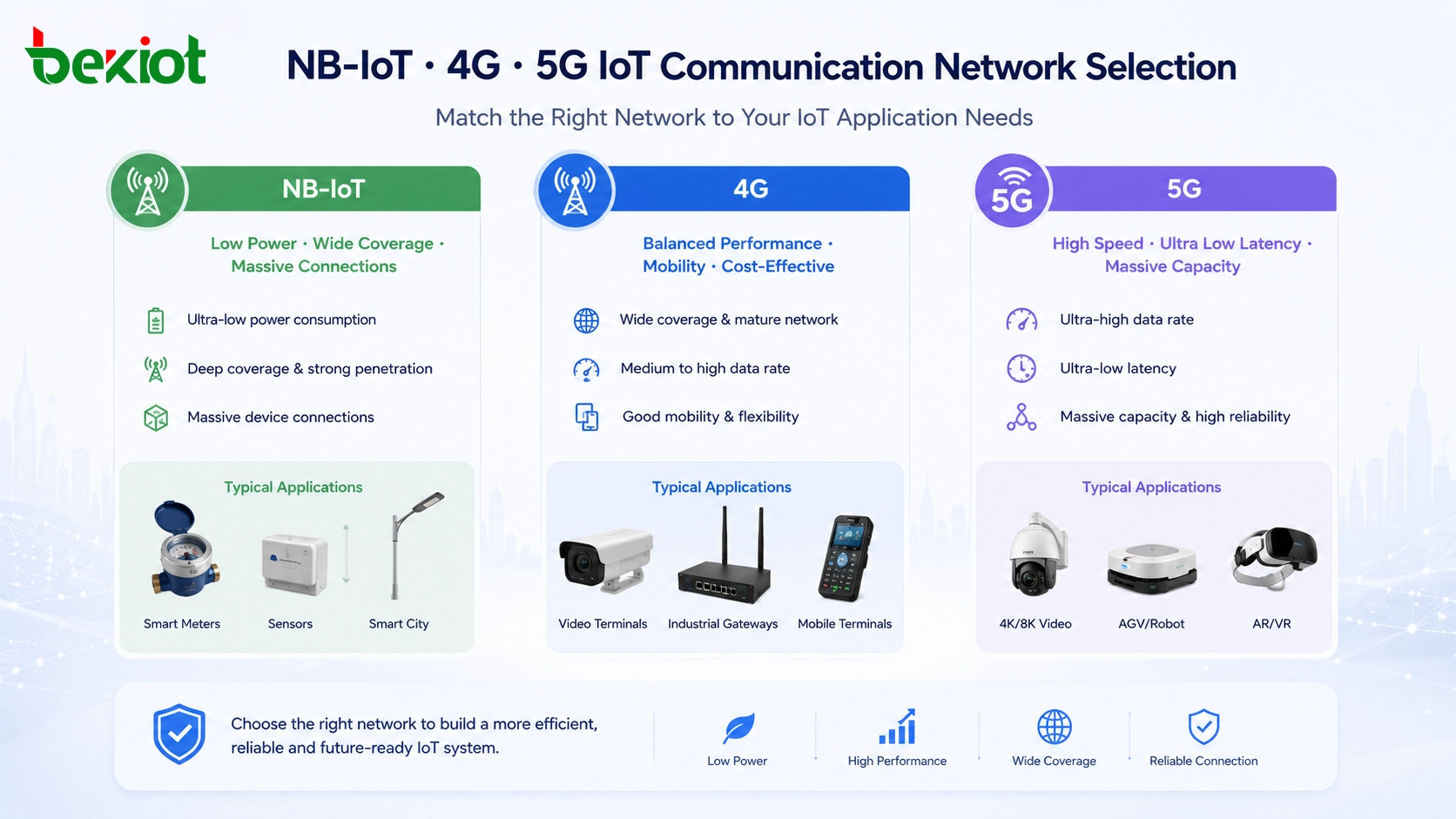
NB-IoT is designed for low-power, low-data-rate, wide-area IoT communication. It is suitable for sensors, smart meters, alarm devices, and other terminals that send small amounts of data. 4G and 5G cellular networks are more suitable for devices that need higher bandwidth, faster response, larger data transmission, audio, video, mobile applications, or real-time interaction. Choosing the right network affects battery life, communication cost, platform design, device stability, and long-term maintenance.
Start from the device workload
The first selection point is the type of device and the amount of data it needs to send. Many IoT terminals only report simple values, such as temperature, humidity, water level, gas concentration, meter readings, door status, battery status, or alarm signals. These devices do not need high bandwidth, but they do need long battery life, stable coverage, and low communication cost.
NB-IoT fits this type of workload well. It is designed to connect a large number of low-power devices that transmit small packets of data. For many sensors and metering terminals, the device may remain in low-power mode most of the time and only wake up periodically to report data. Under suitable conditions, this design can support battery operation for several years.
4G and 5G are better suited to devices with heavier communication requirements. Smart terminals, mobile inspection devices, video equipment, industrial gateways, vehicle-mounted devices, tablets, and edge computing terminals may need faster uplink and downlink speeds. These applications usually consume more power, but they can support richer data transmission and more interactive services.
Data rate defines what the network can carry
NB-IoT has a relatively low transmission rate. In many IoT applications, the data rate may range from a few hundred bits per second to hundreds of kilobits per second. This is enough for periodic reporting, simple alarms, metering data, and status monitoring. It is not suitable for large files, real-time video, high-definition audio, or frequent interactive data exchange.
4G networks can support data rates at the megabit-per-second level, which makes them suitable for applications that require faster data upload and download. 5G can further support higher bandwidth, lower latency, and more advanced mobile communication capabilities when the project environment and terminal devices support it.
This difference is important in solution design. If the device only reports a small sensor value every few minutes, using a high-bandwidth network may increase cost and power consumption without adding much value. If the device needs video, remote control, large data upload, or real-time interaction, NB-IoT will not be enough.
Coverage requirements are not the same
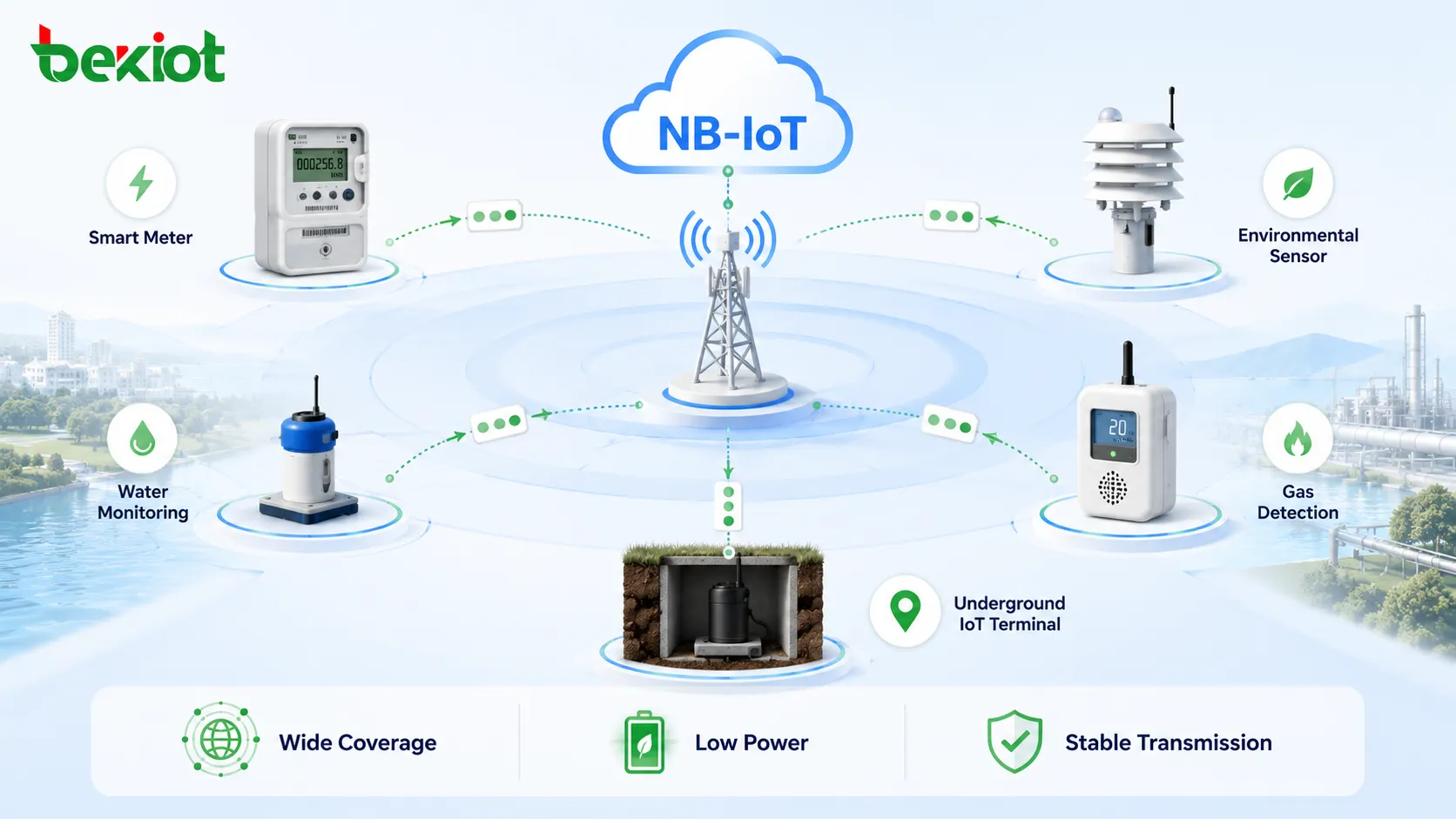
NB-IoT belongs to the low-power wide-area network category. It is designed to provide wide coverage and better penetration for many fixed IoT terminals. This makes it useful in basements, equipment rooms, meter wells, corridors, utility spaces, and other locations where ordinary wireless coverage may be difficult.
In projects such as smart water meters, smart electricity meters, gas monitoring, smoke detection, environmental sensing, and municipal facility monitoring, devices may be distributed across buildings, streets, underground spaces, and remote corners. NB-IoT can help reduce the need for local gateway installation or complex wiring in these scenarios.
4G and 5G also provide wide-area coverage through cellular networks, but their practical performance depends on operator coverage, base station density, indoor signal quality, frequency band, terminal antenna design, and local network load. In remote or shielded areas, the project team still needs to test signal quality before deployment.
Power consumption changes the whole maintenance model
Battery life is one of the biggest differences between NB-IoT and high-speed cellular communication. Many NB-IoT terminals are designed for low-frequency reporting and long sleep periods. This helps reduce power consumption and makes the technology suitable for devices that are difficult to maintain frequently.
For example, a water meter, smoke sensor, manhole sensor, or environmental monitoring terminal may be installed in a place where replacing batteries is inconvenient. If thousands of devices are deployed, maintenance cost becomes a major issue. A low-power network can significantly improve the long-term operating model.
4G and 5G terminals usually need more power because they support faster transmission, richer protocols, and more complex applications. This is not a problem for devices with stable power supply, such as industrial gateways, video terminals, vehicle devices, and outdoor cabinets. However, for small battery-powered sensors, power consumption must be carefully evaluated.
Cost should be judged across the full lifecycle
NB-IoT devices are often designed for low-cost, large-scale deployment. Since the target devices usually have simple functions and low data requirements, the terminal hardware, communication module, and service model can be optimized for massive IoT projects.
4G and 5G devices usually require more processing capability, stronger communication modules, higher power supply capacity, and more complex application support. The terminal cost may be higher, but the network can carry richer services such as video transmission, real-time data upload, remote control, mobile applications, and high-speed gateway communication.
The best choice should not be based only on module price. Project teams should also consider SIM or data plan cost, battery replacement cost, installation cost, maintenance cost, data volume, platform integration cost, and the value of the service being delivered. A low-bandwidth device should not be over-designed, while a high-bandwidth application should not be forced onto a low-rate network.
A comparison for project planning
| Selection Factor | NB-IoT | 4G / 5G |
|---|---|---|
| Typical Device Type | Sensors, meters, alarm terminals, status monitors | Mobile terminals, gateways, video devices, industrial equipment |
| Data Requirement | Small packets, periodic reporting, alarm data | Large data, real-time interaction, audio, video, remote control |
| Typical Data Rate | From hundreds of bps to hundreds of kbps | Mbps level or higher depending on network and device capability |
| Power Consumption | Low power, suitable for long battery life | Higher power, better for powered terminals or rechargeable devices |
| Coverage Focus | Wide-area coverage and better penetration for fixed IoT points | Broad mobile network coverage with higher bandwidth services |
| Best Fit | Massive low-power IoT sensing | High-speed IoT, mobile access, video, and intelligent terminals |
Application scenarios should guide the choice
NB-IoT is suitable for projects where devices are numerous, fixed, low-power, and low-data-rate. Typical examples include smart water meters, smart electricity meters, gas meters, smoke detectors, environmental sensors, parking sensors, manhole monitoring, pipeline monitoring, and facility status reporting.
These applications usually do not need continuous high-speed data transmission. They need reliable small-packet delivery, wide coverage, long battery life, and manageable cost. The platform mainly receives data, stores records, triggers alarms, and displays trends or device status.
4G and 5G are suitable for applications that need higher speed or richer interaction. Typical examples include video surveillance backhaul, mobile law enforcement terminals, industrial routers, vehicle-mounted equipment, remote inspection terminals, outdoor communication gateways, emergency command devices, mobile robots, and smart terminals with multimedia functions.
Platform design must match the communication mode
The communication network also affects the IoT platform architecture. NB-IoT systems often focus on device registration, small-packet data parsing, alarm rules, battery status monitoring, offline judgment, and large-scale device management. Since many terminals may report data periodically, the platform should handle massive device access and event-based data processing.
4G and 5G applications may require more real-time communication, larger data storage, remote configuration, video stream management, edge computing, or continuous connection management. The platform may need stronger bandwidth planning, data security, device authentication, remote upgrade capability, and application-level service integration.
A mature IoT solution should not simply choose a network and then connect devices. It should design the terminal, communication module, data reporting strategy, platform interface, alarm process, maintenance workflow, and security policy as one complete system.
Hybrid networking is often more practical
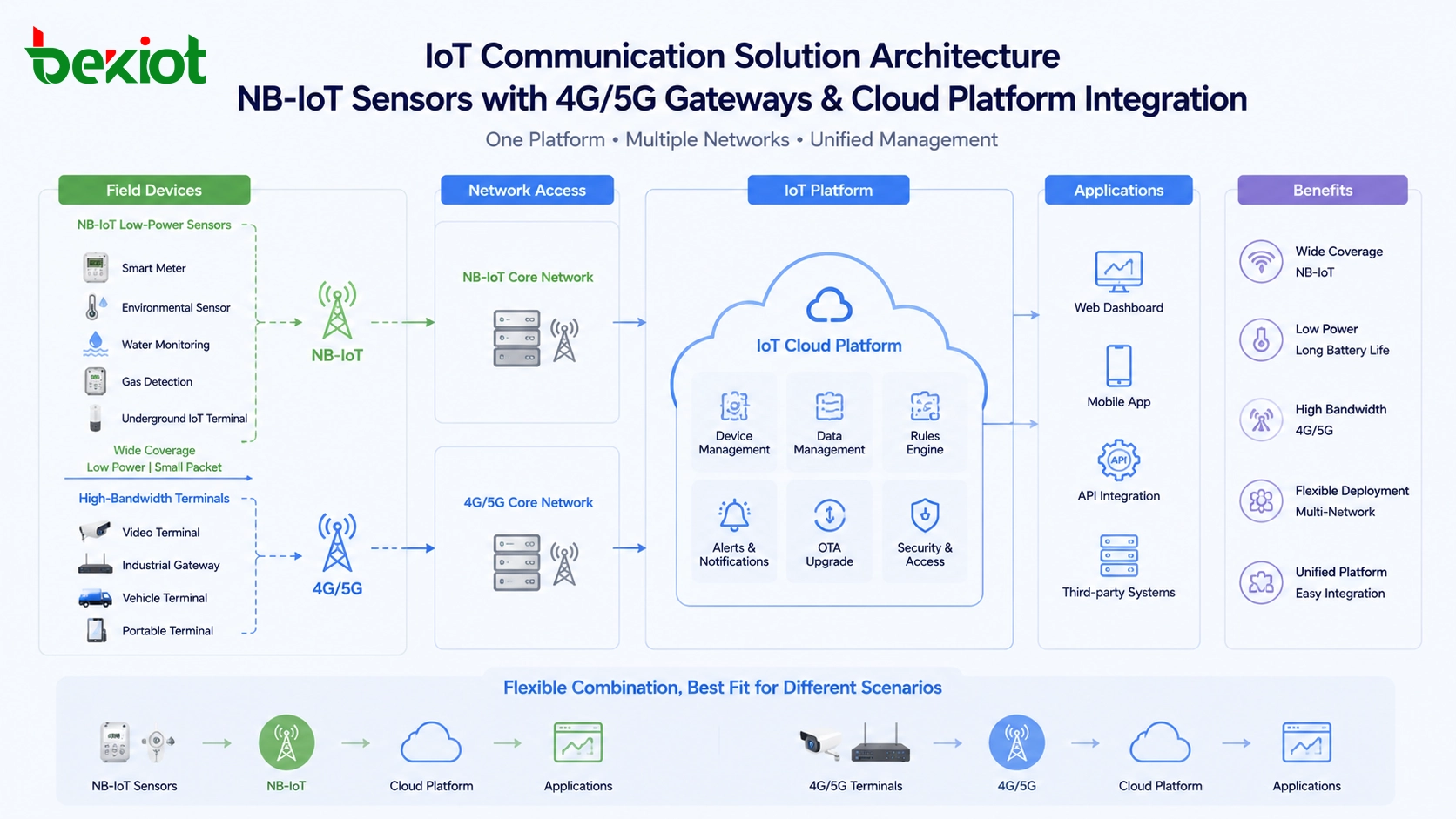
Many IoT projects do not need to choose only one network. A smart park, industrial site, campus, utility system, or city-level platform may use different communication methods at the same time. NB-IoT can be used for low-power sensors and meters, while 4G or 5G can be used for gateways, mobile devices, video terminals, and high-speed field equipment.
This hybrid approach allows each device to use the most suitable network. Low-data terminals can reduce cost and extend battery life, while high-data devices can keep the speed and responsiveness needed for advanced applications. The platform then integrates data from different networks into one management interface.
For project owners, this is usually more practical than forcing all devices onto one communication standard. The goal is not to choose the most advanced network, but to choose the most suitable network for each device and each business process.
Planning points before deployment
Before selecting NB-IoT, 4G, or 5G, project teams should define the device type, installation environment, reporting frequency, data size, latency requirement, power supply condition, expected battery life, coverage area, and operating cost. These factors will directly affect the communication choice.
Signal testing is also important. Even though cellular networks provide wide coverage, the actual performance at the installation point may be affected by walls, underground structures, metal cabinets, terrain, base station distance, and network congestion. For critical applications, field testing should be completed before large-scale deployment.
Security and maintenance should be planned at the same time. The platform should support device identity management, data protection, remote configuration, alarm tracking, offline monitoring, and lifecycle maintenance. This ensures that the communication network can support stable operation after the project is delivered.
Conclusion
NB-IoT and 4G/5G are both important cellular IoT communication technologies, but they serve different purposes. NB-IoT is better for low-power, low-data-rate, wide-coverage applications such as sensors, meters, and alarm devices. 4G and 5G are better for higher-speed, higher-bandwidth, and more interactive IoT applications such as video terminals, mobile devices, industrial gateways, and smart field equipment.
A successful IoT communication solution should be based on real application needs rather than a single technology label. By matching device workload, power consumption, coverage, data rate, cost, and platform requirements, project teams can build a more stable, scalable, and cost-effective IoT network.
FAQ
Can NB-IoT and 4G or 5G be used in the same IoT project?
Yes. Many projects use NB-IoT for low-power sensors and 4G or 5G for gateways, mobile terminals, or video devices. The platform can integrate data from different network types.
Is NB-IoT suitable for real-time control?
It depends on the control requirement. NB-IoT is better for status reporting and low-frequency data transmission. Applications that require fast response or continuous interaction should usually consider 4G, 5G, wired Ethernet, or another low-latency network.
Why do smart meters often use NB-IoT?
Smart meters usually send small amounts of data and may need long battery life, wide coverage, and low maintenance. These requirements match the design strengths of NB-IoT.
When should an IoT device choose 4G or 5G instead?
4G or 5G is more suitable when the device needs high-speed data, audio, video, mobile access, remote maintenance, or frequent interaction with the platform.
Does higher bandwidth always mean a better IoT solution?
No. Higher bandwidth may also bring higher power consumption and cost. The better choice is the network that matches the device workload, installation environment, and long-term maintenance model.







