


Two-way radio communication has long been an important tool for emergency response, public safety, energy operations, transportation, industrial parks and field service teams. Radios are reliable, easy to operate and highly effective for fast group communication. However, as command centers become more digital, voice-only radio systems can no longer meet the full requirements of modern dispatch coordination.
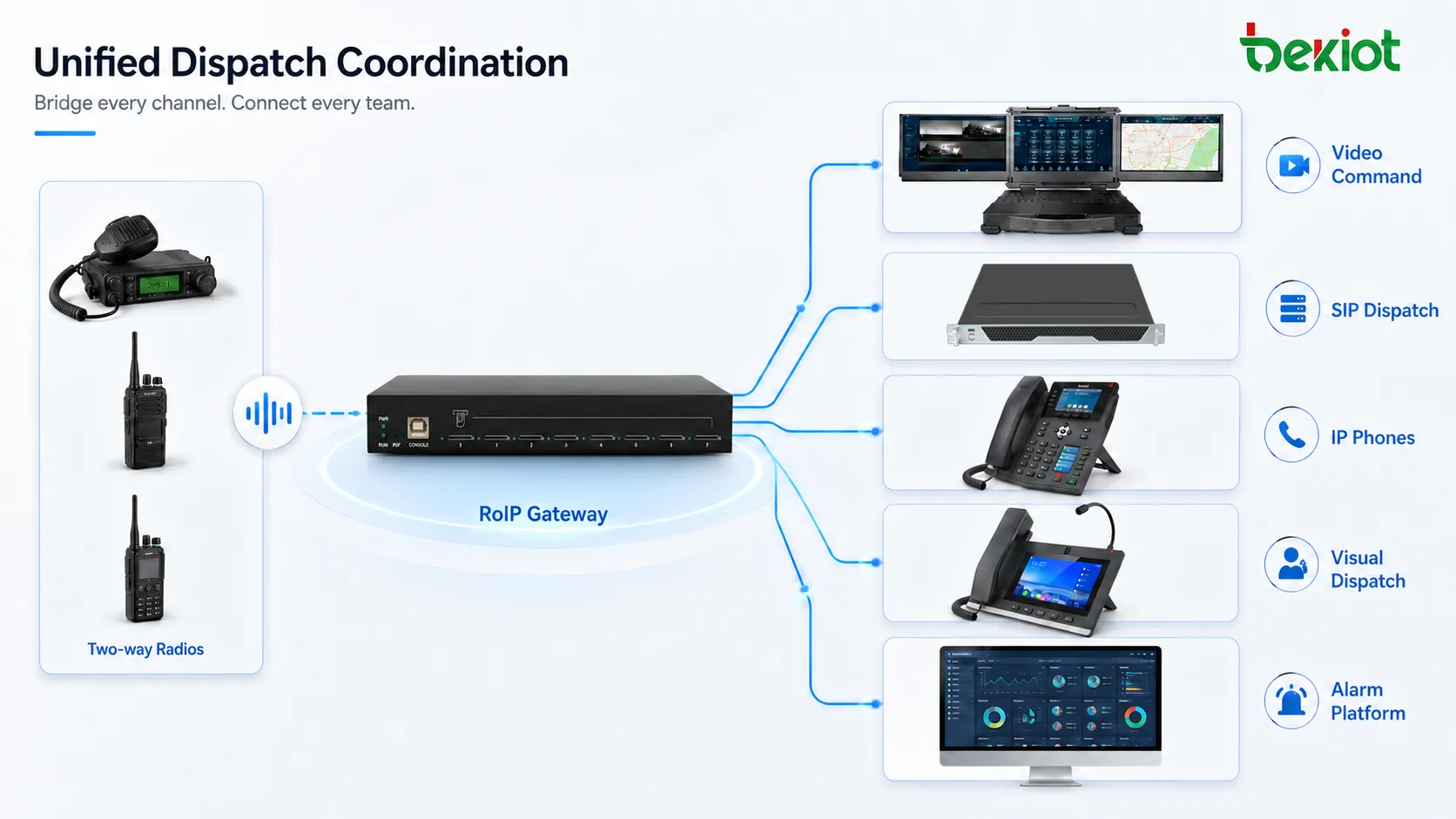
A RoIP Gateway provides the bridge between traditional radio communication and IP-based command platforms. It connects radio users with SIP systems, IP phones, video command platforms, broadcasting systems, alarm systems and business applications. Instead of keeping field radios as isolated communication tools, the gateway turns them into active resources inside a wider command and dispatch environment.
From Voice Calling to Real Operational Coordination
Traditional radio systems mainly solve the problem of voice communication. Users in the same radio network or the same talk group can speak quickly, which is very useful for patrol, rescue, maintenance and on-site coordination. But modern command work requires more than “being able to talk.” It requires cross-system coordination, event linkage, fast notification, status visibility and direct communication between the command platform and frontline teams.
In many projects, radio users, IP phone users, video operators, security platforms and business systems are still separated. The dispatch center may see an alarm on screen but cannot directly call the nearest radio group. A video platform may detect an abnormal event but cannot automatically notify field personnel. A business system may generate a task, but the instruction still needs to be relayed manually by an operator.
This is why a RoIP Gateway is not simply a radio accessory. It is a communication integration node that helps radio systems move from basic voice communication to command collaboration, alarm linkage and digital workflow integration.
The Access Gap Behind Legacy Radio Networks
Traditional radio networks are usually closed by design. They are built around specific channels, frequencies, groups or radio standards. This makes them reliable for internal team communication, but also limits their ability to connect with external systems.
Common limitations include the inability to communicate outside the radio system, difficulty connecting with IP phones or SIP platforms, lack of linkage with video and business systems, and limited support for cross-region or cross-network dispatch. When operations expand across multiple sites, cities or departments, a single closed radio system often becomes insufficient.
For command centers, this creates a practical problem. Radio users may be close to the incident, but the command platform cannot reach them directly. Other systems may generate important information, but that information cannot be sent immediately to the people who need to act. The result is slower response, repeated manual relay and greater risk of missed instructions.
How the Gateway Connects Different Communication Systems
The core role of a RoIP Gateway is communication convergence and protocol conversion. It connects radio communication with IP-based voice and dispatch systems, allowing different networks and terminals to work together under one command architecture.
| Connection Type | Operational Value |
|---|---|
| Radio communication to IP phone | Allows office users, command staff and field radio users to communicate across terminal types. |
| Radio communication to SIP platform | Brings radio channels into SIP-based dispatch, IP PBX or unified communication systems. |
| Radio communication to broadcasting system | Supports wider voice notification, emergency announcement and public address linkage. |
| Radio communication to video command platform | Enables video events and dispatch actions to reach field radio groups quickly. |
| Radio communication to alarm or business platform | Allows system events, task instructions and alarm notifications to be pushed to frontline users. |
After integration, radio channels are no longer isolated islands. They become controllable communication resources inside the dispatch platform. Operators can call a radio group from a SIP console, bridge radio users into a conference, route alarm notifications to field teams or connect radio users with IP phone extensions.
Extending Communication Beyond Local Coverage
Radio communication is often limited by coverage, frequency planning and local network conditions. For a single facility or local team, this may be acceptable. But many command scenarios require communication across regions, branches, mobile teams and remote sites.
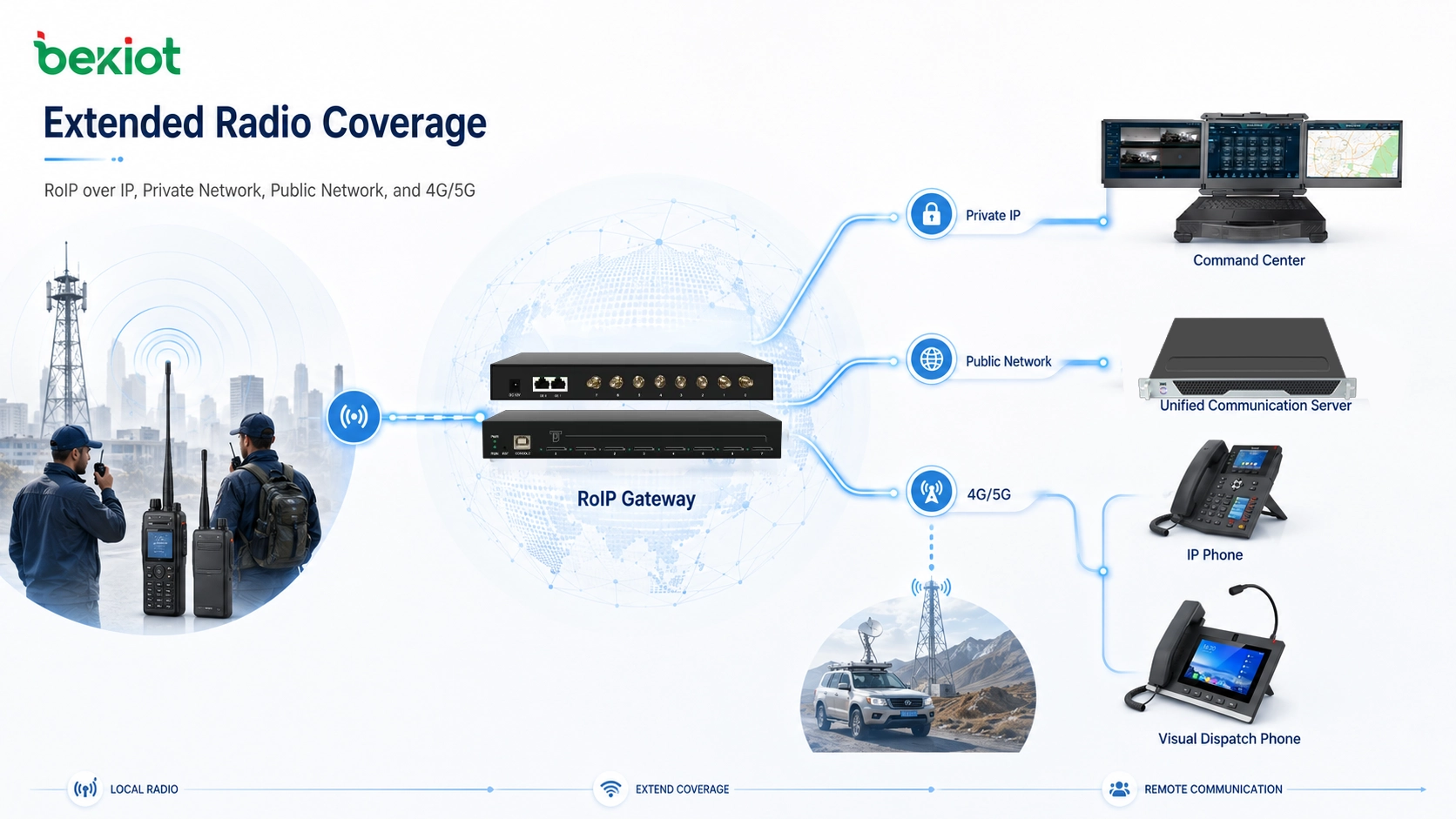
With a RoIP Gateway, radio communication can be extended through IP networks, private lines, public networks and 4G/5G links. This allows dispatch centers to connect radio users across different locations, support cross-city coordination and include remote branches or mobile personnel in the same communication workflow.
This capability is valuable for emergency command, transportation management, utilities, energy sites, industrial parks and multi-branch organizations. The radio system is no longer limited only by its original signal coverage area. It can become part of a wider communication network that reaches more teams and more locations.
Connecting Perception Systems with Frontline Action
Modern command centers usually include video surveillance, alarm platforms, GIS systems, access control, emergency broadcasting, duty management and business applications. These systems can detect events, generate tasks and display information, but the key question is whether the instruction can reach frontline personnel quickly.
A RoIP Gateway helps connect “system awareness” with “field execution.” For example, a video platform detects an abnormal situation. The dispatch platform triggers a response instruction. The RoIP Gateway routes the voice instruction or notification to the relevant radio group. Frontline personnel receive the message and respond immediately.
This changes the role of radio communication. It is no longer only a tool for people to speak with each other. It becomes a delivery channel for system-triggered commands, alarm notifications and coordinated response workflows.
Building a Closed-Loop Response Process
For emergency command and industrial safety, communication should not stop at message delivery. A complete workflow should include event detection, command confirmation, voice dispatch, field response, feedback collection and record review. A RoIP Gateway helps build this closed-loop process by connecting the dispatch platform with the radio users who perform the actual task.
When an alarm is triggered, the command system can notify the correct radio group, connect the dispatcher with frontline personnel and allow the response team to report status through the same communication chain. This reduces the gap between platform information and field action. It also helps managers understand whether the instruction was delivered, who responded and whether the issue has been handled.
In daily operation, the same logic can be used for maintenance dispatch, patrol coordination, duty handover, equipment fault handling and temporary task assignment. The gateway makes radio communication part of a trackable business process instead of a separate voice channel.
What Happens Without This Integration Layer
Without a RoIP Gateway, many command systems face the same problem: they can see events but cannot reach the right people directly. Video platforms, alarm systems and business applications may display important information, but field communication still depends on manual relay.
This often creates several operational risks. The radio system becomes an information island. Dispatchers must repeat messages between different systems. Instructions may be delayed, misunderstood or missed. Automated linkage becomes difficult, and intelligent dispatch cannot fully work because the final communication path to frontline users is disconnected.
When a RoIP Gateway is introduced, information can move from the system directly to people. Alarm events, dispatch instructions and emergency notifications can be delivered to radio groups, SIP users or connected communication resources more efficiently.
Unified Dispatch for Multi-Team Operations
Command work usually involves more than one team. Security staff, maintenance teams, emergency responders, control room operators, management personnel and external support units may all need to communicate during an incident. These users may not use the same terminals or networks.
A RoIP Gateway allows the dispatch system to create a shared voice workflow across different user groups. Radio users can communicate with IP phone users. SIP dispatch consoles can call radio groups. Video command operators can coordinate with field personnel. Broadcast systems can be used for wider notification when required.
This improves the coordination chain from event detection to command decision and field execution. It also reduces dependence on a single operator manually transferring messages between isolated systems.
Related Product: becke RoIP Gateway
The becke RoIP Gateway can be introduced as a radio-to-IP access device for dispatch command, emergency communication, industrial coordination and cross-network voice integration. It helps connect existing two-way radio resources with SIP platforms, IP phones, dispatch consoles, video command systems and unified communication platforms.
Operational Visibility and Record Management
Once radio communication is connected to the dispatch platform, command centers can manage it with better visibility. Radio channels can be named, grouped, monitored and operated according to departments, work zones, emergency levels or business roles. This makes daily dispatch easier and reduces confusion when several teams are active at the same time.
Recording and traceability are also important. In emergency response, security management, chemical production and utility operations, voice records may be needed for incident review, responsibility analysis, duty handover and compliance management. Through IP-based integration, radio calls can be included in centralized recording and event logs together with SIP calls and dispatch actions.
This gives managers a clearer view of what happened before, during and after an incident. Instead of relying only on verbal memory or scattered radio logs, the organization can review communication timelines, call participants, response actions and command decisions more accurately.
Security, Permission and Priority Control
Interconnection must be controlled carefully. Not every phone user, SIP extension or platform operator should have access to every radio group. A reliable solution should define user permissions, channel access rights, emergency priority, monitoring scope and operation logs based on real duty roles.
For example, a security supervisor may be allowed to call all patrol groups, while a maintenance team leader may only access technical support channels. Emergency operators may have higher priority when urgent instructions need to override normal communication. These rules help prevent misuse while keeping the system efficient in critical conditions.
Network security should also be considered. Since radio communication is extended through IP networks, the deployment should include proper network isolation, account management, access authentication and firewall planning. For high-security environments, private networks or dedicated transmission links may be preferred.
Typical Deployment Scenarios
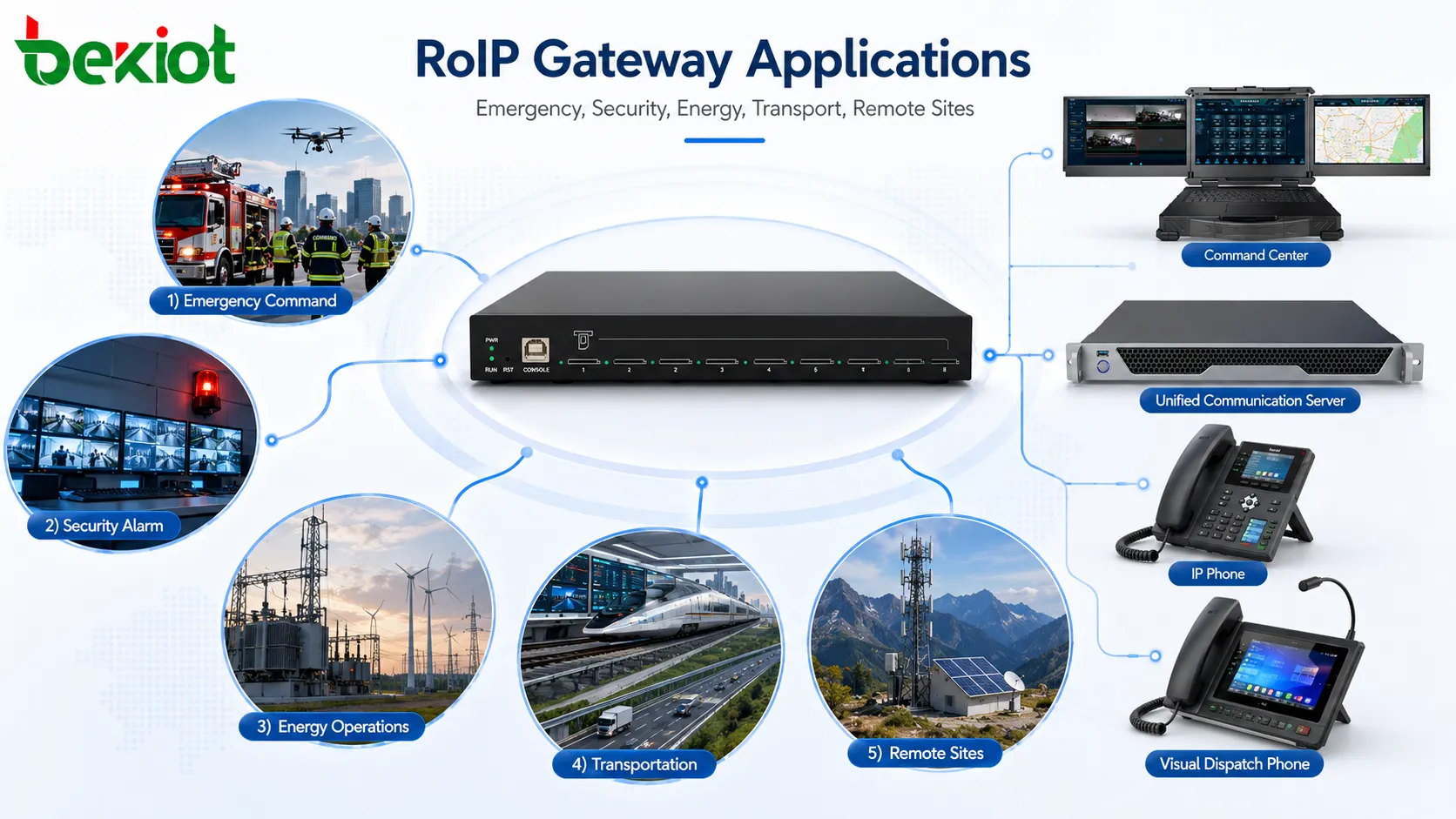
Emergency command
In emergency response, speed and clarity are critical. A RoIP Gateway allows the command platform to reach radio groups directly, deliver instructions quickly and connect field teams with rear command staff, phone users or other communication resources.
Security and alarm linkage
In security systems, alarms are often generated by cameras, sensors, access control devices or management platforms. Through RoIP integration, these alarm events can trigger voice notification to the relevant radio group, helping security teams respond faster.
Energy and chemical operations
Energy, utility and chemical sites often have distributed work areas and strict safety requirements. A RoIP Gateway supports communication between control rooms, patrol teams, maintenance staff and emergency groups across different zones or branches.
Transportation and park management
Railway stations, metro lines, highways, airports, ports, logistics parks and business parks require real-time coordination between dispatch centers and field teams. RoIP integration helps connect radio users with IP dispatch platforms, video systems and telephone users.
Unattended and remote sites
In unmanned substations, pump stations, tunnels, warehouses or remote facilities, system alarms may need to trigger automatic voice notification. A RoIP Gateway can help deliver these notifications to radio groups or dispatch users without waiting for manual relay.
Design Points for a Reliable Solution
Define the radio resources clearly
Before deployment, the project team should identify the radio system type, channel structure, group plan, PTT control method and available audio interface. Clear resource mapping helps the dispatch platform manage radio channels more accurately.
Plan the command workflow before integration
The system should not only connect devices. It should match real command behavior. Project teams should define which radio groups need to communicate with which SIP extensions, dispatch consoles, phone lines, broadcast zones or alarm events.
Control audio quality and response delay
Radio audio, SIP audio and platform audio may have different volume levels, codec behavior and delay. Proper gain adjustment, echo control and network quality planning are important for clear and stable communication.
Set permission and priority rules
Not every user should control every radio group. A professional dispatch system should define user permissions, emergency priority, monitoring rights, call groups and recording policies according to operational roles.
Keep backup communication paths
Emergency communication should always consider fallback operation. Even after radio systems are connected to an IP platform, organizations should keep backup methods for power failure, network interruption or platform maintenance.
Step-by-Step Deployment Approach
For existing radio users, phased implementation is often more practical than a complete replacement project. The first step is to identify the most important radio groups and connect them to the dispatch platform through the RoIP Gateway. This allows the organization to verify basic calling, audio quality, PTT behavior and dispatch operation.
The second step is to expand the integration scope. More radio channels, SIP extensions, IP phones, alarm events, video systems and broadcast zones can be added according to operational priority. At this stage, the project team should also refine naming rules, permission settings, recording policies and emergency call procedures.
The final step is workflow optimization. The system can be connected with duty management, GIS, video command, emergency plans and business systems. This turns radio communication from a standalone voice tool into a coordinated part of command decision-making and field execution.
Value for Long-Term System Evolution
A RoIP Gateway helps organizations protect existing radio investments while moving toward digital command systems. Instead of replacing all radios, the gateway connects them to SIP, IP dispatch and integrated communication platforms.
This gives organizations a smoother upgrade path. They can keep reliable radio communication for field teams while gradually adding video command, GIS location, alarm linkage, emergency broadcasting, recording, mobile applications and unified dispatch functions.
For industries that depend on fast field response, the RoIP Gateway is not an optional add-on. It is a key access layer that determines whether radio communication can truly participate in modern command collaboration.
FAQ
Can a RoIP Gateway work with existing two-way radios?
Yes. In many projects, existing radio channels can be connected through suitable audio and control interfaces, allowing the radio system to join an IP-based dispatch environment.
Does RoIP integration replace the radio system?
No. The purpose is usually to retain existing radio resources and connect them with modern dispatch platforms, IP phones and other communication systems.
Can radio users talk with IP phone users after integration?
Yes. Once the radio channel is converted into an IP or SIP communication resource, it can be connected with IP phones, dispatch consoles and other SIP-based endpoints.
Is this solution only for emergency command centers?
No. It is also useful for industrial parks, transportation systems, utility operations, chemical plants, security centers, remote sites and any organization that needs to connect radio users with digital communication platforms.
What is the main benefit of using a RoIP Gateway?
The main benefit is interoperability. It allows radio communication, IP voice, dispatch systems, alarms and other platforms to work together, reducing manual relay and improving response efficiency.







