


In emergency command, civil defense, public safety, industrial rescue, and multi-agency coordination scenarios, radio communication is still one of the most important tools for field response. Many key units already have their own radios, base stations, or trunking systems, but these systems are often separated by organization, region, frequency, technology standard, and deployment history.
The purpose of an emergency radio integration solution is to connect these scattered radio resources into one unified command and dispatch platform. Through RoIP gateways and a SIP-based integrated dispatch system, different agencies can keep their existing radio systems while enabling centralized calling, cross-system intercom, group dispatch, and emergency coordination from the command center.
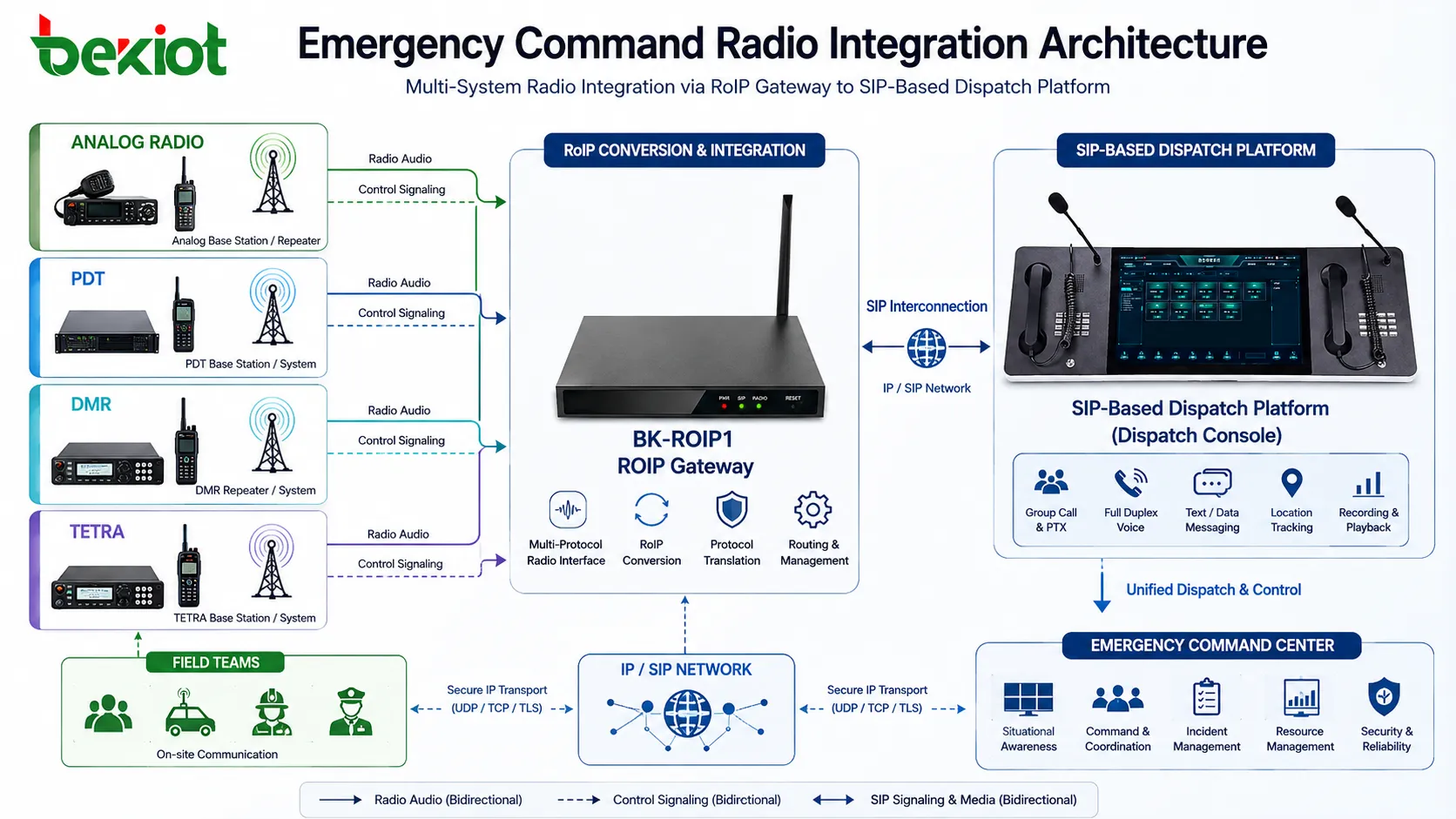
Why Emergency Teams Need Unified Radio Access
Emergency command environments often involve multiple organizations, such as government departments, civil defense units, industrial facilities, rescue teams, security agencies, transportation teams, and key infrastructure operators. Each unit may have built its own radio system according to its operational needs, budget, coverage area, and construction timeline.
These independent systems may work well inside their own organizations, but they become difficult to manage during joint operations. When an emergency occurs, the command center may need to quickly contact several units at once, establish temporary communication groups, call specific radio channels, and coordinate teams that normally use different intercom systems.
If these resources cannot be accessed from one platform, emergency coordination depends on manual relays, phone calls, separate dispatch desks, or temporary workarounds. This reduces response speed and makes command records harder to trace.
The core challenge is not whether each unit has radios, but whether all radio resources can be quickly connected, dispatched, and coordinated under one emergency command workflow.
Different Radio Standards Create Real Integration Barriers
In many regions and industries, radio systems are not built with the same standard. Some units still use ordinary analog radios. Some departments may use PDT systems, while others use DMR or TETRA trunking systems. Their system size, construction period, radio equipment, and operating methods may all be different.
This makes direct interconnection difficult. A command center cannot simply assume that every radio network can communicate with every other radio network. Different standards, interfaces, channels, and dispatch rules create technical and operational barriers.
For emergency command projects, replacing every existing radio system is usually unrealistic. It can be expensive, slow, disruptive, and unnecessary. A more practical method is to use RoIP gateways to access each unit’s existing radio resources and register them into a unified dispatch platform.
| Existing Radio Resource | Typical Challenge | Integration Method |
|---|---|---|
| Analog radio | Simple but isolated channel communication | Connect radio channel through RoIP gateway |
| PDT system | Professional trunking system used by specific departments | Access selected channels into unified dispatch |
| DMR system | Digital radio system with group and channel rules | Integrate through gateway-based radio access |
| TETRA system | Dedicated trunking communication for critical users | Bridge key communication channels to the command platform |
| SIP dispatch system | IP-based command and communication platform | Register RoIP gateways and manage radio resources centrally |
Distributed Gateway Deployment for Key Units
A practical solution is to deploy one RoIP gateway at each important unit or site. The gateway connects externally with the matching radio, base station, or radio channel used by that organization. It then registers to the integrated command and dispatch platform through the network.
With this structure, every unit does not need to abandon its current radio system. Instead, its radio channel becomes a manageable communication resource inside the command center. The dispatch platform can display connected resources clearly, allowing operators to know which units, channels, and radio groups are available.
This method is suitable for emergency management departments, civil defense command centers, industrial parks, large enterprises, transportation hubs, energy facilities, municipal agencies, and other environments where many independent radio resources must be coordinated.
Centralized Dispatch Through SIP-Based Platform
At the command center, an integrated dispatch server can be deployed as the central communication platform. All RoIP gateways from different units register to this platform. Once connected, the command center can manage radio access, SIP communication, dispatch groups, calling permissions, and emergency workflows from one interface.
The use of SIP communication makes deployment more flexible. Radio channels accessed through RoIP gateways can communicate with dispatch consoles, IP phones, conference rooms, mobile apps, and other SIP-based terminals. This allows radio communication to enter the same command system as telephony and IP communication.
For example, an operator can call a radio channel directly from the dispatch console. A meeting room can speak with field radio users. An IP phone can communicate with a radio group. A mobile app user can join a coordinated response. This greatly expands how radio resources can be used in emergency command.
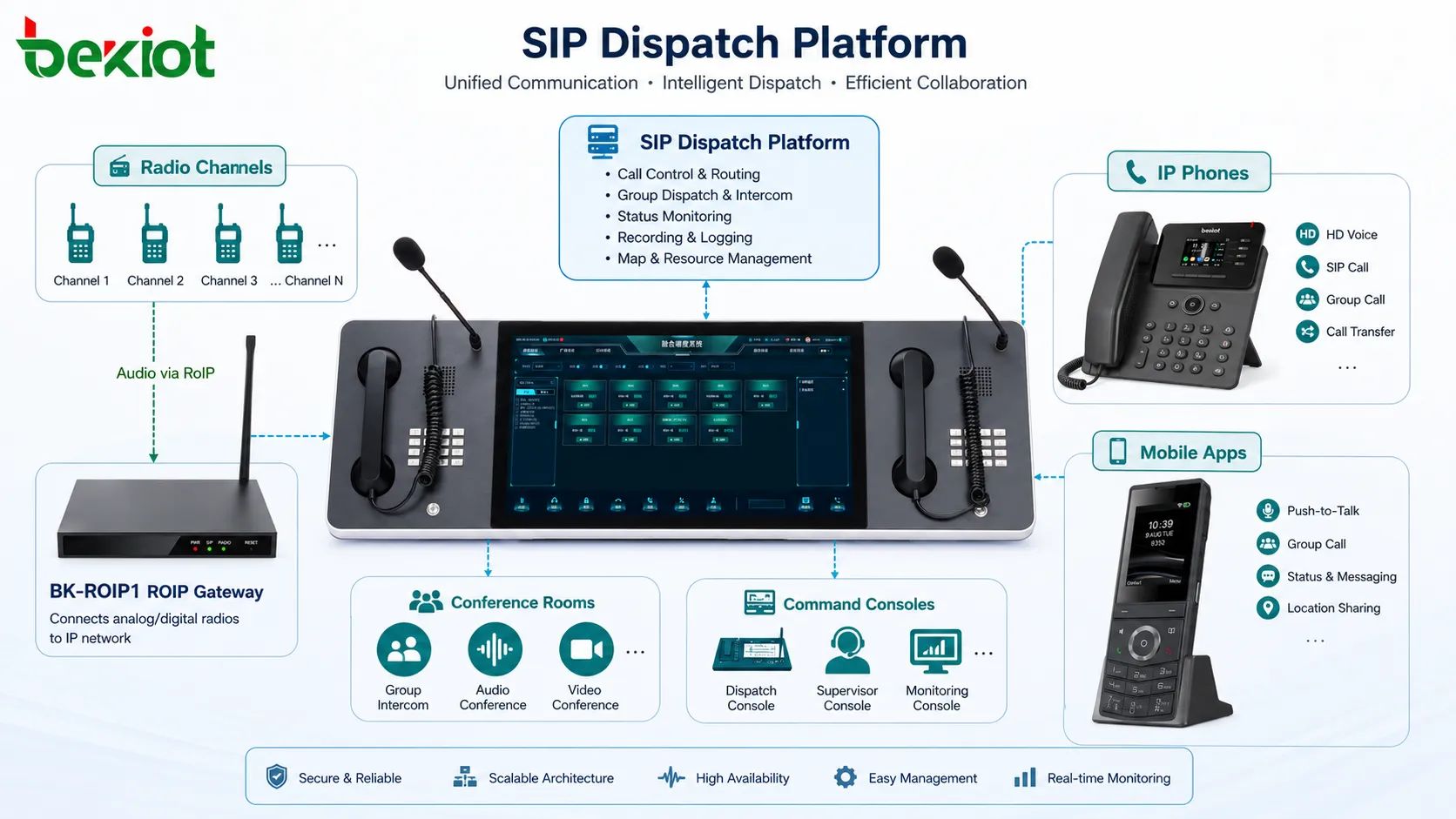
Cross-Agency Group Communication
One of the most important values of this solution is cross-agency group communication. During an emergency, the command center can pull multiple wireless radio channels from different units into one temporary or predefined dispatch group.
This means teams using different radio systems can participate in the same coordinated communication process. A rescue team, industrial safety team, traffic unit, property security team, and civil defense group can be connected under one dispatch group even if their original radio systems are different.
This capability is especially useful during emergency rescue, disaster response, large event security, fire command, industrial accidents, flood control, public safety response, and regional joint operations. It helps build fast, multi-unit critical communication capability when time is limited.
How the Access Workflow Works
The implementation logic is straightforward. First, each key unit keeps its existing radio system and connects a selected radio or radio channel to a local RoIP gateway. Second, the RoIP gateway registers to the integrated command platform over the IP network. Third, the command center adds these channels into the dispatch system and assigns permissions, groups, and operation rules.
After configuration, the dispatcher can call any connected radio channel, create cross-system communication groups, start emergency broadcasts, or connect radio users with SIP terminals. The system can also support call recording, dispatch logs, and command process review, depending on platform configuration.
This workflow avoids large-scale reconstruction. It uses existing radio communication resources and adds an IP-based command layer above them. For many emergency command projects, this is more practical than building a completely new radio network from the beginning.
Application Scenarios
Emergency Management Centers
Emergency management centers often need to coordinate public agencies, industrial units, rescue teams, transport departments, and temporary field teams. Through RoIP gateway access, the center can connect radio channels from different organizations and manage them from one dispatch platform.
When an incident occurs, operators can quickly contact the relevant units, create communication groups, and maintain command continuity during the response process.
Civil Defense and Public Safety Operations
Civil defense and public safety scenarios often require communication across multiple departments. Some units may use analog radios, while others may use PDT, DMR, TETRA, or other professional radio systems.
A unified access method allows the command center to connect these resources without forcing every unit to change its existing system. This improves coordination while protecting previous communication investments.
Industrial and Infrastructure Emergency Response
Large industrial sites, energy facilities, ports, transportation hubs, and municipal infrastructure operators often have independent radio systems for security, maintenance, production, and emergency teams.
RoIP gateway integration allows these resources to be included in a broader emergency command platform. During fire, equipment failure, environmental risk, or safety incidents, the command center can quickly coordinate field teams and external support units.
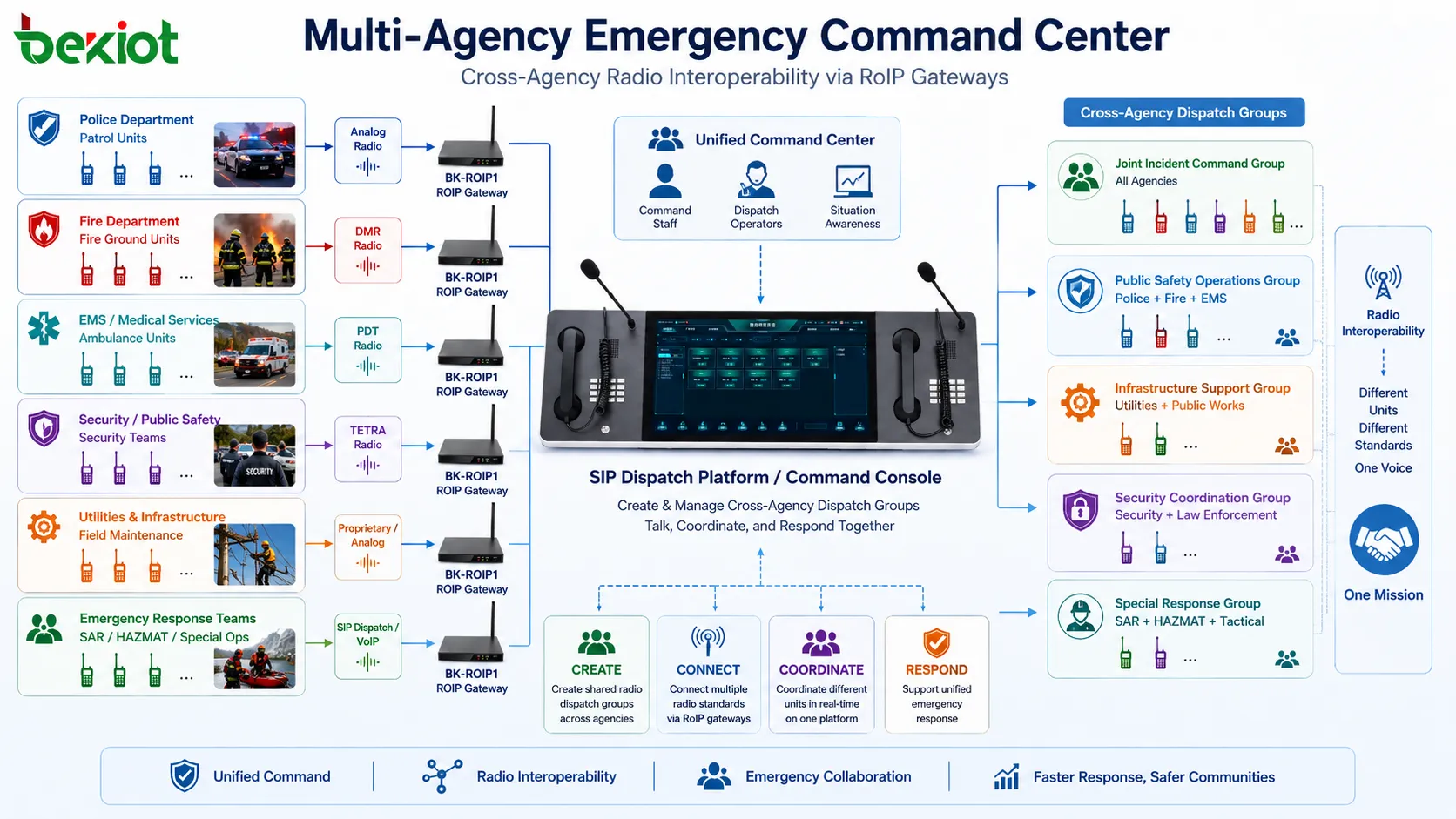
Deployment Logic for Large-Scale Access
The first step is to investigate the radio resources of key units. The project team should confirm which units need to be connected, what radio standards they use, how many channels need dispatch access, and what emergency communication scenarios must be supported.
The second step is to deploy RoIP gateways at selected units. Each gateway should be connected to the corresponding radio equipment or radio channel. The access method should be planned according to the unit’s radio system, channel structure, operating rules, and response responsibilities.
The third step is to configure the integrated dispatch platform. All RoIP gateways should register to the platform through SIP communication. The command center should define channel names, unit groups, dispatch permissions, emergency groups, calling rules, and operation procedures.
The fourth step is joint testing. Testing should cover single-channel calling, cross-channel grouping, radio-to-SIP communication, dispatch console operation, IP phone access, conference room calling, mobile app communication, emergency group creation, audio quality, delay, and command record review.
Operational Value for Emergency Command
This solution helps turn independent radio systems into unified command resources. The command center can see connected radio channels, call specific units, create multi-unit groups, and support cross-region and cross-standard intercom communication.
It also improves emergency response efficiency. Instead of manually relaying messages between separate systems, operators can directly connect multiple units from the dispatch platform. This is important when emergency teams must be organized quickly and communication time is critical.
The solution also protects existing investment. Units can keep their established radio systems, while the command center gains centralized access and dispatch capability through RoIP gateways and SIP-based integration.
For emergency command environments, radio integration should be designed as a practical command workflow, not just a technical connection between devices.
FAQ
Can different radio standards communicate directly after integration?
They do not communicate directly at the radio protocol level. Instead, selected radio channels are accessed through RoIP gateways and managed by the dispatch platform, allowing cross-system communication through the command workflow.
Does every unit need its own RoIP gateway?
Not always. It depends on the number of units, channel distribution, radio coverage, and command requirements. In many projects, one gateway is deployed at each key unit to make local radio resources independently accessible.
Can conference rooms or IP phones talk to field radio users?
Yes. When the RoIP gateway registers to a SIP-based dispatch platform, radio channels can be connected with SIP terminals such as IP phones, conference room systems, dispatch consoles, and mobile apps.
What should be checked before connecting a unit’s radio channel?
The project team should check the radio standard, channel usage, interface method, permission rules, coverage area, emergency priority, and whether the channel should support individual calling, group dispatch, or temporary emergency grouping.
How does this solution support large-scale emergency coordination?
It allows many independent radio resources to be registered into one command platform. The dispatcher can organize cross-unit groups, connect different radio channels, and coordinate response teams without rebuilding every radio network.







