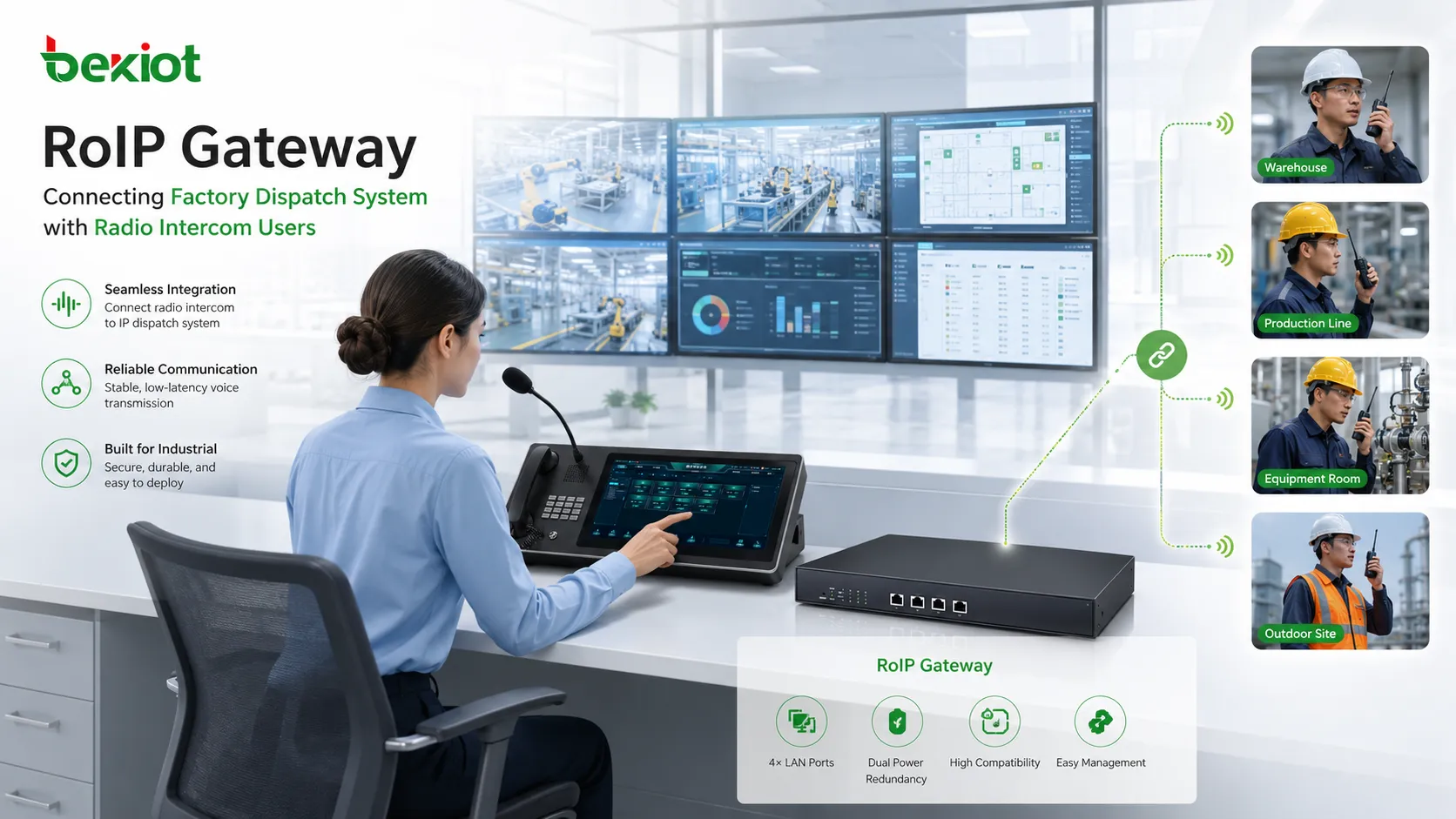
Large factories depend on reliable communication systems for daily production coordination, task assignment, safety management, and emergency response. In many industrial sites, the production dispatch system and the radio intercom system are both essential, but they often run on different communication standards and cannot communicate with each other directly.
A RoIP gateway solution helps solve this problem by connecting radio intercom networks with SIP-based factory dispatch platforms. It converts radio voice into SIP-compatible communication, allowing dispatch consoles, IP phones, telephones, radio channels, and mobile radio users to work together in one unified voice workflow.
Communication Gaps in Modern Industrial Sites
Production dispatch systems are widely used in large factories to support voice calling, coordination, task distribution, production command, and emergency handling. These systems are commonly built on SIP-based VoIP architecture and use IP networks or telephone networks to deliver dispatch communication.
Radio intercom systems, however, use a different communication model. Depending on the site environment, coverage range, and operational requirements, factories may use analog radios, DMR, PDT, TETRA, PoC, or other radio communication systems. These radio systems are practical for mobile teams, outdoor areas, workshops, warehouses, security patrols, and maintenance personnel.
The challenge is that a SIP dispatch platform and a radio intercom network cannot always interconnect by default. Without a proper gateway layer, the dispatch console may not be able to call radio users directly, and radio users may not be able to communicate with office phones or dispatch seats. This creates isolated communication islands inside the same factory.
How a RoIP Gateway Connects Dispatch and Radio Networks
A RoIP gateway works as a protocol and audio conversion bridge between the factory dispatch system and the radio intercom system. On one side, it connects with radios, base stations, vehicle radios, handheld radios, or radio channels through suitable interfaces. On the other side, it registers to the SIP dispatch platform as a standard SIP endpoint.
After integration, a radio channel can be mapped into a SIP number. When the dispatch console or an IP phone needs to communicate with that radio channel, the user only needs to call the corresponding SIP number. The RoIP gateway then converts the SIP voice path into radio audio and sends it to the target radio network.
This approach allows existing radio systems to be connected with the factory dispatch system without rebuilding the entire communication infrastructure. For factories that already use radio intercom networks and SIP-based dispatch platforms, RoIP integration is often a practical and cost-effective modernization path.
Related Solution: RoIP Gateway
Architecture for Unified Factory Voice Dispatch
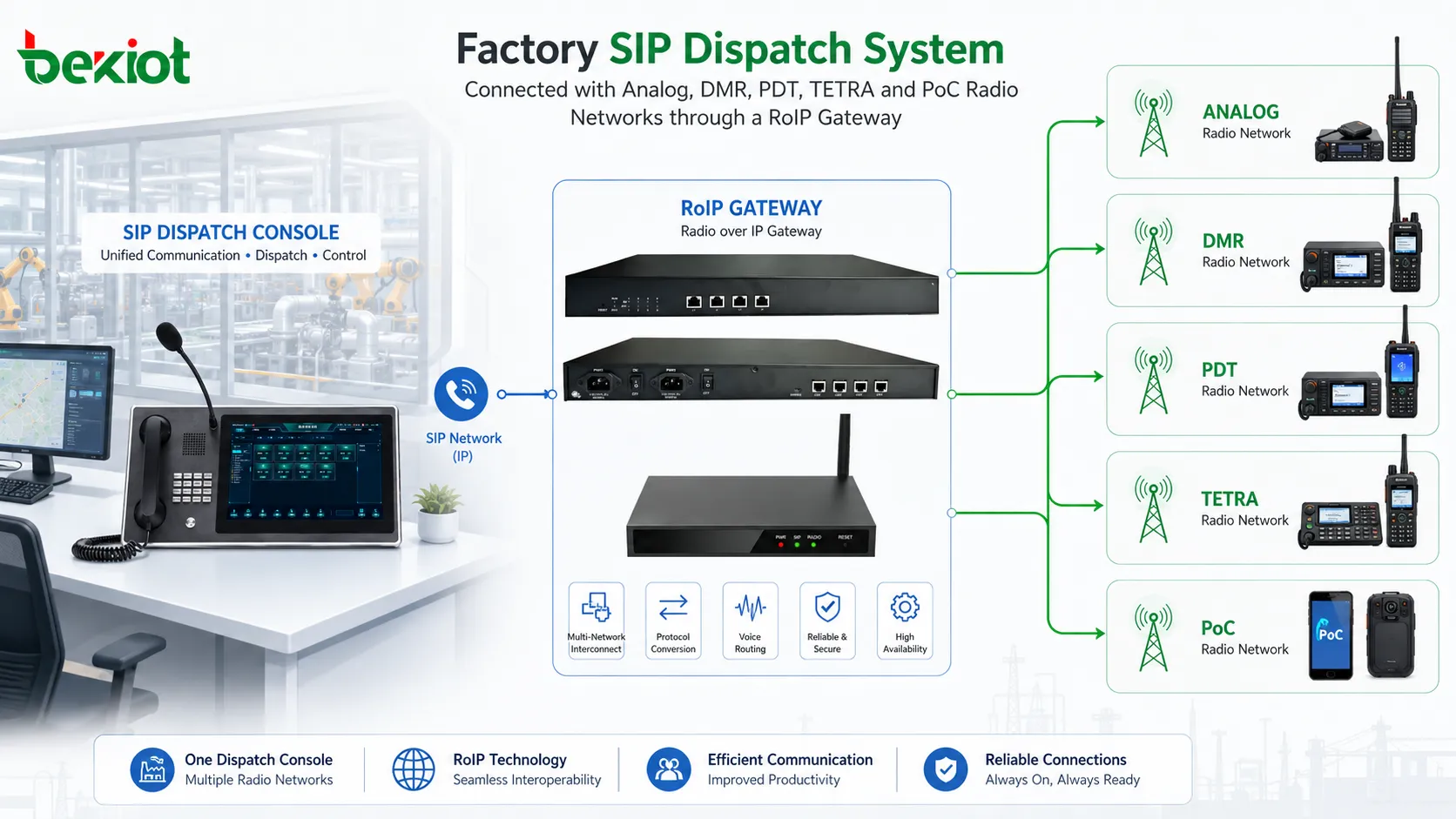
A typical factory deployment includes the SIP dispatch platform, dispatch console, IP phones, RoIP gateway, radio interface cables, radio channels, handheld radios, vehicle radios, and field personnel. The RoIP gateway sits between the SIP communication side and the radio communication side, handling voice conversion, signaling adaptation, and channel access.
On the SIP side, the gateway can register as one or more SIP extensions. On the radio side, each connected radio channel can represent a workshop, production area, maintenance group, security group, emergency response team, or outdoor operating zone. This makes radio users visible and reachable from the dispatch platform.
For larger factories, multiple radio channels can be integrated into the same dispatch environment. The dispatch operator can call one radio channel, call several channels at the same time, or coordinate communication between different radio groups according to production or emergency needs.
Practical Functions After Integration
Dispatch Console Calling Radio Users
After radio channels are connected to the dispatch system, the dispatch console can directly call radio users. The operator does not need to use a separate radio console or relay the message through another person.
This is useful for production command, equipment maintenance, material handling, security patrol, emergency repair, and workshop coordination. Instructions can be sent from the dispatch center to the field team through a familiar dispatch interface.
Calling Multiple Radio Channels Together
Factories often need to notify several teams at the same time. For example, a production abnormality may require the maintenance team, security team, workshop supervisor, and equipment operator to receive the same instruction quickly.
With RoIP gateway integration, the dispatch platform can support simultaneous calling or group communication across multiple radio channels. This helps reduce repeated calling and improves coordination efficiency during urgent situations.
Communication Between Different Radio Groups
Different areas of a factory may use separate radio channels or even different radio systems. Without integration, these groups may not be able to talk to each other directly.
A RoIP gateway can help connect different radio channels into a controlled communication workflow. This allows one radio group to communicate with another when cross-area coordination is required, while the dispatch center keeps overall control of the communication process.
Phone-to-Radio and Radio-to-Phone Calling
RoIP integration also allows telephone users to communicate with radio users. Office staff, control room personnel, or management teams can call a mapped SIP number to reach a radio channel, while radio users can also be connected back to phones or dispatch seats according to the configured call flow.
This function is valuable when production management, safety supervision, and front-line execution teams need to cooperate across different communication devices.
Compatibility Across Different Radio Standards
Industrial sites may use different radio technologies because of historical deployment, coverage requirements, operating habits, or industry standards. Some areas may use analog radios, while others may use DMR, PDT, TETRA, PoC, or mixed radio systems.
A well-planned RoIP gateway solution should focus on compatibility. It should be able to connect different radio systems through suitable interfaces and adapt them into SIP-based communication without requiring deep redevelopment of the existing dispatch platform.
The original technical logic of this solution emphasizes that gateway configuration should not be limited to simple audio connection. In real factory environments, audio level adjustment, delay control, push-to-talk behavior, signaling adaptation, channel mapping, and call quality tuning are all important. More detailed configuration capability can help improve the stability and clarity of the final communication effect.
The goal of RoIP integration is not only to connect two systems, but to make radio communication usable, manageable, and reliable inside the factory dispatch workflow.
Recommended Deployment Structure
| Layer | Main Component | Function in the Solution |
|---|---|---|
| Dispatch layer | SIP dispatch platform and dispatch console | Handles calling, group communication, operator control, and production coordination |
| Interconnection layer | RoIP gateway | Converts radio voice into SIP communication and maps radio channels to SIP numbers |
| Radio layer | Analog, DMR, PDT, TETRA, PoC, or other radio systems | Supports mobile communication for field workers, patrol teams, and emergency personnel |
| User layer | Handheld radios, vehicle radios, IP phones, and dispatch seats | Allows different users to communicate through one coordinated workflow |
| Management layer | Recording, monitoring, permission, and maintenance tools | Supports traceability, operation review, and long-term system management |
Value for Factory Dispatch Operations
Unified Communication Across Departments
After integration, workshop teams, maintenance teams, security teams, warehouse teams, outdoor operators, and control room staff can communicate more smoothly. The dispatch center can coordinate radio users and phone users from one platform instead of switching between separate systems.
This improves daily production communication and also strengthens emergency response when multiple departments must act at the same time.
Improved Emergency Handling
During equipment failure, fire risk, chemical leakage, production interruption, power abnormality, or safety incident, communication speed becomes critical. A RoIP gateway allows dispatch operators to reach radio users quickly and organize group communication across different teams.
Field feedback can also return to the dispatch center more directly, helping supervisors understand the situation and issue the next instruction without unnecessary delay.
Better Use of Existing Communication Assets
Many factories already have radio systems in operation. Replacing all existing devices may not be realistic or necessary. A RoIP gateway creates an interconnection layer that helps reuse current radio assets while extending them into the SIP dispatch environment.
This makes system upgrades more flexible. Factories can improve communication integration step by step while protecting previous investment in radio networks and dispatch platforms.
More Manageable Voice Workflow
When radio channels are mapped as SIP numbers, the dispatch system can manage communication in a more structured way. Number planning, call routing, group calling, recording, and permission control can be designed around the factory’s actual operation process.
This helps the communication system become part of the production management workflow rather than a collection of disconnected devices.
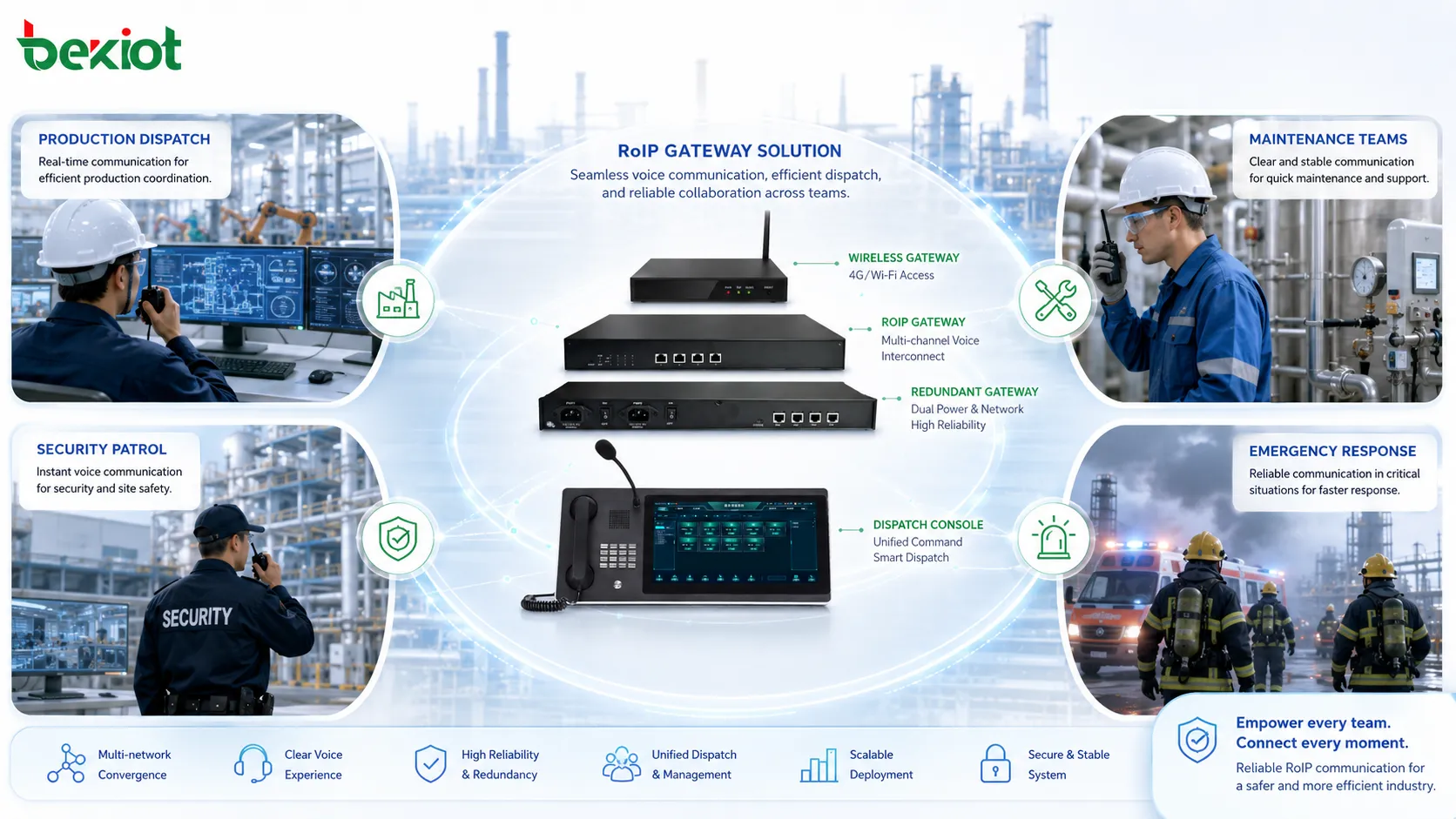
Application Scenarios in Industrial Facilities
This solution is suitable for large manufacturing plants, chemical plants, steel plants, power plants, logistics parks, mining facilities, ports, warehouses, industrial parks, utility sites, and other environments where fixed dispatch systems and mobile radio users must work together.
In daily production, it can support workshop coordination, maintenance dispatch, warehouse operation, equipment inspection, safety supervision, and security patrol communication. In emergency situations, it can support rapid notification, cross-team communication, command center coordination, and field response organization.
For factories that also need emergency broadcasting, public address, alarm linkage, radio interconnection, and dispatch platform integration, Becke Telcom can provide light solution planning support for SIP dispatch, RoIP gateway access, industrial communication terminals, and related emergency communication systems.
Planning Points Before Implementation
Before deployment, the factory should confirm the radio systems already in use, the number of radio channels to be integrated, the SIP dispatch platform interface, the required call scenarios, and the number mapping strategy for each radio channel.
Technical planning should also include audio level adjustment, push-to-talk control, codec compatibility, network stability, permission control, call recording, redundancy requirements, and maintenance access. These details affect the final voice quality and long-term reliability of the system.
If the factory uses several radio standards at the same time, the project team should test each system separately before full integration. Compatibility testing helps confirm whether the gateway can support the required call direction, group communication, channel control, and audio performance.
FAQ
Can a RoIP gateway connect old analog radios with a modern SIP dispatch system?
Yes, in many projects this is one of the main reasons for using RoIP. The final result depends on the available radio interface, audio wiring, control method, and gateway configuration.
Does each radio channel need a separate SIP number?
Not always, but assigning SIP numbers to radio channels usually makes dispatch operation clearer. It helps operators identify which workshop, team, or area they are calling.
What affects the voice quality of a RoIP gateway deployment?
Voice quality may be affected by radio audio levels, network latency, codec selection, push-to-talk timing, cable quality, grounding, electromagnetic interference, and gateway tuning parameters.
Can radio calls be recorded after integration?
Yes, if the SIP dispatch platform or recording system supports the call path. Recording is useful for production review, safety investigation, training, and emergency event tracing.
Is RoIP integration suitable for factories with multiple sites?
Yes. When network conditions and routing design are properly planned, RoIP gateways can help connect radio users from different factory areas or remote sites into a centralized dispatch workflow.