


Public network push-to-talk, often called PoC or public-network PTT, uses 4G mobile networks to extend intercom-style communication beyond the distance limits of traditional radios. As long as users are within mobile network coverage, field teams, command centers, supervisors, and emergency responders can stay connected across cities, regions, industrial sites, transport routes, and temporary operation areas.
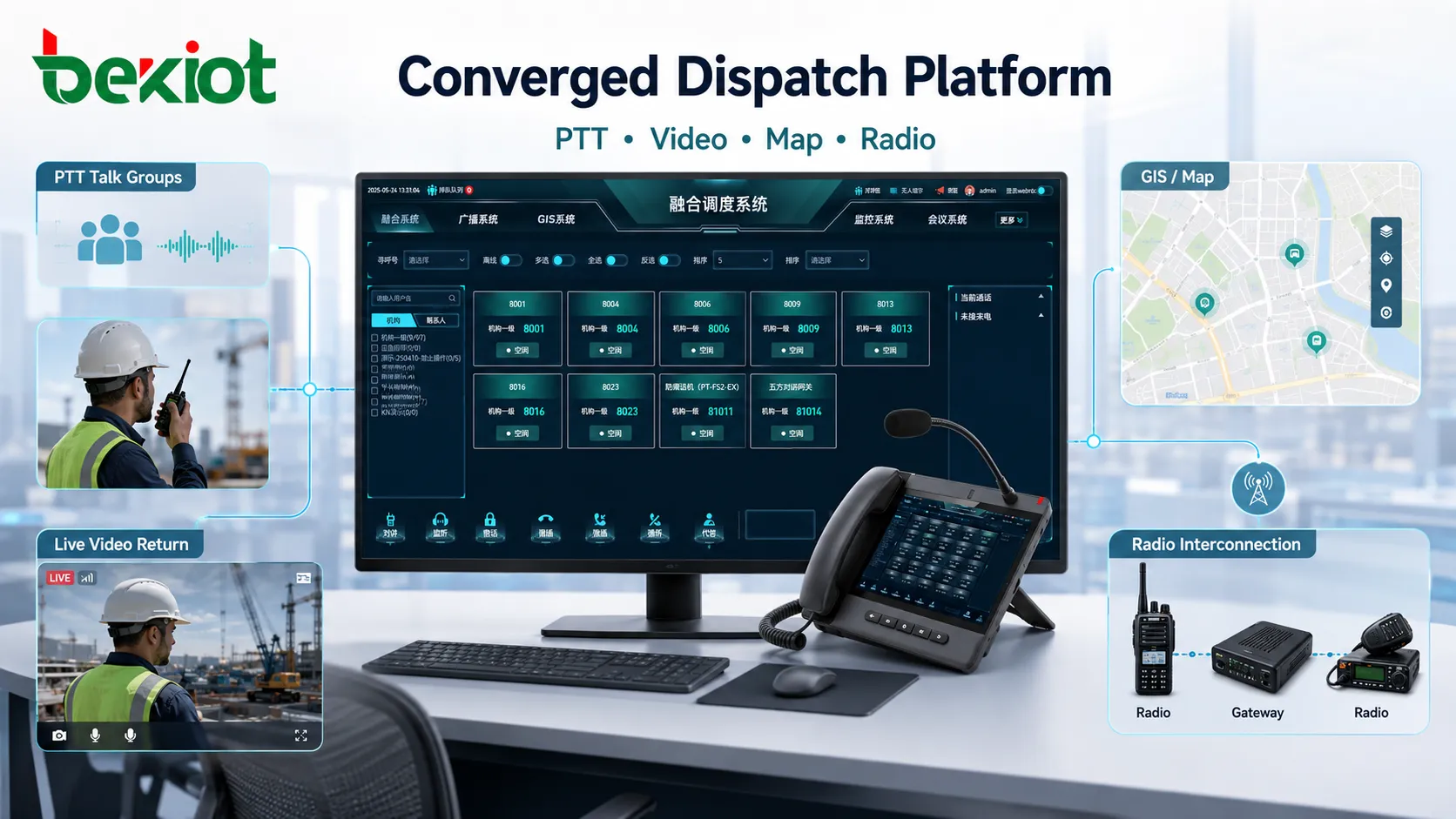
For command dispatch systems, this changes the communication model from simple voice calling to mobile audio-video coordination. Dispatchers can manage group calls, individual calls, video communication, location tracking, field video return, messaging, and interconnection with private radio systems from one platform. This makes public-network PTT especially valuable in emergency command, public safety support, industrial operations, utilities, transportation, logistics, and large-area service management.
Instead of depending on a single communication channel, organizations can build a more flexible dispatch environment where voice, video, location, task information, and radio interoperability work together. This is important for teams that move frequently, respond to incidents in different locations, or need unified command across several departments.
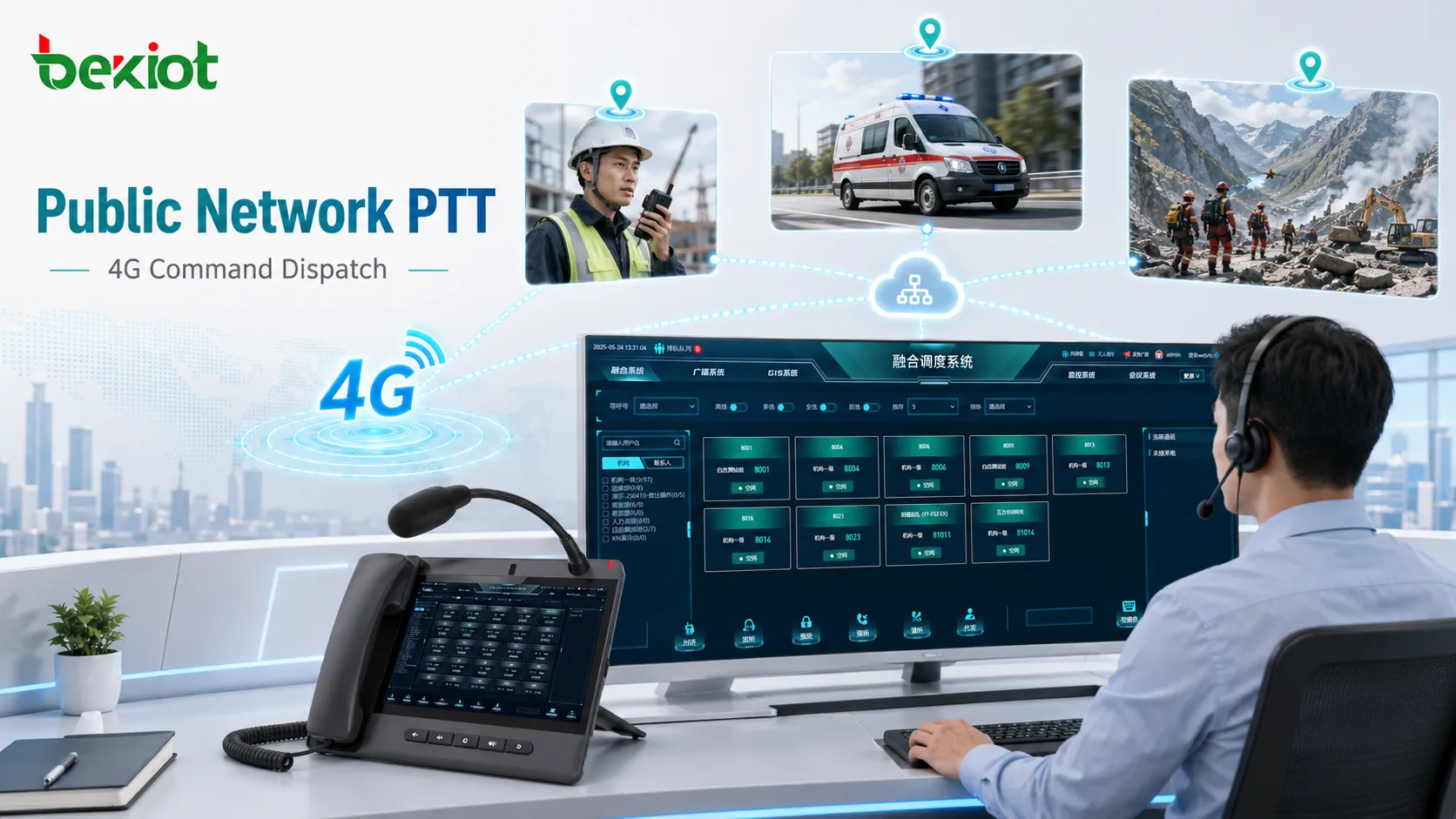
Why Mobile Dispatch Needs More Than Phone Calls
Traditional dispatch often depends on telephone calls, standalone radio channels, or separate video tools. These methods can work for small teams, but they become inefficient when an organization needs fast group communication, location awareness, and visual information from the field.
In emergency response and operational command, the dispatcher must often answer several questions at once: Who is available? Where are the teams located? Which group needs instructions first? What is happening at the scene? Can a field worker send live video? Can the command center speak to both public-network users and private-radio users?
A public-network PTT dispatch platform addresses these needs by combining voice, video, mapping, messaging, and group management into one operational environment. Instead of relying only on phone calls, teams can use a more direct and controlled dispatch workflow.
This is also valuable when an incident develops quickly. A dispatcher can call a whole group, open a temporary emergency group, check nearby personnel on a map, request video from the scene, and coordinate support teams without switching between multiple disconnected systems.
Core Capabilities for Field Coordination
The basic function is push-to-talk group communication. Users can press a button on a smart terminal, rugged handset, vehicle device, or mobile app to talk with an assigned group. This keeps the familiar radio-style operation while using the reach of 4G mobile networks.
Beyond group talk, modern public-network PTT can support full-duplex voice calls, video calls, video return, short messages, GPS positioning, track playback, electronic maps, and dispatcher-controlled operations. These capabilities allow a command center to move from voice-only coordination to real-time situational awareness.
One important advantage is that full-duplex voice communication can be carried over the data network. In many deployments, the terminal uses a data card or mobile data plan and does not need a traditional SIM voice service. This can simplify account handling and reduce dependence on standard mobile phone calling.
The platform can also support user grouping by department, region, role, vehicle, project, or emergency level. For example, routine patrol teams, maintenance teams, supervisors, and emergency response teams can be placed into different talk groups, while the command center keeps the ability to initiate cross-group communication when necessary.
Live Video Makes the Command Center More Informed
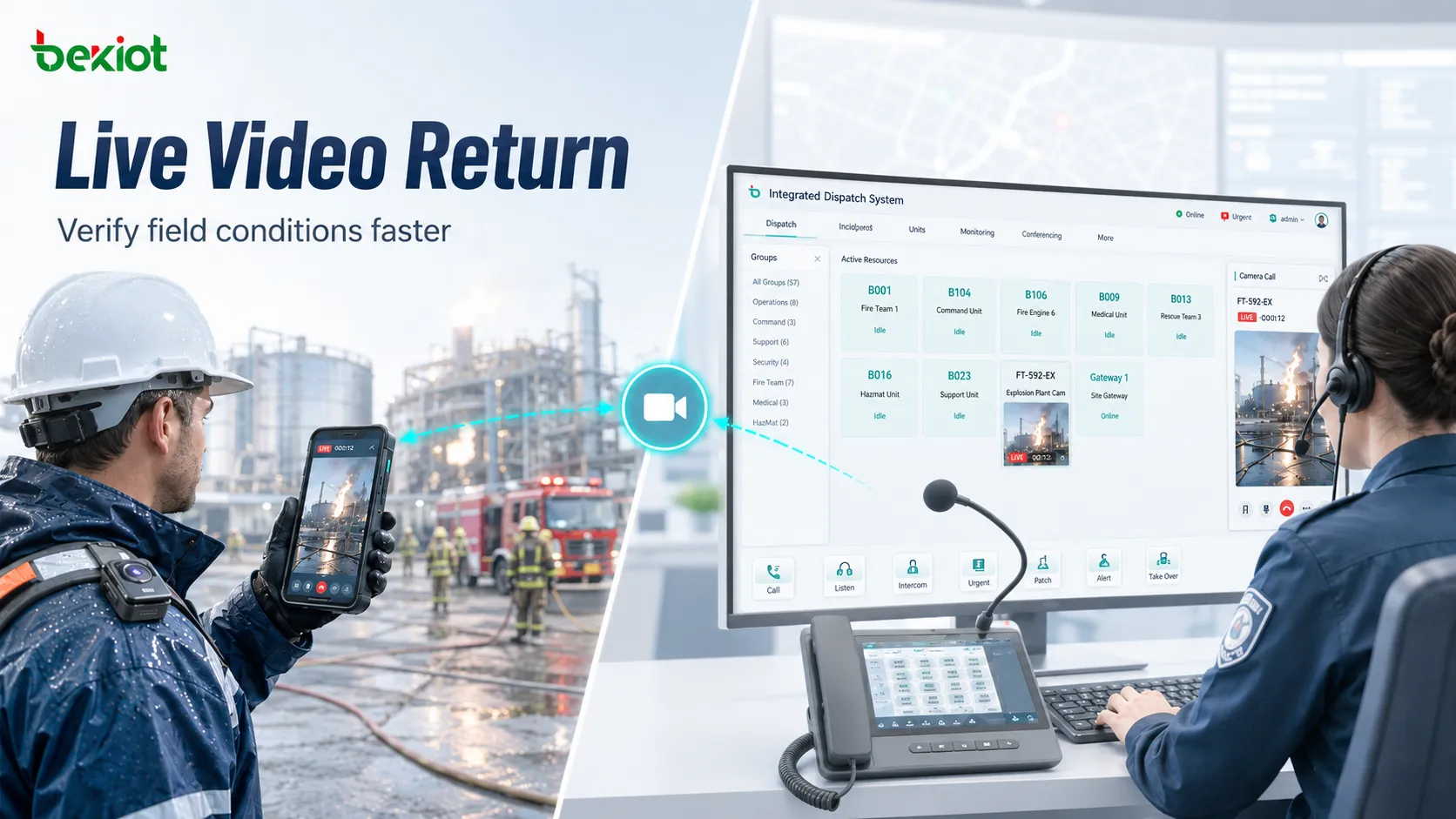
Voice communication is fast, but it cannot always explain a complex site condition. Public-network PTT terminals with cameras can initiate video calls or send live video back to the dispatch center. This is useful for emergency scenes, traffic incidents, utility maintenance, security patrols, construction sites, and remote industrial operations.
With video return, the dispatcher can see the field condition directly instead of relying only on verbal reports. This helps reduce misunderstanding, improves command accuracy, and supports faster decision-making during urgent events.
Video is especially useful when the field team needs expert support from a remote command center. Supervisors can observe equipment status, site damage, road conditions, crowd flow, or safety risks in real time, then provide more precise instructions to the team at the scene.
Location Awareness Improves Resource Control
Because public-network PTT often runs on smart terminals, GPS positioning can be integrated into the dispatch platform. Dispatchers can view team members on an electronic map, check current positions, review movement tracks, and use geofencing for specific operation zones.
This is especially useful for mobile teams that work across wide areas. For example, patrol staff, emergency repair teams, transportation personnel, and inspection workers may not stay in fixed locations. Real-time positioning helps the command center assign the nearest available team, confirm arrival, and monitor field movement during critical operations.
Track playback can also support event review and operational improvement. After an incident, managers can check whether personnel arrived on time, whether the route was reasonable, and whether the dispatch process needs adjustment. This turns location data into a management tool rather than only a monitoring feature.
Interconnection with Private Radio Systems
Many industries still rely on private radio systems such as PDT, DMR, or TETRA. These systems are important in public safety, transportation, energy, industrial parks, and large facilities. However, public-network PTT may also be needed for wider-area coverage, mobile video, flexible user expansion, or temporary team access.
The practical challenge is interoperability. A command dispatch solution should allow public-network PTT users and private-radio users to communicate when required. Through a gateway-based architecture, organizations can connect existing private radio systems with public-network PTT without replacing the whole radio infrastructure.
This approach protects earlier investment while adding new mobile communication capabilities. It also helps organizations build a staged migration path from single-mode voice dispatch to converged audio-video dispatch.
In real projects, this kind of interconnection is useful when headquarters, mobile supervisors, field workers, and legacy radio users must join the same command process. The public-network side can provide wider mobility and smart functions, while the private-radio side continues to serve local mission-critical voice communication.
Flexible Deployment for Dedicated Operations
Public-network PTT platforms can be deployed on physical servers, virtual machines, private data centers, or cloud infrastructure. When public IP addressing and network conditions are ready, a dedicated system can be deployed quickly. In simple cloud deployment scenarios, a basic dedicated platform may be brought online within about one hour.
Compared with building a traditional private radio network over a large area, public-network PTT can reduce deployment complexity. It uses existing mobile network coverage and allows organizations to manage their own users, groups, permissions, and dispatch functions through a dedicated platform.
This makes it suitable for emergency agencies, industrial operators, logistics companies, utilities, campuses, transportation organizations, and service teams that need rapid expansion and centralized management.
For organizations with strict data and management requirements, a private or dedicated deployment can help separate business communication from public consumer apps. User accounts, group permissions, recording policies, map access, and dispatch privileges can be defined according to internal operating rules.
Related solution: Converged Communication System
Recommended System Components
A complete solution is usually built around a dispatch platform, mobile PTT terminals, network access, location services, video capability, and optional interconnection gateways. The exact architecture depends on whether the organization needs only public-network communication or also needs to connect existing private radio systems.
When designing the system, it is important to avoid focusing only on terminals. The real value comes from how terminals, platform, network, dispatch console, permissions, video, and external systems work together. A well-planned architecture can support daily communication, emergency response, supervision, evidence review, and cross-department coordination.
| Component | Role in the Solution | Typical Value |
|---|---|---|
| Dispatch platform | Manages users, groups, calls, video, maps, permissions, and command operations | Centralized control and faster coordination |
| PTT smart terminals | Provide group talk, voice call, video call, positioning, and field reporting | Mobile communication without fixed site limits |
| Video return | Sends field video to the command center | Better situational awareness |
| Electronic map | Displays user location, movement tracks, and operation zones | Improved resource assignment |
| Radio interconnection gateway | Connects public-network PTT with PDT, DMR, TETRA, or other private radio systems | Converged communication without replacing existing systems |
Where This Solution Fits Best
Public-network PTT is well suited for scenarios where teams are distributed, mobile, and difficult to coordinate through fixed communication channels. It can support emergency command, city management, transportation dispatch, industrial inspection, property security, logistics fleets, field maintenance, construction projects, and temporary event operations.
The solution is also useful when users need both routine communication and emergency response. During daily operations, it can support group communication, task coordination, and location monitoring. During incidents, it can quickly shift into emergency command mode with group calls, video return, map-based dispatch, and cross-system communication.
In industrial and infrastructure environments, public-network PTT can connect maintenance engineers, safety managers, security teams, contractors, and remote supervisors. In public service scenarios, it can help coordinate inspection teams, emergency volunteers, road service teams, and city management personnel across different areas.
Key Benefits for Organizations
The first benefit is coverage flexibility. Since communication is based on the public mobile network, users are not limited by the physical coverage area of one radio base station. This is helpful for cross-region operations and mobile teams.
The second benefit is functional integration. Public-network PTT is not limited to voice. It can combine group talk, voice calling, video calling, live video return, messages, GPS positioning, movement tracks, electronic fences, and dispatch console control.
The third benefit is easier deployment and capacity management. Organizations can build a dedicated system, manage users by themselves, define communication groups, and expand capacity according to operational needs. When interconnection gateways are added, existing private radio systems can also become part of the broader command network.
Another benefit is operational traceability. Call records, dispatch logs, location tracks, and video materials can help with incident review, service quality improvement, safety audits, and internal accountability. This is important for organizations that need both fast response and reliable after-action analysis.
Implementation Considerations
Before deployment, organizations should evaluate mobile network coverage, user scale, command hierarchy, security requirements, video bandwidth, storage needs, and whether private radio interconnection is required. The system should also define permissions clearly, especially for emergency groups, supervisor users, cross-department communication, and dispatcher operations.
For mission-critical environments, platform reliability, data protection, account management, network redundancy, and emergency backup plans should be considered from the beginning. Public-network PTT is powerful, but it should be planned as part of a broader communication architecture rather than as a simple replacement for every existing radio system.
Terminal selection should also match the field environment. Indoor office users may only need a mobile app or standard smart terminal, while outdoor workers may require rugged devices with strong battery life, loud audio, clear PTT keys, camera support, and stable positioning. For vehicle teams, mounted terminals or accessories may improve usability during mobile operations.
Conclusion
Public-network PTT gives command dispatch systems a practical way to connect mobile teams over wide areas while adding video, positioning, messaging, and platform-based management. It supports the familiar push-to-talk experience, but extends it with modern mobile network capabilities.
For organizations that need emergency coordination, field visibility, cross-region communication, and integration with private radio systems, a public-network PTT dispatch solution can become an important part of a converged communication strategy. It helps command centers move from isolated voice tools to a unified, visual, and more responsive dispatch environment.
The best results come from treating the system as a complete communication workflow, not just a terminal purchase. When group communication, video return, map dispatch, permissions, recording, and radio interconnection are planned together, public-network PTT can support both daily operations and urgent emergency command.
FAQ
Is public-network PTT suitable for replacing all private radio systems?
Not always. Private radio systems may still be required in some mission-critical or regulated environments. Public-network PTT is often best used as an extension, supplement, or converged layer that adds wide-area coverage, video, and smart dispatch functions.
Can public-network PTT support temporary emergency teams?
Yes. Because users can be added through terminals or mobile apps, it is suitable for temporary teams, event security, rescue coordination, inspection groups, and short-term field projects.
What should be checked before enabling video return?
Organizations should evaluate uplink bandwidth, mobile signal quality, video resolution policy, storage requirements, dispatcher workload, and privacy rules before enabling live video return on a large scale.
Does the system require a public IP address?
A public IP address can simplify access in some self-hosted deployments. If one is not available, cloud deployment or controlled network mapping can be considered depending on the system architecture and security policy.
How does a dispatch console improve daily operations?
A dispatch console gives supervisors a centralized view of users, groups, calls, video sessions, and map locations. This helps reduce manual coordination and allows faster response when incidents occur.







