


Oil depots store and transfer petroleum products that require strict safety management, reliable communication, and rapid emergency response. Because of the flammable and high-risk nature of these facilities, daily operation cannot rely only on ordinary office phones or isolated walkie-talkies. Modern oil depot management needs an integrated command dispatch solution that connects the dispatch center, office area, operation area, emergency meeting room, field personnel, broadcasting terminals, video monitoring, and explosion-proof communication devices.
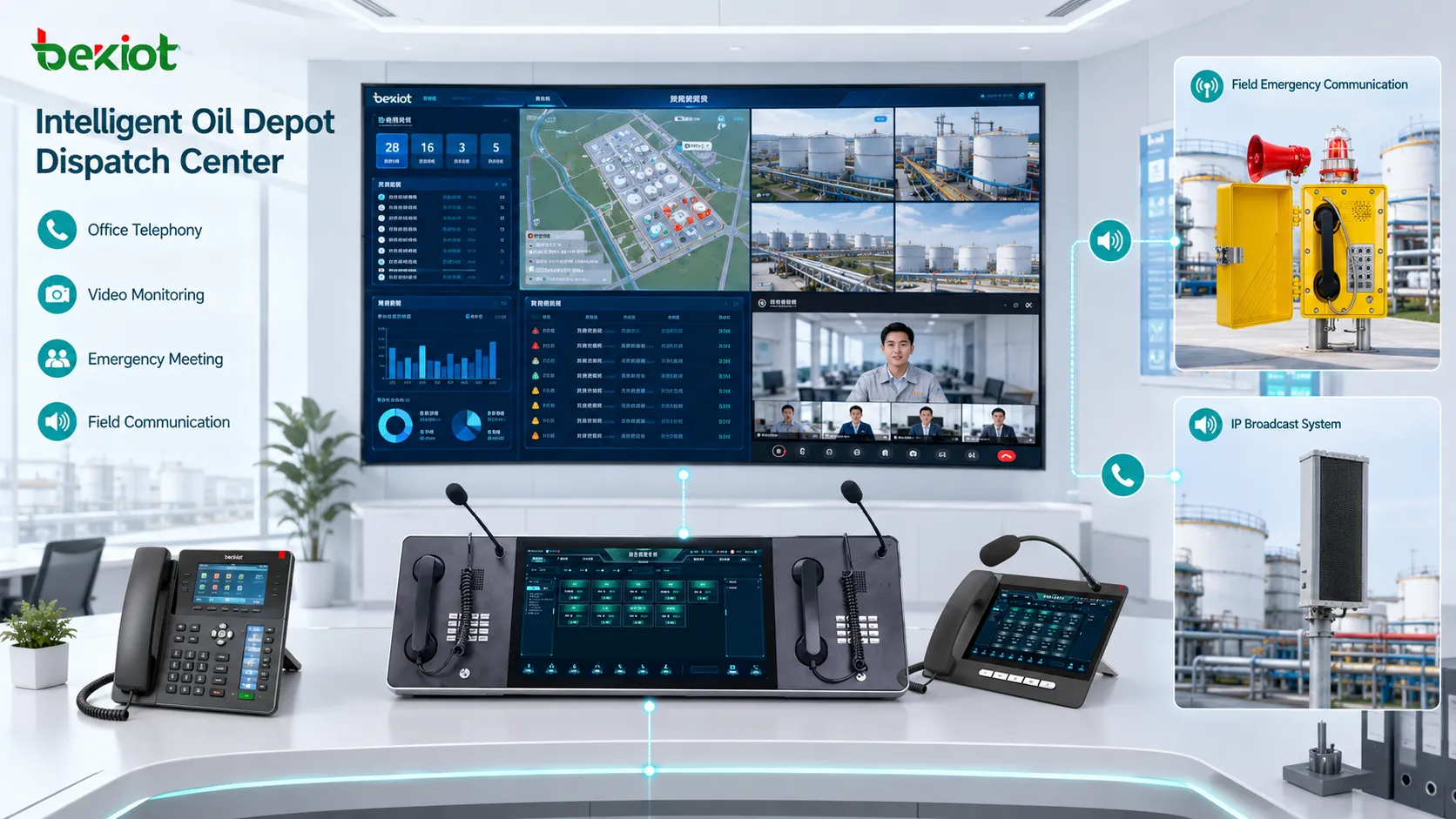
The Becke intelligent command dispatch solution is designed around the practical workflow of oil depot management. It supports daily office communication, production coordination, emergency dispatch, remote meetings, voice broadcasting, visual intercom, video monitoring linkage, and communication with field workers in restricted areas. By bringing these functions into one platform, the oil depot can improve operational intelligence, reduce communication delays, and strengthen the technical foundation for safe production and emergency handling.
Communication Challenges Inside Oil Depot Environments
Oil depot communication is different from ordinary enterprise communication. The site usually includes a management office, storage tanks, loading and unloading areas, pump rooms, access control points, inspection routes, control rooms, and emergency gathering zones. Each area has different safety restrictions and communication requirements.
In the office area, staff need stable telephone communication for daily business, coordination, reporting, and external contact. In the operation area, communication equipment must consider fire prevention, explosion protection, emergency alarms, and restricted mobile phone usage. In the dispatch center, supervisors need to communicate with field teams, office staff, duty personnel, and external emergency contacts quickly.
A fragmented communication system can create delays. For example, office phones may not reach explosion-proof walkie-talkie users directly. Field workers may not be able to report an emergency through a nearby fixed device. A meeting room may not be connected to the dispatch system during an urgent work deployment. These gaps can affect both daily efficiency and emergency response quality.
A Central Platform for Daily Operation and Emergency Response
The core of the solution is a command dispatch platform deployed at the oil depot management center. For a city-level oil depot management company or regional depot operator, the dispatch center can act as the communication hub for multiple functional areas. It connects the telephone system, dispatch console, field communication devices, conference room gateway, broadcasting terminals, and video monitoring resources.
Through integration with the telephone system, the dispatch center can meet the needs of daily phone calls and emergency outbound calls to external numbers. This is important when the command center must contact fire services, management leaders, maintenance contractors, transport teams, or other external support units during an abnormal event.
The platform is not only for emergencies. During normal production, it helps duty staff handle routine calls, internal coordination, inspection communication, work arrangement, and interdepartmental collaboration. When an incident occurs, the same platform can quickly switch to emergency command mode, allowing supervisors to call relevant groups, start broadcasting, connect field users, and organize remote communication.
Dispatch Center Design for Unified Control
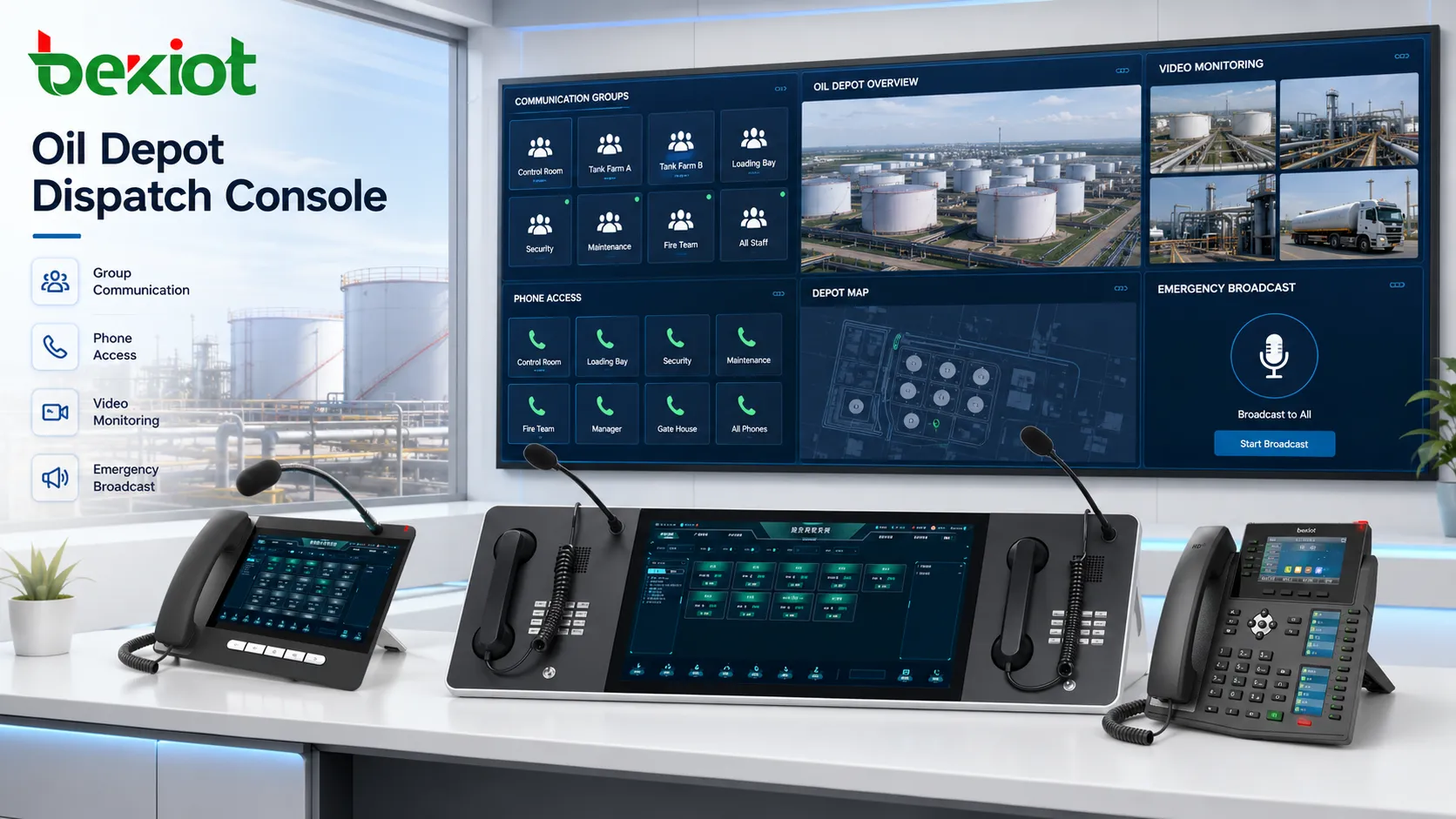
At the dispatch center, the system can provide a unified communication architecture that supports command operation, phone access, voice dispatch, intercom calling, and linkage with monitoring systems. The dispatcher can use a visual dispatch console to manage communication between office users, duty stations, field terminals, and emergency contact points.
A key requirement is that the dispatch center should not become another isolated communication island. It should connect the existing phone system, field communication network, emergency broadcast system, and meeting room equipment. This allows managers to coordinate daily work and emergency tasks through a single interface instead of switching between several unrelated systems.
In emergency handling, the dispatch center can call key personnel, connect operation-area users, organize temporary communication groups, and support multi-party communication. This reduces the risk of missed information and helps the command team make decisions based on clearer communication.
Remote Meeting Support for Urgent Work Deployment
Oil depot emergencies often require rapid decision-making from multiple departments. A conference room gateway can connect the meeting room to the dispatch system, allowing the dispatch center, management team, duty personnel, and remote participants to join emergency meetings or work deployment sessions.
This is useful for accident review, emergency planning, equipment fault discussion, safety inspection reporting, and production scheduling. When the meeting room is integrated with the command dispatch platform, the organization can avoid the delay caused by separate conferencing tools and manual phone coordination.
In practical operation, the meeting room can become an extension of the dispatch system. Managers can discuss field conditions, connect with duty staff, contact external support, and issue work instructions through a more organized communication structure.
Office Area Communication for Routine Management
In the oil depot office area, office phones can be deployed to support daily communication between administrative staff, operators, supervisors, safety managers, and the dispatch center. These phones handle routine internal calls, external business communication, work reporting, and coordination between the office and depot areas.
For duty personnel, a visual dispatch duty phone can provide more than ordinary calling. It can call depot walkie-talkie users, initiate communication with the main dispatch center, and support broadcast-related operations when needed. This helps the duty station become an active communication node rather than a passive answering point.
The office area also needs clear permission control. Not every user should have the same ability to broadcast, call emergency groups, or contact field workers. A platform-based design allows roles and permissions to be planned according to the management structure of the oil depot.
Field Communication in Restricted Operation Areas
The operation area is the most sensitive part of an oil depot. Because of strict fire prevention and explosion-risk control, personnel are often prohibited from carrying ordinary mobile phones and non-certified communication devices. This creates a practical communication challenge: workers still need to report conditions, receive instructions, request help, and coordinate with the dispatch center.
To solve this problem, a cluster gateway can be used to connect explosion-proof walkie-talkies or private radio users to the dispatch platform. With this connection, field personnel, office staff, and the main dispatch center can communicate across different communication modes. A dispatcher can call field radio users, and field users can be included in the broader command workflow.
This design is especially valuable because it protects existing communication investment while adding centralized dispatch capability. The oil depot does not need to replace every field device immediately. Instead, the system can connect existing radio resources with newer dispatch, telephony, and emergency communication functions.
Fixed Emergency Points for Safer On-Site Help Calls
Explosion-proof walkie-talkies can be expensive, and not every temporary worker, visiting contractor, or external maintenance person can be assigned a dedicated radio. For this reason, fixed emergency intercom points are important in key control areas, access points, loading areas, tank zones, pump rooms, and other high-risk locations.
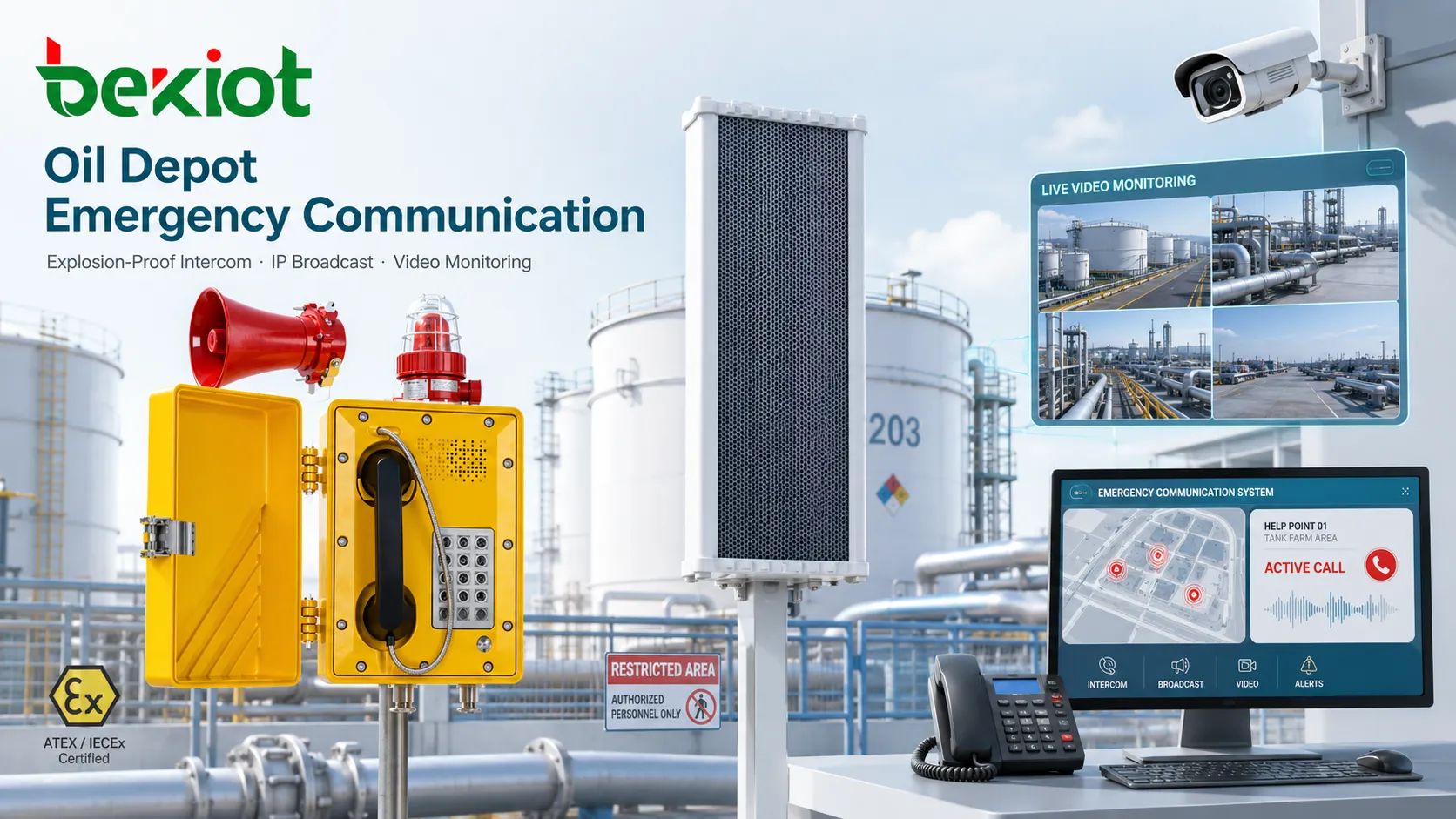
Explosion-proof intercom facilities can be deployed at important nodes to provide emergency voice or video communication. When a person encounters a problem, they can use the nearby help point to contact the duty station or dispatch center directly. This improves emergency accessibility for people who do not carry personal communication equipment.
Video intercom can further improve situational awareness. The dispatch center can not only hear the caller but also view the local environment if the device supports video. This is useful for judging whether the situation involves personal injury, equipment abnormality, unauthorized access, fire risk, leakage, or other safety concerns.
Broadcasting and Alarm Notification Across Key Areas
Oil depots need reliable public address and emergency broadcasting in important areas. IP broadcast terminals can be deployed in the depot, while explosion-proof broadcast horns can be installed in high-risk zones that require special safety design. These devices allow the dispatch center or duty station to issue voice announcements, warning messages, evacuation instructions, and emergency alarms.
Broadcasting is not only for emergency evacuation. It can also support routine reminders, operation notices, maintenance announcements, inspection instructions, and safety education. However, during an emergency, the ability to broadcast quickly to the correct area becomes critical.
When broadcasting is combined with video monitoring, dispatchers can observe the condition of key areas and issue targeted voice instructions. For example, if an abnormal situation is detected near a loading area, the command center can use video to confirm the scene and then broadcast an immediate warning to nearby personnel.
Video Monitoring Linkage for Faster Situation Assessment
Video monitoring is already common in modern oil depot management, but it becomes more valuable when connected with communication and dispatch. If the dispatch system can work alongside the camera monitoring system, operators can verify field conditions while speaking to personnel or issuing broadcast instructions.
This helps reduce the uncertainty that often exists in voice-only reporting. A field worker may describe smoke, leakage, abnormal noise, unauthorized entry, or equipment failure, but the command center needs visual confirmation before making a decision. Video linkage gives the dispatcher a clearer basis for action.
The combination of video, voice, intercom, telephone, and broadcasting also supports post-event review. Managers can analyze whether the alarm was handled quickly, whether communication was effective, and whether the command process needs improvement.
Suggested Architecture and Functional Roles
A complete oil depot command dispatch solution should be planned according to site zones, personnel roles, risk levels, communication restrictions, and emergency procedures. The system normally includes a central dispatch platform, office phones, visual duty phones, conference room gateway, cluster gateway, explosion-proof walkie-talkies, explosion-proof intercom points, IP broadcasting terminals, explosion-proof horns, and video monitoring integration.
The table below summarizes typical system components and their roles in the overall solution.
| System Area | Main Equipment or Function | Operational Value |
|---|---|---|
| Dispatch center | Command dispatch platform, dispatch console, telephone access | Centralized control for daily communication and emergency command |
| Conference room | Conference room gateway connected to the dispatch system | Supports emergency meetings, remote communication, and work deployment |
| Office area | Office phones and visual dispatch duty phones | Improves routine communication and duty-station coordination |
| Operation area | Cluster gateway and explosion-proof walkie-talkie access | Connects restricted field users with the dispatch platform |
| Key safety points | Explosion-proof intercom and help call facilities | Provides emergency calling for workers, contractors, and visitors |
| Broadcast zones | IP broadcast terminals and explosion-proof horns | Enables area announcements, alarm broadcasting, and evacuation guidance |
| Monitoring system | Camera linkage and video monitoring integration | Helps dispatchers verify field conditions and issue accurate instructions |
Management Value for Oil Depot Operators
The main value of this solution is that it brings scattered communication tools into a unified dispatch framework. Daily office calls, duty communication, field radio access, emergency intercom, broadcasting, remote meetings, and video monitoring can all serve the same management goal: safer and more efficient oil depot operation.
For production management, the system improves communication between office staff, duty teams, field personnel, and supervisors. For safety management, it provides emergency call points, broadcast notification, dispatch command, and video-assisted verification. For emergency response, it shortens the path from incident discovery to command decision and action.
The solution also supports information-based management. Communication logs, call records, broadcast actions, and dispatch records can provide useful references for safety review, duty assessment, emergency drills, and process optimization.
Deployment Considerations Before Implementation
Before implementing an intelligent oil depot dispatch solution, the site should be surveyed carefully. Important factors include the number of office users, field communication zones, high-risk areas, existing radio systems, camera distribution, emergency procedures, explosion-proof requirements, network conditions, and the expected role of the dispatch center.
Device selection should follow the safety level of each area. Ordinary office phones are suitable for administrative zones, while restricted operation areas may require explosion-proof intercoms, explosion-proof broadcast horns, or certified communication devices. The system should also consider redundancy, power supply, network stability, permission control, and maintenance convenience.
A good solution should not simply add more devices. It should create a clear communication path: who can call whom, who can broadcast, who receives alarms, how emergency meetings are started, how field users contact the dispatch center, and how the command team verifies the scene through video.
Conclusion
Intelligent oil depot command dispatch is not only a communication upgrade. It is a safety-management infrastructure that supports daily operation, production coordination, field communication, emergency response, and management informatization. By integrating office telephony, dispatch control, emergency meetings, explosion-proof intercom, field radio access, IP broadcasting, and video monitoring, oil depots can build a more reliable communication environment for both routine work and emergency handling.
This solution provides a practical framework for oil depot operators that need centralized control, safer field communication, and faster response to abnormal situations. With the right architecture, the dispatch system can become the communication backbone for safe production, emergency command, and intelligent oil depot management.
FAQ
Why should an oil depot use a dedicated dispatch system instead of ordinary phones?
Ordinary phones mainly support point-to-point calling. A dedicated dispatch system can connect phones, intercoms, radios, broadcasting devices, video monitoring, and emergency workflows, which is more suitable for complex oil depot operations.
Are explosion-proof devices necessary in every area?
No. Device selection should match the risk level of each zone. Administrative offices may use standard communication terminals, while storage, loading, pump, and other hazardous areas may require explosion-proof communication equipment.
Can the solution work with an existing camera system?
Yes. In many projects, the dispatch platform can be planned to work alongside video monitoring so that operators can verify field conditions while communicating with personnel or issuing broadcast instructions.
What is the role of the conference room gateway?
It connects the meeting room to the dispatch communication system, making it easier to organize emergency meetings, remote discussions, and management work deployment during urgent situations.
How does broadcasting improve emergency handling?
Broadcasting allows the command center to send warnings, evacuation messages, and safety instructions to specific areas quickly, especially when direct one-to-one communication is not enough.







