


Modern networks are no longer simple collections of computers connected by cables. Enterprises, campuses, hospitals, data centers, industrial parks, and service providers all need networks that can move large volumes of data quickly, separate different user groups safely, and support reliable communication between multiple IP subnets. In this environment, a Layer 3 switch becomes more than a common switching device. It combines the high-speed forwarding capability of a Layer 2 switch with the routing intelligence of a router, making it an important foundation for scalable network architecture.
A Layer 3 switch is often described as a device that can both switch and route. At the access and aggregation layers, it helps local devices communicate efficiently. At the core or distribution layer, it can route traffic between VLANs, departments, server groups, service zones, and network segments. This dual capability allows organizations to build networks that are faster, cleaner, easier to manage, and better prepared for future growth.
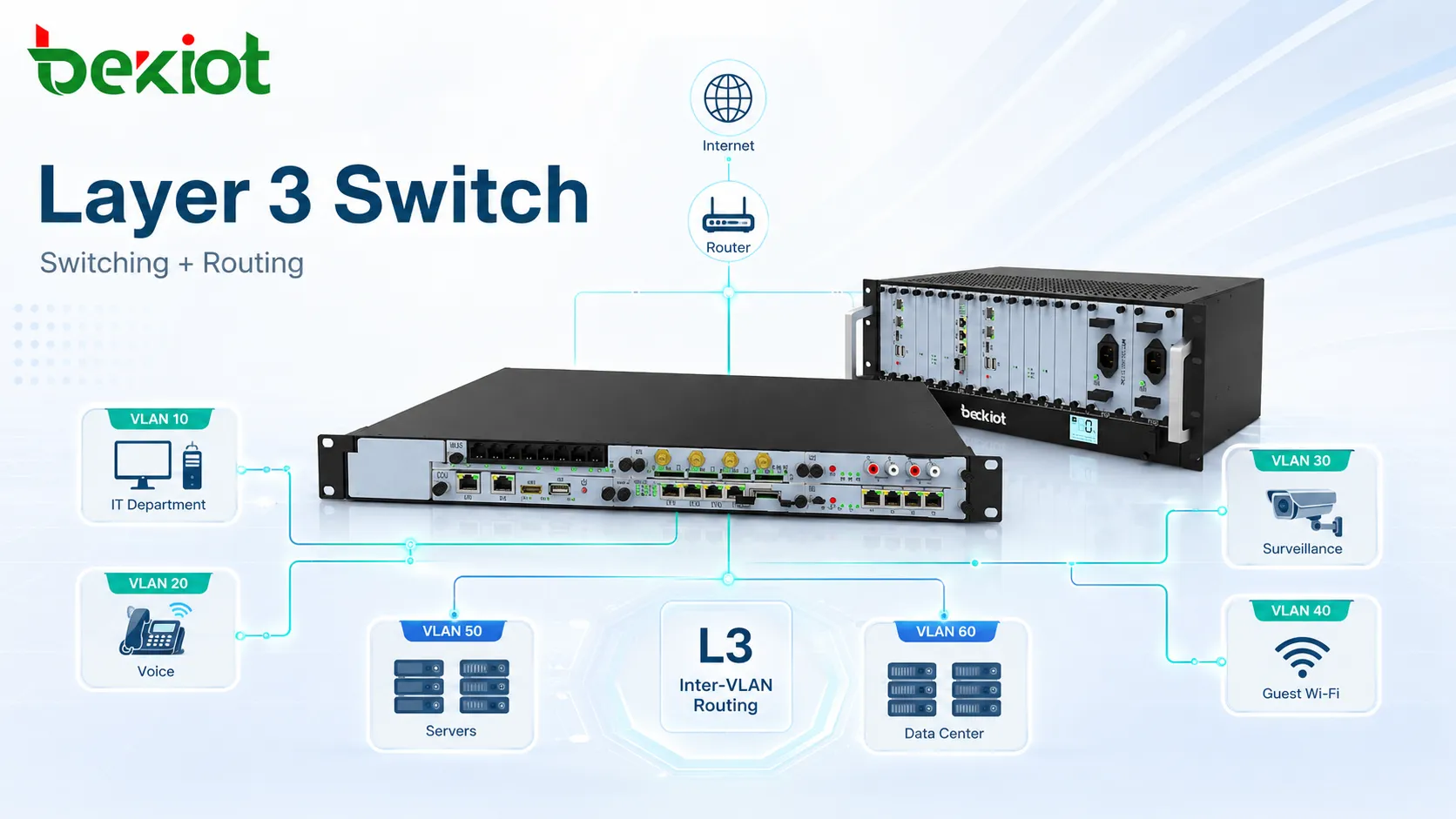
From Simple Forwarding to Intelligent Traffic Control
Different network devices handle data in different ways. A hub simply broadcasts traffic to all connected ports and is largely obsolete in modern networks. A Layer 2 switch forwards frames inside a local area network according to MAC addresses. A router forwards packets between different IP networks according to IP routes. A Layer 3 switch brings these two worlds together by using both MAC address forwarding and IP routing.
In a traditional local network, a Layer 2 switch works well when all devices belong to the same subnet or VLAN. However, when users in different departments, service zones, or VLANs need to communicate, traffic must be routed between IP networks. If every inter-VLAN flow is sent to a separate router, the network can become inefficient, especially when internal traffic volume is high.
A Layer 3 switch solves this problem by performing routing inside the switching platform. It can forward local traffic at Layer 2 and route cross-subnet traffic at Layer 3, reducing unnecessary detours and improving the overall response speed of the network.
How the Core Mechanism Works
The core value of a Layer 3 switch can be summarized as “route once, switch many times.” When a packet first needs to move from one subnet to another, the switch performs Layer 3 routing decisions in a way similar to a router. After the traffic flow is identified, later packets with the same forwarding path can be handled at high speed through hardware-based switching.
This mechanism allows the network to keep the intelligence of routing while gaining performance close to Layer 2 switching. For internal enterprise traffic, this is especially useful because many applications require frequent communication between different VLANs, server networks, office networks, wireless networks, and security zones.
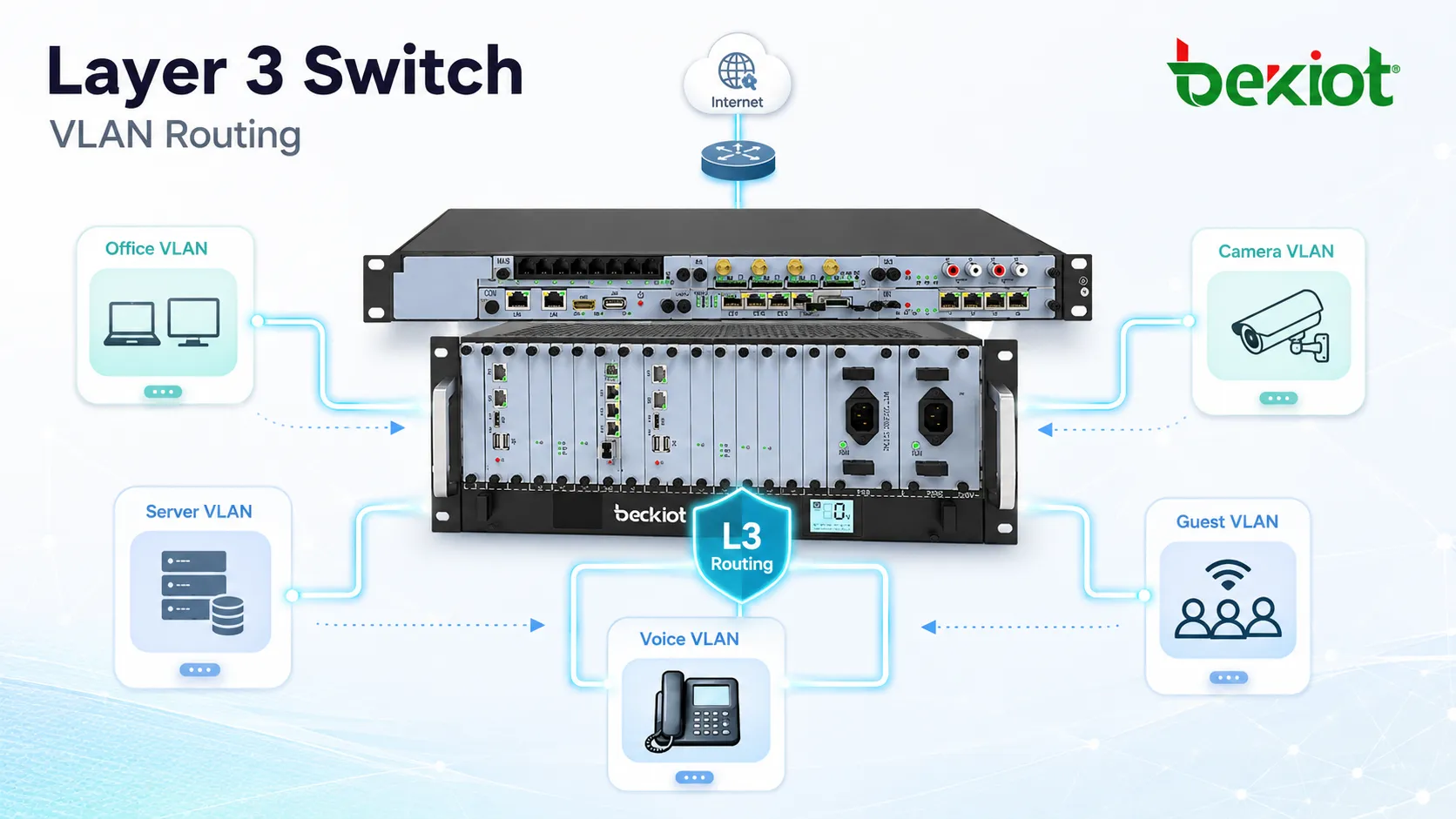
In practical network design, this means that inter-VLAN communication does not always need to depend on an external router. The Layer 3 switch can act as the routing gateway for multiple VLANs, while still maintaining fast forwarding between connected ports.
Two Tables Behind Smarter Forwarding
A Layer 3 switch maintains two important types of forwarding information. The first is the MAC address table, which records the relationship between device MAC addresses and switch ports. This table supports Layer 2 switching inside the same broadcast domain or VLAN.
The second is the routing table, which records different IP network segments, outgoing interfaces, next-hop information, and route preferences. This table supports Layer 3 routing between different IP subnets. When traffic arrives, the switch checks whether the destination belongs to the same subnet. If it does, the switch forwards the frame through the MAC address table. If it does not, the switch uses the routing table to determine the proper forwarding path.
This combined logic makes the device more intelligent than a simple Layer 2 switch and more efficient for internal high-speed routing than many traditional software-based routing designs.
Hardware Routing Reduces Delay
One of the key technical advantages of Layer 3 switching is hardware-based routing. Traditional routers often rely more heavily on software processing for routing functions, while Layer 3 switches use dedicated switching chips, often referred to as ASICs, to accelerate forwarding decisions.
Because routing and forwarding can be handled in hardware, Layer 3 switches can reduce forwarding delay to the microsecond level in suitable designs. High-performance Layer 3 switches can also support wire-speed forwarding, which means the device can forward traffic at the maximum physical rate of its interfaces under proper conditions.
This is why Layer 3 switches are widely used in networks where both routing intelligence and high throughput are required. They are not simply “larger switches.” They are designed to make cross-subnet communication faster and more practical in busy internal networks.
VLAN Segmentation Builds a Cleaner Network
VLAN support is one of the most important reasons organizations deploy Layer 3 switches. A VLAN allows a physical network to be divided into multiple logical networks. For example, an enterprise may separate office users, finance systems, wireless users, IP cameras, voice terminals, guest access, and servers into different VLANs.
Without routing, these VLANs remain isolated. With a Layer 3 switch, the organization can define routing paths between VLANs while keeping traffic boundaries clear. This makes the network more secure, more manageable, and more flexible than placing all devices in one large flat network.
Proper VLAN segmentation can also reduce broadcast traffic, simplify troubleshooting, and improve policy control. Network administrators can apply different rules for different departments, service systems, or security zones instead of treating every device the same way.
Routing Protocols for Growing Networks
A Layer 3 switch can support multiple routing methods depending on the network size and complexity. In smaller networks, static routes may be enough. In medium and large networks, dynamic routing protocols such as RIP, OSPF, and BGP can help the network learn routes automatically and adapt to topology changes.
OSPF is commonly used inside enterprise and campus networks because it supports scalable internal routing and faster path calculation. BGP is more often used in carrier, data center, or large multi-network environments where route control and policy-based routing are important. The exact protocol choice depends on the network architecture, redundancy requirement, and management capability.
By supporting routing protocols, a Layer 3 switch can participate in a broader routing system instead of only acting as a local inter-VLAN gateway. This is important for enterprises with multiple buildings, branch sites, data centers, or upstream network connections.
Enterprise Architecture with Core, Aggregation, and Access Layers
In many enterprise networks, a three-layer design is used: core layer, aggregation layer, and access layer. Access switches connect endpoint devices such as computers, printers, IP phones, wireless access points, cameras, and industrial terminals. Aggregation switches collect traffic from multiple access switches. The core layer provides high-speed forwarding and routing between major network areas.
A Layer 3 switch is often deployed at the core layer or aggregation layer because these positions require both speed and routing capability. It can connect different department VLANs, server zones, internet exits, firewall interfaces, and data center networks. This design keeps access switches simpler while placing routing control closer to the traffic center.
For an enterprise, this architecture helps improve scalability. New departments, floors, production areas, wireless networks, or service systems can be added through VLAN planning and routing policies rather than by rebuilding the entire network.
Data Centers Need Fast and Low-Latency Switching
Data centers place high demands on switching performance. Modern server environments may contain thousands of servers, virtual machines, storage systems, container platforms, and application clusters. These systems generate both north-south traffic between servers and external networks and east-west traffic between servers inside the data center.
Layer 3 switches help data centers build flatter network structures, reduce unnecessary forwarding hops, and improve throughput. In high-performance environments, using suitable Layer 3 switching architecture can significantly improve traffic efficiency. Some related performance comparisons indicate that high-performance Layer 3 switching in data center scenarios can reduce north-south traffic latency by more than 40% in optimized designs.
For applications such as cloud platforms, online services, virtualization, storage networking, and real-time business systems, lower latency and higher forwarding capacity can directly affect service response time and user experience.
Service Provider and Metropolitan Network Use Cases
In service provider and metropolitan network environments, Layer 3 switches are often used at edge nodes, enterprise access points, and aggregation positions. They can provide VLAN isolation, flexible routing, policy-based forwarding, and high-speed packet handling for many customers or service groups.
These networks require both traffic separation and efficient routing. A Layer 3 switch can help separate customer traffic, connect multiple service VLANs, support route policies, and forward large amounts of traffic with stable performance. This makes it suitable for enterprise private line access, building aggregation, campus connectivity, and metro Ethernet services.
Compared with a pure Layer 2 aggregation network, Layer 3 capability gives operators more control over traffic paths, service isolation, and network resilience.
High-Reliability Scenarios Require More Than Speed
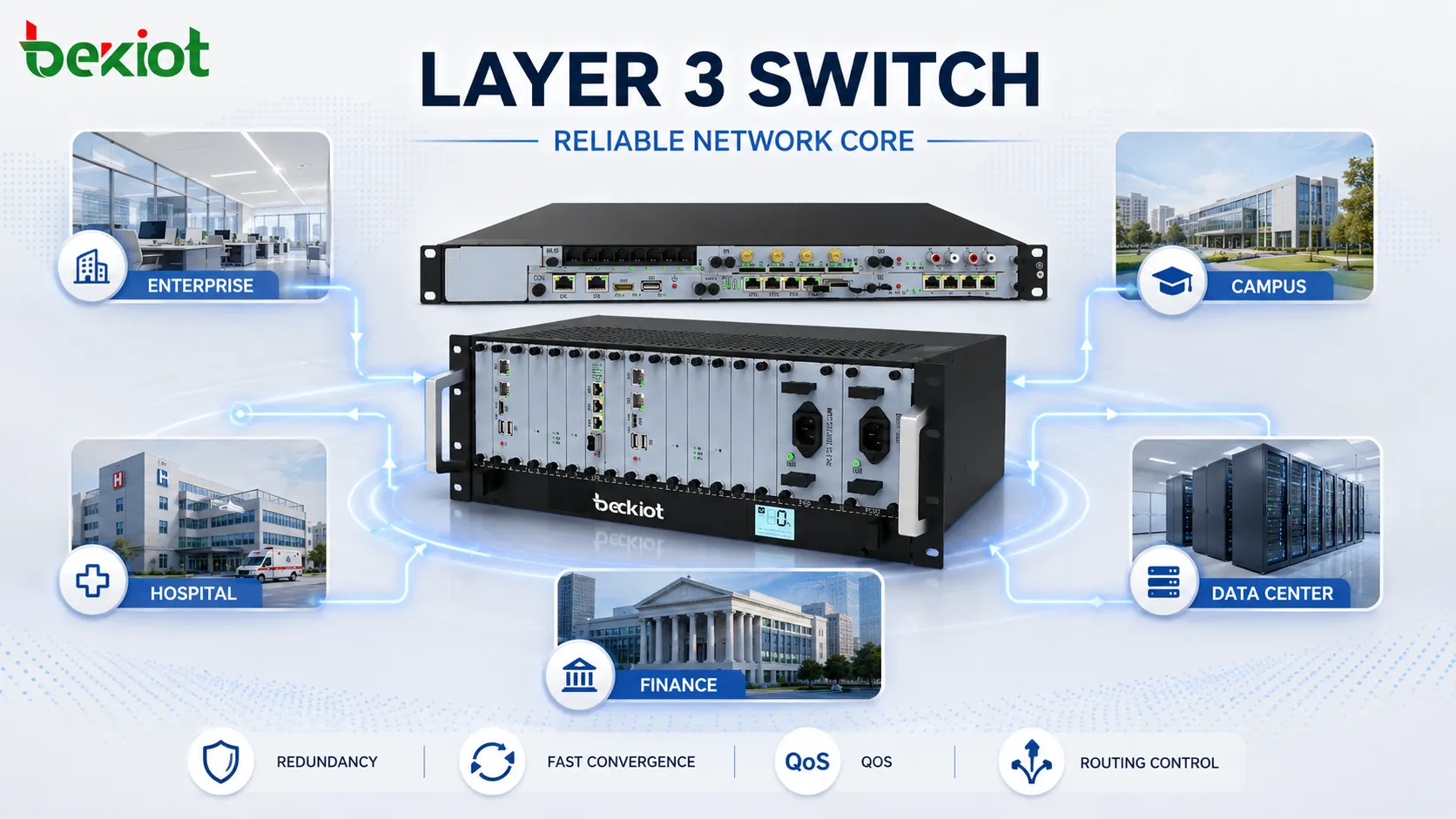
Campus networks, hospital networks, financial trading systems, control rooms, and large enterprise headquarters all require stable network operation. In these environments, speed is important, but reliability, fast recovery, and traffic prioritization are equally important.
Layer 3 switches can support redundant links, fast convergence, link aggregation, routing backup, and QoS policies. Redundancy helps maintain connectivity when a link or device path fails. Fast convergence reduces the time needed for the network to find another path. QoS allows important traffic, such as voice, video, medical systems, trading traffic, or management services, to receive higher priority when the network is busy.
This makes Layer 3 switches suitable for networks where downtime or delay can affect business continuity, safety management, or user experience.
Recommended Solution Components
A complete Layer 3 switch solution should not focus only on the switch itself. It should include VLAN planning, IP addressing, routing design, gateway placement, redundancy, QoS policy, security control, monitoring, and future expansion. The goal is to create a network that is fast, structured, secure, and easy to manage.
| Solution Element | Main Function | Network Value |
|---|---|---|
| Layer 3 switching core | Combines MAC-based switching and IP-based routing | Supports high-speed forwarding and inter-VLAN communication |
| VLAN segmentation | Separates departments, services, users, and security zones | Improves control, security, and network organization |
| Routing design | Uses static routes, RIP, OSPF, BGP, or mixed routing policies | Enables scalable communication between multiple IP networks |
| Redundancy and convergence | Provides backup paths, link aggregation, and fast recovery | Reduces service interruption during link or path failures |
| QoS policy | Prioritizes voice, video, control, or business-critical traffic | Maintains service quality under network load |
| Monitoring and management | Tracks traffic, ports, routes, errors, and performance trends | Helps administrators detect problems and optimize capacity |
Planning Points Before Deployment
Before deploying a Layer 3 switch solution, administrators should first define the network zones and service priorities. This includes deciding which VLANs are needed, which subnets should communicate, which services require isolation, and which traffic should receive priority.
IP addressing should be planned clearly. A disorganized IP structure can make routing, troubleshooting, and expansion more difficult. Gateway placement is also important. In many enterprise designs, the Layer 3 switch serves as the default gateway for multiple VLANs, which allows local routing to happen close to the users and servers.
Redundancy should be considered from the beginning. Critical networks should avoid single points of failure in uplinks, power, core connections, and routing paths. Management access, configuration backup, logging, and monitoring should also be included in the design rather than added only after problems appear.
Future-Ready Development Direction
As 5G, cloud computing, IoT, artificial intelligence, and edge computing continue to develop, networks will need to carry more devices, more applications, and more real-time traffic. Layer 3 switches are also moving toward higher performance, stronger automation, and easier centralized management.
Future network environments will increasingly require 400G and 800G interface capability in high-end core and data center scenarios. AI-assisted traffic optimization may help networks identify abnormal patterns, adjust policies, and improve resource use. Cloud-native management and automation can make large-scale deployment and maintenance more efficient.
For organizations planning long-term network upgrades, Layer 3 switching is not only a current performance improvement. It is also a foundation for more intelligent, automated, and scalable network operations.
Conclusion
A Layer 3 switch solution gives modern networks the ability to combine fast local switching with intelligent IP routing. It supports VLAN segmentation, inter-subnet communication, dynamic routing, redundancy, QoS, and high-performance forwarding in one architecture.
From enterprise networks to data centers, from campuses to service provider access, Layer 3 switches help data move more smoothly across complex environments. When properly planned, they can reduce routing bottlenecks, improve security boundaries, simplify network structure, and support future growth.
The best result comes from treating Layer 3 switching as part of a complete network solution, not just as a device upgrade. VLAN design, routing policy, redundancy, security, traffic priority, and management visibility should work together to create a stable and scalable communication foundation.
FAQ
Is a Layer 3 switch the same as a router?
No. Both can route IP traffic, but they are designed for different roles. A Layer 3 switch is optimized for high-speed internal network forwarding, while a router is often used for WAN access, internet edge functions, NAT, firewall integration, or complex external routing.
When should an organization upgrade from Layer 2 to Layer 3 switching?
An upgrade is usually needed when the network has multiple VLANs, several departments, growing server traffic, inter-subnet communication requirements, or performance pressure caused by sending too much internal traffic through an external router.
Does every access switch need Layer 3 capability?
Not always. Many networks use Layer 2 switches at the access layer and Layer 3 switches at the aggregation or core layer. This design keeps endpoint access simple while placing routing and policy control at a stronger central point.
Can a Layer 3 switch improve network security?
It can help by supporting VLAN separation, routing control, access policies, and traffic boundaries. However, it should still work with firewalls, authentication systems, monitoring tools, and security policies for complete protection.
What should be considered when choosing a Layer 3 switch solution?
Important factors include port speed, forwarding capacity, VLAN scale, routing protocol support, redundancy features, QoS capability, management tools, power reliability, and future expansion requirements.







