


Public network trunked intercom systems have become widely used in mobile communication and dispatch scenarios. Based on 4G and 5G mobile networks, this type of system is often called PoC, or push-to-talk over cellular. Compared with traditional digital trunking systems such as DMR and PDT, public network PTT offers simpler deployment, lower construction cost, wider coverage, and richer multimedia capabilities.
For many organizations, buying a public PTT service from an operator is the easiest way to start. Users only need to select a service package according to the number of terminals required. However, this model is usually limited when deeper integration is needed. If an enterprise wants to connect its existing video monitoring platform, private radio system, phone system, video meeting platform, business software, and customized dispatch workflow, a self-built public network PTT solution becomes a more suitable choice.
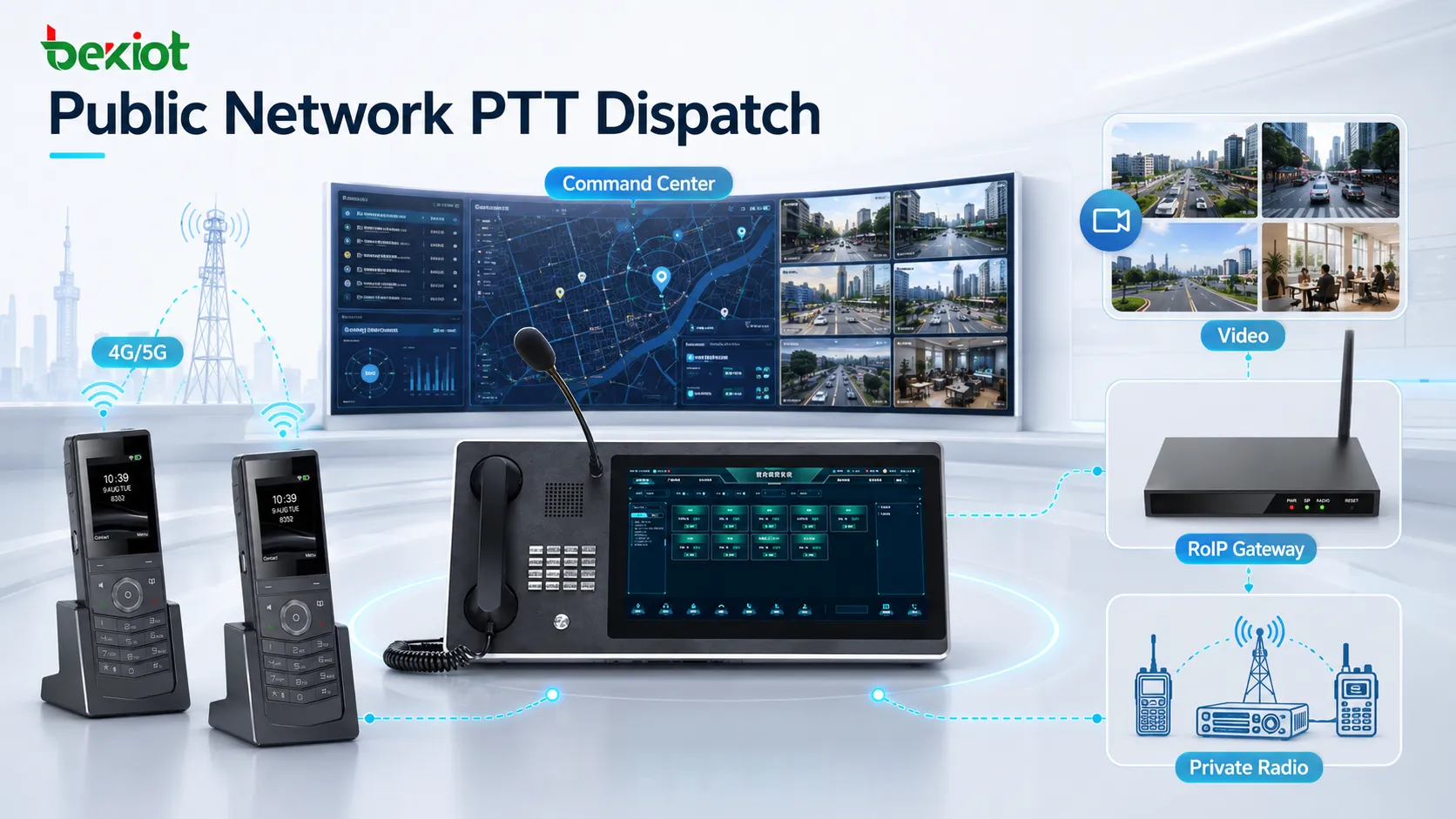
Why Organizations Choose Private Deployment
A self-built system gives the organization more control over users, groups, permissions, call logic, emergency plans, data access, and platform expansion. Instead of accepting a fixed operator service model, the organization can design communication rules according to its own command structure and operational process.
This is important for industries that need more than simple push-to-talk. For example, emergency teams may need predefined response plans. Industrial parks may need different talk groups for security, maintenance, production, and management. Transportation operators may need dispatch groups by route, region, vehicle type, or duty shift. A self-built platform can support these more detailed communication structures.
The key value is not only ownership of the platform. It is the ability to make the platform match the actual operation environment. Management rights, configuration rights, integration rights, and development rights can be controlled by the organization itself, making the system more adaptable over the long term.
More Flexible Dispatch and Group Control
Public network PTT already provides wide-area group communication through 4G and 5G networks. A self-built solution goes further by allowing the administrator to define group hierarchy, user roles, temporary groups, emergency call priorities, and dispatch permissions more freely.
In daily operations, users can communicate through fixed groups such as department groups, patrol groups, maintenance groups, vehicle groups, or project groups. During an emergency, the command center can create temporary groups, call key personnel, or activate preset communication plans. This makes the system useful for both routine communication and urgent command scenarios.
Compared with a general operator platform, self-management can also support stricter access control. Administrators can define which users can speak, monitor, record, dispatch, broadcast, or connect to external systems. This helps prevent disorder when the number of users grows.
Video Monitoring Becomes Part of Dispatch
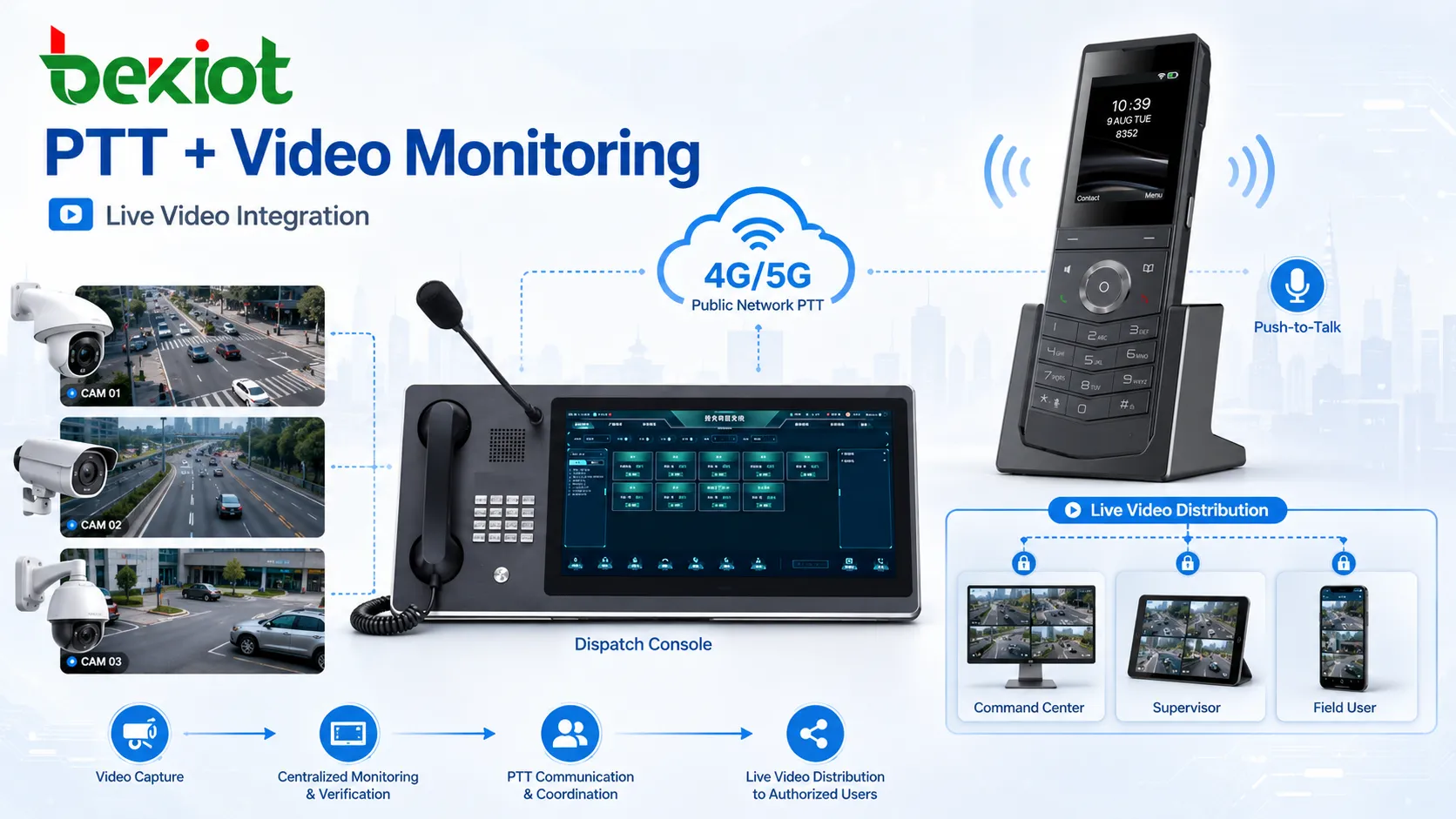
One major advantage of a self-built public network PTT platform is the ability to connect with video monitoring systems. By adding video access capability, the dispatch platform can bring cameras and PTT terminals into the same command workflow.
Public network PTT is a broadband trunked communication system, so it can support more multimedia services than traditional narrowband voice systems. After integration, field users may view monitoring images through authorized smart terminals, while the command center can select cameras for live video distribution in special situations.
This creates more practical value in security patrol, emergency response, industrial inspection, traffic control, construction management, and remote site supervision. Dispatchers no longer rely only on voice reports. They can combine video observation with voice command to understand the scene more accurately.
Connecting Narrowband Radio Systems
Many industry users still depend on narrowband trunked radio systems. Industrial parks, mines, airports, utilities, public safety departments, and transportation organizations may already use PDT, DMR, TETRA, or other private radio technologies. These systems are often reliable and deeply embedded in daily operations.
A self-built public network PTT solution can connect with existing narrowband private radio systems through a gateway-based architecture. This allows public network PTT users and private radio users to communicate without changing the original radio environment.
This approach protects earlier investment and avoids forced replacement. The organization can keep the existing private radio system for local mission-critical voice communication, while using public network PTT for wider coverage, mobile multimedia communication, remote dispatch, and flexible user expansion.
Telephony Integration Expands Communication Methods
A self-built public network PTT system can also connect with telephone systems through a telephony gateway. After integration, the communication platform can support interaction between PTT users, office phones, IP phones, dispatch terminals, smart intercom terminals, and other voice endpoints.
This makes the communication environment more complete. Office users can participate in dispatch communication. Duty rooms can contact field teams more directly. The command center can use both PTT and telephone resources according to the actual situation.
In industrial and enterprise scenarios, the solution may also be extended to fixed communication points, broadcast terminals, emergency call points, or site intercom devices. The goal is not to replace every existing tool, but to connect them into a more unified dispatch communication system.
Video Meetings for Command Collaboration
A self-built public network PTT platform can become a multimedia communication hub. In addition to voice PTT, the system can support video-related services such as video calls, live video return, and video meeting integration.
By connecting a video meeting platform or deploying meeting control capability, organizations can allow dispatch centers, managers, remote experts, field users, and mobile terminals to participate in visual coordination. This is especially useful in emergency command, field troubleshooting, remote inspection, and multi-department decision-making.
In many command scenarios, voice alone is not enough. A meeting connection allows supervisors to discuss the situation, view field information, contact users, and issue instructions more efficiently.
Terminal Choice Can Match Real Workplaces
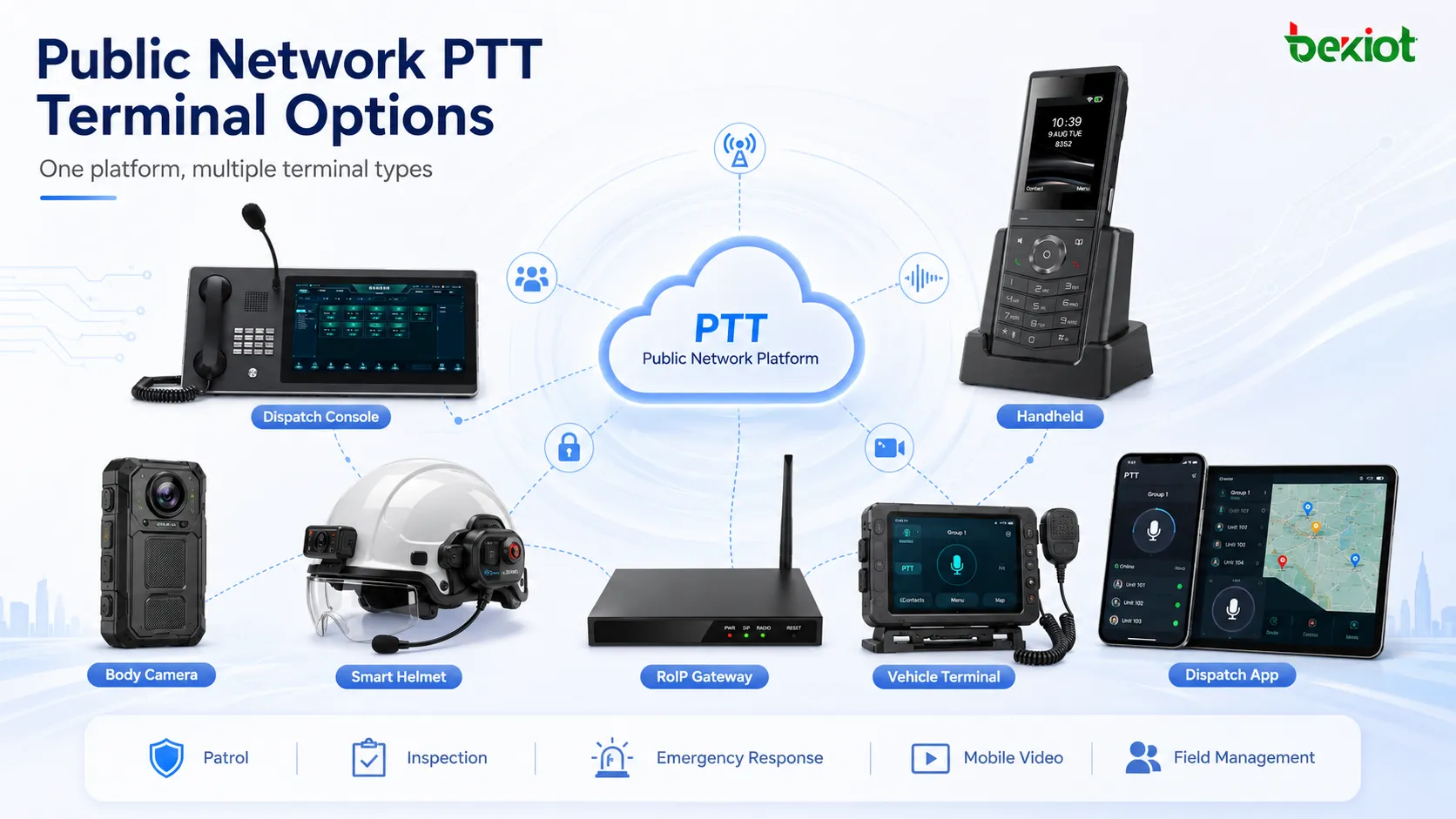
Operator-provided public PTT terminals are often selected for common use cases. This can be convenient, but it may not fully match the needs of special industries. A self-built solution allows the organization to adapt more terminal types according to real working conditions.
In addition to common PTT handheld terminals, the platform can be extended to smart terminals, body-worn cameras, mobile video devices, portable surveillance units, safety helmets, smart flashlights, vehicle terminals, and other field devices. This flexibility makes the system more suitable for patrol, inspection, rescue, construction, logistics, security, and industrial management.
Terminal diversity is important because users do not all work in the same environment. Some need loud audio and long battery life. Some need video return. Some need positioning. Some need wearable equipment. A self-built platform provides more room for this kind of adaptation.
APIs Support Deeper Business Integration
Another important advantage of a self-built public network PTT solution is the availability of API and SDK resources. With development interfaces, industry users can connect the communication platform with their own business systems, command platforms, GIS systems, monitoring platforms, emergency management systems, or mobile applications.
This creates room for customized dispatch consoles, customized terminal apps, automated alarms, workflow integration, data exchange, and industry-specific command functions. Instead of using a fixed public service interface, the organization can develop functions that match its own management model.
For users with deep dispatch requirements, API capability is often the key difference between a basic communication service and a real command solution.
Suggested Architecture and Functional Roles
A self-built public network PTT solution should be planned as a complete communication architecture. It normally includes a dispatch platform, 4G or 5G network access, PTT terminals, group management, video monitoring integration, private radio gateway, telephone gateway, video meeting integration, API resources, and management tools.
The design should be based on actual user roles, coverage requirements, existing systems, emergency procedures, and data management needs. The table below summarizes typical functional modules and their value.
| Function Area | Main Role | Solution Value |
|---|---|---|
| Dispatch platform | Manages users, groups, permissions, calls, and command workflows | Provides centralized control and flexible configuration |
| 4G/5G PTT communication | Supports wide-area push-to-talk over mobile networks | Reduces distance limits and simplifies deployment |
| Video monitoring access | Connects cameras and monitoring resources to dispatch | Improves visual command and field verification |
| Private radio interconnection | Links PDT, DMR, TETRA, or other narrowband radio systems | Protects existing investment and enables cross-system communication |
| Telephony gateway | Connects PTT users with phone systems and IP voice endpoints | Expands communication methods across office and field users |
| Video meeting integration | Supports visual collaboration and remote command meetings | Helps multi-party coordination during complex incidents |
| API and SDK resources | Enables integration with business systems and custom apps | Supports deeper industry customization |
Best-Fit Application Scenarios
A self-built public network PTT platform is suitable for organizations that require deeper integration with existing information systems. It is especially useful when a general operator service cannot meet dispatch, emergency management, system interconnection, terminal adaptation, or software development requirements.
Typical scenarios include emergency command, industrial parks, airports, mines, logistics fleets, transportation management, security patrol, utilities, large construction projects, smart city operations, and enterprise service teams. These environments often need wide-area communication, field visibility, private radio compatibility, and customized workflows.
For organizations with simple communication needs, an operator service may be enough. For users that need control, integration, and customization, a self-built solution provides stronger long-term value.
Planning Points Before Deployment
Before building the system, the organization should evaluate user scale, coverage requirements, terminal types, existing radio systems, video monitoring resources, telephone system conditions, meeting requirements, security policies, and integration goals.
Network conditions should also be considered. Since the system depends on 4G or 5G mobile communication, the quality of local coverage will affect voice, video, positioning, and real-time dispatch performance. For important command scenarios, backup communication plans and platform reliability should be included in the design.
A successful project should not simply install a platform and terminals. It should create a complete command communication workflow: who can call, who can dispatch, which systems need to interconnect, what video sources can be accessed, which terminals are suitable, and how data should be managed.
Conclusion
A self-built public network PTT solution gives organizations more than a communication tool. It provides a flexible command platform that can combine 4G/5G PoC communication, group dispatch, video monitoring, narrowband radio interconnection, telephone integration, video meetings, multiple terminal types, and API-based business customization.
Compared with buying a standard public PTT service, self-building is more suitable for users that need deeper integration, independent management, and stronger dispatch control. When properly planned, it can help organizations build a communication system that better matches their actual work environment and long-term command requirements.
FAQ
Is self-built public network PTT suitable for small teams?
Small teams with only basic communication needs may prefer an operator service. A self-built solution is more suitable when the organization needs custom management, system integration, private data control, or multi-system dispatch capability.
Can public network PTT work together with existing radios?
Yes. With the right gateway and interface design, public network PTT can communicate with existing narrowband radio systems such as PDT, DMR, or TETRA without replacing the original radio network.
What makes APIs important in this type of solution?
APIs allow the communication system to connect with business platforms, emergency systems, GIS maps, monitoring platforms, and custom applications. This turns the PTT platform into part of a wider digital command workflow.
Does a self-built system require special terminals?
Not necessarily. The system can be planned to support different terminal types, including handheld PTT devices, smart terminals, wearable devices, vehicle terminals, and video-capable field equipment depending on the application.
What should be checked before choosing self-deployment?
The organization should check user scale, 4G or 5G coverage, integration targets, security requirements, platform reliability, terminal suitability, dispatch permissions, and future expansion needs.







