


Power Line Communication, commonly abbreviated as PLC, is a communication technology that transmits data over electrical power lines. Instead of installing a separate communication cable for every device, PLC allows selected signals to travel through wiring that already carries electrical power. This makes it useful in homes, buildings, factories, utility grids, smart meters, street lighting, energy management systems, and automation networks.
The basic idea is simple: power and data can share the same conductor when they occupy different frequency ranges and are separated by suitable coupling, filtering, modulation, and signal processing methods. In practice, the reliability of PLC depends heavily on the electrical environment, wiring quality, noise level, distance, coupling method, frequency band, regulatory limits, and the type of devices connected to the power network.
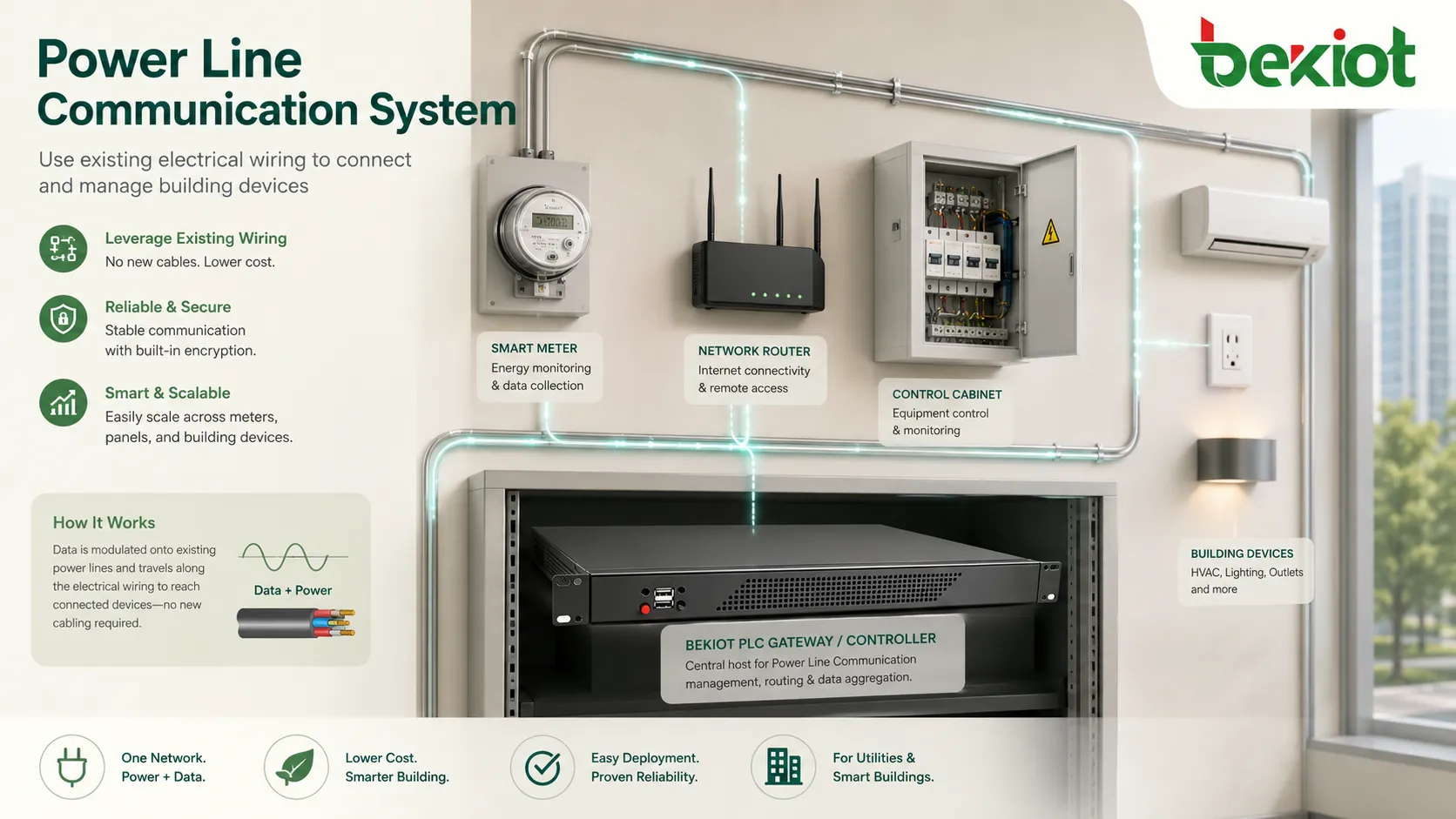
Using Electrical Wiring as a Data Path
Electrical wiring was originally designed to distribute power, not data. This makes PLC different from Ethernet, fiber, coaxial cable, or dedicated control wiring. The power line environment can be noisy, uneven, branched, and affected by connected loads. A refrigerator, motor drive, charger, dimmer, inverter, or switching power supply can change the signal condition on the same wiring network.
To make communication possible, PLC systems inject a controlled carrier signal onto the power line. The receiver listens for that signal, separates it from the power waveform, demodulates the data, and corrects errors when possible. Depending on the system design, the data rate may be low and robust for control signals, or higher for broadband networking inside a building.
This is why PLC is often divided into narrowband and broadband categories. Narrowband systems usually focus on long reach, low data rate, and strong tolerance for utility or industrial environments. Broadband systems focus on higher speed over shorter distances, such as home networking or in-building connectivity.
Core Signal Flow
Coupling to the Power Line
The first step is coupling the communication signal onto the electrical conductor. The coupling circuit injects data signals while protecting the communication electronics from dangerous mains voltage. It may include capacitors, transformers, filters, isolation components, surge protection, and impedance-matching elements.
Good coupling is essential because the device must transmit and receive data without compromising electrical safety. In utility or industrial systems, coupling design may also need to withstand voltage surges, load switching, grounding differences, and harsh environmental conditions.
Modulation and Coding
PLC modems use modulation to encode digital information onto a carrier signal. Different systems may use methods such as OFDM, spread spectrum, FSK, PSK, or other modulation schemes depending on frequency band and application requirements.
Because power lines can contain strong noise and changing impedance, many systems also use error correction, interleaving, adaptive modulation, and automatic repeat mechanisms. These methods help improve communication reliability when the channel becomes unstable.
Transmission Through the Wiring Network
After modulation, the signal travels through the power line. The signal path may pass through branch circuits, distribution panels, transformers, connectors, circuit breakers, meters, or coupling units. Each of these elements may attenuate, reflect, distort, or block part of the signal.
In a simple home network, the path may be short and relatively easy to manage. In a utility distribution network, the path may be long and affected by transformers, load changes, and outdoor line conditions.
Reception and Error Handling
The receiver extracts the communication signal from the electrical wiring and converts it back into digital data. It must separate useful data from mains frequency, harmonics, transient noise, and interference from other equipment.
If errors occur, the system may use retransmission, forward error correction, channel estimation, or adaptive rate control. The goal is not always maximum speed. In many smart grid and control applications, stable delivery is more important than high throughput.
Reliability Depends on the Electrical Environment
PLC reliability is strongly influenced by the power network itself. Unlike a dedicated communication cable, a power line can change its behavior throughout the day as loads turn on and off. The channel may be clean in one hour and noisy in another hour. This makes planning and testing important before relying on PLC for critical communication.
Common reliability challenges include impulse noise, continuous conducted noise, high attenuation, phase separation, transformer blocking, poor grounding, long branch circuits, old wiring, loose terminals, and interference from power electronics. These problems do not always stop communication completely, but they may reduce speed, increase latency, or cause intermittent failure.
Reliable deployments usually combine robust modulation, proper coupling, suitable frequency selection, repeaters or mesh behavior, strong filtering, surge protection, and site testing. For mission-critical systems, PLC should also be compared with alternatives such as fiber, Ethernet, wireless mesh, cellular, or dedicated control cable.

Narrowband and Broadband Approaches
Narrowband Systems
Narrowband PLC operates at lower frequencies and is commonly used for utility, metering, street lighting, building control, and industrial monitoring applications. It usually provides lower data rates but can support longer distances and stronger penetration through challenging electrical networks.
This makes it suitable for applications that exchange small data packets, status information, meter readings, control commands, fault messages, and periodic monitoring data. The priority is often coverage and stability rather than high-speed data transfer.
Broadband Systems
Broadband PLC uses higher frequencies and wider channels to provide higher data rates. It is often used for home networking, multimedia distribution, broadband-over-power-line concepts, and in-building data connectivity where installing new network cable is difficult.
Broadband systems can be convenient, but performance depends on wiring quality, circuit distance, noise sources, phase coupling, and how many devices share the same power network. Real throughput may be much lower than the theoretical maximum.
Hybrid Communication
Some systems combine PLC with wireless, Ethernet, cellular, RF mesh, or fiber. A hybrid approach can improve coverage and resilience. If power line conditions are poor in one area, another communication path may carry the data.
This approach is useful in smart grids, campuses, industrial sites, and building automation networks where one communication medium may not perform equally well everywhere.
Common Standards and Technology Families
| Technology Area | Typical Focus | Common Use |
|---|---|---|
| IEEE 1901 | Broadband communication over power lines. | Home networking, in-building data distribution, smart energy, broadband powerline devices. |
| ITU-T G.hn | High-speed networking over existing home wiring, including power lines. | Residential networking, broadband distribution, multimedia connectivity. |
| G3-PLC | Narrowband OFDM-based communication for utility and grid use cases. | Smart meters, distribution automation, street lighting, grid monitoring. |
| PRIME | Narrowband powerline communication for smart metering networks. | Advanced metering infrastructure and utility communication. |
| Legacy Control Systems | Low-rate signaling over electrical wiring. | Simple home control, lighting control, device switching, older automation systems. |
Benefits for Deployment
Reduced New Cabling
The strongest practical benefit is the use of existing power wiring. In older buildings, underground utility networks, street lighting systems, and finished interior spaces, pulling new communication cable can be expensive, disruptive, or impractical.
PLC can reduce installation work when the existing electrical path is suitable. This is especially useful when the connected devices already require power and are located along the same electrical infrastructure.
Wide Physical Coverage
Power wiring reaches many places where communication wiring may not exist. Utility meters, streetlights, electrical cabinets, pump stations, building rooms, and household outlets are already connected to power networks.
This allows PLC to support distributed devices without requiring a separate communication drop at every point.
Useful for Low-Data Control
Many automation tasks do not need high bandwidth. A meter reading, relay command, lighting status, energy value, alarm input, or device health report may only require small packets.
For these use cases, a robust low-rate PLC link may be more practical than a high-speed system that is harder to stabilize across long or noisy lines.
Good Fit for Grid and Metering Workflows
Power utilities already operate the electrical network. PLC allows data communication to follow part of the same infrastructure, which can be convenient for metering, distribution monitoring, load control, and grid automation.
However, utilities still need careful planning because transformers, long feeders, impedance changes, and noise sources can affect coverage.
Retrofit-Friendly Connectivity
PLC can be attractive in retrofit projects where opening walls, digging trenches, or adding conduits is difficult. It can provide a communication option for buildings, campuses, street lighting, and legacy electrical systems.
Retrofit success depends on testing. Existing wiring may include old joints, mixed phases, protective devices, or noise sources that affect performance.
Limitations That Should Not Be Ignored
Noise from Electrical Loads
Power lines carry many devices that can generate noise. Switching supplies, dimmers, motors, inverters, chargers, welding equipment, and variable frequency drives can all disturb PLC signals.
Filters, better device placement, noise source isolation, and robust modulation can help, but some environments remain difficult.
Unpredictable Wiring Paths
Electrical wiring may not follow a clean point-to-point layout. Branches, panels, phases, transformers, breakers, and shared circuits can create unpredictable signal paths.
This means that two outlets physically close to each other may not always have the best communication path, while two distant devices may communicate well if the electrical route is favorable.
Limited Performance Guarantees
PLC performance can vary by time, load condition, frequency band, and installation quality. A site test may show good results during commissioning, but later changes in connected equipment may reduce performance.
For critical communication, monitoring and fallback paths should be considered.
Regulatory and EMC Constraints
PLC signals must coexist with other electrical and radio systems. Emission limits, frequency band restrictions, and electromagnetic compatibility requirements can affect transmit power, channel selection, and product certification.
Products should be selected according to the target market and applicable regulations. Installations should also consider interference with radio services or sensitive equipment.
PLC is most reliable when treated as a communication system that happens to use power lines, not as a simple cable-free shortcut.
Where It Is Commonly Used
Smart Metering
Smart meters use PLC to send electricity usage data, status information, tamper events, and control messages through the distribution network. This can reduce the need for separate communication wiring at every meter location.
Metering applications usually prioritize stable low-rate communication, coverage, and manageability rather than high bandwidth.
Grid Automation
Utilities may use PLC for feeder monitoring, fault indication, load control, distribution automation, and remote switching. The technology can support communication between field devices and control systems where the power infrastructure already exists.
Reliability planning is important because grid conditions may change with load, switching operations, weather, and network topology.
Street Lighting Control
Streetlight networks are well suited to PLC in some deployments because the lighting devices are already connected through power circuits. PLC can support dimming, status reporting, fault alerts, scheduling, and energy monitoring.
For large outdoor lighting networks, segment design, cabinet gateways, and surge protection are important.

Home and Building Networking
Powerline adapters can extend network connectivity through existing electrical outlets. This can be useful where Wi-Fi coverage is poor or where installing Ethernet cable is not practical.
Performance depends on wiring age, electrical circuit layout, distance, outlet type, surge protectors, power strips, and interference from appliances. Direct wall outlets usually perform better than filtered extension strips.
Industrial Monitoring
Some industrial systems use PLC for equipment monitoring, energy data collection, remote sensors, low-rate control, or communication with field devices. It may be useful where power lines already reach remote equipment but data cables are unavailable.
Industrial use requires careful EMC design because motors, drives, relays, and high-current equipment can create severe conducted noise.
Building Automation
Lighting, HVAC controls, energy management devices, occupancy systems, and electrical panels may use PLC where a dedicated communication bus is unavailable. It can support retrofit automation without major rewiring.
Building systems should still be tested by zone because panels, phases, transformers, and electrical noise may affect coverage.
Design Checklist for Better Results
Start by identifying the application requirement. A smart meter network, home internet adapter, industrial sensor link, and street lighting control system have very different data rate, distance, latency, and reliability needs.
Survey the electrical environment. Check wiring age, phase arrangement, transformer locations, panel structure, grounding, noise sources, surge protection, and connected loads. This helps predict where communication may be strong or weak.
Select the right technology type. Narrowband systems are often better for long reach and low data rates, while broadband systems are better for higher-speed in-building communication. Do not choose based only on theoretical maximum speed.
Plan gateways and repeaters. Large installations may require concentrators, repeaters, mesh routing, phase couplers, or segment gateways to improve coverage.
Test during real operating conditions. Communication should be checked when motors run, lights switch, chargers operate, inverters work, and building loads change. A quiet test may not reveal normal daily interference.
Security and Data Protection
Because PLC uses shared electrical infrastructure, security should be considered from the beginning. Devices should support authentication, encryption, access control, secure commissioning, and protection against unauthorized joining where the application requires it.
In utility and building systems, device identity management is important. A rogue or misconfigured device should not be able to join the network and send control commands. Firmware updates and key management should also be planned.
For home networking, users should enable encryption or pairing features provided by the equipment. This reduces the risk of unintended access through nearby wiring paths, shared circuits, or multi-dwelling electrical infrastructure.
Common Problems and Troubleshooting
Low Data Rate
Low data rate may be caused by distance, noise, poor outlet quality, phase separation, old wiring, surge protectors, or too many branches in the signal path. Moving the device to another outlet or adding a repeater may improve performance.
Connection Drops at Certain Times
If communication fails only when certain equipment runs, the cause may be noise from motors, chargers, dimmers, welding equipment, inverters, or switching power supplies. Identifying the time pattern helps locate the interference source.
Devices Cannot Pair
Pairing failure may come from different technology families, incompatible standards, encryption mismatch, poor signal path, or devices connected through filtered power strips.
Works in One Room but Not Another
The two locations may be on different phases, separated by a distribution panel, affected by breakers, or connected through a long wiring path. Phase coupling or a different gateway location may be needed.
Interference with Other Equipment
In rare cases, poorly installed or non-compliant PLC devices may create interference with radio or sensitive electronics. Use compliant equipment, correct filters, and suitable installation practices.
Maintenance and Long-Term Reliability
PLC networks should be monitored over time. Communication quality can change when electrical loads are added, panels are modified, wiring ages, surge protectors fail, or new equipment introduces noise.
For utility and industrial systems, maintenance teams should review link quality indicators, packet loss, retries, device offline events, and gateway logs. Sudden degradation may indicate a new noise source or wiring problem.
For building and home systems, users should avoid moving adapters to filtered power strips, overloaded outlets, or unstable circuits. If performance changes after adding an appliance, charger, or lighting dimmer, that device should be considered during troubleshooting.
FAQ
Can PLC work across different electrical phases?
Sometimes, but performance may be reduced. Some installations require phase couplers, repeaters, or gateways to improve communication between phases.
Does PLC replace Ethernet or fiber?
Not usually. It is useful where existing power wiring is convenient, but Ethernet and fiber are often more predictable for high-bandwidth or mission-critical data networks.
Can surge protectors affect performance?
Yes. Some surge protectors and filtered power strips can attenuate PLC signals. Direct wall outlets or PLC-compatible pass-through adapters often work better.
Is PLC secure enough for utility or building systems?
It can be secure when proper authentication, encryption, key management, device provisioning, and access controls are used. Security depends on implementation and configuration, not only the physical medium.
What should be tested before deployment?
Test signal coverage, data rate, packet loss, latency, phase crossing, noise during normal load operation, gateway placement, security settings, and behavior during power switching or equipment startup.







