


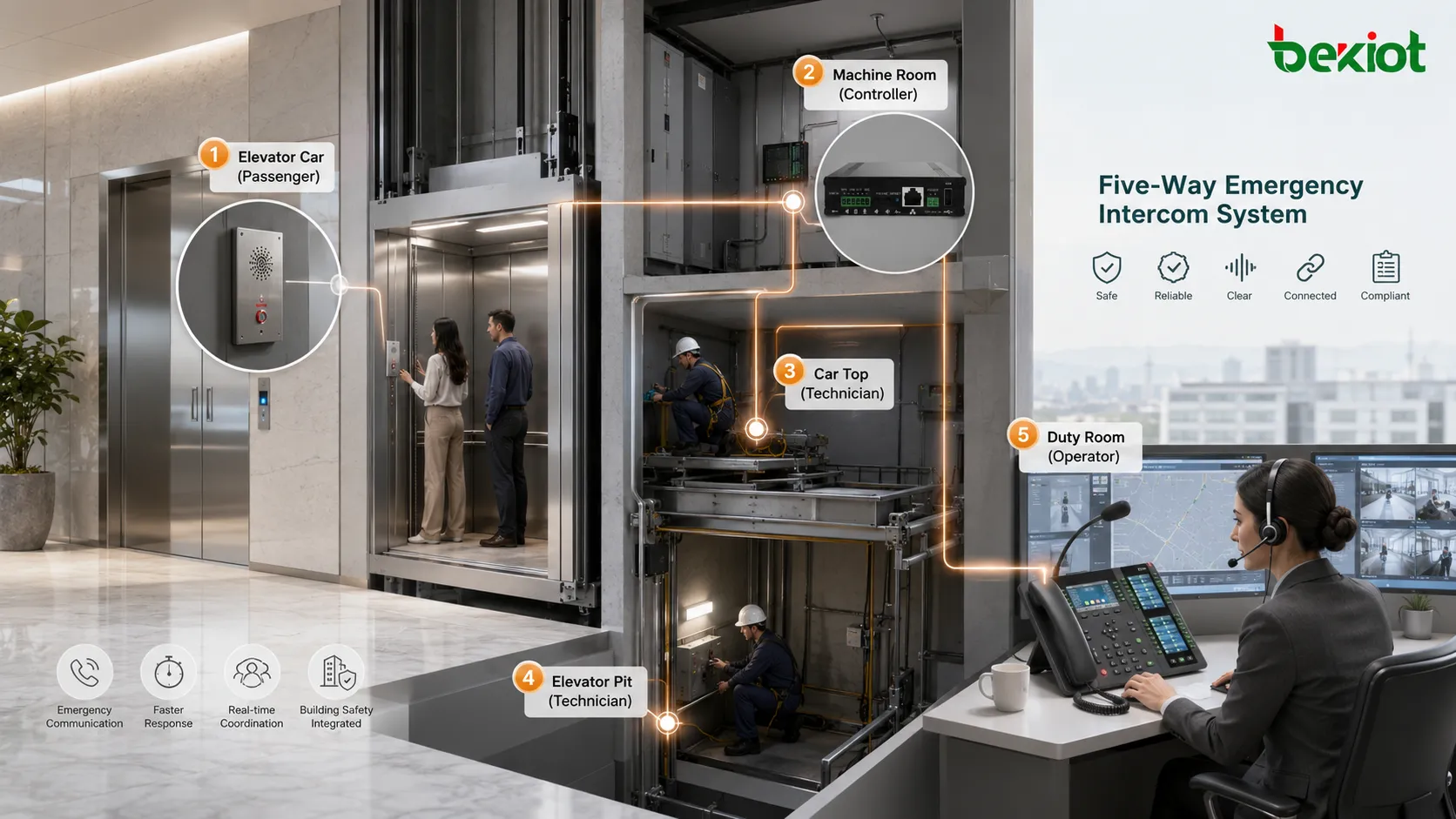
Elevator five-way intercom is an emergency and maintenance communication arrangement that connects several key elevator locations through a dedicated voice system. In many projects, the five common communication points include the elevator car, machine room or control cabinet area, car top, pit, and duty room, security room, monitoring center, or property management room. The exact naming may vary by country, building type, elevator design, and local code practice.
The important question is not only whether the system has five physical terminals. The real purpose is to ensure that trapped passengers, rescue staff, maintenance technicians, and building operators can communicate quickly and clearly during emergencies, inspections, repairs, and abnormal elevator operation. In some jurisdictions, emergency two-way communication from the elevator car is explicitly required, while the full “five-way” arrangement may be required by local regulations, project specifications, inspection rules, property management standards, or safety design practice.
Why This Communication Layout Exists
Elevator emergencies are different from ordinary building incidents because people may be trapped inside a moving or stopped enclosure, rescue staff may need to work in the hoistway, and building operators may not be physically near the elevator. A reliable intercom system helps connect these separated locations so that information can move faster than personnel.
If passengers are trapped in the car, they need a simple way to request help. If technicians are working on the car top or in the pit, they may need to coordinate with another person before movement, inspection, or rescue action. If a duty room or monitoring center receives the call, operators need to identify the elevator and contact maintenance or emergency personnel.
The five-way concept is therefore a safety communication structure. It supports passenger rescue, maintenance coordination, duty-room monitoring, and emergency response. It is not just an accessory added for convenience.
Is It Mandatory?
The answer depends on the jurisdiction, adopted code year, elevator type, building occupancy, inspection authority, and project specification. In many markets, an emergency communication device for passengers inside the elevator car is mandatory. However, the exact requirement may be described as emergency alarm, two-way communication, remote alarm system, rescue communication, accessible communication, or other code language rather than the phrase “five-way intercom.”
In some regions and project environments, the five-way arrangement is treated as a standard elevator safety configuration, especially in residential buildings, commercial buildings, hospitals, public facilities, hotels, schools, transportation sites, and high-rise buildings. In other places, the legal requirement may focus on the elevator car emergency phone, while additional intercom points are defined by maintenance safety rules, local elevator inspection requirements, owner specifications, or engineering design practice.
For this reason, designers should not assume that one global rule applies everywhere. The correct approach is to check the locally adopted elevator code, building code, fire safety requirements, accessibility rules, maintenance standards, and authority having jurisdiction. A system that is accepted in one city may need changes in another city if the adopted code edition or inspection practice is different.
What the Five Points Usually Mean
Elevator Car
The car station is the most passenger-facing point. It normally includes an emergency call button, speaker, microphone, hands-free talk function, or phone-style device. When a passenger presses the alarm or help button, the call should reach authorized personnel or a rescue service according to the building’s response plan.
The car-side device should be easy to find and easy to use. Clear labeling, accessible height, audible feedback, visual status indication, and reliable power are important because passengers may be stressed, injured, elderly, disabled, or unfamiliar with the building.
Machine Room or Controller Area
The machine room or controller area is where technical staff may need to communicate during inspection, troubleshooting, testing, or rescue operations. In machine-room-less elevators, the equivalent point may be near the control cabinet, controller panel, or maintenance access location.
This point helps technicians coordinate with the car, pit, car top, and duty room. During rescue or maintenance, clear voice communication can reduce misunderstandings and support safer operation.
Car Top
The car top is a maintenance and inspection location. Personnel working there may need to communicate with others before movement or while checking doors, guide rails, sensors, wiring, and mechanical parts.
A car-top intercom point supports maintenance safety. It is especially useful when normal mobile phone coverage is weak inside the hoistway or when technicians need hands-free or direct communication with the machine room or duty room.
Pit
The pit is another high-risk maintenance area. Technicians working in the pit may be separated from the car, controller, and building operator. A voice point in this area supports emergency reporting, coordination, and rescue communication.
Because the pit may be exposed to dust, moisture, oil, limited space, and mechanical hazards, the device should be installed and protected according to the environment. Placement should not interfere with elevator movement or maintenance access.
Duty Room or Monitoring Center
The duty room, property office, security room, control room, or monitoring center is usually the receiving point for emergency calls. Operators here may coordinate rescue, contact maintenance staff, notify emergency services, and monitor call status.
This location should not be a passive endpoint. Staff should know how to answer calls, identify the elevator, speak with passengers, record the incident, contact rescue personnel, and follow the building’s emergency procedure.
How the System Works During an Emergency
When a passenger presses the emergency call button, the car device sends a call to the duty room, monitoring center, rescue service, or configured external destination. The receiving person answers and speaks with the passenger. The operator should confirm the situation, reassure the passenger, identify the elevator location, and start the rescue workflow.
If building staff or maintenance personnel need to coordinate, they may use other intercom points such as the machine room, car top, or pit. The system may allow point-to-point calls, group communication, or priority calling depending on design.
In more advanced deployments, the intercom may be connected with elevator monitoring, CCTV, building management, alarm logs, call recording, or dispatch systems. These integrations can help operators verify elevator identity, check status, and manage rescue action more efficiently.
Standards and Code Directions to Review
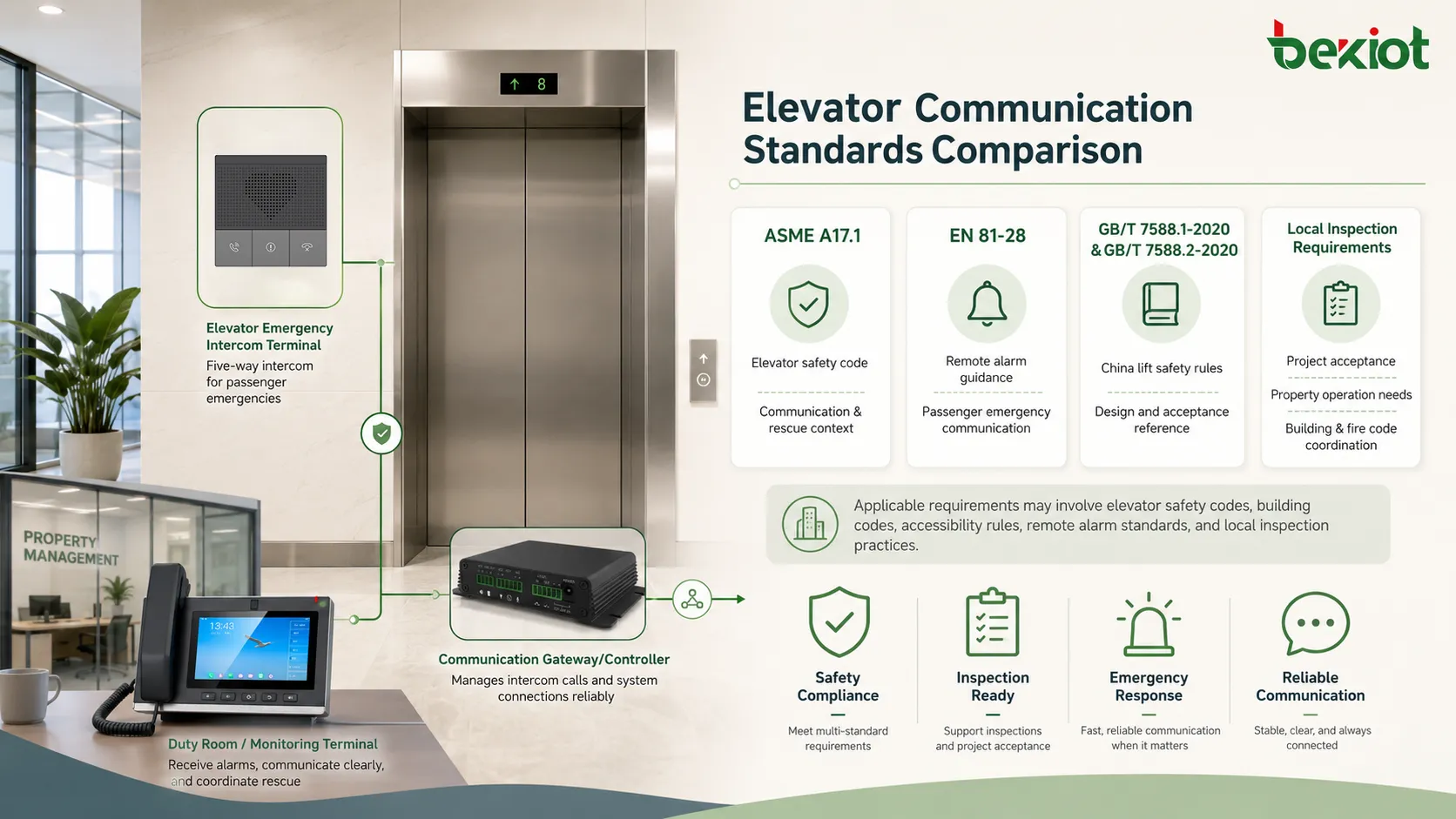
ASME A17.1/CSA B44
In North America, ASME A17.1/CSA B44 is a major elevator and escalator safety code reference. It includes emergency communication requirements for elevator cars, and recent editions have placed more attention on communication accessibility, location identification, and communication with authorized personnel.
Code adoption can vary by state, province, city, or authority. A building owner should verify which edition is legally adopted locally and whether accessibility-related communication functions, video, text, or visual indicators are required.
International Building Code
The International Building Code may reference elevator emergency communication requirements and coordinate with elevator safety codes. In practice, the building code and elevator code may work together, especially for accessibility, emergency response, and communication between the car and a point outside the hoistway.
Designers should check the adopted building code edition and local amendments. The same equipment design may need additional features when a newer code edition is adopted.
EN 81-28
In Europe and many markets that reference EN standards, EN 81-28 covers remote alarm systems for passenger and goods passenger lifts. It addresses alarm activation, alarm transmission, information for use and maintenance, and site testing before the lift is used.
This standard is especially relevant when the elevator emergency alarm must connect to a rescue service or remote response point. It focuses on reliable alarm communication rather than simply installing a speaker and button.
EN 81-20 and EN 81-50
EN 81-20 and EN 81-50 are important safety standards for passenger and goods passenger lifts. They cover construction, installation, design rules, calculations, examinations, and testing of lift components. Communication-related requirements may interact with the broader lift safety design.
When applying EN-based requirements, designers should review the full elevator safety framework rather than isolating the intercom from the rest of the lift system.
GB/T 7588.1 and GB/T 7588.2
In China, GB/T 7588.1-2020 and GB/T 7588.2-2020 are important references for safety rules for the construction and installation of passenger lifts and goods passenger lifts. They replaced the older GB 7588-2003 framework and are relevant to elevator safety design and inspection direction.
For Chinese building projects, designers should also review local elevator inspection rules, special equipment requirements, fire and building codes, and project acceptance specifications. The five-way intercom arrangement is often evaluated in the context of local elevator safety acceptance and property operation requirements.
Key Functions That Should Be Checked
Reliable Two-Way Voice
The most basic requirement is clear two-way communication. Passengers or technicians must be able to hear and be heard. The system should not produce excessive echo, low volume, noise, delay, or unstable connection.
Audio should be tested in realistic conditions. Elevator cars, hoistways, pits, and machine areas may have echo, mechanical noise, ventilation noise, or poor signal conditions.
Emergency Call Priority
Emergency calls should receive higher priority than routine communication. If the system supports multiple internal calls, maintenance calls, or monitoring channels, the passenger emergency call should not be blocked by non-critical use.
Priority design is especially important when multiple elevators share one duty-room terminal or central monitoring platform.
Location Identification
Operators must know which elevator is calling. A good system should identify the building, elevator number, group, floor reference if available, and call source. This reduces response time and prevents confusion in buildings with many elevators.
Location identification may be shown on a display, call panel, monitoring software, PBX caller ID, or alarm platform depending on system design.
Backup Power
Emergency communication should remain available during power failure or elevator fault conditions. The system may rely on elevator emergency power, battery backup, UPS, line power, PoE backup, or another protected supply.
Backup power should be tested. A system that works only during normal power may fail during the incident it is supposed to support.
Self-Test and Fault Indication
Modern systems may include self-test, line supervision, registration monitoring, battery status, call failure alarms, or fault outputs. These functions help maintenance teams detect problems before an emergency happens.
A silent fault is dangerous. If the intercom fails without notification, staff may not discover the problem until a trapped passenger tries to call for help.
Analog, IP, and Hybrid Architectures
Traditional systems often use dedicated elevator intercom wiring between the car, machine room, pit, car top, and duty room. These systems can be simple and reliable, but they may offer limited monitoring, remote management, or integration with modern platforms.
IP-based systems can use Ethernet, SIP, VoIP, network switches, and centralized software to connect elevator communication points. They may support remote monitoring, call recording, device status, multi-site management, and integration with security systems. However, they depend on network design, power backup, cybersecurity, and QoS planning.
Hybrid systems are common in retrofit projects. Existing elevator wiring may remain in place while gateways, adapters, or monitoring platforms are added to connect the legacy intercom to newer communication infrastructure.
| Architecture | Main Advantage | Design Concern |
|---|---|---|
| Analog Dedicated Wiring | Simple structure and familiar maintenance method. | Limited remote monitoring and less flexible integration. |
| IP or SIP-Based System | Centralized management, software integration, logging, and remote access. | Requires stable network, backup power, cybersecurity, and proper configuration. |
| Hybrid Retrofit | Preserves existing elevator wiring while adding modern call routing or monitoring. | Compatibility and failure behavior must be tested carefully. |
| Remote Monitoring Service | Can route emergency calls to an external rescue or monitoring center. | Requires reliable line, identification, service agreement, and periodic testing. |
Installation and Acceptance Considerations
Wiring and Cable Protection
Elevator communication wiring may pass through moving cables, hoistway areas, machine rooms, control cabinets, and building pathways. Cables should be selected and installed according to elevator movement, mechanical protection, fire requirements, electrical noise, and maintenance access.
Poor cable routing can cause intermittent audio, broken conductors, noise pickup, or communication failure. Traveling cable interfaces should be inspected carefully.
Terminal Placement
Each intercom point should be accessible to the intended user. The passenger device should be visible and reachable. Maintenance points should be positioned where technicians can use them safely without obstructing elevator components.
Equipment placement should not create hazards, interfere with inspection space, or expose devices to avoidable mechanical damage.
Noise and Acoustic Testing
Voice quality should be tested in the car, pit, car top, and machine area. The duty-room operator should confirm that speech is understandable from each point.
Testing should include normal and abnormal conditions where possible, such as ventilation noise, machinery operation, and door movement. A system that sounds clear in silence may be difficult to use during actual rescue work.
Call Routing Verification
Every emergency call path should be tested. The car should reach the correct receiving point. The duty room should be able to identify the elevator. Backup routing should work if the primary destination is unavailable.
If the system uses a PBX, SIP platform, or external monitoring service, test number formatting, caller ID, call priority, timeout behavior, and failover.
Documentation and Handover
Acceptance should include wiring diagrams, device locations, call flow records, configuration files, phone numbers, maintenance instructions, backup power details, test results, and emergency response procedures.
Without documentation, future technicians may not understand how the system is connected or how to restore service after a fault.
Where the System Is Commonly Applied
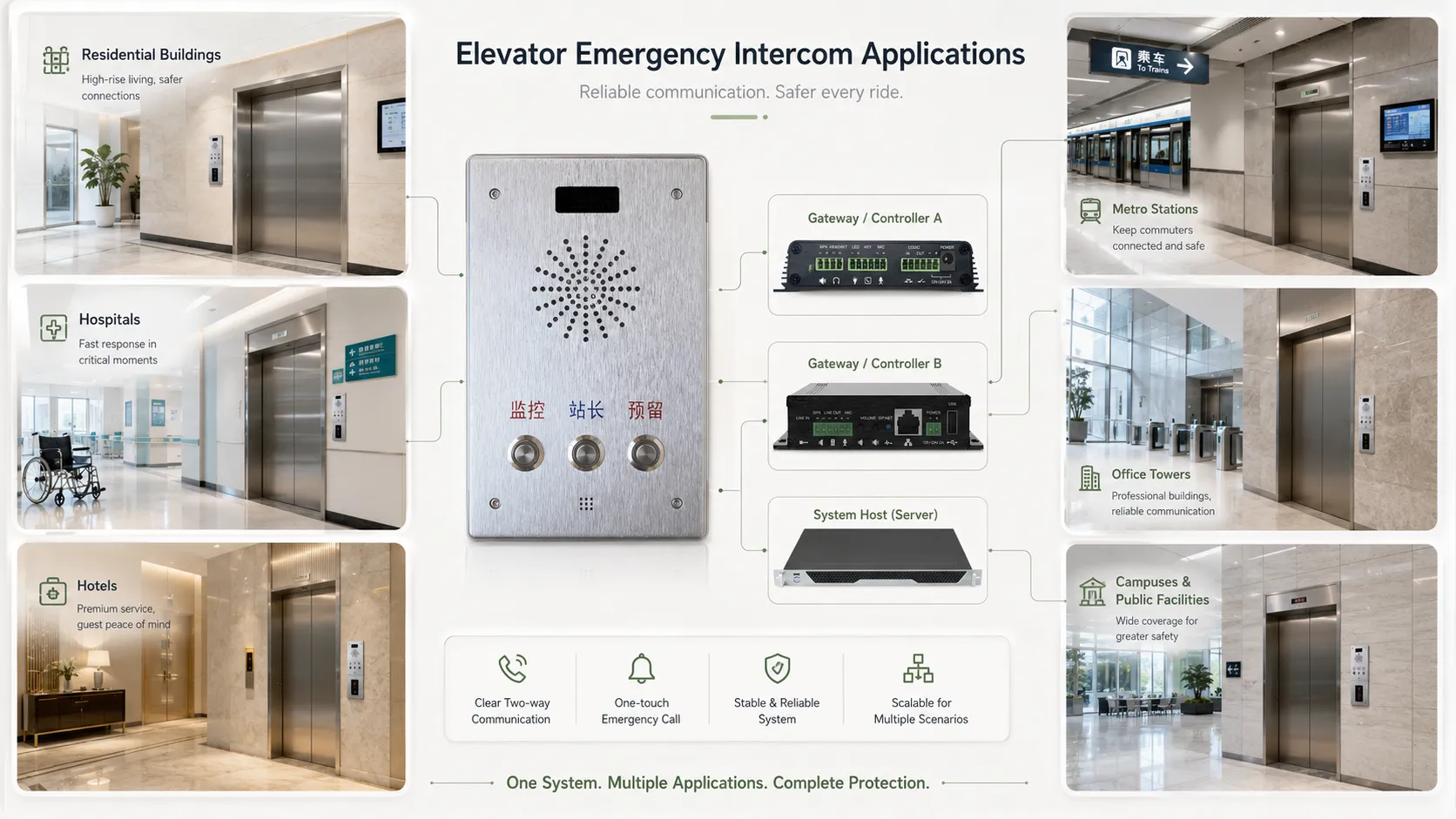
Residential Buildings
Residential elevators need simple and dependable emergency communication because occupants may include children, elderly residents, visitors, and people unfamiliar with emergency procedures. A duty room or property office should be able to answer calls quickly.
Regular testing is important because elevator emergency calls may be rare. Rare use does not mean the system can be ignored.
Commercial and Office Towers
Large office buildings may contain many elevators, multiple banks, basement levels, service elevators, and security control rooms. Operators need clear elevator identification and reliable routing.
For high-rise buildings, emergency communication should be coordinated with fire command centers, security desks, building management systems, and elevator maintenance procedures.
Hospitals and Healthcare Facilities
Hospitals may use passenger elevators, bed elevators, service elevators, and emergency transport elevators. Communication reliability is important because trapped passengers may include patients, medical staff, or visitors needing assistance.
Response procedures should define who receives calls, how maintenance is notified, and how patient-related situations are escalated.
Hotels and Public Venues
Hotels, shopping centers, stadiums, museums, and exhibition centers serve many visitors who may not know the building layout. Elevator emergency communication should be easy to recognize and should connect to trained staff.
Multilingual signage, clear voice prompts, and operator training may improve response quality in visitor-heavy environments.
Transportation Facilities
Metro stations, airports, railway stations, and bus terminals often have elevators for accessibility and passenger flow. Emergency calls may need to reach a station control room, maintenance center, or external rescue service.
These sites may also require integration with CCTV, public address, access control, and operation control systems.
Common Mistakes in Design and Operation
Assuming the Term Means the Same Everywhere
The phrase “five-way intercom” is not always used in the same way across countries. Some standards describe emergency communication functions rather than five named terminals. Others may require multiple communication points through local elevator practice.
Designers should translate the project requirement into actual communication points, call paths, emergency behavior, and acceptance tests rather than relying only on the label.
No Staff Response Plan
An intercom is only useful if someone answers and knows what to do. If the duty room is unmanned, if operators are untrained, or if emergency numbers are outdated, the system may fail operationally even when the hardware works.
Training and staffing should be part of the communication design.
Ignoring Backup Power
Elevator emergencies may happen during power problems. If the intercom depends on ordinary power without backup, it may become unavailable when needed most.
Backup power should be specified, maintained, and tested as part of routine elevator safety checks.
Poor Audio Quality
Low volume, echo, noise, and poor microphone placement can make communication difficult. In an emergency, unclear audio increases stress and slows response.
Audio testing should be included in commissioning and periodic maintenance.
Incomplete Maintenance Records
Intercom faults may be caused by cable damage, device failure, power problems, network changes, or configuration errors. Without records, troubleshooting becomes slower and more expensive.
Maintenance logs should record test dates, call results, device status, repairs, configuration changes, and unresolved issues.
Maintenance and Periodic Testing
Elevator emergency communication should be tested regularly according to local requirements and building maintenance policy. A practical test should confirm that each point can call, receive, speak clearly, and reach the correct destination.
Testing should also confirm power backup, duty-room response, elevator identification, fault alarms, remote monitoring status, and call transfer behavior where applicable. If the system uses IP networking, switch power, network registration, firewall rules, and SIP account status should also be checked.
After elevator modernization, controller replacement, PBX migration, network change, duty-room relocation, or building renovation, the intercom should be retested. A small infrastructure change can break the emergency call path.
Project Checklist Before Acceptance
Confirm the locally applicable elevator code, building code, accessibility rules, and inspection requirements. Do not assume that a foreign standard or another city’s practice automatically applies.
Define all communication points clearly: car, machine room or controller area, car top, pit, and duty room or monitoring center. If the project uses a different layout, document the reason and approval basis.
Test every call path under realistic conditions. Verify speech clarity, ringing behavior, call priority, location identification, backup route, power backup, and operator procedure.
Prepare complete documentation. Include system diagrams, wiring routes, device labels, configuration settings, emergency numbers, maintenance instructions, test reports, and staff response procedures.
Assign responsibility for ongoing operation. Someone must own periodic testing, fault repair, contact number updates, staff training, and inspection record management.
The safest elevator communication design is not simply the one with the most terminals. It is the one that meets local code, connects the right locations, remains powered, is tested regularly, and leads to a real rescue response.
FAQ
Does every elevator need exactly five intercom points?
Not always. Some projects require a five-point arrangement, while other jurisdictions focus on passenger emergency communication and rescue service connection. The required points depend on local code, elevator type, and project specification.
Can a mobile phone replace the elevator emergency intercom?
Usually no. Mobile phones may lose signal, run out of battery, or fail to identify the elevator location. A dedicated emergency communication system is designed to be part of the elevator safety arrangement.
Who should answer the emergency call?
The receiving point should be an authorized and available person or service capable of starting rescue action. This may be a duty room, security room, monitoring center, property office, or external rescue service depending on the building plan.
What should be tested after replacing an elevator controller?
Test all intercom points, emergency call button, call routing, elevator identification, duty-room display, backup power, alarm output, network or PBX connection, and rescue procedure before handover.
Is IP-based elevator intercom acceptable?
It can be acceptable when it meets local requirements and is designed with reliable power, network stability, cybersecurity, call priority, monitoring, and backup behavior. The local inspection authority should confirm acceptance conditions.







