


A partitioned page table is a virtual memory management design in which address translation metadata is divided into smaller logical units instead of being maintained as one large flat mapping structure. The goal is to make page table storage, lookup, protection, switching, and maintenance more efficient as process address spaces become larger and more dynamic.
In operating systems, every process normally works with virtual addresses. The processor and memory management unit translate those virtual addresses into physical memory locations by using page tables. When the address space is small, a simple flat table may be manageable. When the address space grows to gigabytes or terabytes, a direct one-entry-per-page table can become wasteful. Partitioning the mapping structure helps the system allocate, search, update, and protect memory more intelligently.
Why Flat Mapping Becomes Expensive
A flat page table is easy to understand because it can map virtual pages to physical frames in a direct indexed structure. However, modern address spaces are usually sparse. A process may reserve a large virtual range while actually using only a small part of it. Large unused areas may exist between program code, heap, stack, shared libraries, memory-mapped files, and device mappings.
If the system allocates page table entries for every possible virtual page, much memory is wasted on entries that describe pages not currently used. The problem becomes more serious with 64-bit address spaces, many processes, containers, virtual machines, and applications that reserve large memory ranges.
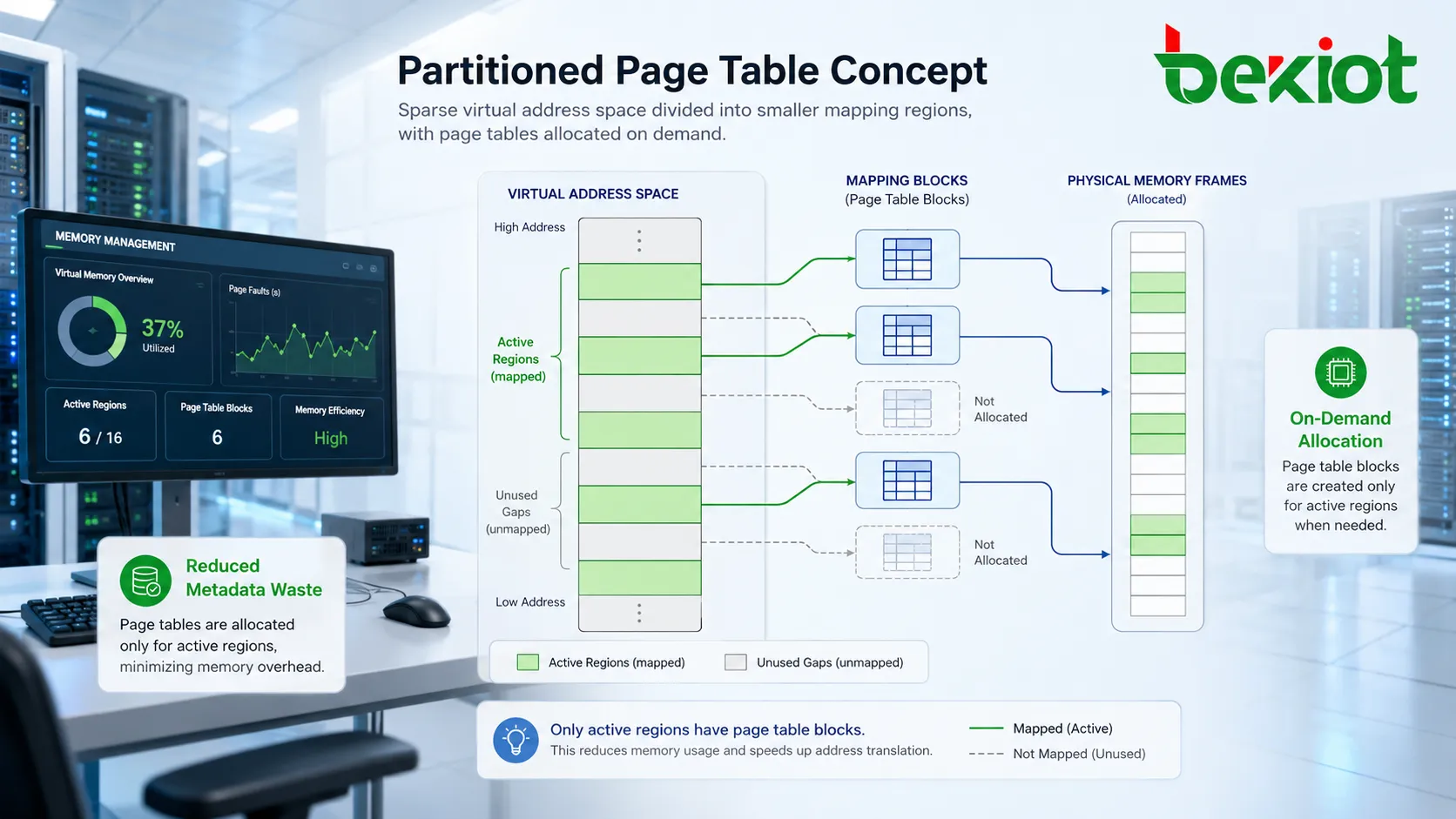
Partitioning solves this by allocating translation metadata only where it is needed. Instead of building one giant structure in advance, the system can create smaller mapping blocks on demand.
Core Working Logic
Virtual Address Decomposition
The processor treats a virtual address as a structured value. Instead of using all bits as one flat index, different bit ranges can select different parts of the translation structure. One part may select a top-level directory, another may select a lower-level table, and another may select the final page entry. The remaining bits identify the offset inside the page.
This decomposition allows the address space to be divided into manageable sections. A translation path can move from a broad region to a narrower region until it finds the final physical frame mapping.
On-Demand Table Allocation
A key idea is that lower-level structures do not need to exist until a virtual range is actually used. If a process never touches a large region, the corresponding lower-level mapping blocks can remain unallocated.
This saves memory and reduces initialization cost. It also gives the operating system flexibility to expand the mapping structure gradually as the process grows.
Hierarchical Lookup
Most practical designs use some form of hierarchy. A top-level structure points to second-level structures, which may point to further structures or final entries. The exact number of levels depends on architecture, address width, page size, and operating system design.
The lookup is not simply a software data search. Hardware memory management units often walk the structure automatically when a translation is missing from the translation lookaside buffer.
Function in Address Translation
The primary function is to support virtual-to-physical address translation. When a CPU instruction accesses memory, the system must determine which physical frame corresponds to the requested virtual page. The page table structure provides that mapping.
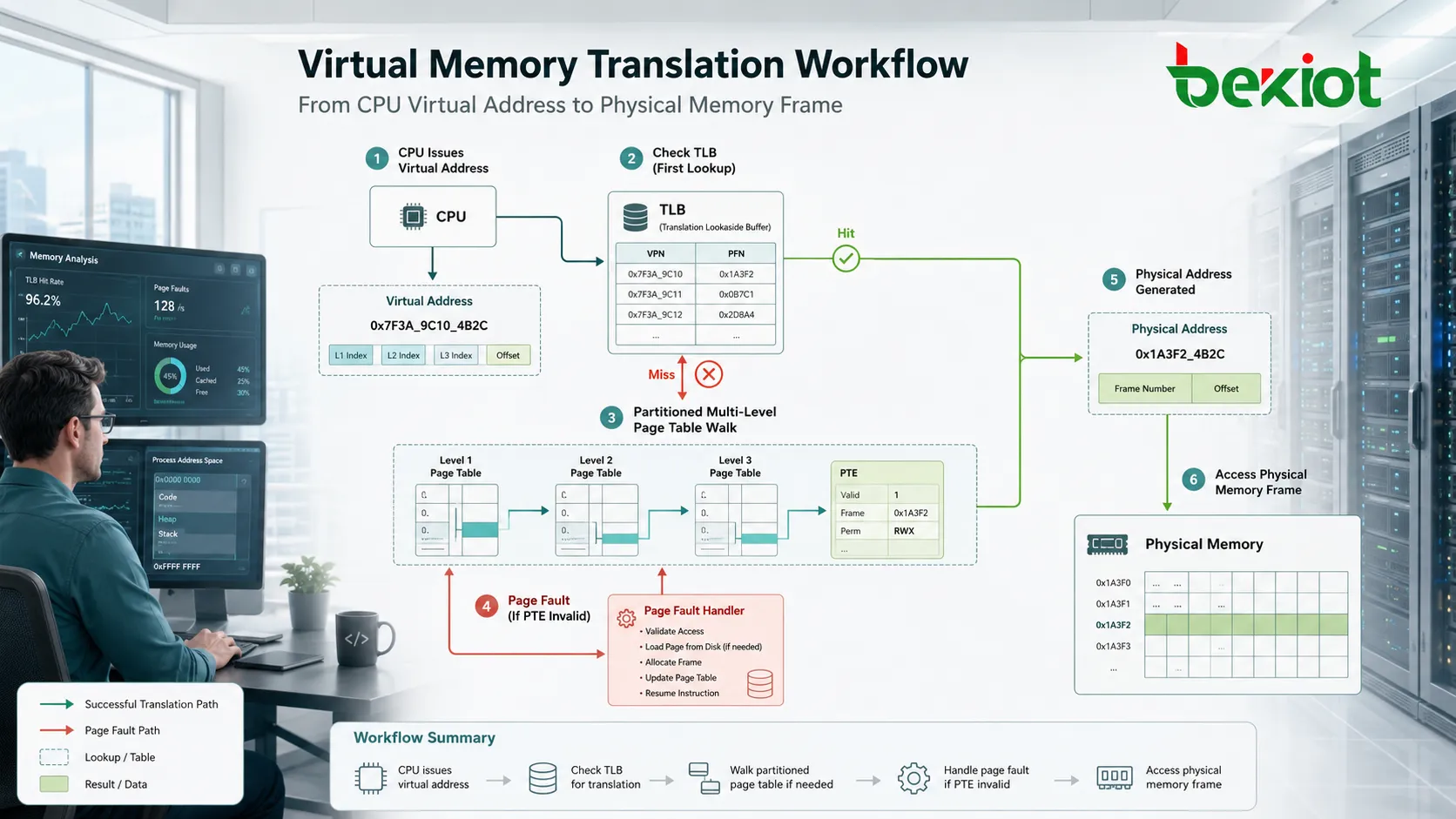
In a partitioned design, the lookup follows a staged path. The virtual address identifies which partition or level should be examined. If the needed structure exists and the entry is valid, the translation can be completed. If the entry is missing, invalid, or protected, the system may raise a page fault or permission exception.
This staged design allows a very large virtual address space to be represented with far less memory than a fully populated flat table.
Memory Overhead Reduction
One of the strongest system values is reduced metadata overhead. Page tables consume memory, and that memory is not directly available to applications. If thousands of processes each require large mapping tables, the overhead can become significant.
Partitioning allows unused address ranges to remain compact. Only active regions need detailed translation entries. This is especially valuable for large applications, browser processes, database systems, virtual machines, container platforms, and systems with many concurrent tasks.
The result is not only memory saving but also better scalability. The operating system can support larger address spaces and more processes without proportionally increasing mapping metadata.
Isolation and Protection
Page tables are not only mapping structures. They also define access permissions. Entries can indicate whether a page is readable, writable, executable, present, user-accessible, shared, cached, or protected.
Partitioning supports clean separation between different regions. User code, kernel mappings, stack, heap, shared libraries, device memory, and memory-mapped files can be controlled with different attributes. Invalid partitions can prevent accidental access to unmapped regions.
This helps enforce process isolation. One process should not directly access the private memory of another process. Page table structures, combined with CPU privilege levels and operating system policy, make that separation possible.
Interaction with the TLB
Fast Translation Cache
Walking a multi-level or partitioned structure can be more expensive than reading a flat table entry. To avoid repeated walks, processors use a translation lookaside buffer, usually called the TLB. It stores recently used virtual-to-physical translations.
When the requested translation is already in the TLB, memory access can proceed quickly. When it is not, the processor or operating system performs a page table walk and then updates the cache.
Locality Effects
Programs often show memory locality. They tend to access nearby instructions and data repeatedly over short periods. This makes cached translations effective. A well-designed partitioned structure works together with the TLB to balance memory savings and access performance.
If a workload frequently jumps across many unrelated regions, TLB pressure can increase. This is why page size, mapping layout, and memory allocation strategy still matter.
Invalidation and Shootdown
When mappings change, cached translations may need to be invalidated. In multi-core systems, this can require coordination across processors. This process is often called TLB shootdown.
Partitioning does not eliminate this cost, but it can help the operating system reason about which regions are affected by a mapping change.
Role in Page Fault Handling
A page fault occurs when the system cannot complete a memory access using the current mapping state. The page may not be present, may be protected, may require loading from disk, or may need copy-on-write handling.
Partitioned structures make it possible to distinguish between different cases. A missing lower-level structure may mean the region has never been used. An invalid final entry may mean the page is reserved but not present. A permission bit may indicate that the access violates policy.
The operating system page fault handler uses this information to decide whether to allocate memory, load a page, terminate the process, expand the stack, handle copy-on-write, or report an access violation.
System Value in Large Address Spaces
Large address spaces are common in modern computing. A 64-bit process can represent far more virtual memory than it actually uses. Without a sparse and partitioned mapping method, the metadata required to describe every possible page would be impractical.
Partitioned page table design makes large virtual address spaces usable. Applications can reserve memory, map files, load libraries, create stacks, and share memory regions without forcing the system to allocate mapping metadata for every possible address.
This is a foundational reason why modern operating systems can provide each process with a large private virtual address space while still using physical memory efficiently.
Support for Demand Paging
Demand paging means memory pages are loaded or allocated only when needed. A partitioned mapping structure supports this naturally because entries can represent pages that are not yet present.
When a process touches such a page, the system can allocate a physical frame, load data from storage, or create a zero-filled page. The mapping is then updated, and execution can continue.
This allows systems to run programs that reserve or reference more virtual memory than is physically available at one moment. It also supports efficient startup because the system does not need to load every page immediately.
Support for Shared Memory and Mapping
Multiple processes may map the same physical memory for shared libraries, shared memory communication, memory-mapped files, or kernel-managed buffers. The page table structure allows different virtual addresses to point to the same physical frame where policy permits.
Partitioning helps organize these mappings by region. A process may have private regions, shared code regions, file-backed regions, and device-backed regions arranged separately in its address space.
This organization makes memory sharing practical while preserving process-specific virtual layout.
Virtualization and Container Impact
Virtualization adds another layer of address translation. A guest operating system may maintain its own virtual-to-guest-physical mappings, while the hypervisor manages guest-physical-to-host-physical mappings. This can increase translation complexity.
Efficient page table organization becomes important in virtualized environments because many guest systems may run on the same host. Hardware-assisted virtualization and nested paging techniques help reduce overhead, but mapping structure efficiency still affects performance and memory use.
Containers do not usually create the same hardware translation layers as full virtual machines, but they increase the number of isolated workloads. Efficient per-process mapping remains important for density and resource control.
Performance Trade-Offs
Partitioning reduces memory waste, but it can make lookup paths more complex. A flat table may offer direct indexing, while a hierarchical structure may require several memory references during a page walk.
The TLB reduces most of this overhead for common accesses. However, workloads with large working sets, random access patterns, or frequent mapping changes may still experience translation-related costs.
The design trade-off is therefore clear: the system saves memory and gains flexibility, while relying on caching, locality, and hardware support to keep translation fast.
Design Factors
Page size affects the number of entries needed. Smaller pages offer fine-grained memory control but require more entries. Larger pages reduce entry count and TLB pressure but may waste memory if allocations do not align well.
The number of levels affects both scalability and lookup cost. More levels can represent larger sparse address spaces, but each level may add walk overhead when the TLB misses.
Permission bits and metadata also matter. Modern systems often need fine-grained access control, execute protection, dirty tracking, accessed bits, copy-on-write support, and caching attributes.
Reliability and Error Containment
A structured mapping system helps the operating system detect invalid access. If a process dereferences a null pointer, jumps to non-executable memory, writes to a read-only page, or accesses unmapped space, the mapping structure can block the operation.
This containment prevents many errors from corrupting other processes or the kernel. Instead of silently damaging memory, the system can raise an exception and handle the fault according to policy.
In this sense, page table partitioning contributes not only to memory efficiency but also to system stability.
Operational Visibility
Operating systems and diagnostic tools can inspect mapping regions to understand how a process uses memory. Developers may examine code regions, heap growth, stack layout, mapped files, shared objects, anonymous memory, and protected gaps.
This visibility helps troubleshoot memory leaks, unexpected access violations, fragmentation, permission errors, and performance issues. Partitioned structures align naturally with region-based reporting because memory usage is not one continuous block.
In production environments, this information can support capacity planning and fault analysis.
Common Implementation Challenges
One challenge is keeping the structure consistent during concurrent access. Multiple threads, cores, interrupts, and kernel routines may interact with memory mappings. Locking, reference counting, and invalidation must be carefully designed.
Another challenge is managing fragmentation. Although virtual space may be large, physical memory and mapping metadata still need efficient allocation.
A third challenge is balancing compatibility and optimization. Operating systems must support different processors, page sizes, permission models, and hardware translation features.
A fourth challenge is handling security hardening. Kernel/user separation, execute-disable protection, address space layout randomization, and guarded regions all rely on correct mapping behavior.
Application Scenarios
Partitioned page table concepts are important in general-purpose operating systems, embedded systems with memory protection, database servers, browser engines, virtualization hosts, container platforms, high-performance computing, and security-sensitive systems.
Database systems may map large files and memory regions. Browsers may isolate many processes. Virtualization hosts may maintain complex address translation layers. Embedded systems may need controlled memory protection with limited resources.
Although application developers may not configure page tables directly, the performance and reliability of their software are affected by how the operating system manages virtual memory.
System Value Summary
The main value is scalable address translation. Partitioned structures allow large and sparse virtual address spaces to exist without requiring enormous flat mapping tables.
They also support memory protection, demand paging, shared mapping, fault handling, virtualization, diagnostic visibility, and efficient process isolation.
The design reflects a broader principle in system architecture: large spaces should not be represented as fully populated structures when most regions are unused. Sparse, layered, and demand-allocated metadata makes the system more efficient and more adaptable.
A partitioned page table provides practical value by turning a huge virtual address space into manageable mapping regions that can be allocated, protected, cached, updated, and diagnosed efficiently.
FAQ
Is a partitioned page table the same as a multi-level page table?
They are closely related concepts. Multi-level page tables are a common way to partition address translation metadata, but the broader idea includes any design that divides mapping information into smaller controlled units.
Why do 64-bit systems still need efficient mapping structures?
A 64-bit address space is extremely large. Even if physical memory is limited, the virtual range can be huge, so sparse and demand-allocated mapping structures are necessary.
Can larger pages remove the need for partitioning?
No. Larger pages can reduce entry count and TLB pressure, but they do not solve all sparse address space and protection needs. Many systems use both large pages and hierarchical mapping.
Why can a program crash even when the system has free memory?
The program may access an unmapped address, violate page permissions, exceed address space limits, or hit a guard region. Free physical memory alone does not guarantee that a virtual access is valid.
Does page table design affect application performance?
Yes. Most effects are hidden by hardware caching, but large working sets, frequent allocation, memory mapping, virtualization, and TLB misses can make address translation behavior visible in performance results.







