Satellite communication is a wireless communication method that uses satellites in orbit to relay signals between earth-based terminals, gateways, vehicles, ships, aircraft, sensors, phones, and network platforms. It is designed to extend communication beyond the practical reach of fiber, copper, cellular towers, microwave links, or local radio systems.
Its value is especially clear where terrestrial infrastructure is unavailable, damaged, too expensive, or difficult to deploy. Remote villages, offshore vessels, aircraft, deserts, mountains, disaster zones, border areas, mining sites, scientific stations, and temporary field operations can all depend on space-based links for data, voice, navigation support, video transmission, and operational coordination.
Why Space-Based Connectivity Is Becoming More Important
The communication industry is moving from isolated satellite services toward integrated terrestrial and non-terrestrial networks. Traditional geostationary systems remain important for broadcast, trunking, maritime, aviation, government, and remote connectivity. At the same time, low earth orbit constellations, multi-orbit services, satellite IoT, direct-to-device development, and cloud-connected ground infrastructure are changing how satellite networks are designed and consumed.
The main driver is coverage. Terrestrial networks are strong in cities, towns, roads, and enterprise sites, but they still leave gaps across oceans, rural regions, polar routes, mountains, and disaster-affected areas. Satellites help close those gaps by placing part of the communication infrastructure above the earth rather than only on the ground.
Another driver is resilience. When fiber is cut, mobile towers lose backhaul, or a storm damages local networks, satellite links can provide an alternative communication path. This does not mean every service should move to space. It means satellite systems are becoming a more important layer in hybrid network planning.
Signal Path From Ground to Orbit
Uplink Transmission
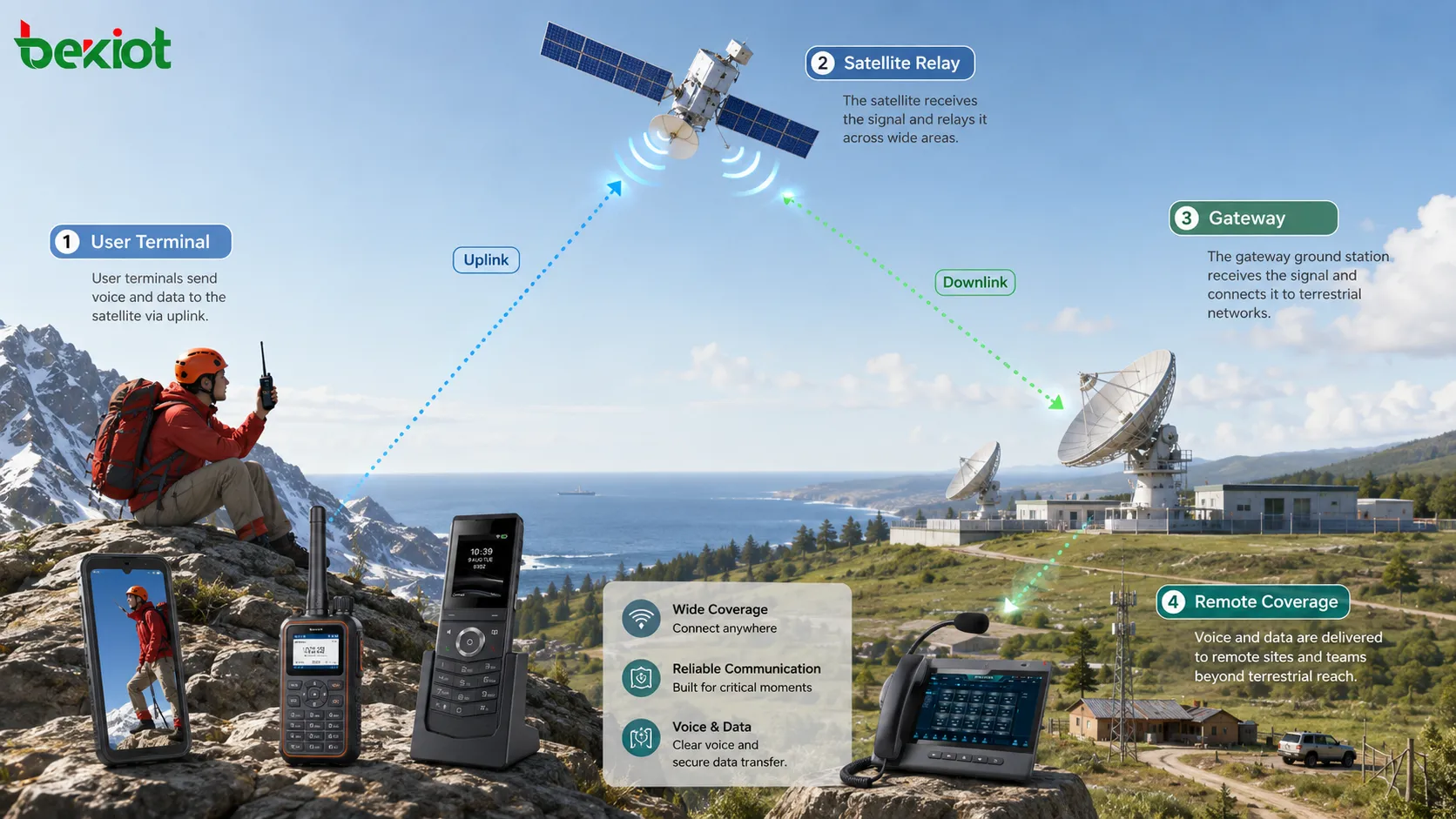
The process begins when a user terminal or ground station sends a radio signal upward to a satellite. This signal may carry internet data, voice packets, video streams, telemetry, emergency messages, broadcast content, or IoT sensor data.
The uplink requires a suitable antenna, modem, frequency band, transmit power, line of sight, and authorization to operate. In fixed sites, the antenna may be a dish pointed at a specific orbital position. In mobile systems, electronically steered or tracking antennas may follow the satellite while the vehicle, aircraft, or vessel is moving.
Space Segment Processing
After receiving the uplink, the satellite processes the signal according to its payload design. A traditional bent-pipe satellite may amplify, shift frequency, and retransmit the signal without deep packet processing. A regenerative satellite may demodulate, process, route, or switch traffic onboard before sending it onward.
Modern designs increasingly use digital payloads, spot beams, beamforming, inter-satellite links, software-defined capacity, and more flexible routing. These capabilities help the system allocate capacity where demand changes across regions and time periods.
Downlink Delivery
The satellite then sends the signal back to earth. The downlink may go directly to a user terminal, to a gateway station connected to the internet backbone, to a broadcast receiving antenna, or to another network node.
In two-way broadband service, the user terminal both transmits and receives. In broadcast service, many receivers may listen to the same downlink. In IoT service, small devices may send short messages that are collected by satellite and forwarded to a cloud or enterprise platform.
Orbit Layers and Service Behavior
Geostationary Orbit
Geostationary satellites orbit above the equator and appear almost fixed from the perspective of a ground antenna. This allows fixed dishes to point at one position without continuous tracking. One satellite can cover a very large region, which makes this orbit useful for broadcast, wide-area service, remote connectivity, and stable regional coverage.
The trade-off is distance. A signal must travel a long path to reach the satellite and return to earth, so latency is higher than with lower orbits. For email, broadcast, file transfer, monitoring, and many enterprise applications, this may be acceptable. For highly interactive applications, the delay may be more noticeable.
Medium Earth Orbit
Medium earth orbit sits between low and geostationary orbits. It can offer a balance between broader coverage than very low orbits and lower latency than geostationary systems. It is used in navigation constellations and can also support broadband or specialized communication services.
Because satellites move relative to the ground, user terminals and network systems need handover or tracking logic. The design is more dynamic than a fixed geostationary link but may provide better latency and coverage characteristics for certain regions.
Low Earth Orbit
Low earth orbit satellites fly much closer to earth. This can reduce latency and allow smaller user terminals in many applications. However, each satellite covers a smaller area and moves quickly across the sky, so continuous service requires a constellation of many satellites and frequent handovers.
LEO systems are a major area of industry development because they can support broadband, mobile backhaul, maritime connectivity, aviation connectivity, remote enterprise links, and emerging direct-to-device services. Their complexity lies in constellation management, spectrum coordination, gateway placement, traffic routing, terminal tracking, and orbital sustainability.
Coverage Range Is Not a Single Fixed Number
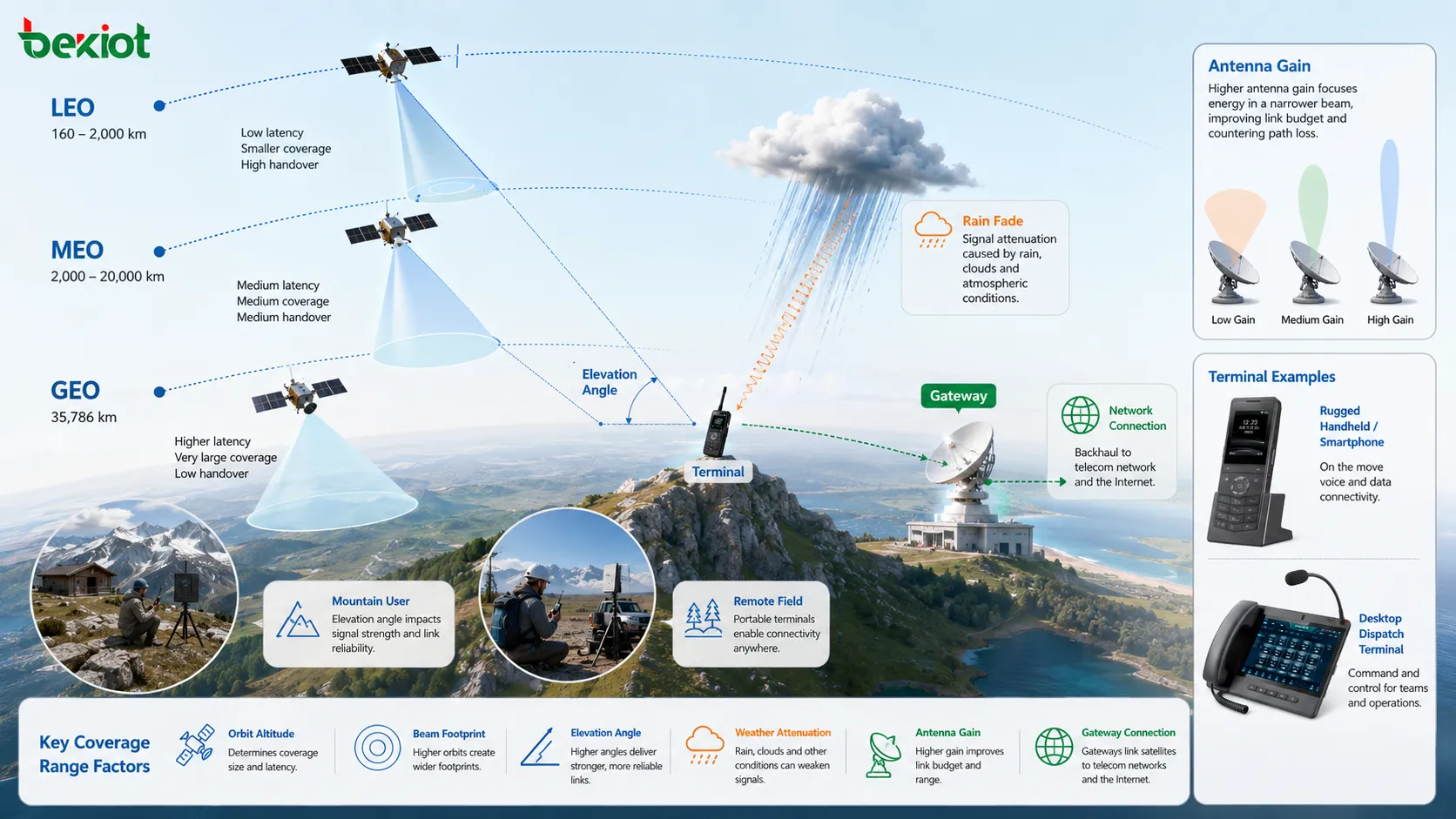
The coverage range of a satellite service depends on several factors. The orbit determines the basic viewing area. The antenna beam determines the service footprint. Frequency, transmit power, receiver sensitivity, elevation angle, weather, terrain, and regulatory approval also influence whether communication is possible at a specific location.
A geostationary satellite can cover a broad continental or oceanic region, while a LEO satellite covers a smaller moving footprint. Spot beams can concentrate capacity on specific areas rather than spreading power evenly over a wide region. A constellation can combine many moving footprints to provide near-continuous regional or global availability.
Coverage maps are therefore service-specific. A location may be physically visible to a satellite but still outside a commercial service zone, outside an authorized regulatory area, blocked by terrain, or limited by terminal capability.
| Orbit Type | Coverage Behavior | Typical Strength | Main Limitation |
|---|---|---|---|
| Geostationary | Wide regional footprint from a fixed sky position | Stable coverage and efficient broadcast | Higher latency and lower elevation near polar regions |
| Medium Earth Orbit | Large moving coverage zones | Balanced reach and latency | Requires tracking and constellation planning |
| Low Earth Orbit | Smaller moving footprints across many satellites | Lower latency and growing broadband capacity | Needs handover, many satellites, and dense coordination |
Frequency Bands and Link Quality
Different frequency bands are used for different services. Lower frequency bands may be more tolerant of weather and easier for smaller or mobile terminals, while higher frequency bands can support greater capacity but may be more affected by rain, atmospheric loss, or pointing accuracy.
Common service designs may use L-band, S-band, C-band, X-band, Ku-band, Ka-band, or other regulated spectrum depending on mission, region, equipment, and licensing. The band choice affects antenna size, bandwidth, propagation behavior, terminal cost, and interference planning.
Link quality is measured through factors such as carrier strength, noise, modulation, coding, antenna gain, weather margin, pointing accuracy, and network congestion. A strong service design includes margin for rain fade, movement, obstruction, and changing traffic demand.
Ground Segment and Gateway Role
The ground segment is just as important as the satellite itself. It includes user terminals, gateway stations, antennas, network operation centers, modems, routers, power systems, monitoring platforms, and internet or private network connections.
Gateways connect satellite traffic to terrestrial networks. In many broadband systems, user data travels from the terminal to the satellite, then to a gateway, and then into the internet or enterprise network. Gateway location affects latency, routing, service availability, and regulatory compliance.
For remote enterprise or government systems, traffic may be routed into private networks rather than the open internet. For broadcast systems, a teleport may uplink content to the satellite for wide-area distribution.
Latency and User Experience
Latency depends heavily on orbit altitude and network route. Higher orbit systems have longer signal paths. Lower orbit systems can reduce round-trip delay, but they still require routing, gateway processing, handover, and network management.
User experience also depends on application type. Web browsing, messaging, video streaming, file transfer, telemetry, and voice service all react differently to delay and jitter. A high-throughput link may still feel slow if latency is high and the application requires many interactive exchanges.
For critical applications, designers should evaluate latency, availability, throughput, packet loss, jitter, and failover behavior together rather than focusing on one number.
Capacity Planning and Contention
Satellite capacity is not unlimited. A beam has finite bandwidth, and many users may share the same capacity pool. During peak demand, service quality may depend on traffic management, service plans, priority rules, and available spectrum.
Spot beams, frequency reuse, adaptive coding, traffic shaping, and multi-orbit routing can improve capacity use. Still, high-density urban broadband and low-density remote coverage have very different economics.
This is why many deployments use satellite links as part of a hybrid architecture. Fiber, cellular, microwave, Wi-Fi, and satellite may work together, with each technology used where it performs best.
Mobility Support
Mobile satellite service is important for ships, aircraft, trains, vehicles, emergency teams, and remote field workers. Unlike fixed sites, mobile terminals must maintain links while moving, turning, vibrating, or crossing coverage zones.
Mobility support requires tracking antennas, handover control, service authorization across regions, and stable power. For aircraft and ships, antenna placement, aerodynamic design, radome loss, and route coverage are major engineering considerations.
As users expect connectivity everywhere, mobility is becoming one of the strongest growth areas for satellite networks.
Use Cases in Remote Connectivity
Remote connectivity is one of the most familiar applications. Communities, mining camps, oil and gas sites, offshore platforms, farms, research stations, and construction projects may use satellite links when terrestrial service is unavailable or too costly.
The link can support internet access, voice service, operational monitoring, video calls, cloud applications, security systems, and enterprise data exchange. In many cases, satellite is not the cheapest option per bit, but it may be the only practical option for the location.
For remote sites, installation planning should include antenna visibility, power stability, weather exposure, grounding, maintenance access, and backup communication procedures.
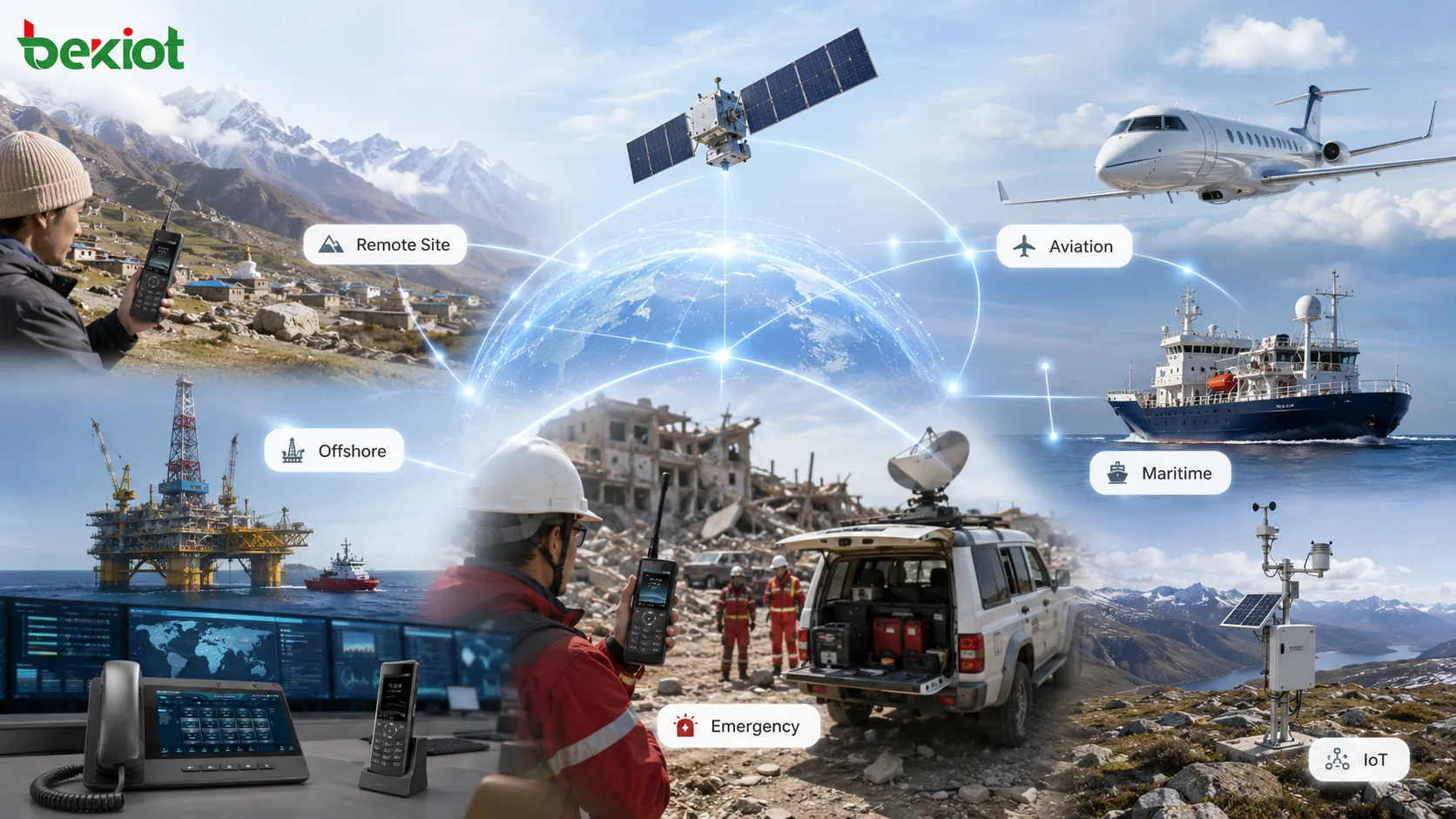
Use Cases in Emergency Response
Disasters can damage ground infrastructure. Earthquakes, floods, wildfires, hurricanes, conflicts, and power failures may interrupt fiber, towers, and local networks. Satellite terminals can provide temporary communication channels for rescue teams, shelters, command posts, hospitals, and field coordination.
Emergency use requires more than equipment availability. Teams need trained operators, preconfigured service plans, charged power systems, mounting hardware, clear sky access, and tested procedures. A terminal stored in a box but never tested may not help when the emergency arrives.
For public safety planning, satellite should be considered a resilience layer rather than a last-minute replacement for all local communication.
Use Cases in Maritime and Aviation
Ships and aircraft operate across areas where terrestrial networks are unavailable. Satellite links support passenger connectivity, crew communication, operational data, navigation support, safety reporting, weather updates, maintenance information, and logistics coordination.
Maritime environments require coverage across oceans, ports, offshore energy zones, fishing routes, and polar paths. Aviation systems require reliable service across flight routes, altitude changes, aircraft movement, and regulatory regions.
These sectors often use specialized terminals and service agreements because mobility, safety, certification, and global coverage requirements are more demanding than ordinary fixed broadband.
Use Cases in IoT and Machine Data
Satellite IoT supports devices that send small amounts of data from remote or mobile assets. Examples include environmental sensors, pipelines, agriculture equipment, shipping containers, wildlife trackers, weather stations, energy facilities, and remote infrastructure monitors.
The data volume may be small, but the value can be high. A sensor reading from a remote asset can support maintenance, safety, logistics, environmental monitoring, or compliance.
For IoT applications, power consumption, message size, antenna design, reporting interval, and subscription cost are often more important than high throughput.
Use Cases in Broadcasting and Content Distribution
Satellite broadcasting can deliver the same content to many receivers across a wide area. This remains useful for television, radio, emergency alerts, distance learning, corporate content distribution, and public information systems.
Broadcast-style delivery is efficient when the same signal must reach many locations at once. It is less dependent on local broadband infrastructure and can cover regions where terrestrial distribution is difficult.
Even as internet streaming grows, satellite distribution remains relevant for wide-area content delivery and backup paths.
Use Cases in Enterprise Backup and Hybrid Networks
Enterprises may use satellite as a backup link for branches, ATMs, retail stores, energy sites, security systems, and remote operations. When the primary terrestrial link fails, traffic can switch to the satellite path.
Hybrid design requires routing policies, failover testing, priority settings, and application awareness. Not all traffic should automatically move to satellite during a failure. Critical services may need priority over large downloads or non-essential updates.
Well-designed backup links are tested regularly. A failover path that is never tested may fail when it is needed most.
Security Considerations
Satellite links should be protected like any other network path. Encryption, authentication, secure management interfaces, access control, terminal hardening, traffic monitoring, and update management are important.
Because the signal travels over radio, the system must consider interception, jamming, spoofing, unauthorized terminal access, and gateway security. Mission-critical applications may require stronger protection and redundant paths.
Security planning should cover both the space segment and the ground segment. A secure satellite payload is not enough if terminal credentials, routers, or management portals are poorly protected.
Regulatory and Spectrum Factors
Satellite systems operate in regulated spectrum. Service availability depends not only on technical coverage but also on licensing, coordination, national rules, terminal approval, and interference management.
Different countries may have different rules for user terminals, mobile operation, gateways, encryption, and importation of equipment. Global service providers must manage these differences carefully.
As more constellations and services enter orbit, spectrum coordination and orbital sustainability are becoming more important industry issues.
Limitations and Practical Challenges
Line of sight is a common requirement. Buildings, mountains, trees, ship structures, aircraft parts, or indoor placement can block or weaken the signal. Some terminals need a clear view of a specific sky region.
Weather can affect certain frequency bands, especially during heavy rain. Mobility can introduce pointing and handover challenges. Power supply can be difficult in remote sites. Capacity may vary by region and time.
These limitations do not reduce the importance of satellite communication, but they show why engineering design and site planning matter.
Industry Direction
The future of satellite connectivity is likely to be multi-layered. Geostationary systems, medium earth orbit services, low earth orbit constellations, terrestrial 5G, private networks, fiber, and cloud platforms will increasingly be combined according to application needs.
Direct-to-device concepts may expand basic messaging or narrowband connectivity to ordinary phones in areas without mobile coverage. Multi-orbit enterprise services may combine capacity, latency, and resilience. Satellite IoT may grow in industries where assets are distributed across remote regions.
The strongest trend is integration. Satellite communication is becoming part of broader network architecture rather than a separate niche service. Its system value is highest when it is planned together with terrestrial links, security policy, operations management, and real application workflows.
Satellite communication works by relaying radio signals through orbiting spacecraft, but its real value comes from extending coverage, improving resilience, supporting mobility, and connecting remote assets where terrestrial networks cannot reach reliably.
FAQ
Can satellite service completely replace fiber?
In some remote locations it may be the primary option, but in dense areas fiber usually offers higher capacity, lower cost per bit, and more stable latency. Satellite is often best as an extension or backup layer.
Why does indoor installation often perform poorly?
Most terminals need a clear path to the sky. Walls, roofs, coated glass, metal structures, and nearby buildings can block or weaken the signal.
What is rain fade?
Rain fade is signal weakening caused by rain or atmospheric moisture, especially in higher frequency bands. Systems may use link margin, adaptive coding, or larger antennas to reduce its impact.
Do moving vehicles need special equipment?
Yes. Vehicles, ships, and aircraft usually require mobile-capable antennas, tracking systems, approved mounting, and service plans that support movement across coverage areas.
Is satellite internet always slower than mobile networks?
Not always. Performance depends on orbit, capacity, terminal type, congestion, gateway routing, and service plan. Some modern systems can deliver strong broadband performance, while some mobile networks may be weak in remote areas.