


Dual-Tone Multi-Frequency, commonly abbreviated as DTMF, is an audio signaling method that uses a pair of tones to represent keypad input. When a user presses a key on a telephone keypad, the system generates two simultaneous frequencies: one from a low-frequency group and one from a high-frequency group. The receiving system detects this tone pair and converts it into a digit, symbol, or control command.
Although DTMF is closely associated with traditional telephony, it remains relevant in modern communication and control scenarios. Interactive voice response systems, call routing, access control, remote control, SIP-based voice systems, alarm reporting, dispatch platforms, radio gateways, and legacy interface systems may still rely on tone recognition. Its long-term value comes from a simple idea: commands can travel through an ordinary audio path without requiring a separate data channel.
Why Two Frequencies Are Used
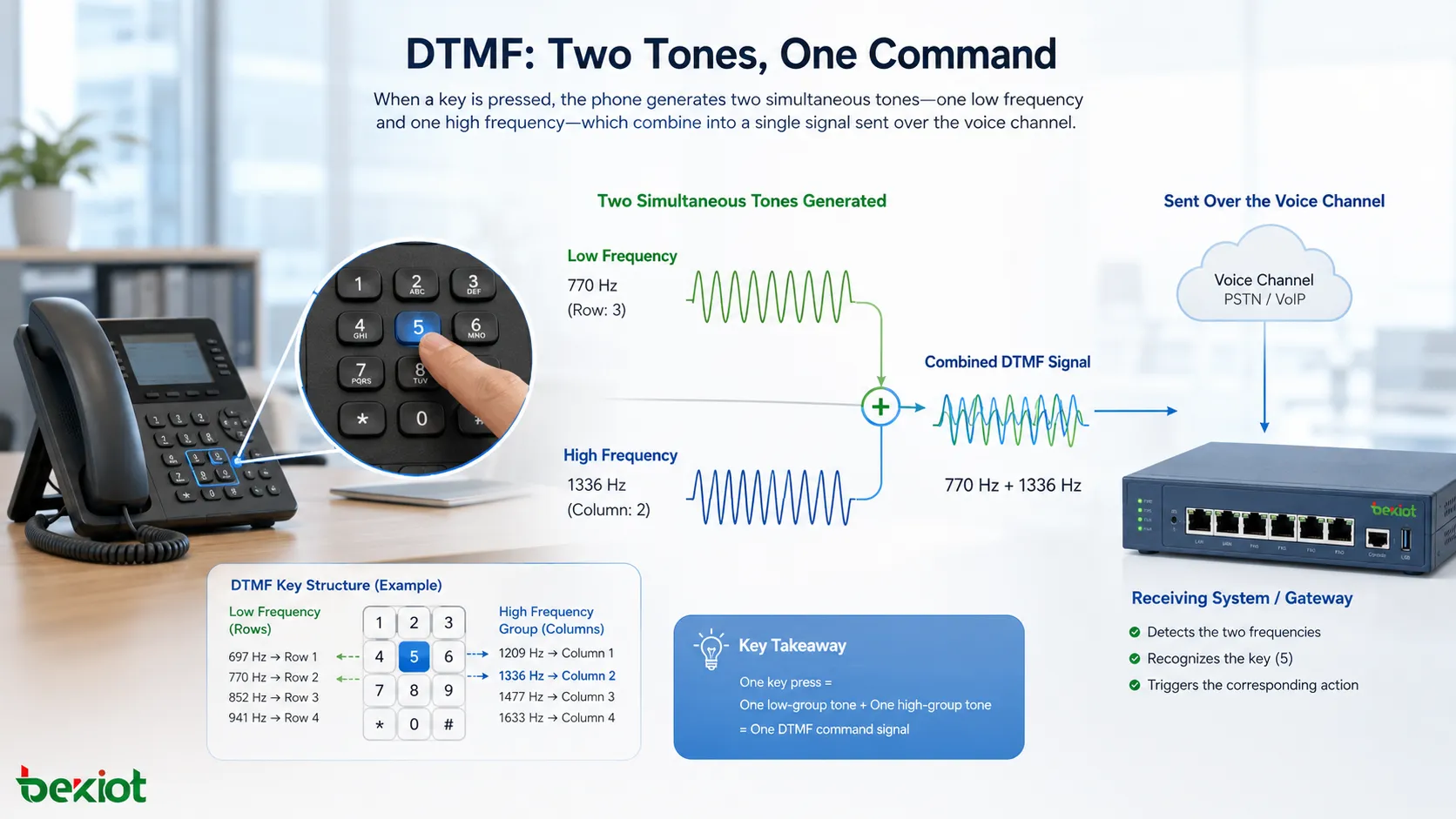
The most important design feature is the use of two tones at the same time. Each valid key is represented by one frequency from a low group and one frequency from a high group. This reduces the chance that speech, background sound, line noise, or music will be mistaken for a valid keypad command.
A single tone would be easier to imitate accidentally. Human speech contains many changing frequency components, and certain vowels or noises may overlap with individual frequencies. A dual-tone structure makes recognition more selective because the receiver expects a specific pair, a valid amplitude relationship, and a stable duration.
This design gives DTMF an audio advantage: it is simple enough to pass through voice-grade channels, but structured enough to be decoded reliably by filters, digital signal processors, or software algorithms.
Signal Structure and Key Mapping
A standard keypad uses frequency groups rather than random tones. The low group includes 697 Hz, 770 Hz, 852 Hz, and 941 Hz. The high group includes 1209 Hz, 1336 Hz, 1477 Hz, and 1633 Hz. A normal telephone keypad mainly uses the first three high-frequency columns for digits 0–9, star, and pound. The fourth column is used for A, B, C, and D in extended applications.
For example, pressing “1” generates 697 Hz and 1209 Hz together. Pressing “5” generates 770 Hz and 1336 Hz. Pressing “0” generates 941 Hz and 1336 Hz. The receiver identifies the low tone, identifies the high tone, checks that the combination is valid, and then reports the corresponding key.
This grid-based structure makes the system predictable. It also allows decoders to reject invalid combinations. If two low tones appear without a high tone, or if a detected frequency does not belong to the expected set, the signal can be ignored.
Audio Advantage in Voice Channels
DTMF was designed to travel through voice paths. This is one reason it became so widely used. The tones sit within the audible band and can pass through many telephone circuits, analog lines, PBX systems, voice gateways, radio links, and audio processing chains.
The signal does not require high bandwidth. It does not need complex modulation. It can be transmitted as sound and decoded from sound. This makes it practical in systems where voice is already available but digital signaling may not be directly accessible.
In many real systems, this compatibility is more important than theoretical efficiency. A command that can travel through an existing audio path may be easier to deploy than a separate control protocol that requires new signaling infrastructure.
Recognition Stability
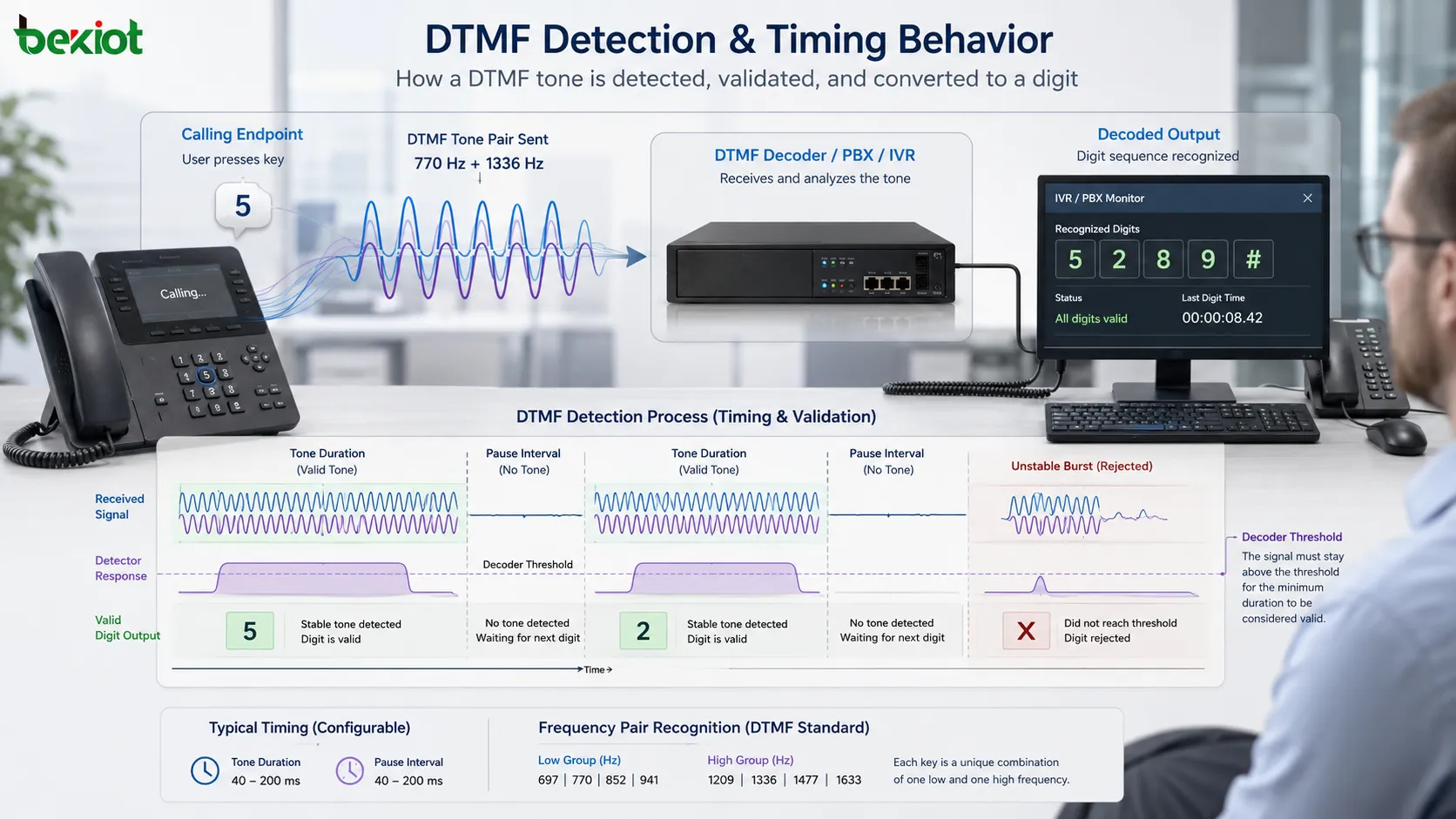
The tone pairs are separated enough to allow reliable detection. A receiver can use filters or digital frequency analysis to identify whether the expected low and high components are present. It can also check tone duration, pause timing, and amplitude levels.
Reliable recognition depends on several conditions. The tone must last long enough. The two frequencies must be accurate enough. The audio path must not distort or heavily compress the signal. Noise should not overpower the tone pair. The receiver should also reject short accidental bursts.
Compared with speech recognition or complex audio interpretation, DTMF recognition is much simpler. The decoder does not need to understand language, grammar, speaker accent, or sentence meaning. It only needs to detect a known tone pair.
Resistance to Ordinary Speech Confusion
DTMF is not completely immune to false detection, but its structure helps reduce confusion with ordinary speech. Speech is dynamic and irregular, while a valid tone pair is stable and frequency-specific. Decoders can require a valid low-high pair for a defined minimum duration before accepting a key.
This is why DTMF can be used during voice sessions. A caller may speak, listen to prompts, and then press keys. The system listens for tone patterns rather than trying to parse the entire conversation.
However, talk-off can still occur when speech accidentally resembles a valid tone pair closely enough. Good decoder design includes guard time, twist tolerance, frequency tolerance, and speech rejection logic to reduce this risk.
Tone Duration and Timing Behavior
Duration matters because very short signals may be noise, clicks, compression artifacts, or accidental sounds. A receiver normally requires the tone to remain valid for a minimum period before reporting a digit.
Pause time between digits also matters. If digits are sent too quickly, the receiver may miss one or merge events incorrectly. If the pause is too long, the receiving application may treat the input as incomplete or time out.
In practical systems, DTMF timing should be tested across the full audio route. A tone that is generated correctly at one endpoint may be shortened, clipped, delayed, or distorted by another part of the transmission path.
Twist and Level Balance
Twist describes the level difference between the low-frequency component and the high-frequency component. In a real audio path, one frequency group may become stronger or weaker than the other. If the difference becomes too large, the decoder may fail to recognize the pair correctly.
Good systems tolerate a reasonable level difference while rejecting unrealistic combinations. This is important because telephone lines, codecs, amplifiers, microphones, speakers, and gateways can change frequency response.
Level balance also affects user experience. If tones are too weak, the receiver may miss them. If they are too strong, they may clip or distort. Proper gain planning is part of reliable deployment.
Compatibility with Analog and Digital Systems
One advantage of DTMF is its ability to bridge older and newer systems. It can work on analog telephone lines, digital PBX systems, VoIP gateways, SIP endpoints, radio links, and audio-based control paths if the audio is transmitted with enough fidelity.
In VoIP systems, DTMF may be carried in different ways. It can be sent as in-band audio, as RTP events, or through signaling messages depending on system configuration. Each method has different behavior and compatibility considerations.
In-band audio is simple conceptually because the tones travel as sound. However, it can be affected by voice codecs, compression, echo cancellation, packet loss, and noise suppression. Out-of-band methods may be more reliable in IP networks when all devices support them correctly.
Common Transport Methods in IP Voice
In modern packet-based voice systems, DTMF can be transported through several methods. In-band transmission sends the actual tones inside the audio stream. RTP event transmission represents the digit as a special event in the media path. SIP INFO sends digit information through SIP signaling messages.
Each method exists because real networks have different requirements. In-band audio is useful when the receiver expects to hear actual tones. RTP events can avoid distortion caused by codecs. SIP INFO can be useful in some application-server environments, but it depends on signaling support and interoperability.
Mismatch between endpoints is a common problem. If one side sends RTP events while the other side expects in-band tones, digit recognition may fail. Deployment should confirm that all gateways, PBX systems, softswitches, terminals, and application servers use compatible settings.
Functional Value in Interactive Systems
DTMF is widely used in interactive voice response. A caller hears a prompt and presses a digit to choose a menu option. The system decodes the digit and routes the call, plays information, collects input, or starts another workflow.
The advantage is direct user control. The caller does not need a smartphone app, data service, or web page. A basic phone keypad is enough. This remains valuable for customer service, banking prompts, utility hotlines, emergency menus, enterprise call routing, and service verification.
Because input is structured, the system can respond quickly. Digits such as account numbers, PINs, menu choices, and extension numbers can be processed without natural language interpretation.
Functional Value in Remote Control
DTMF can also serve as a simple remote control method. A remote device or system can listen for specific tone sequences and map them to actions. Examples include opening a gate, selecting a radio channel, controlling a repeater, activating a relay, changing an audio route, or triggering a predefined command.
This is useful when a voice path already exists and only a small number of commands are needed. The system does not need a broadband connection or complex user interface.
However, command security must be considered. If tones are accepted from any caller without authentication, unauthorized users may trigger actions. Sensitive controls should require authorization, passcodes, caller verification, or additional security layers.
Functional Value in Communication Gateways
Gateways often connect different communication technologies. They may bridge analog lines, SIP trunks, PBX extensions, radio channels, dispatch systems, and public networks. DTMF can help pass control signals across these boundaries.
For example, a user may enter digits after a call is connected to navigate a remote IVR. A gateway must preserve, translate, or regenerate the digit information correctly. If it fails, the voice call may connect but menu operation will not work.
This is why DTMF handling is an important test item in voice gateway deployment. Call audio quality alone does not guarantee that keypad commands will pass correctly.
Audio Processing Risks
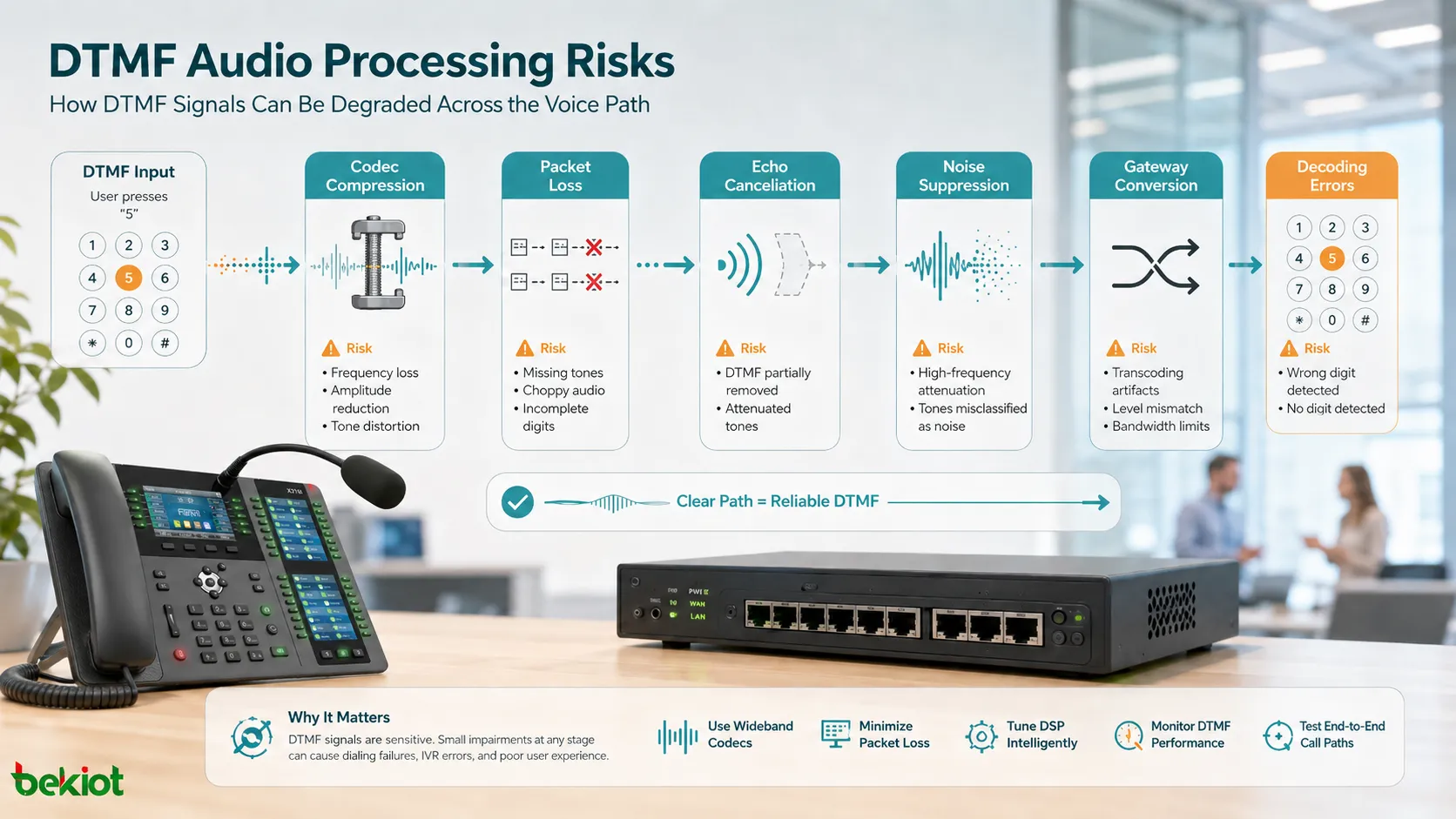
Many modern audio systems include echo cancellation, automatic gain control, noise suppression, comfort noise generation, packet loss concealment, and codec compression. These functions are useful for speech quality, but they can affect tone integrity.
A codec optimized for human speech may not preserve exact tone frequency and amplitude as well as needed. Noise suppression may treat a tone as artificial audio. Echo cancellers may interact with tones in unexpected ways. Packet loss can break a tone into fragments.
For reliable operation, systems should use suitable transport methods and test DTMF across the actual network path rather than assuming that any voice path will work.
Decoder Design Considerations
A decoder should identify valid frequencies while rejecting noise, speech, music, and short transient sounds. It should measure tone duration, amplitude, twist, frequency tolerance, and timing gaps.
Digital implementations may use algorithms such as filter banks or spectral analysis to detect the expected frequency groups. The design should avoid accepting false positives while still tolerating real-world line variation.
Good decoders also report events cleanly. A long tone should not generate repeated digits unless the application expects that behavior. A noisy signal should not generate random keypad input.
Security and Abuse Prevention
DTMF itself is not an encryption or authentication method. Anyone who can send tones into the accepted audio path may be able to generate input if the receiving application does not verify identity.
For low-risk menu navigation, this may be acceptable. For access control, account operations, payment systems, remote equipment control, or emergency functions, additional security is necessary.
Security measures may include caller authentication, one-time codes, account validation, call origin checks, role permissions, rate limits, logging, and confirmation prompts. Sensitive digits such as PINs should also be handled carefully in recordings and logs.
Testing Checklist for Real Systems
Testing should include every path where tone input is expected. Engineers should test local calls, remote calls, gateway calls, SIP trunk calls, mobile calls, analog line calls, and call transfer scenarios if they exist.
The test should confirm that each digit is recognized correctly, that repeated digits do not merge, that long tones do not duplicate unexpectedly, and that voice prompts do not interfere with input.
Codec selection should also be tested. If in-band tones are required, highly compressed speech codecs may cause problems. If RTP events are used, the endpoints must negotiate and interpret them consistently.
Maintenance and Troubleshooting
When digit recognition fails, teams should first identify how the tones are being transported. The failure may not be caused by the keypad itself. It may be caused by codec conversion, gateway configuration, signaling mismatch, media relay behavior, packet loss, or application server settings.
Useful checks include packet captures, SIP traces, RTP event analysis, audio recording, gateway logs, PBX configuration, IVR logs, and endpoint settings. Comparing a working call path with a failing call path often reveals the difference.
Maintenance teams should document the chosen transport method and keep it consistent across connected systems. Unplanned changes during PBX migration, SIP trunk replacement, codec policy update, or gateway upgrade can break previously working digit input.
Advantages and Limitations
The main advantages are simplicity, compatibility, low bandwidth requirement, easy generation, structured detection, and practical use over existing voice channels. DTMF allows command input without a separate data interface, which is why it remains widely used.
The limitations are also clear. It carries small command sets rather than large data. It can be affected by audio processing. It is not secure by itself. It may fail if transport modes are mismatched. It is not suitable for complex modern data exchange.
The best use is therefore focused control and input, not general data communication. When the requirement is simple digit or command signaling inside a voice workflow, DTMF is still highly practical.
Industry Relevance
Even as web apps, mobile apps, AI voice assistants, and rich APIs become more common, DTMF remains important because many systems still depend on keypad input. Voice menus, contact centers, SIP trunks, telephony gateways, conferencing systems, radio interconnects, and remote control interfaces continue to require reliable tone handling.
The industry trend is not that DTMF disappears. Instead, its role becomes more specialized. It is often used as a compatibility layer between old and new systems, or as a simple control method inside broader communication workflows.
For this reason, engineers should understand both the audio characteristics and the transport behavior. A system may look modern at the application level but still depend on accurate DTMF handling underneath.
DTMF remains useful because it converts keypad input into structured audio signals that can pass through voice communication paths and trigger reliable command recognition when the transmission chain is configured correctly.
FAQ
Can DTMF tones be heard by people?
Yes. When sent as in-band audio, they are audible tones. Some systems mute or convert them depending on transport method and application behavior.
Why do tones work on one call path but not another?
Different call paths may use different codecs, gateways, SIP settings, RTP event handling, media relays, or IVR detection rules. Any mismatch can affect recognition.
Is DTMF suitable for sending passwords?
It can be used for PIN entry in some systems, but sensitive digits should be protected. Recordings, logs, call paths, and application security must be considered.
What causes double digits during input?
Long tone duration, repeated event reporting, gateway conversion errors, or application debounce settings may cause one key press to be interpreted more than once.
Does noise cancellation improve tone recognition?
Not necessarily. Noise cancellation is designed mainly for speech. In some cases, it may distort, suppress, or interfere with tone signals.







