In modern software platforms, enterprise systems, industrial management tools, cloud services, mobile applications, IoT platforms, and communication systems, isolated operation is becoming less practical. A business platform may need to exchange user data with a CRM, send alarms to a dispatch system, synchronize orders with an ERP, receive device status from a monitoring platform, trigger messages through a notification service, or allow a third-party application to build new functions on top of existing data. Open API integration is the technical method that makes these cross-system connections possible.
An Open API does not simply mean that a system exposes a few URLs for developers to call. In real projects, it includes interface design, authentication, permission scope, request format, response structure, data mapping, error handling, callback mechanism, rate control, documentation, version management, monitoring, and security protection. Its value lies in turning a closed platform into an extensible service capability, so that different systems can cooperate without manually transferring data or rebuilding the same function repeatedly.
When system isolation becomes the bottleneck
Many organizations first build systems to solve separate problems. A sales team uses a CRM. A finance team uses billing software. A warehouse uses inventory management. A factory uses equipment monitoring. A security center uses an alarm platform. A customer service team uses a call center. Each system may work well within its own boundary, but problems appear when business processes cross those boundaries.
If data cannot move automatically, people start to copy information manually. If status cannot synchronize, teams make decisions based on outdated records. If alarms cannot trigger response systems, operators must watch several screens at once. If customer data cannot flow between platforms, service staff repeat questions that the company already knows. These problems are not caused by the absence of software; they are caused by the absence of integration.
Open API integration solves this by allowing systems to communicate through defined interfaces. Instead of giving every external system direct database access or forcing users to export and import files, the platform exposes controlled functions. An external application can query data, submit records, trigger actions, receive status, or subscribe to events according to permission rules.
This changes the system from a closed application into a service provider. Other systems can use its capabilities without knowing its internal database design, source code, or deployment structure. The API becomes a stable contract between platforms. As long as the contract is respected, both sides can evolve more safely.
How an integration request flows through the interface
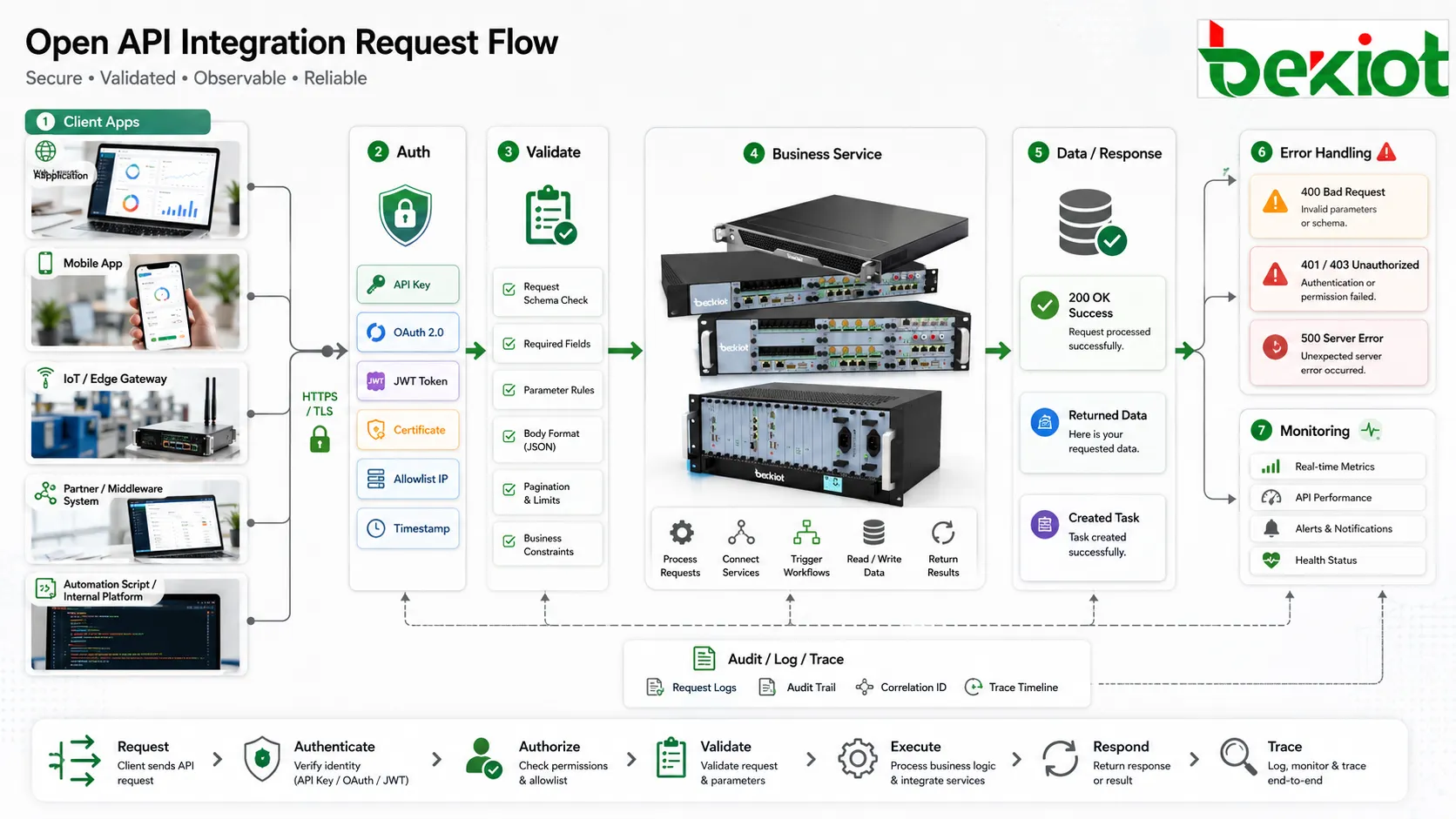
An Open API integration usually begins when a client system sends a request to a service endpoint. The client may be a web application, mobile app, backend service, middleware platform, IoT gateway, automation script, partner system, or internal business platform. The endpoint represents a specific function, such as querying a device list, creating a ticket, sending a message, updating a user profile, retrieving alarm records, or triggering a workflow.
Before the service accepts the request, it normally verifies identity. This may involve an API key, OAuth token, JWT, client certificate, signature, timestamp, IP allowlist, session token, or another authentication method. Authentication answers the question: who is calling the API? Authorization answers another question: what is this caller allowed to do?
After identity and permission are verified, the system checks the request format. It may validate required fields, parameter types, request body structure, file size, timestamp, signature, pagination rules, and business constraints. If the request is invalid, the API should return a clear error response rather than silently fail. Good validation protects both the service provider and the caller.
Once the request passes validation, the backend service executes the corresponding business logic. It may read data, write data, call another service, trigger an event, update a status, start a task, or return a result. The API response then tells the caller whether the request succeeded, what data was returned, what error occurred, or what next step is required.
This request-response model is common in RESTful APIs and many HTTP-based services. Other integration patterns may use GraphQL, SOAP, gRPC, message queues, webhooks, or event streams. The technical form may differ, but the core idea remains the same: systems communicate through defined interfaces instead of uncontrolled internal access.
Interface design turns functions into reusable services
The function of an Open API depends heavily on interface design. A poorly designed API may expose technical details but fail to support real business needs. A well-designed API turns platform functions into reusable services that other systems can call reliably. This requires clear endpoint naming, consistent request formats, predictable responses, and stable behavior.
Common Open API functions include data query, data creation, status update, message sending, file upload, task triggering, user synchronization, alarm reporting, device control, order processing, payment callback, ticket creation, log retrieval, and report export. Each function should be designed according to business purpose rather than only database structure.
For example, an API named “create work order” is more meaningful than exposing direct database insert behavior. The caller wants to create a valid work order, not understand every table behind it. The service should handle validation, default values, permission checks, workflow status, notification triggers, and error messages internally.
Reusable service design also reduces duplication. Instead of building separate integrations for every partner or department, the platform provides common API capabilities. A mobile app, web portal, automation tool, and partner system may all use the same interface with different permissions. This improves maintainability and reduces custom development cost.
Interface design should consider future change. If the API exposes too many internal details, small backend changes may break external systems. If the API is too vague, callers may not know how to use it correctly. A good API contract is stable enough for integration and flexible enough for platform evolution.
Authentication defines who can access the API
Open API integration must include authentication because an exposed interface can become a security entry point. If anyone can call the API without verification, data may be leaked, actions may be triggered incorrectly, and systems may be abused. Authentication is the first gate of API security.
API keys are common in simple integrations. A system issues a unique key to a caller, and the caller includes it in requests. API keys are easy to use, but they must be protected carefully. If a key is leaked, another party may impersonate the caller. Keys should be revocable, rotated when needed, and limited by scope or usage policy where possible.
OAuth-based authorization is common when user identity and delegated access are needed. Instead of sharing a password, the user or system grants limited access through a token. The token can carry scope, expiration, and permission information. This is useful for third-party apps, cloud services, and multi-tenant platforms.
JWT tokens may be used to carry signed claims between services. Client certificates and mutual TLS may be used in higher-security service-to-service integration. Request signatures may be used to verify that a request has not been forged or modified. IP allowlists may restrict access to trusted network sources.
The correct method depends on risk. A public developer API, internal service API, payment API, device control API, and emergency system API should not necessarily use the same authentication level. The more sensitive the operation, the stronger and more controlled the authentication should be.
Authorization and scope prevent overexposure
Authentication proves identity, but authorization defines permission. An authenticated caller should not automatically access every function. Open API integration should use scope, role, tenant boundary, resource ownership, or policy rules to limit what each caller can do.
For example, a partner system may be allowed to query order status but not modify prices. A mobile app may read user profile data but not export all customer records. A device gateway may report telemetry but not delete devices. A monitoring platform may receive alarm events but not change configuration. These distinctions protect the platform from excessive access.
Scope control also supports safer integration with multiple partners. Different callers may use the same API gateway but receive different permissions. If one integration is compromised, the damage can be limited. This is especially important when the API connects with external vendors, contractors, developers, or customer systems.
Authorization should be enforced on the server side. It is not enough to hide buttons in a front-end interface. If an API endpoint exists, the backend must check whether the caller can perform the requested action on the requested resource. Every sensitive operation should assume that the caller may attempt something outside its allowed scope.
Permission design should be documented clearly. API users need to know which scopes are required for each endpoint, what errors appear when permission is insufficient, and how access can be requested or revoked. Clear permission rules reduce integration mistakes and improve security review.
Data mapping connects different business languages
Open API integration often fails not because the network cannot connect, but because the systems describe data differently. One system may call a customer “client,” another may call it “account.” One system may use internal numeric IDs, another may use external codes. One system may store time in local format, another may require UTC. One system may use status values such as “open,” “processing,” and “closed,” while another uses numbers or custom labels.
Data mapping translates these differences. It defines how fields from one system correspond to fields in another system. It also defines value conversion, unit conversion, time format, language handling, default values, required fields, optional fields, and error behavior when data is incomplete.
Good data mapping is essential for stable integration. If the mapping is vague, errors may appear later in business operation. A wrong customer ID may update the wrong account. A missing status value may stop a workflow. A time zone error may schedule a task at the wrong time. A unit mismatch may create wrong inventory or billing data.
Mapping should also consider data ownership. Not every system should be allowed to overwrite every field. One system may be the master source for customer identity, another for payment status, another for device status, and another for work order progress. If ownership is unclear, integrations may overwrite each other and create inconsistent records.
In larger projects, middleware or an integration platform may manage mapping rules. This reduces direct dependency between systems. Instead of every system translating every other system, the integration layer can provide a controlled transformation path.
Webhooks support event-driven integration
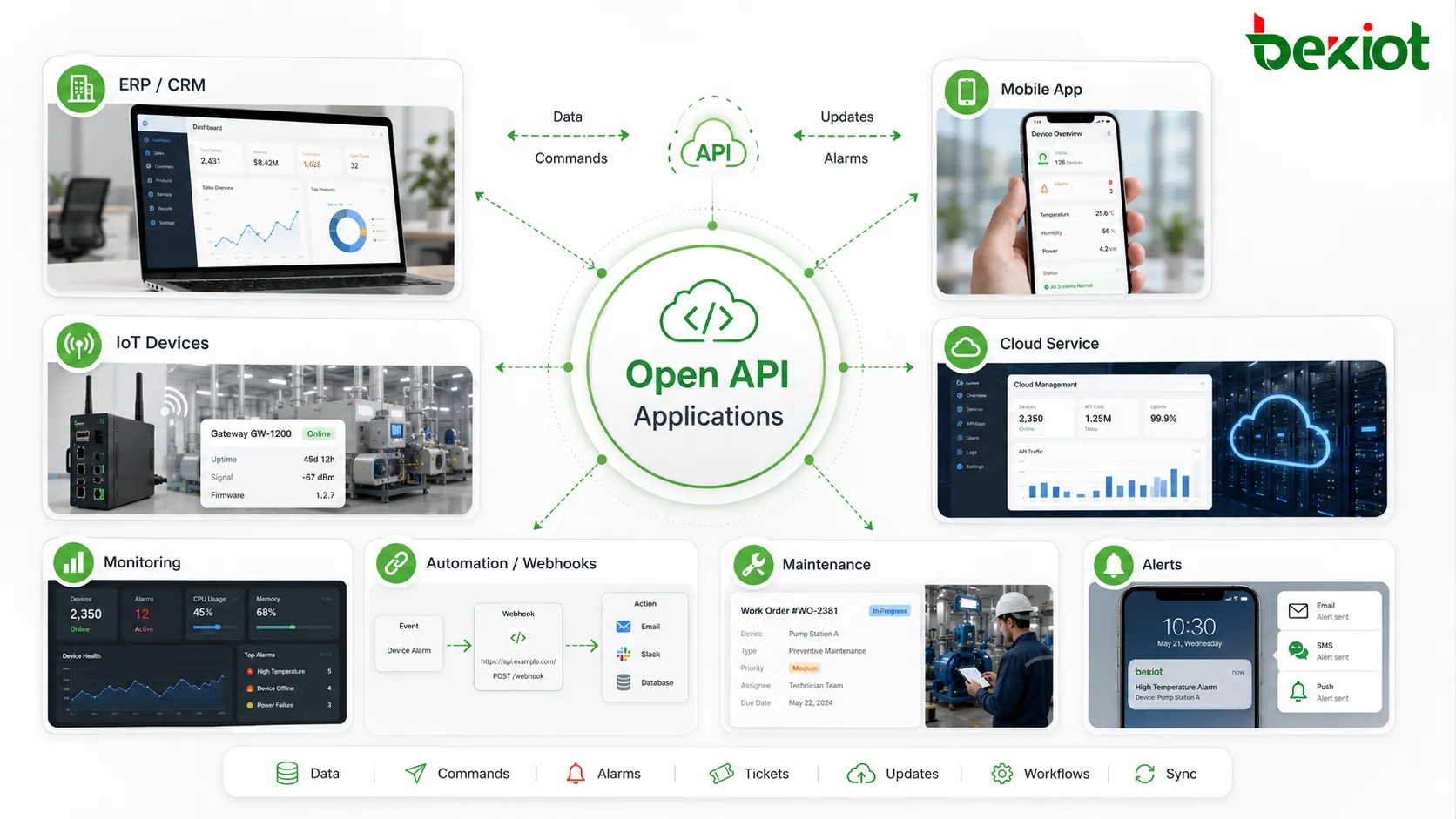
Not all integrations should rely on repeated polling. If a client system constantly asks, “Is there any new data?” it may waste resources and create delays. Webhooks provide another model: when an event happens, the platform actively sends a notification to a configured callback URL.
Webhooks are useful for events such as order creation, payment success, alarm occurrence, device offline status, ticket update, message delivery result, user registration, file processing completion, or workflow approval. The external system receives the event quickly and can take action without checking repeatedly.
Event-driven integration improves responsiveness. A dispatch system can receive an alarm event immediately. A CRM can update customer status when a transaction completes. A monitoring platform can notify a maintenance system when a device fails. A notification service can trigger messages when a workflow reaches a specific stage.
Webhook design requires reliability planning. The receiving system may be offline, slow, or temporarily unavailable. The API provider should support retry rules, timeout handling, event signatures, delivery logs, and duplicate-event protection. The receiver should design idempotent processing so that repeated webhook delivery does not create duplicate records.
Security is also important. A webhook endpoint should verify that the event came from a trusted source. Signatures, tokens, timestamps, IP restrictions, and replay protection may be used. Since webhooks push data outward, the receiving endpoint becomes part of the security boundary.
API gateways provide control and visibility
In many systems, APIs are not exposed directly from backend services to external callers. An API gateway sits in front of the services and manages access, routing, authentication, rate limits, logging, monitoring, and sometimes transformation. This is especially useful when there are many APIs or many callers.
The gateway can centralize security. Instead of implementing authentication separately in every backend service, the gateway can verify tokens, check signatures, apply IP restrictions, and enforce access policies. Backend services still need security controls, but the gateway reduces duplicated work and provides a consistent entry point.
Rate limiting is another gateway function. If a caller sends too many requests, the gateway can slow or reject traffic before it affects backend systems. This protects the service from accidental overload, abusive behavior, or poorly designed polling. Rate limits can be defined by user, application, endpoint, tenant, or time window.
Gateways also improve observability. They can record request volume, latency, error rate, caller identity, endpoint usage, failed authentication attempts, and traffic patterns. This helps administrators understand how APIs are being used and where performance bottlenecks appear.
In some integrations, the gateway also transforms requests and responses. It may convert formats, rewrite paths, add headers, mask sensitive data, or route traffic to different service versions. These functions should be used carefully because too much hidden transformation can make troubleshooting harder.
Error handling determines integration stability
A reliable Open API should not only work when everything is normal. It should also explain what went wrong when a request fails. Error handling is one of the most important indicators of API quality because integrations inevitably face invalid input, expired tokens, missing resources, permission problems, network timeouts, duplicate requests, and backend failures.
Good error responses should be clear, consistent, and machine-readable. A caller should know whether the problem is authentication, authorization, validation, not found, rate limit, conflict, timeout, or server failure. Human-readable messages help developers, while structured error codes help applications react automatically.
For example, if a token has expired, the client may refresh it. If a request is rate-limited, the client may wait and retry. If a field is invalid, the client may show a correction message. If the resource does not exist, the client may stop the process. Without clear error codes, integration logic becomes fragile.
Error handling should also avoid exposing sensitive internal details. A response should not reveal database structure, stack traces, private server paths, internal IP addresses, or secret configuration. The API should provide enough information for correction without giving attackers useful internal knowledge.
Timeout and retry behavior should be designed carefully. Automatic retry can improve reliability for temporary network failures, but it can also create duplicate operations if the request is not idempotent. Critical APIs should define which operations can be retried safely and how duplicate submissions are detected.
Version management protects long-term integrations
Open APIs often live longer than the first application that uses them. Once third-party systems, mobile apps, customer platforms, or internal services depend on an API, changing it carelessly can break operations. Version management is therefore a core part of integration planning.
Versioning allows a platform to improve APIs without suddenly breaking existing clients. A new version may add fields, change behavior, improve security, or restructure responses. Older clients may continue using the previous version during a transition period. This gives integrators time to upgrade.
Backward compatibility should be considered whenever possible. Adding an optional field is usually safer than removing a required field. Changing the meaning of an existing status value can be risky. Changing authentication behavior may require careful migration. Deprecation notices should be clear and early.
API documentation should state supported versions, release dates, change logs, deprecation timelines, and migration guides. Integrators need to know what changed and how to adapt. Without clear communication, even small changes can cause production incidents.
Version management is especially important for mobile applications and embedded systems because clients may not update quickly. A server-side API change can affect many installed clients that remain on older software versions. Long-term compatibility should be part of the design.
Documentation turns an interface into a usable product
An Open API is not truly open if developers cannot understand how to use it. Documentation is the bridge between technical capability and real integration. Good documentation explains authentication, endpoints, request parameters, response fields, error codes, rate limits, examples, webhooks, permissions, pagination, versioning, and testing methods.
Developers often judge API quality by how quickly they can complete a working integration. Clear examples reduce trial and error. Sample requests and responses show the expected structure. Authentication guides reduce setup mistakes. Error code explanations help debugging. Webhook examples help receivers design correct event handling.
Documentation should also explain business rules. For example, if an order cannot be canceled after shipment, the API should document that. If a device status update must include a timestamp, that requirement should be clear. If pagination has a maximum page size, developers need to know it. Technical syntax alone is not enough.
Interactive documentation or sandbox environments can improve adoption. Developers can test requests before connecting production systems. A sandbox can provide sample data, test credentials, and controlled responses. This reduces risk during integration development.
Documentation must be maintained. Outdated documentation is dangerous because it causes wrong assumptions. When an API changes, the documentation should change with it. A platform with strong APIs but weak documentation may still create high integration cost.
Monitoring and logs support operation
After integration goes live, monitoring becomes essential. API calls may fail due to expired credentials, network interruption, backend errors, invalid requests, rate limits, data format changes, or third-party system problems. Without monitoring, these failures may remain hidden until users complain or business data becomes inconsistent.
Useful monitoring includes request volume, response time, error rate, authentication failures, endpoint usage, rate-limit events, webhook delivery status, retry count, timeout rate, and abnormal traffic patterns. These indicators help administrators detect issues early and understand whether APIs are performing normally.
Logs are important for troubleshooting. When an integration fails, the team needs to know what request was received, who sent it, which endpoint was called, what validation failed, what response was returned, and whether the backend completed the action. Logs should be detailed enough for diagnosis but should avoid storing sensitive secrets or unnecessary personal data.
Alerting is necessary for important APIs. If payment callbacks fail, device alarms cannot be delivered, work orders stop synchronizing, or authentication errors suddenly increase, responsible teams should be notified. API failures can directly affect business continuity.
Monitoring also supports capacity planning. If request volume grows, the platform may need more resources, caching, queue processing, database optimization, or rate-limit adjustment. API integration is not a one-time connection; it is an ongoing service that must be observed and maintained.
Common applications in enterprise systems
Enterprise systems use Open API integration to connect CRM, ERP, finance, HR, customer service, e-commerce, inventory, workflow, document management, and reporting platforms. These integrations reduce manual work and keep business data consistent across departments.
A CRM may receive customer information from a website form, send sales status to an ERP, or create service tickets in a support platform. An ERP may synchronize orders, invoices, stock levels, and delivery status with other applications. A finance system may receive payment confirmations and update billing records. These flows all depend on controlled data exchange.
APIs also support workflow automation. When a contract is approved, the system may trigger invoice creation, notify the sales team, create a delivery task, update the customer account, and generate a report. Without APIs, each step may require manual entry across several systems.
Enterprise integration must pay attention to data ownership. Customer data, order data, payment data, and inventory data may have different master systems. If the ownership rule is unclear, two systems may overwrite each other. API design should support synchronization while preserving authoritative sources.
Security and audit are especially important in enterprise integration. Business APIs may expose financial records, employee data, customer information, contracts, and internal workflow status. Permission scope, logging, encryption, and access review should be included from the beginning.
Applications in mobile apps and web platforms
Mobile applications and web platforms often rely on Open APIs as their backend connection layer. The app interface may look simple, but behind it the API handles login, profile data, messaging, search, order submission, payment status, file upload, push notification, device binding, and user activity synchronization.
APIs allow the same backend service to support multiple front ends. A website, Android app, iOS app, tablet interface, and partner portal may all call the same service endpoints. This reduces duplicated backend development and keeps behavior consistent across channels.
For mobile apps, network conditions may be unstable. API design should handle timeout, retry, pagination, offline behavior, token refresh, and partial synchronization. A mobile client may switch between Wi-Fi and cellular networks, lose connection temporarily, or send repeated requests after reconnection. The API should be resilient to these conditions.
User experience depends on API performance. Slow response, inconsistent errors, unstable authentication, or large payloads can make the app feel unreliable. API integration is therefore not only a backend concern; it directly affects front-end usability.
Privacy is also critical. Mobile and web APIs often handle personal data, location information, messages, device identifiers, and payment details. The API should limit exposed data, protect transport security, enforce access scope, and avoid leaking sensitive information in logs or error responses.
Applications in IoT and device platforms
IoT platforms use Open APIs to connect devices, gateways, cloud services, monitoring dashboards, maintenance systems, and business applications. Devices may report telemetry, receive commands, upload logs, request firmware updates, or send alarms. External systems may query device status, create maintenance tickets, or analyze operating data.
API integration is important because IoT data often becomes useful only when connected to business workflows. A temperature alarm may need to create a maintenance task. A device offline event may need to notify an operations team. A usage record may need to update billing. A firmware update status may need to appear in a management dashboard.
Device APIs require careful identity control. A device should not be able to impersonate another device. Credentials should be unique where possible. Permission should limit what each device can report or control. For high-risk devices, stronger methods such as client certificates, signed requests, or secure hardware may be considered.
IoT APIs also need scale planning. Thousands or millions of devices may send data frequently. The system may need message queues, batch upload, rate control, compression, edge processing, and asynchronous handling. A simple synchronous API may not be enough for large-scale telemetry.
Firmware update integration deserves special attention. APIs may deliver update metadata, download links, version checks, and status reports. Transport security, package signing, rollback control, and staged rollout are important to prevent device failure or malicious modification.
Applications in industrial and operational systems
Industrial and operational systems use Open API integration to connect monitoring platforms, alarm systems, dispatch systems, device management platforms, maintenance systems, production systems, access control, video platforms, and reporting tools. These integrations improve situational awareness and reduce manual coordination.
An equipment monitoring platform may send alarms to a dispatch system. A maintenance system may create a work order when a device reports a fault. A video platform may open a related camera when an alarm event arrives. A production system may receive machine status and update line operation dashboards. These connections make operational response faster and more traceable.
Industrial API integration must consider reliability and security. A wrong command or unauthorized access may affect equipment behavior. APIs that control devices should use strict permission, audit logs, command confirmation, and sometimes manual approval. Read-only data APIs may have lower risk, but they still need protection if the data reveals operational details.
Network segmentation is important. Industrial systems may not allow direct internet access. APIs may be exposed through gateways, VPNs, private networks, or controlled integration zones. The architecture should protect critical systems while still allowing necessary data exchange.
Latency and availability requirements vary. A reporting API may tolerate delay. An alarm integration may need near-real-time delivery. A device control API may need confirmation and rollback handling. The API design should match the operational importance of the function.
Applications in partner ecosystems
Open APIs are often used to build partner ecosystems. A platform may allow third-party developers, system integrators, resellers, customers, or service providers to build applications around its data and functions. This expands the platform’s value beyond its original interface.
Partner APIs may support account creation, data query, order submission, device management, payment status, messaging, reporting, or workflow integration. The platform provider can define what partners are allowed to access while protecting internal systems and sensitive data.
A strong partner API program needs more than endpoints. It needs developer documentation, sandbox testing, API keys or app registration, permission review, usage limits, support process, change notices, and monitoring. Without these operational elements, partner integration becomes difficult to scale.
Partner access should be carefully governed. Each partner should receive only the data and functions required for its purpose. Tenant isolation is important in multi-customer platforms. One partner should not be able to access another customer’s data. Audit records should show how partner applications use the API.
API analytics can help platform providers understand ecosystem value. Usage data shows which functions are popular, which endpoints generate errors, which partners need support, and where new business opportunities may exist. API integration therefore becomes not only a technical feature but also a platform strategy.
Applications in automation and low-code platforms
Open APIs support automation by allowing systems to trigger actions without manual operation. Workflow tools, robotic process automation, low-code platforms, and integration platforms can call APIs to create records, update statuses, send notifications, retrieve reports, and connect applications.
For example, when a form is submitted, an automation platform may call an API to create a customer record, send a confirmation message, assign a task, update a spreadsheet, and notify a team. When an alarm arrives, automation may create a ticket, send a message, and update a dashboard. When a payment succeeds, automation may activate a service.
Low-code platforms depend on APIs because they often provide visual workflow design rather than custom coding. A well-documented API allows non-core developers to connect systems more quickly. However, permission and validation remain important because automation can perform many actions repeatedly.
Automation should include error handling. If one API call fails in a workflow, the system should decide whether to retry, stop, notify a user, or roll back previous steps. Without error handling, automated workflows may create incomplete or inconsistent business data.
Open APIs make automation scalable, but they should not encourage uncontrolled process creation. Organizations should review critical automations, document business logic, and monitor API usage to prevent hidden dependencies.
Security risks in Open API integration
Open API integration creates value, but it also expands the attack surface. Every exposed endpoint may become a target for unauthorized access, data scraping, injection attacks, credential abuse, replay attacks, denial of service, or business logic misuse. Security must be part of the API lifecycle.
Common risks include weak authentication, excessive permissions, missing input validation, insecure direct object reference, poor rate limiting, sensitive data in logs, unencrypted transport, exposed test endpoints, outdated API versions, and weak webhook verification. These risks can lead to data leaks or unauthorized actions.
API security should include HTTPS, strong authentication, least-privilege authorization, input validation, output filtering, request signing where needed, rate limiting, logging, anomaly detection, secret rotation, and regular security testing. Sensitive operations may require additional approval, multi-factor authentication, or transaction confirmation.
Data minimization is important. An API should return only the data required for the caller’s purpose. If a mobile app needs a user’s display name, it should not receive full identity records. If a partner needs order status, it should not receive unrelated financial data. Reducing data exposure limits risk.
Security should also include lifecycle control. Old API keys should be revoked. Unused integrations should be disabled. Deprecated versions should be retired safely. Partner access should be reviewed. Logs should be monitored. API security is not completed at launch; it is an ongoing practice.
Performance and scalability considerations
API integration can create unpredictable traffic. A successful mobile app may generate many requests. A partner system may synchronize large datasets. IoT devices may send frequent telemetry. Automation scripts may call endpoints repeatedly. Without capacity planning, the API layer may become a bottleneck.
Performance design includes caching, pagination, filtering, asynchronous processing, message queues, batch endpoints, compression, database optimization, connection pooling, and rate limiting. Large data exports should not overload transactional endpoints. Long-running tasks may need background processing and status query APIs.
Pagination is especially important for list APIs. Returning thousands of records in one response can slow the system and the client. A well-designed API allows the caller to request data in pages and filter by time, status, type, or keyword. This reduces unnecessary transfer.
Asynchronous processing is useful when operations take time. File conversion, report generation, bulk import, batch synchronization, and large device commands may not complete within a normal request timeout. The API can accept the task, return a task ID, and allow the caller to query status later or receive a webhook when complete.
Scalability also depends on monitoring. Request latency, error rates, queue depth, database load, cache hit rate, webhook retry rate, and rate-limit events should be observed. Performance problems are easier to solve when detected early.
Governance and lifecycle management
Open API integration should be governed like a product. Each API should have an owner, purpose, permission model, documentation, version plan, support process, monitoring method, and retirement policy. Without governance, APIs may multiply without control and become difficult to secure or maintain.
API lifecycle begins with design. The team defines the use case, data model, endpoint behavior, security level, error response, and expected traffic. It then moves to development, testing, documentation, release, monitoring, improvement, and eventually deprecation. Each stage needs clear responsibility.
Testing should include functional testing, security testing, performance testing, compatibility testing, and failure testing. APIs should be tested not only for success cases but also for invalid inputs, expired tokens, duplicate requests, missing permissions, and backend failures.
Governance also includes developer communication. When an API changes, users need notice. When an endpoint is deprecated, users need a migration path. When rate limits change, callers need to adjust. Communication prevents integration surprises.
In larger organizations, an API catalog can help. It lists available APIs, owners, documentation, versions, permission requirements, and usage status. This prevents teams from building duplicate interfaces and helps developers find approved integration paths.
Common implementation mistakes
One common mistake is exposing internal database structure directly through APIs. This may seem fast at first, but it creates tight coupling. If the database changes, external integrations break. API design should expose business functions and stable resources, not raw internal tables.
Another mistake is insufficient permission control. If one API key can access all endpoints and all data, any leak becomes serious. Access should be scoped by function, resource, tenant, and operation type. Sensitive actions should require stronger control.
Poor documentation is also a major problem. If developers cannot understand request formats, error codes, authentication, pagination, and business rules, integration takes longer and produces more support requests. Documentation should be treated as part of the API product.
Ignoring error behavior creates fragile integration. APIs should return consistent errors and define retry rules. If the caller cannot distinguish between validation failure and temporary service failure, it may retry incorrectly or stop when it should continue.
Finally, many teams forget monitoring after launch. An API may work during testing but fail under real traffic, partner behavior, network instability, or data growth. Production monitoring and alerting are necessary for long-term reliability.
How to evaluate a good Open API integration
A good Open API integration should solve a real business or system connection problem. It should not expose interfaces only because integration sounds modern. The first evaluation question is whether the API reduces manual work, improves data consistency, speeds up response, enables automation, supports partners, or expands platform capability.
The second question is whether the API contract is clear. Developers should understand how to authenticate, what endpoint to call, what data to send, what response to expect, what errors mean, and how versions are managed. Clear contracts reduce integration cost.
The third question is whether security is proportional to risk. Public APIs, partner APIs, internal APIs, device APIs, and control APIs may need different protection levels. Authentication, authorization, logging, encryption, rate limiting, and audit should match the sensitivity of the function.
The fourth question is whether integration is reliable under failure. What happens if the receiver is offline? What happens if a webhook fails? What happens if a request is duplicated? What happens if a token expires? What happens if the backend is slow? Reliable APIs define these behaviors.
The fifth question is whether the integration can be maintained. APIs need owners, documentation, monitoring, versioning, testing, and lifecycle management. A good integration remains understandable and controllable after the original developers move on.
Closing Insights
Open API integration provides a controlled way for systems, applications, devices, platforms, and third-party services to exchange data and trigger functions. Its core capabilities include request handling, authentication, authorization, data mapping, webhook callbacks, API gateway control, error handling, version management, documentation, monitoring, and lifecycle governance.
Its application value appears across enterprise systems, mobile apps, IoT platforms, industrial operation, partner ecosystems, cloud services, automation workflows, and service integration. By replacing manual transfer and isolated operation with standardized interfaces, Open APIs improve efficiency, consistency, extensibility, and response speed.
The strongest Open API integration is not only technically accessible. It is secure, documented, monitored, versioned, scoped, and aligned with real business processes. When these conditions are met, an Open API becomes a long-term platform capability rather than a short-term interface connection.
FAQ
Is an Open API the same as open source?
No. An Open API means that a system exposes defined interfaces for other systems or developers to use. Open source means the source code is publicly available under a license. A platform can provide Open APIs without being open source.
What is the main purpose of Open API integration?
The main purpose is to allow different systems to exchange data, trigger actions, synchronize status, automate workflows, and extend platform functions through controlled interfaces instead of manual operation or direct database access.
Why is authentication important for Open APIs?
Authentication verifies who is calling the API. Without it, unauthorized systems may access data or trigger actions. Authentication should be combined with authorization so each caller can use only the functions and data allowed for its role.
What is the difference between an API request and a webhook?
An API request is usually initiated by a client asking the service to perform an action or return data. A webhook is initiated by the service when an event occurs, sending a notification to a configured callback address.
What should be checked before releasing an Open API?
Before release, the team should check endpoint design, authentication, permission scope, request validation, error responses, rate limits, documentation, versioning, monitoring, logging, security testing, and whether the API supports real integration scenarios.