


In industrial environments, communication is often affected by noise, distance, safety risks, equipment movement, dust, moisture, outdoor exposure, restricted areas, and the need for fast response. A normal office telephone or consumer communication tool may work in a quiet room, but it may not remain practical beside a production line, at a tunnel entrance, in a utility station, near a loading bay, or inside a high-risk maintenance area. This is why industrial intercom systems are designed as fixed, reliable, and purpose-built communication channels for field operation.
An industrial intercom system is not only a device used for speaking from one point to another. It is a communication layer that connects field workers, control rooms, security desks, maintenance teams, emergency response points, public address systems, access control areas, and management platforms. Its value comes from clear voice delivery, stable installation, quick calling, visible location, system integration, and the ability to work under conditions where ordinary communication methods are not enough.
Communication built around the field environment
The first reason industrial intercom systems are different from ordinary voice systems is that they are designed around the physical field environment. In factories, mines, tunnels, power plants, ports, warehouses, oil and gas sites, railway facilities, water treatment plants, and large public infrastructure, communication devices may face vibration, dust, humidity, high noise, temperature changes, corrosion, electromagnetic interference, and frequent human operation. The system must continue to work where comfort-based office devices may fail or become inconvenient.
Field communication also has a different usage pattern. Users may not sit at desks. They may wear gloves, helmets, protective clothing, hearing protection, or safety equipment. They may need to communicate while standing beside machines, walking through corridors, checking panels, loading goods, inspecting pipelines, handling emergencies, or coordinating work permits. In these situations, the device should be easy to locate, easy to operate, and reliable enough to support repeated daily use.
Industrial intercom systems are therefore usually planned as fixed communication points. Each point is installed where communication is likely to be needed: near entrances, production lines, machine rooms, control cabinets, gates, platforms, emergency exits, pump rooms, loading docks, chemical handling zones, parking areas, guard posts, or service corridors. The location matters as much as the terminal itself because the system is used in real operating space.
A well-designed system gives field personnel a predictable way to reach the control room or another responsible team. Instead of searching for a mobile phone signal, remembering a personal number, or walking back to an office, the user can press a button, lift a handset, or speak through an intercom terminal at the nearest communication point. This improves response efficiency and reduces dependence on informal communication habits.
Core voice functions for daily operation
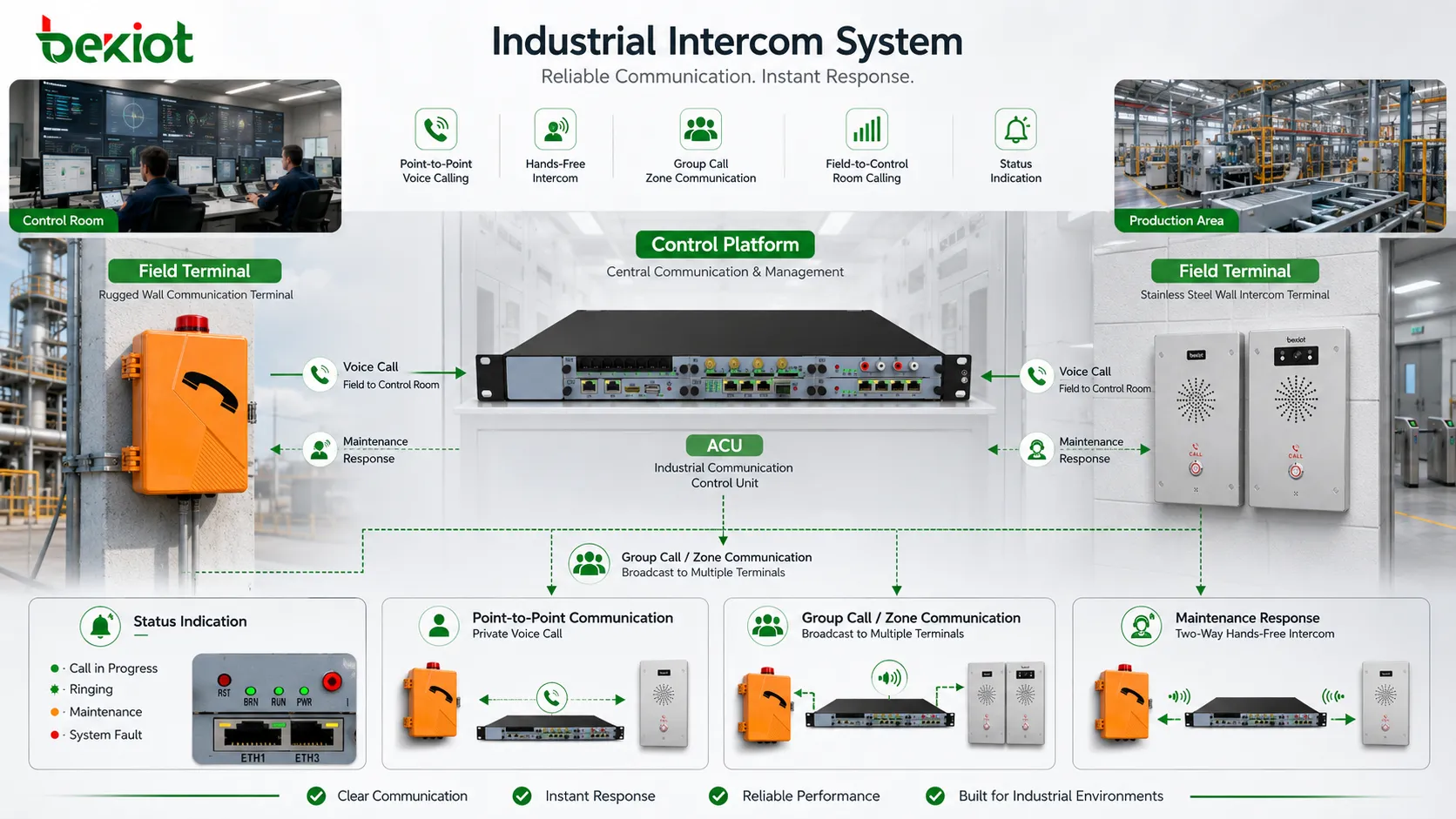
The most basic function is point-to-point voice calling. A worker at a field terminal can call a control room, security desk, maintenance office, dispatch console, or another field station. The call may be initiated by a button, speed dial key, handset action, keypad entry, or software rule depending on the device and platform. This function supports routine coordination such as maintenance requests, equipment status reporting, access confirmation, and service communication.
Another common function is hands-free intercom. In environments where users need both hands for work or where a handset may be inconvenient, hands-free operation allows the user to speak through a built-in microphone and speaker. This is useful at gates, production areas, emergency help points, clean corridors, service windows, and equipment rooms. Hands-free design should still consider background noise, echo, speaker volume, microphone sensitivity, and privacy.
Group calling and zone communication are also important. A control room may need to speak to several intercom points in one area, or a supervisor may need to reach a whole workshop zone. Instead of calling each point one by one, the system can support group announcements or area-based calling. This improves coordination when the message affects more than one location.
Some systems support full-duplex communication, where both sides can speak and listen at the same time, while others use half-duplex or push-to-talk behavior depending on noise level, bandwidth, hardware design, and operating requirements. The selected mode should match the actual environment. Full-duplex is natural for conversations, while push-to-talk may work better in noisy or radio-like coordination scenarios.
Call indication is another practical function. Field terminals may use lights, tones, screen prompts, relay outputs, or platform notifications to show call status. Operators need to know whether the call is ringing, answered, failed, queued, recorded, or disconnected. Without clear status feedback, users may repeat calls or assume the system is not working.
Rugged terminal design and installation reliability
Industrial intercom terminals often need stronger housings, stable mounting structures, protected cable entries, durable buttons, weather-resistant components, and clear user interfaces. The device may be wall-mounted, embedded, pole-mounted, cabinet-mounted, desktop-mounted, or installed inside a protective enclosure. The installation form should match the site risk and user behavior.
For example, a rugged industrial telephone such as the Becke Telcom BT27 can be considered in projects where a fixed voice terminal is required near industrial work areas, outdoor service points, or maintenance zones. In this type of application, the focus is not on decorative appearance but on durability, stable voice access, and practical installation close to the point of use.
Mounting reliability is essential. A terminal may be pressed, pulled, cleaned, exposed to vibration, or contacted by equipment. Screws, brackets, back boxes, cable glands, and wall structures should be selected according to the device weight and usage force. A strong terminal installed on a weak wall or thin panel may still become unstable over time.
Cable protection is equally important. Power, network, signal, audio, and control cables should be routed with proper strain relief, labeling, bending radius, and protection from water or mechanical damage. Many communication faults are caused not by the terminal electronics but by loose cables, poor connectors, water entry, wrong grounding, or undocumented wiring changes.
Installation height should match the user group and operating method. A handset device, call button, microphone, speaker, or display must be placed where users can operate it safely and naturally. Emergency terminals should be visible and accessible. Maintenance-only devices may be installed differently from public help points. The installation should be planned from the user’s actual position, not only from drawing convenience.
Fast calling and emergency access
One of the strongest features of an industrial intercom system is fast access to help. In many field environments, users should not need to search through menus, dial long numbers, or remember complex procedures. A single button, fixed speed dial, hotline rule, or auto-answer path can connect the user to the right destination quickly.
Emergency calling is different from ordinary communication. The caller may be under stress, injured, unfamiliar with the site, or unable to explain the location clearly. The system should help by associating each terminal with a known location, device name, zone, or alarm identity. When the call arrives at the control room or security desk, the operator should know where the call came from.
A wall-mounted intercom device such as the Becke Telcom BHP-SOS series can be used as an example of a fixed help point for sites that need visible emergency calling, visitor assistance, or security communication. In such deployments, the value comes from combining a physical call point with a clear response workflow: press, connect, identify location, speak, and dispatch help if needed.
Emergency access may also require priority handling. A call from an emergency help point should not be treated the same as a routine internal call. The system may route it to a security desk, duty phone, control room, or emergency group. It may trigger a visual alarm, record the conversation, open a video view, activate a relay, or create an event log depending on integration design.
Fast calling must be tested in the real environment. The button should work, the audio should be clear, the destination should answer, the location should appear correctly, and the fallback path should be known if the first destination is busy or unavailable. A help point that has not been tested is only an installed device, not a reliable emergency communication channel.
Control room coordination and dispatch response
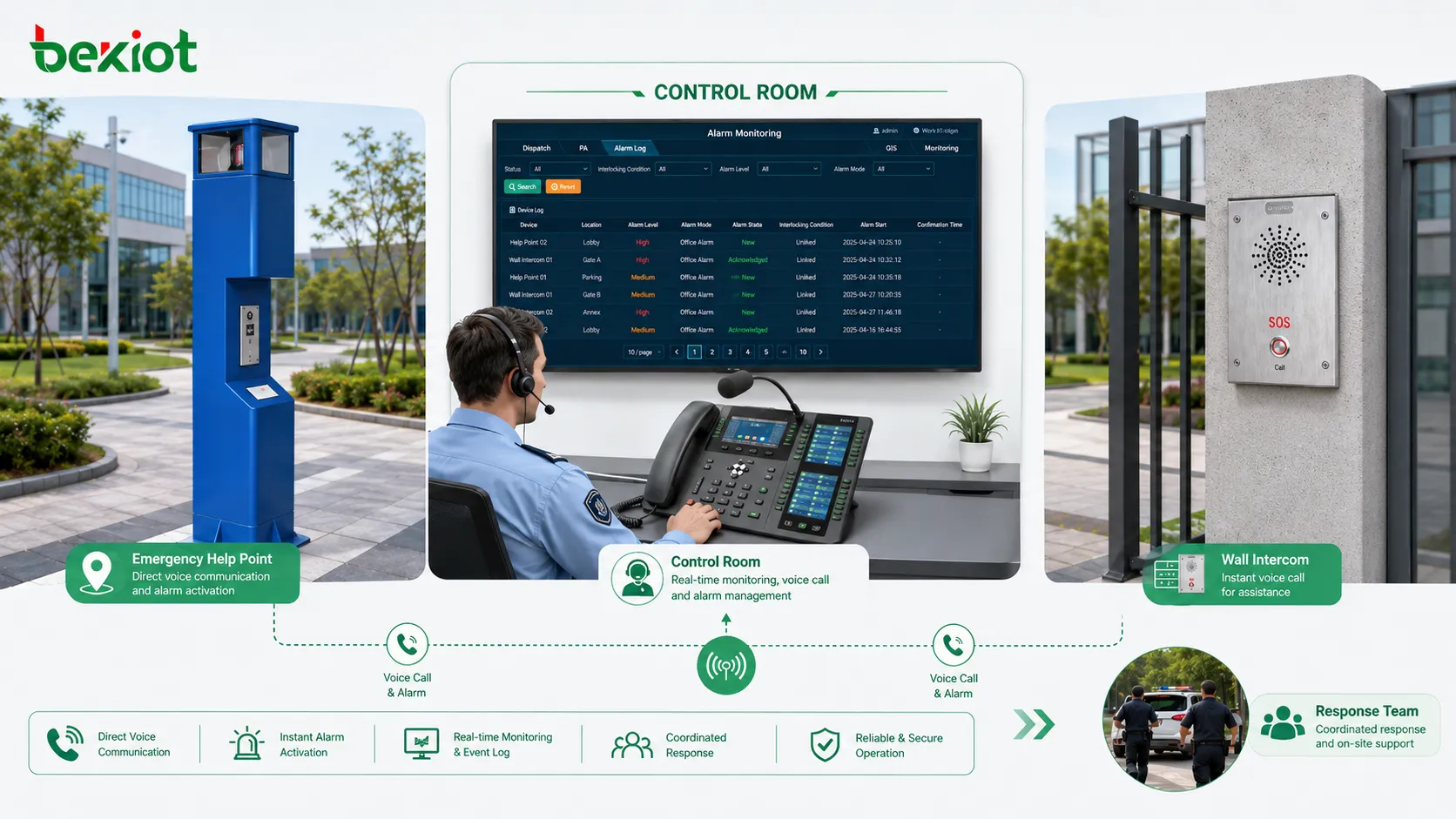
Industrial intercom systems often connect field points to a central control room or dispatch desk. The control room may supervise production, safety, utilities, security, transport movement, access, alarms, and maintenance activities. Intercom communication gives operators a direct voice channel to the field when data screens or alarms are not enough.
When a field worker calls from a terminal, the operator can ask for details, confirm the situation, provide instructions, or coordinate support. When the control room needs to contact the field, it can call a specific intercom point, page a zone, or speak through a speaker terminal. This creates a two-way operational loop between monitoring and action.
The dispatch value becomes clear during abnormal events. An alarm may show that equipment has stopped, but voice communication helps confirm what happened. A camera may show movement near a gate, but an intercom call can verify intent. A sensor may report a fault, but the maintenance worker can explain whether it is a real failure, a test, or a local condition.
In complex sites, control room operators may need call queues, priority display, location mapping, recording, call history, status monitoring, and integration with video or alarm systems. The intercom system should help operators manage several field communication points without losing context. A call should not arrive as an anonymous ring; it should carry useful operational information.
Dispatch response also depends on role rules. A security-related call may go to the security desk first. A maintenance call may go to engineering. An emergency call may go to the control room and duty supervisor at the same time. Routing should match responsibility rather than simply connect every call to one overloaded operator.
Noise handling and audio intelligibility
Industrial environments are often noisy. Machines, motors, fans, pumps, vehicles, tools, alarms, conveyors, air compressors, ventilation systems, and public activity can all reduce voice clarity. A powerful intercom system must therefore focus not only on connection but also on intelligibility.
Audio intelligibility begins with device placement. A terminal installed directly beside a loud machine may be hard to use even if its speaker is powerful. A microphone facing a noisy airflow may pick up background noise. A speaker mounted in a reflective corner may create echo. Installation should consider acoustic conditions, not only wiring convenience.
Hardware design also matters. Industrial terminals may use stronger speakers, protected microphones, noise-reducing structures, handset options, full-duplex echo control, or push-to-talk modes. In very noisy areas, a handset may provide better listening privacy and clarity than open hands-free audio. In other areas, hands-free may be more convenient.
Volume should be adjusted by site condition. Too low, and the user cannot hear. Too high, and the audio may distort or disturb nearby work. Some systems may support adjustable gain, speaker volume profiles, or different device types for different zones. Audio planning should be tested with actual background noise.
In safety-related environments, intercom may need to work together with visual indicators, flashing lights, screens, sirens, public address systems, or radio communication. Voice is important, but it should be part of a complete notification and response method when the environment is extremely noisy or when users wear hearing protection.
Integration with alarms, access, video, and public address
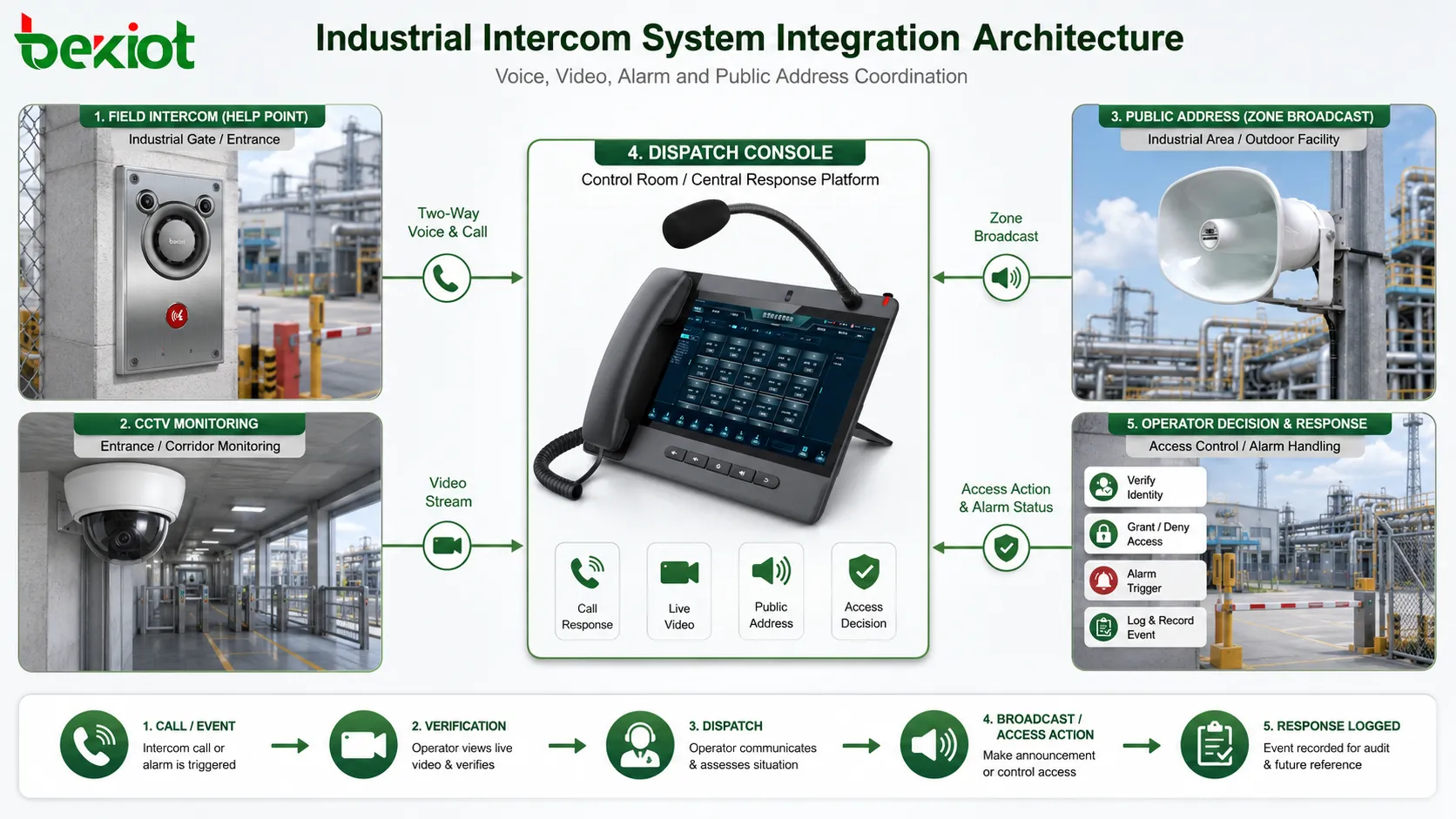
One reason industrial intercom systems are widely used is that they can become part of a larger site communication and safety architecture. Intercom points may connect with alarm systems, access control, CCTV, public address, dispatch platforms, building management systems, fire alarm interfaces, or industrial monitoring platforms.
Access control integration is common at gates, doors, restricted rooms, parking entrances, and service areas. A visitor or field worker can call the control room through an intercom point. The operator can speak with the person, check identity, view a camera if available, and decide whether to open a door or dispatch staff. This improves both security and service efficiency.
Video integration gives operators visual context. When an intercom call comes from a tunnel entrance, gate, platform, or machine area, a linked camera can help the operator understand the situation faster. Voice provides explanation; video provides confirmation. Together they reduce guesswork.
Public address integration allows the system to move from one-to-one communication to wider announcement. If a field call reveals a safety issue, the operator may need to broadcast a warning to a zone. If an emergency call arrives from a help point, the system may trigger an announcement, alarm tone, or evacuation instruction. This connection between intercom and paging improves response coordination.
Alarm integration should be planned carefully. Not every intercom event should trigger a major alarm. Not every alarm should open a voice channel. The system should define event types, trigger conditions, routing rules, priority levels, and reset procedures. Integration is useful only when it supports a clear workflow.
Special applications in factories and production lines
Factories use industrial intercom systems to support production coordination, equipment maintenance, safety communication, quality inspection, and shift handover. A production line may need quick contact with the control room when a machine stops, material is delayed, a process parameter changes, or a safety issue appears.
In large production areas, workers may not be able to leave their positions to make a phone call. A fixed intercom terminal near the line allows them to contact maintenance or supervision quickly. This reduces downtime because information reaches the responsible team sooner. It also reduces informal communication errors because the call comes from a known location.
Intercom can also support maintenance dispatch. A technician in a utility room may call the engineering office to confirm a breaker status. A worker near a conveyor may report abnormal sound. A supervisor may call a machine station to give temporary instructions. These small voice interactions can prevent delays and misunderstandings during daily operation.
Production areas may need different terminal types. Some zones may use handset phones for clarity. Some may use hands-free intercoms for quick calls. Some may use emergency call points. Some may use paging speakers for announcements. The system design should match the task at each location rather than force one device type everywhere.
Special applications in tunnels, transportation, and infrastructure
Tunnels, railway stations, metro systems, airports, ports, highway facilities, bridges, and underground passages often require fixed communication points because mobile coverage may be unstable and public movement may be complex. Intercom terminals can provide direct contact between field points and the operation center.
In tunnels, intercom systems may be installed near emergency exits, cross passages, equipment rooms, evacuation routes, maintenance points, and service niches. If a user or maintenance worker needs help, the call point provides a known location and a direct path to operators. The operator can give instructions, coordinate rescue, or connect with public address and monitoring systems.
Transport stations use intercom for passenger help, platform communication, gate support, staff coordination, elevator assistance, parking management, and security response. The intercom point should be easy to identify, durable enough for public use, and integrated with the facility’s response workflow.
Infrastructure projects often extend across long distances. A centralized control room may need to communicate with many distributed points. Fixed intercom devices reduce reliance on personal mobile devices and provide a more structured channel for operational communication. This is important when location identification and response accountability matter.
Special applications in energy and utility sites
Power plants, substations, renewable energy sites, water treatment plants, pumping stations, district heating systems, oil and gas facilities, and pipeline stations often operate with distributed equipment and strict safety procedures. Communication must support maintenance, inspection, emergency handling, and remote operation.
In these environments, intercom terminals may be installed at control gates, switch rooms, pump rooms, chemical dosing areas, outdoor yards, hazardous areas, and unmanned stations. A worker can contact the control room before entering a restricted area, while operators can verify field status before authorizing work.
Utility sites often involve high consequence operations. A miscommunication during switching, maintenance, isolation, startup, shutdown, or chemical handling can create safety risks. A fixed industrial intercom provides a dedicated communication point that can be included in procedures and inspection plans.
Some energy and utility environments may also require special device protection such as explosion protection, corrosion resistance, weatherproofing, or high visibility. The device and installation method should be selected according to the actual hazard, environmental exposure, and applicable project requirements.
Special applications in warehouses and logistics facilities
Warehouses and logistics facilities use intercom systems for loading coordination, gate communication, dispatch instructions, security checks, equipment support, and emergency response. These sites often include large spaces, moving vehicles, high racks, loading docks, parking areas, and multiple access points.
A fixed intercom at a loading dock can connect drivers, warehouse staff, and dispatchers. A gate intercom can help security staff verify arrivals. A service point near a conveyor or sorting area can support maintenance calls. A help point in a parking or yard area can improve safety and visitor support.
Because logistics sites are noisy and fast-moving, device placement should avoid vehicle impact and support clear communication. Wall-mounted or protected terminals may be needed near docks, gates, and equipment zones. The interface should be simple because users may be temporary drivers, contractors, or staff working under time pressure.
Intercom systems can also reduce radio traffic. Instead of using open radio channels for every local request, certain fixed locations can communicate through intercom points. This helps organize communication by location and function.
Special applications in security and public facilities
Security and public facility environments use intercom systems for visitor assistance, help points, gate communication, emergency calling, parking support, elevator assistance, campus safety, building management, and public service coordination. These applications often involve users who are not trained employees, so the interface must be intuitive.
A public help point should clearly show what it does. Users should know where to press, where to speak, and what to expect after calling. If the point connects to a security desk, the operator should see the location and, if available, related camera information. This improves response and reduces confusion.
Parking areas, campuses, hospitals, commercial complexes, office parks, stadiums, and government buildings may all use intercom points to improve service and safety. A visitor who cannot enter a gate, a driver needing help at a barrier, a person in distress, or a staff member reporting an incident can use the fixed point to reach support.
In these environments, durability and misuse prevention are important. Public terminals may face weather, vandalism, heavy use, and accidental impact. A wall-mounted intercom device such as the BHP-SOS series can be planned where a visible and fixed help point is required, while the final selection should still consider installation position, environmental exposure, response workflow, and maintenance policy.
Architecture choices for different project scales
Industrial intercom systems can be designed in different architectures. A small site may use several terminals connected to a local controller or PBX. A large facility may use a centralized platform with many field endpoints, paging zones, recording servers, dispatch consoles, and integration interfaces. A multi-site organization may connect intercom points across several buildings or remote stations.
Analog architectures may be simple and stable for certain local audio applications, but they can be less flexible when many locations, routing rules, or integrations are needed. IP-based architectures are more scalable and easier to integrate with network management, SIP communication, software platforms, recording, and remote maintenance. The choice depends on project needs, existing infrastructure, budget, reliability requirements, and technical capacity.
Hybrid systems are also common. A site may use IP intercom devices in new areas while connecting existing analog speaker or call systems through gateways. This allows gradual modernization without replacing everything at once. The design should define which functions remain local and which are managed centrally.
Architecture should also consider failure behavior. If the central platform fails, can local calls still work? If the network link to a remote site is interrupted, can emergency calls still reach a local duty point? If power fails, which terminals remain available? System architecture should not only focus on normal operation but also on degraded operation.
Network and power requirements
For IP-based industrial intercom systems, network quality directly affects voice performance. Delay, packet loss, jitter, bandwidth limitation, VLAN configuration, firewall rules, multicast support, SIP registration, and routing design can all influence whether calls connect and whether audio remains clear.
Voice traffic should be treated as real-time traffic. If it shares a network with video, production data, file transfers, backups, or guest internet traffic, quality of service planning may be necessary. Poor network design can create choppy audio, delayed calls, registration loss, or failed paging.
Power planning is equally important. Some terminals may use PoE, local DC power, or dedicated power supplies. Emergency communication points may require backup power or connection to a protected circuit. The design should define what happens during a local power failure and which communication points must remain active.
Outdoor or remote devices may need surge protection, grounding, cable shielding, and weather-resistant cable entry. Industrial sites may have electrical noise, lightning exposure, long cable runs, and grounding differences. These conditions should be considered during installation, not after faults appear.
Management, monitoring, and maintenance
A large industrial intercom system should be manageable. Administrators need to know which devices are online, which calls were made, which terminals failed, which users have permission, and whether audio paths are working. Without management visibility, the system may appear functional until a critical call fails.
Monitoring may include device online status, SIP registration, network reachability, power status, button events, call logs, fault alarms, relay status, recording status, and integration events. The available functions depend on the platform and device capability. Critical points should receive more attention than ordinary service points.
Routine maintenance should include visual inspection, function testing, audio quality checks, cable inspection, button operation, microphone and speaker testing, seal condition, label condition, and log review. Emergency points should be tested according to site procedures. A help point that is never tested may fail silently.
Configuration management is also important. Device names, numbers, locations, routing rules, permissions, groups, priorities, and integration settings should be documented. When a terminal is moved or replaced, records should be updated. Good documentation reduces troubleshooting time and helps new staff understand the system.
Security and access control considerations
Industrial intercom systems should not be left without access control. If anyone can broadcast, call restricted areas, open doors, trigger relays, or change routing rules, the system may become a security risk. Permissions should match user roles and operational responsibility.
Field terminals may be public, semi-public, or restricted. A public help point should allow users to call for assistance but should not allow unauthorized control of internal systems. A staff terminal may allow more functions. A control room console may have high authority. These roles should be separated.
Network security should also be considered. IP intercom devices may have web management pages, SIP accounts, firmware interfaces, API functions, or remote access paths. Default passwords, exposed management ports, weak authentication, and uncontrolled remote access can create vulnerabilities. Device hardening should be part of deployment.
For sensitive environments, call recording, audit logs, encryption, network segmentation, firewall rules, and account management may be required. Security does not mean making the system difficult to use. It means ensuring that the right people can use the right functions while limiting misuse and unauthorized changes.
Design mistakes that reduce system value
One common mistake is treating industrial intercom as a collection of devices rather than a communication workflow. Installing terminals at several locations does not guarantee that calls will reach the right team, be answered in time, or create useful response records. Routing, responsibility, and operation rules must be defined.
Another mistake is poor location planning. A terminal installed where it is easy to cable may not be where users actually need it. Communication points should follow work areas, risk points, access routes, emergency paths, and service locations. Field walking and user interviews are often necessary before final placement.
Audio testing is often insufficient. A device may sound clear in a quiet room but fail beside machinery or in a reverberant tunnel. Testing should happen in the real environment with normal background noise. Speaker level, microphone pickup, echo, and user behavior should be checked.
Overly complex operation is another problem. If a worker must remember several codes or press many buttons during an urgent event, the system is not practical. Critical functions should be simple, visible, and consistent.
Finally, maintenance is sometimes ignored. Devices may become dirty, blocked, offline, damaged, or misconfigured over time. Without periodic testing and monitoring, the system may lose reliability gradually. Industrial communication systems should be maintained as operational infrastructure, not as passive accessories.
How to evaluate a suitable solution
A suitable industrial intercom system should be evaluated by field usability, not only by feature quantity. The first question is whether users can reach the system quickly from the locations where communication is needed. The second question is whether the call reaches the correct operator, desk, team, or system. The third question is whether both sides can hear each other clearly under real environmental conditions.
The system should also support the required response workflow. If a call comes from an emergency point, the operator should know the location. If the call requires dispatch, the system should help connect or notify the responsible team. If the site needs recording or event review, logs and recordings should be available. If the system connects with access, video, alarm, or public address, integration behavior should be tested.
Terminal selection should match the site. A rugged industrial telephone such as BT27 may fit areas that need fixed voice calling and durable installation. A BHP-SOS wall-mounted intercom point may fit help-point or emergency-call scenarios. Other areas may need hands-free terminals, explosion-proof equipment, paging speakers, consoles, or software clients. The best system may use several terminal types rather than one device everywhere.
Reliability should be evaluated across the whole path. Device, cable, network, power, platform, routing, operator response, and maintenance process all affect final performance. A strong device connected through a weak network or poorly managed route may still fail. A well-designed industrial intercom system treats communication as an end-to-end service.
Final Notes
An industrial intercom system is valuable because it provides dependable voice communication where ordinary office or consumer communication tools are not enough. Its features include rugged terminals, fast calling, emergency access, control room coordination, group communication, noise-aware audio design, system integration, monitoring, recording, and role-based operation.
Its special applications cover factories, tunnels, energy sites, utilities, warehouses, logistics facilities, transport infrastructure, public help points, security areas, and large facility management. In these environments, communication must be fixed, visible, reliable, and connected to real response procedures.
The key to success is matching device, location, architecture, routing, audio quality, power, network, permissions, and maintenance with the site’s actual workflow. When products such as BT27 industrial telephones and BHP-SOS wall-mounted intercom points are applied as part of a planned system rather than isolated terminals, they can support safer field communication and more efficient operational response.
FAQ
What makes an industrial intercom system different from an ordinary phone system?
An industrial intercom system is designed for field communication under harsh or complex conditions. It usually focuses on rugged terminals, fixed locations, fast calling, emergency access, control room response, audio clarity, and integration with alarms, access control, video, or paging systems.
Where should industrial intercom terminals be installed?
They should be installed near real communication needs, such as production lines, gates, loading docks, tunnels, machine rooms, emergency exits, service corridors, utility rooms, parking areas, guard posts, and control points. Placement should follow workflow and risk, not only cable convenience.
Can an industrial intercom system support emergency communication?
Yes, if it is designed for that purpose. Emergency use requires visible call points, clear routing, location identification, reliable power, tested audio, priority handling, monitoring, and defined response procedures. A device alone is not enough without the workflow behind it.
Why is audio testing important before handover?
Industrial environments may have machinery noise, echo, airflow, vehicle movement, or outdoor sound interference. Audio that is clear in a quiet office may be unclear in the field. Testing should confirm real speaking and listening quality at the actual installation location.
How should the system be maintained after deployment?
Maintenance should include device inspection, button testing, microphone and speaker checks, cable and seal inspection, network and registration status review, call routing verification, log review, and periodic emergency-point testing. Records should be updated when devices or routes change.







