


CFU is the call forwarding rule that does not wait.
Before the phone rings, before the user becomes busy, before a no-answer timer expires, the system already knows where the call should go. This is why Call Forwarding Unconditional is simple on the surface but important in real telephony operation: it changes the first routing decision of an incoming call.
The direct meaning of unconditional forwarding
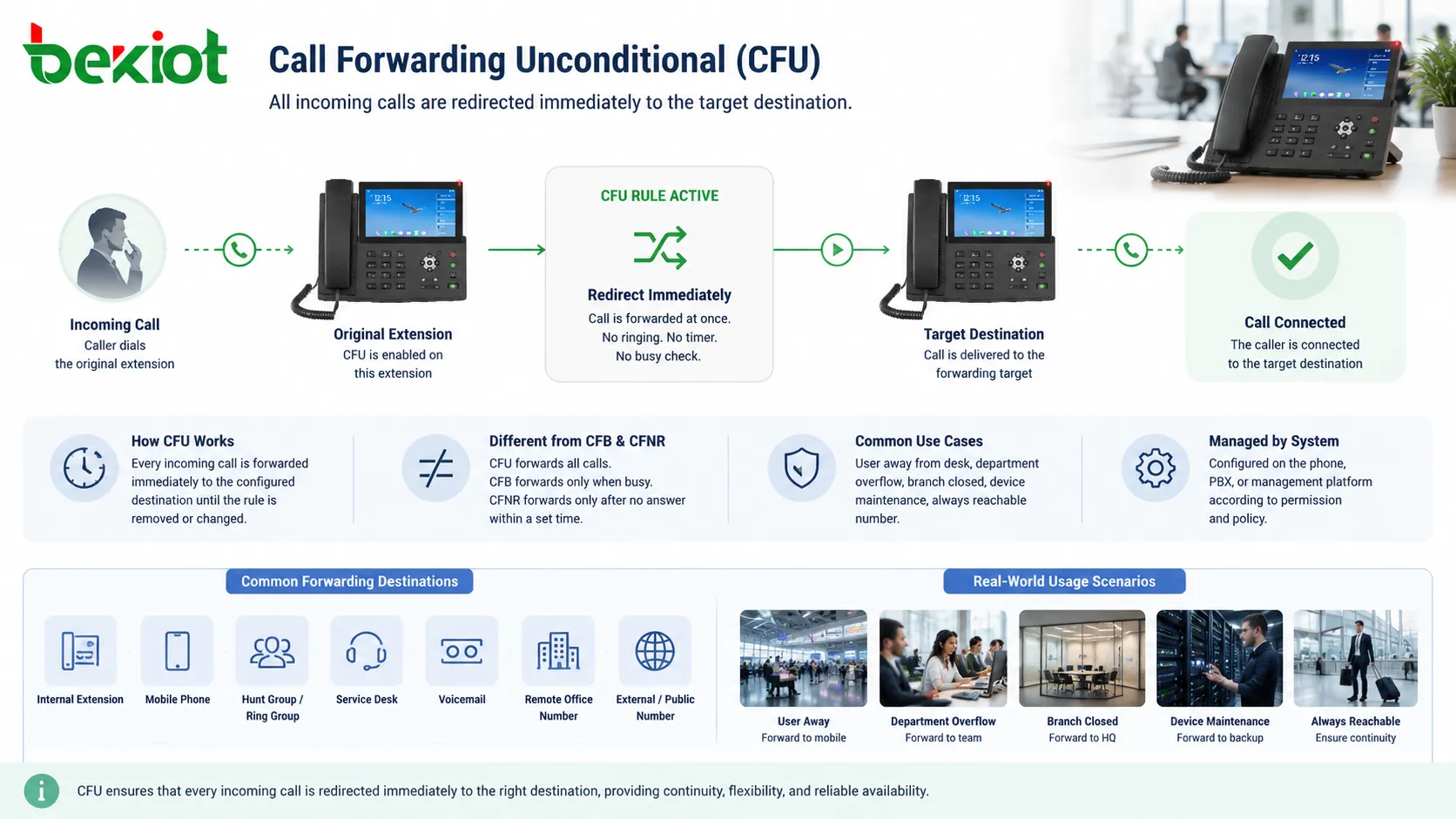
Call Forwarding Unconditional, commonly abbreviated as CFU, is a telephony feature that redirects all incoming calls from one number or extension to another destination immediately. The destination may be another internal extension, a mobile phone, a service desk, a hunt group, a voicemail box, a remote office number, or an external public telephone number, depending on system policy.
The word “unconditional” is the key. CFU does not depend on whether the original extension is busy, unanswered, offline, or unavailable. As soon as the call reaches the number with CFU enabled, the forwarding rule takes effect. The caller may never hear the original phone ring because the system redirects the call before that stage.
This makes CFU different from Call Forwarding Busy and Call Forwarding No Answer. CFB works only when the original line is busy. CFNR works only after the call is not answered within a defined time. CFU is more absolute. It says: every incoming call should go somewhere else until the rule is removed or changed.
Because of this behavior, CFU is often used when a user is away from the desk, when a department wants calls handled by another team temporarily, when a branch office is closed, when a device is under maintenance, or when a number must remain reachable even though the original endpoint should not answer directly.
Where the forwarding decision is made
CFU can be configured at different points in a communication system. The forwarding decision may be made on a desk phone, inside a PBX, in a hosted voice platform, by a carrier service, or through an application portal. The user experience may look similar, but the technical behavior can be different depending on where the rule is stored and executed.
Phone-side forwarding is usually configured directly on the terminal. A user opens the call settings menu, selects call forwarding, enters the destination number, and enables unconditional forwarding. This method is easy for individual users, but it may depend on whether the phone stays registered and whether the system accepts endpoint-managed forwarding.
PBX-side forwarding is configured on the call server or communication platform. In this case, the rule belongs to the extension profile, not only to the physical phone. Even if the phone is powered off, replaced, or moved, the platform can still forward incoming calls according to the extension rule. For business systems, this is often more controllable.
Carrier-side forwarding is handled by the public network or service provider. It is often used for external numbers, mobile numbers, or hosted voice services. This can be useful when calls must be redirected before they even reach the enterprise PBX. However, carrier-side forwarding may have different activation codes, billing rules, caller ID behavior, and restrictions.
Understanding the decision point is important during troubleshooting. If CFU is configured on the phone, disabling it in the PBX may not solve the issue. If it is configured on the carrier side, the enterprise system may never see the original incoming call. A correct diagnosis starts by identifying where the forwarding rule actually lives.
Common methods for configuration
The most familiar method is configuration through the phone interface. Many IP phones, digital phones, and softphones include a call forwarding menu. The user chooses unconditional forwarding, enters the destination, confirms the setting, and checks whether a forwarding icon or status message appears. This method is suitable for personal temporary forwarding, such as leaving the office for a meeting or working from another location.
Another common method is using feature access codes. In many systems, users can dial a star code or service code to activate, cancel, or query CFU. For example, a user may dial an activation code followed by the destination number, then use another code to cancel forwarding later. The exact codes vary by PBX, carrier, country, and service platform, so they should be documented for the specific system.
Administrative portal configuration is more suitable for organizations. A system administrator can open the extension settings, enable unconditional forwarding, define the destination, apply permissions, and record the reason for the change. This is useful for department numbers, service lines, temporary staff replacement, after-hours routing, or emergency redirection during maintenance.
Some platforms also support user web portals or mobile apps. This gives users self-service control without giving them full administrative access. It can be useful for sales staff, support teams, remote workers, and managers who frequently switch call destinations. The platform can still apply rules such as allowed destinations, external dialing permission, and forwarding restrictions.
In more controlled environments, CFU may be changed only through approval. This prevents users from forwarding important service numbers to unverified destinations. For example, a reception line, emergency contact number, customer service queue, or public-facing department number should not be redirected casually without operational awareness.
Number format and destination planning
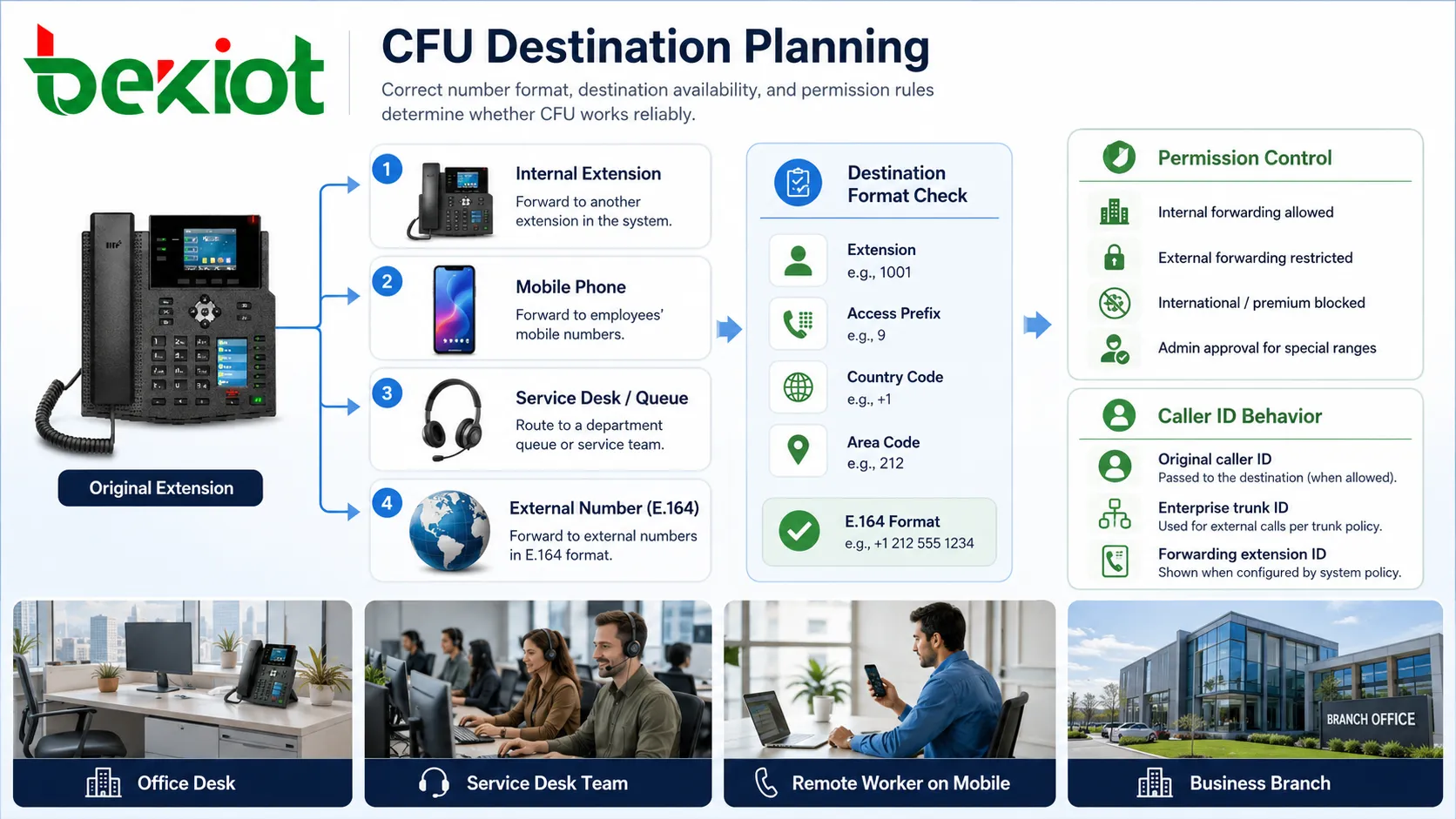
A CFU rule is only useful if the destination is written in a format the system can route correctly. Internal destinations may be short extensions. External destinations may need an access prefix, country code, area code, or normalized E.164 format. If the number format is wrong, calls may fail silently, route to the wrong place, or be rejected by outbound rules.
Destination planning should also consider whether the forwarded number is always available. Forwarding an important office extension to a mobile phone may seem convenient, but the mobile phone could be out of coverage, powered off, or answered by the wrong person. Forwarding to a group, queue, or service desk may provide better continuity when the call volume is unpredictable.
Permission control matters as well. Not every user should be able to forward calls to international numbers, premium numbers, or personal external destinations. A poorly controlled CFU rule can create billing risk or security risk. Many organizations restrict external forwarding or require administrator approval for certain number ranges.
Caller ID behavior should be considered before deployment. Some systems send the original caller’s number to the forwarding destination. Others send the enterprise trunk number or the forwarding extension number. This affects whether the receiver can recognize the caller, call back correctly, or distinguish forwarded business calls from direct personal calls.
Applications in personal mobility
CFU is often used to keep users reachable when they are away from their normal endpoint. A manager may forward desk calls to a mobile phone during travel. A technician may redirect calls to a temporary workstation. A remote employee may forward an office extension to a softphone or home office number. In these cases, CFU reduces missed calls and keeps the user’s primary number useful.
The advantage is simplicity. Callers continue to dial the known number. They do not need to remember a temporary contact. The user does not need to publish multiple numbers for every working condition. The forwarding rule handles the change behind the scenes.
However, personal mobility should be managed with clear expectations. If a user forwards calls to a mobile phone after working hours, they may receive business calls at inappropriate times. If several people forward to one colleague without notice, that person may become overloaded. CFU improves reachability, but it should not replace thoughtful contact planning.
For personal use, the best practice is to set a clear activation period and cancel the rule when it is no longer needed. Forgotten CFU settings are a common reason for “missing calls” complaints. The call is not lost; it is simply going somewhere the user no longer expects.
Applications in service and department numbers
Department numbers often need CFU more than personal extensions. A reception line, service desk, maintenance office, warehouse contact, security room, or customer support number may need to remain reachable even when the normal answering position changes. CFU allows the organization to redirect calls quickly without changing the public number.
For example, a small service team may forward its main number to another branch during lunch breaks or staff shortage. A reception number may be forwarded to security after office hours. A maintenance number may be forwarded to an on-duty engineer during a shutdown. A temporary project office may forward calls to a central coordinator after the site team leaves.
This is useful because callers do not need to understand internal staffing changes. They dial the same number, while the organization adjusts the answering destination. The public contact remains stable even when internal operations change.
Department-level CFU should usually be administered rather than left to informal user action. Since these numbers affect multiple callers and business processes, changes should be recorded. The destination should be tested, and the team receiving the forwarded calls should know why the calls are arriving.
Use during maintenance, outage, and migration
CFU is also useful during system maintenance and migration. If a phone, gateway, branch device, office area, or call center position is temporarily unavailable, calls can be redirected to another working destination. This allows service continuity while equipment is repaired, replaced, or reconfigured.
During a migration project, old numbers may need to remain reachable while users move to a new system. CFU can help bridge the transition. Calls to a legacy extension may be forwarded to a new SIP extension, service queue, or temporary operator. This avoids forcing all users and customers to change dialing habits at once.
In outage scenarios, CFU can provide a fast workaround if the forwarding rule is still reachable at the platform or carrier level. For example, if a local office phone is down but the central service platform remains active, calls can be forwarded to another site. If the forwarding must happen after the call reaches a failed local PBX, it may not help. This is why the location of the forwarding rule matters.
Maintenance forwarding should be temporary and documented. After the work is completed, the rule should be removed or restored to the normal routing plan. Many call routing problems appear after maintenance because temporary forwarding was not cancelled.
Interaction with other forwarding and routing features
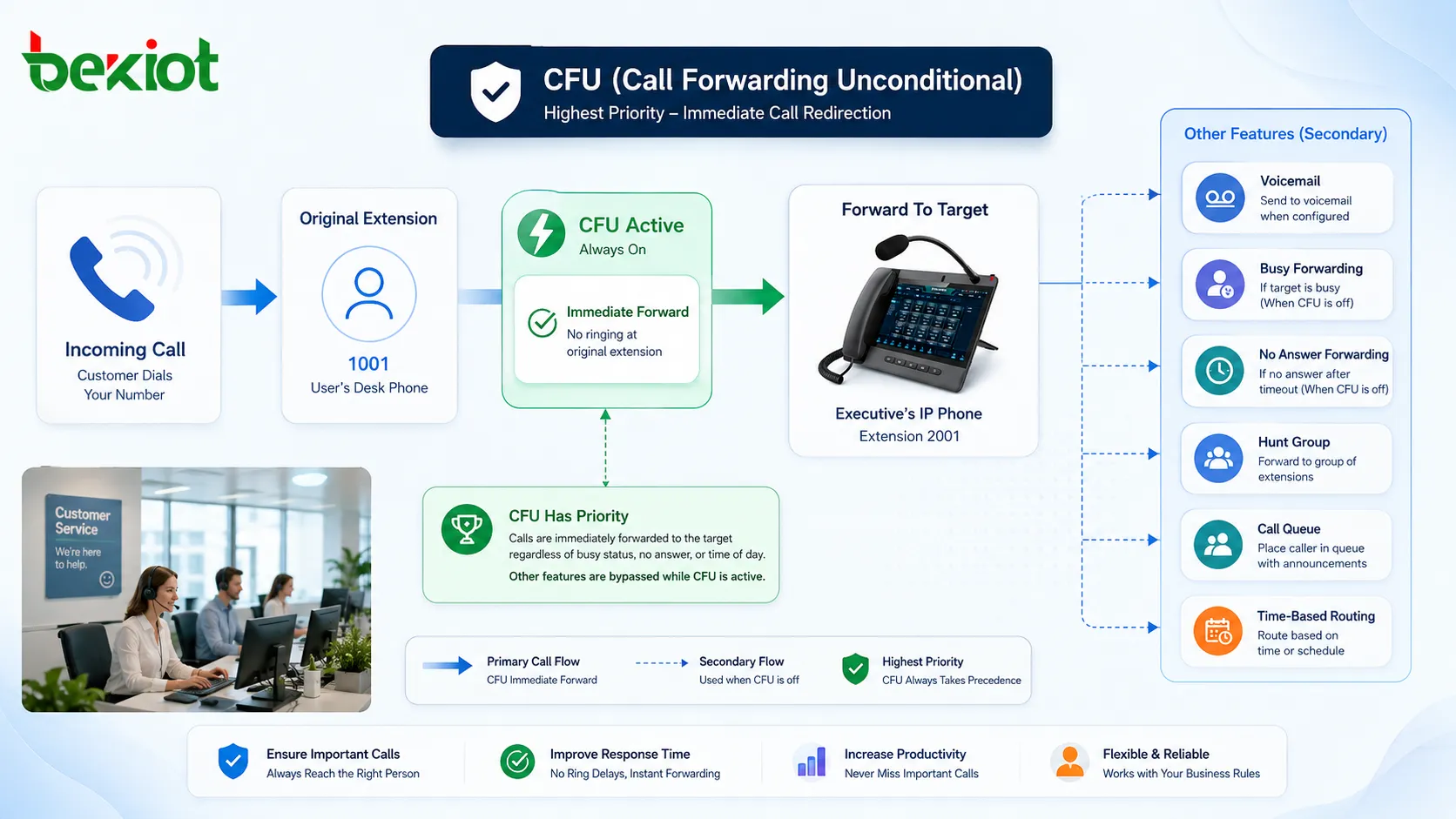
CFU rarely exists alone. It may interact with busy forwarding, no-answer forwarding, voicemail, hunt groups, call queues, simultaneous ringing, do-not-disturb, time-based routing, and call pickup rules. The order in which these features are evaluated determines the final call behavior.
In many systems, CFU has higher priority than busy or no-answer forwarding. This means that once CFU is active, the call may never reach the stage where busy or no-answer conditions are checked. The call goes directly to the unconditional forwarding destination. This can confuse users who expect voicemail or group ringing to remain active.
CFU can also change queue behavior. If a queue member activates CFU on a personal extension, calls routed through the queue may or may not follow that forwarding rule depending on platform design. Some systems ignore personal forwarding for queue calls to protect service logic. Others allow forwarding and may create unexpected call distribution results. This should be tested before use in service environments.
Time-based routing and CFU require careful planning. A department may have business-hours routing, after-hours routing, holiday routing, and emergency routing. If an unconditional forwarding rule is applied on top of these schedules, it may override the intended plan. Administrators should know whether CFU is applied before or after time conditions.
Security and cost considerations
CFU can create risk if users are allowed to forward calls without limits. External forwarding may use outbound trunks, mobile networks, or long-distance routes. If a compromised account activates forwarding to an expensive destination, the organization may face toll fraud. This is why forwarding permissions should be controlled, especially for external and international numbers.
Administrators should define who can activate CFU, which destinations are allowed, whether external forwarding is permitted, and whether certain numbers are blocked. Sensitive numbers such as emergency lines, public service numbers, customer support numbers, and control room contacts may require stricter control than ordinary personal extensions.
Audit logs are useful. The system should record who activated CFU, when it was enabled, which destination was used, and when it was cancelled. These records help troubleshoot routing complaints and investigate suspicious activity. In business environments, unrecorded forwarding changes can create confusion and accountability problems.
Cost planning is also important. A forwarded call may consume two call legs: one inbound leg to the original number and one outbound leg to the forwarding destination. Depending on the network and service provider, this may affect trunk capacity or call charges. High-volume forwarding from a service number to external mobile phones can become expensive if not planned properly.
Testing before relying on CFU
CFU should be tested after configuration, especially for department numbers and important service lines. A simple test call can confirm whether the destination rings, whether caller ID is displayed correctly, whether audio works in both directions, and whether the call returns to voicemail if unanswered. Testing should include both internal and external callers where relevant.
It is also useful to test cancellation. Many operational problems happen not when CFU is enabled, but when the team assumes it has been disabled. The user or administrator should confirm that calls return to the normal destination after cancellation. If the system provides a status display, it should be checked.
For external forwarding, test trunk permission and number format. A call that works from an internal phone may not work as a forwarding destination if the system applies different outbound rules to forwarded calls. Some platforms restrict redirected calls differently from user-initiated calls. Testing prevents surprises during real use.
In service environments, test call volume behavior. A single forwarded call may work, but multiple simultaneous calls may fail if the destination supports only one call or if trunk capacity is limited. For department numbers, forwarding to a group or queue may be better than forwarding to one person.
Operational habits that prevent confusion
CFU is simple enough to enable, which is also why it is easy to forget. Good operational habits help prevent routing confusion. Users should know how to check whether forwarding is active. Administrators should be able to view forwarding status across important extensions. Department forwarding should be recorded when it affects service operation.
Temporary CFU should have a planned end time. For example, a team may forward calls during maintenance from 18:00 to 22:00, or during a holiday period, or until a replacement phone is installed. If the platform supports scheduled forwarding, it should be used. If not, the responsible person should confirm cancellation manually.
Labels and communication matter. When calls are forwarded to another team, that team should be informed. Otherwise, they may answer calls without context or assume the calls are wrong. For public-facing numbers, internal notification is part of service continuity.
For larger systems, periodic review helps. Administrators can check active CFU rules weekly or monthly, especially on service numbers, management extensions, and external forwarding destinations. Old or unexplained forwarding rules should be removed after confirmation.
When CFU is not the best choice
CFU is useful, but it is not always the best routing method. If calls should first ring the original phone and then move elsewhere only when unanswered, Call Forwarding No Answer is more suitable. If calls should be redirected only when the user is already on another call, Call Forwarding Busy is better. If several people should answer together, a hunt group, call queue, or simultaneous ringing feature may be more appropriate.
For customer service, forwarding all calls to one mobile phone may create a bottleneck. A queue with multiple agents, overflow routing, and reporting may provide better service control. For emergency or security numbers, unconditional forwarding should be used carefully because it may bypass the intended control room or recording system.
For after-hours service, time-based routing is often cleaner than manual CFU. It can automatically send calls to night service, voicemail, duty staff, or an external answering service based on schedule. CFU may still be used as a temporary override, but it should not replace a well-designed routing plan.
The practical question is whether every call should always be redirected immediately. If the answer is yes, CFU is suitable. If the answer depends on time, user status, call type, or service load, another routing method may provide better control.
FAQ
What is the main difference between CFU and call forwarding no answer?
CFU redirects every incoming call immediately. Call forwarding no answer redirects only after the original destination rings for a defined time and does not answer. CFU is immediate, while no-answer forwarding is conditional.
Can CFU forward calls to an external mobile number?
Yes, many systems allow this, but it depends on outbound permissions, number format, trunk policy, and administrator settings. External forwarding should be controlled to avoid cost and security risks.
Why does my phone not ring after CFU is enabled?
That is normal behavior. With CFU active, the call is redirected before the original phone rings. The original device may show a forwarding status, but it usually will not receive the incoming call directly.
Can CFU affect voicemail?
Yes. If CFU is active, the call may be sent to the forwarding destination before voicemail rules on the original extension are reached. The final voicemail behavior depends on the destination and system routing order.
What should be checked when CFU does not work?
Check whether the forwarding rule is active, whether the destination number format is correct, whether external forwarding is allowed, whether trunk access is available, whether another routing rule overrides the setting, and whether the forwarding destination can receive calls.







