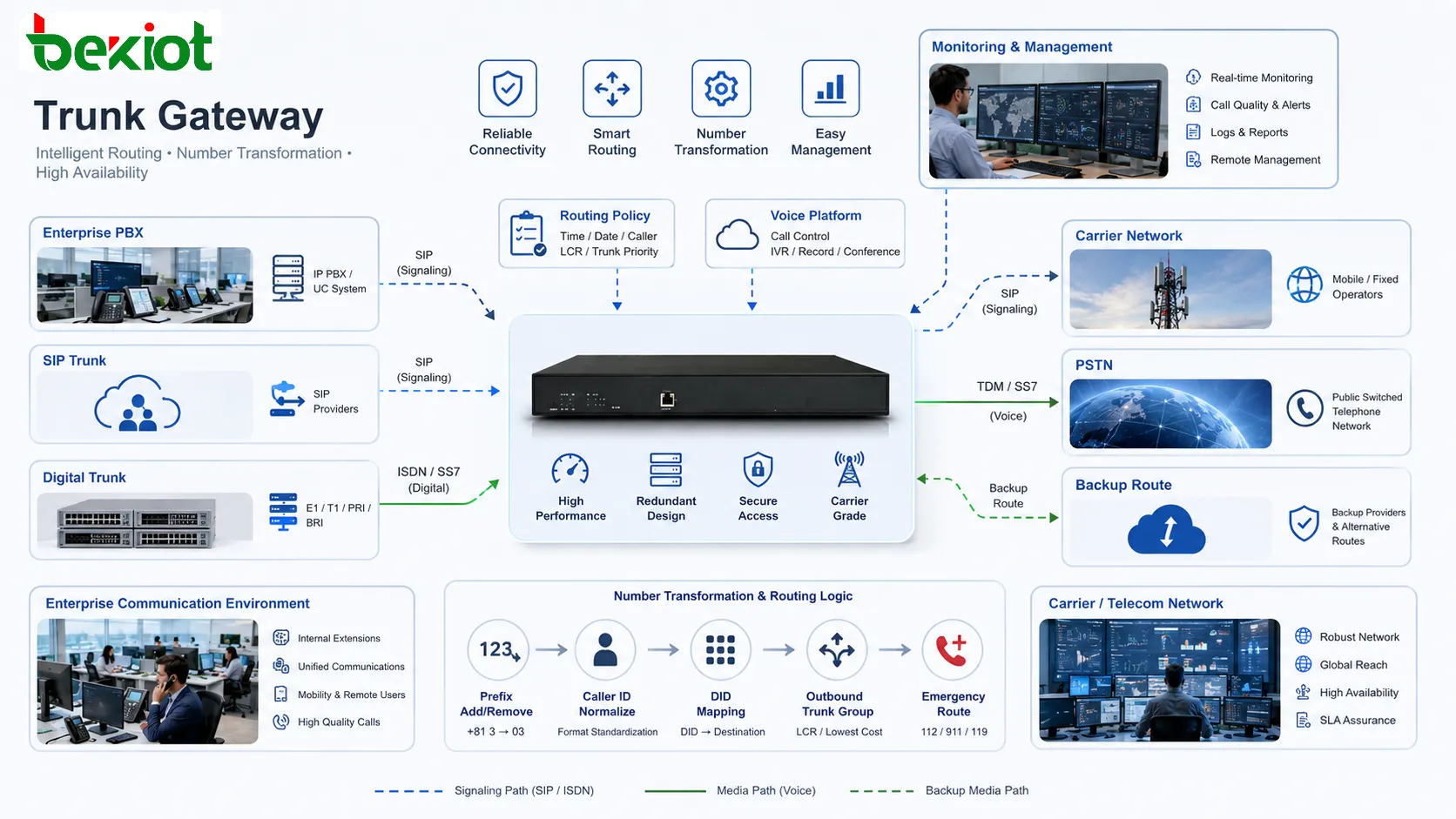
A trunk gateway is not simply a voice interface device placed between two communication systems. Its network architecture is unique because it often handles high-capacity voice paths, carrier-facing trunks, PBX interconnection, legacy digital circuits, SIP trunk access, number routing, media conversion, call admission, and service continuity at the same time. In many projects, the trunk gateway becomes the boundary between an internal communication network and an external or legacy voice network.
Unlike a small access gateway that mainly connects individual analog phones or endpoints, a trunk gateway is usually responsible for trunk-level traffic. It may connect an IP PBX to PSTN lines, bridge E1/T1 or PRI circuits into a SIP platform, interconnect branch PBX systems, provide SIP trunk access to a carrier, or act as a migration bridge between traditional telephony and modern IP voice. Its architecture must therefore consider signaling, media, numbering, synchronization, security, QoS, redundancy, and operation management as one complete design.
What makes trunk gateway architecture different
Trunk-level traffic concentration
The first difference is traffic concentration. A trunk gateway usually carries many simultaneous calls through trunk groups rather than supporting only one or two endpoints. A digital trunk may carry multiple voice channels, and a SIP trunk may support many concurrent sessions. Because of this concentration, a trunk gateway failure can affect many users, departments, or sites at once.
This requires stronger capacity planning. Engineers need to estimate peak call volume, external call ratio, emergency call demand, branch-to-branch traffic, fax use, recording needs, and future expansion. A trunk gateway should not be selected or placed only according to the number of physical ports; its concurrent call capacity and processing ability also matter.
Boundary between networks
A trunk gateway often sits at the boundary between different voice domains. One side may be an enterprise PBX or unified communication platform, while the other side may be a carrier SIP trunk, PSTN circuit, legacy PBX, private voice network, or digital trunk interface. This boundary role makes architecture design more sensitive.
The gateway must decide what traffic can pass, how calls are routed, which numbers are accepted, how caller ID is presented, how emergency calls are handled, and how external access is protected. If this boundary is not clearly designed, the network may face wrong routing, toll fraud, service exposure, or difficult troubleshooting.
Signaling and media separation
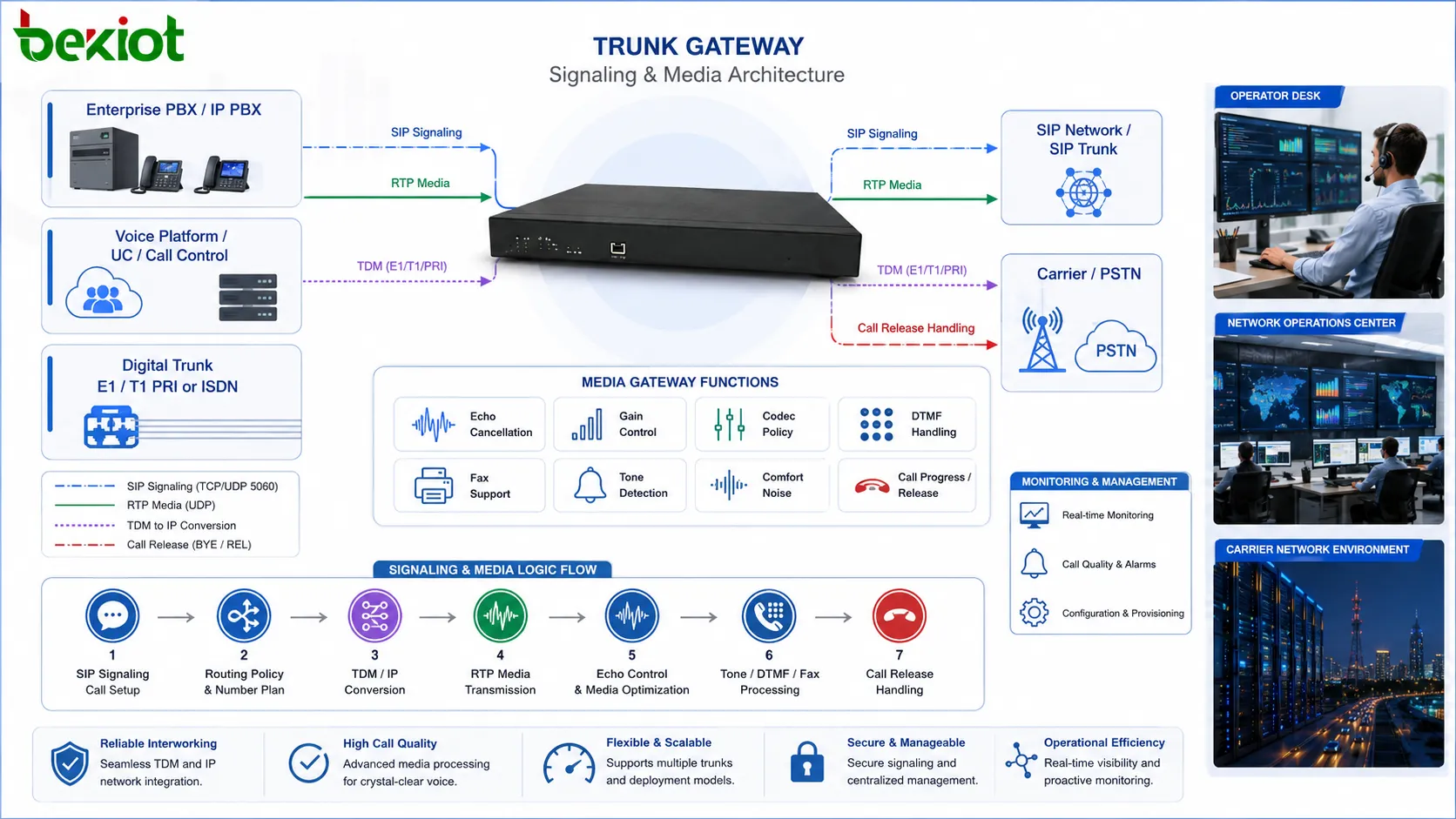
Trunk gateway architecture must handle both signaling and media. Signaling controls call setup, ringing, answer, transfer, release, number delivery, and service messages. Media carries the actual voice packets or voice channels. These two paths may follow different processing logic.
For SIP trunks, signaling may pass between PBX, gateway, SBC, and carrier, while RTP media may be anchored, proxied, relayed, or sent directly depending on the architecture. For digital trunks, signaling and bearer channels may be carried inside the trunk interface and then converted to SIP or another IP signaling form. A stable design must define both control path and audio path.
Number routing as a core function
A trunk gateway usually performs number transformation and routing. It may add or remove prefixes, normalize caller ID, map DID numbers to extensions, route outbound calls to trunk groups, select backup routes, handle emergency numbers, and convert between legacy numbering plans and SIP-based addressing.
This makes the gateway part of the call policy layer. A wrong digit rule can block important calls, send calls to the wrong trunk, expose expensive routes, or break inbound direct dialing. Number routing must be treated as a design task, not as a minor configuration detail.
Core architecture layers
Trunk access layer
The trunk access layer is where the gateway connects to external or legacy voice resources. This may include SIP trunks, E1/T1 lines, PRI circuits, CAS trunks, legacy PBX trunks, carrier voice links, or private trunk networks. This layer determines how calls enter and leave the gateway.
Design at this layer should consider trunk type, channel count, physical interface, clock source, framing, signaling mode, carrier requirements, route ownership, and service level. For SIP trunks, IP reachability, authentication, registration or peer mode, and media port ranges matter. For digital trunks, timing and signaling compatibility are critical.
Voice control layer
The voice control layer manages call logic. It may include SIP proxy behavior, gateway routing, call admission control, digit manipulation, caller ID rules, trunk group selection, failover routing, disconnect supervision, and protocol conversion. This layer decides how the gateway reacts when a call arrives.
A strong control layer prevents trunk resources from becoming chaotic. It defines which calls are accepted, which routes are preferred, which routes are blocked, which calls are emergency priority, and how failure is handled. Without this layer, the gateway becomes only a conversion device rather than a managed trunk resource.
Media processing layer
The media processing layer handles audio paths. It may process RTP streams, convert between TDM and IP media, perform codec negotiation, apply echo cancellation, support fax relay, manage packetization, and anchor or relay media. Media design directly affects call quality.
For trunk gateways that connect digital circuits to IP systems, media conversion is a central function. The gateway must receive channelized voice from the trunk side and packetize it into IP media, or perform the reverse direction. Timing accuracy, codec choice, jitter handling, and echo control all affect user experience.
Management and monitoring layer
The management layer supports configuration, monitoring, logs, alarms, performance analysis, call detail records, firmware updates, backup files, packet capture, and remote maintenance. Because trunk gateways often carry important traffic, visibility is essential.
Administrators should be able to see trunk status, channel usage, call failures, registration state, alarm conditions, clock status, packet loss, jitter, CPU load, memory usage, and abnormal routing events. Without monitoring, trunk faults may only be discovered after many users are affected.
Signaling architecture
SIP trunk signaling
When the trunk gateway connects to a SIP trunk, it must handle SIP messages for call setup, ringing, answer, session negotiation, and call release. The architecture should define whether the gateway registers to the SIP provider, uses static peer mode, or communicates through an SBC. Each model has different security and routing implications.
SIP trunk signaling must also handle authentication, header normalization, contact addressing, domain matching, caller ID presentation, early media, session timers, and failover behavior. In real deployments, different carriers may have different SIP expectations. The gateway should be tested with the actual provider instead of relying only on generic SIP compatibility.
Digital trunk signaling
For E1/T1, PRI, or other digital trunks, signaling may include channel state, number delivery, answer supervision, release cause, caller ID, and service messages. The trunk gateway must translate this information into the IP voice side correctly. If signaling translation is wrong, calls may fail, release incorrectly, or show wrong caller information.
Digital trunk signaling also depends on framing, line coding, clocking, and interface mode. A mismatch between the carrier, legacy PBX, and gateway can cause unstable channels or complete trunk failure. This is why trunk gateway architecture must include both IP and physical-layer voice knowledge.
Protocol conversion
Many trunk gateways perform protocol conversion. They may convert PRI to SIP, CAS to SIP, SIP to analog trunk, legacy PBX signaling to IP trunking, or private trunk signaling to modern call control. The challenge is not only passing audio, but preserving call states and service behavior.
Protocol conversion should be tested for normal calls, busy calls, unanswered calls, call release, emergency calls, caller ID, DTMF, fax, call forwarding, and special service codes. If one side expects a feature that the other side cannot represent, the gateway must map it properly or the project must adjust the service design.
Cause code and disconnect handling
Disconnect handling is important in trunk gateway architecture. When one side hangs up, the gateway must release resources on both sides. It must also map cause codes or release reasons so the connected system can understand why the call ended. Poor disconnect handling can leave channels occupied or cause wrong failure messages.
For carrier-facing trunks, release cause analysis helps diagnose blocked numbers, busy circuits, network failure, rejected calls, invalid format, or service restrictions. For enterprise systems, it helps administrators understand why users cannot complete calls. Proper cause mapping improves both troubleshooting and service quality.
Media architecture
RTP media routing
In SIP-based trunk gateway deployments, RTP carries voice media across the IP network. The architecture must define where RTP flows. It may travel between the gateway and PBX, gateway and SBC, gateway and carrier, or gateway and media server. If firewalls or NAT devices are involved, RTP port ranges and address translation must be planned carefully.
One-way audio is a common symptom of media path problems. A call may be established successfully because signaling works, but the user cannot hear audio because RTP is blocked, misrouted, or advertised with the wrong IP address. Trunk gateway design should always include media path diagrams.
TDM-to-IP media conversion
When a trunk gateway connects digital circuits to IP voice systems, it converts TDM voice channels into packet-based media. This conversion must preserve timing and audio quality. The gateway must packetize audio, negotiate codec, manage jitter, and send RTP packets according to the selected media profile.
The reverse direction is equally important. Incoming RTP packets must be decoded and placed into the correct trunk channel. If timing is unstable, audio may suffer from slips, gaps, echo, or distortion. The gateway must handle both circuit timing and packet timing properly.
Codec and transcoding policy
Codec policy should be designed before deployment. A trunk gateway may connect systems that support different codecs. If both sides support the same codec, the gateway can avoid transcoding. If not, it may need to transcode, which consumes processing resources and may affect quality.
Common design goals include minimizing transcoding, preserving voice quality, meeting carrier requirements, supporting fax, controlling bandwidth, and maintaining compatibility with legacy systems. Codec policy should be matched with network capacity and expected call volume.
Echo, gain, and tone handling
Trunk gateways may need echo cancellation, gain adjustment, comfort noise control, and tone detection. Echo can appear when digital or analog trunk interfaces interact with IP delay, hybrid circuits, or impedance mismatch. Gain problems may cause calls to sound too quiet or too loud.
Tone handling is also important when connecting to legacy systems. Busy tone, ringback, reorder tone, disconnect tone, and progress tone may need correct interpretation. If tone detection is wrong, calls may not release correctly or users may hear confusing call progress behavior.
Numbering and routing architecture
Inbound number mapping
Inbound routing determines how calls from carrier trunks, PSTN lines, digital circuits, or other PBX systems reach internal destinations. A gateway may map DID numbers to extensions, operator groups, IVR menus, call queues, dispatch consoles, fax devices, emergency phones, or branch systems.
The design should define exact number format. Some trunks send full national numbers, some send only the last digits, and some include prefixes. The gateway may need to strip, add, or translate digits before forwarding calls to the PBX. Inbound mapping should be tested with real carrier numbers.
Outbound route selection
Outbound routing decides which trunk group is used when internal users call outside numbers. The gateway may choose a route based on prefix, caller identity, department, time schedule, destination type, cost, availability, or emergency priority. This makes the gateway part of the organization’s voice policy.
Good outbound routing prevents wrong carrier use and reduces call failure. For example, local calls, national calls, international calls, emergency calls, and service numbers may require different routes. Backup routes should be defined for trunk failure or busy conditions.
Caller ID and presentation rules
Caller ID presentation is often handled through the trunk gateway. The gateway may need to present a main company number, department number, direct number, emergency callback number, or carrier-approved number. If caller ID is incorrect, calls may be rejected by the carrier or appear unprofessional to recipients.
Caller ID rules should also consider privacy and compliance needs. Some internal extensions should not expose private numbers. Some emergency routes may require a valid callback number. Caller ID design should be included in routing architecture.
Least-cost and policy routing
Some trunk gateways support policy routing or least-cost routing. Calls can be sent through different carriers or trunks depending on destination and cost. This is useful for organizations with multiple trunks, international routes, or branch interconnection.
Cost should not be the only criterion. Reliability, call quality, emergency support, caller ID correctness, and carrier service level also matter. A cheaper route that produces poor audio or rejected calls may create higher operational cost later.
Security architecture
Trunk boundary protection
Because trunk gateways connect internal voice systems to external or semi-trusted networks, they must be protected. Security design should include firewall rules, access control lists, trusted peer configuration, strong passwords, management interface restrictions, and monitoring of abnormal call attempts.
If a SIP trunk gateway is exposed without protection, it may receive scanning, brute-force attempts, unauthorized call attempts, or toll fraud traffic. Only trusted PBX, SBC, provider, or management addresses should be allowed to reach sensitive ports where possible.
SBC and firewall placement
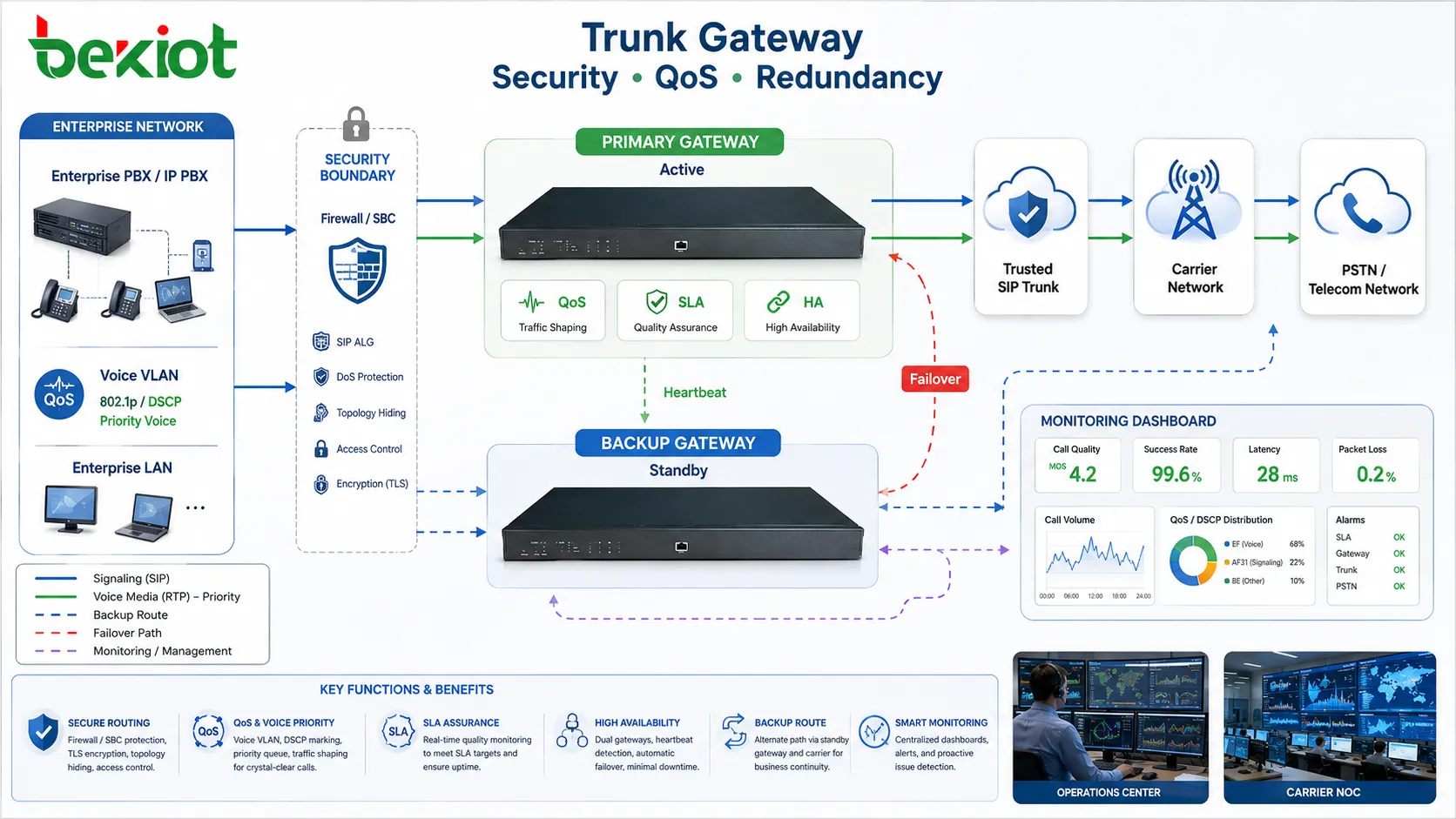
In many SIP trunk designs, an SBC is placed at the network edge. The trunk gateway may sit behind the SBC or may work together with it. The SBC can provide topology hiding, NAT traversal, SIP normalization, media anchoring, access control, and security enforcement.
The decision depends on project scale and risk. A small internal trunk gateway connected only to a private PBX may not need the same edge architecture as a public SIP trunk. However, any carrier-facing or internet-facing design should be reviewed carefully.
Call permission control
Security is not only about network access. Call routing permissions are equally important. The gateway should not allow every user or trunk to dial every destination. International calls, premium numbers, external forwarding, and special service numbers may need restrictions.
Toll fraud often occurs when attackers find a path to expensive outbound routes. Route permissions, destination barring, caller-based rules, time-based restrictions, and CDR monitoring help reduce this risk.
Secure management access
Management interfaces should be protected. Web access, SSH, Telnet, SNMP, API ports, and provisioning services should not be exposed to untrusted networks. Default accounts should be changed, unnecessary services should be disabled, and management access should be logged.
Remote management is useful, but it should be controlled through VPN, management VLAN, IP restrictions, or secure access methods. A trunk gateway carries important traffic; its configuration should not be easily reachable.
QoS and reliability architecture
Bandwidth and concurrent call planning
Trunk gateways may carry many simultaneous calls. Bandwidth planning should consider codec, packetization interval, RTP overhead, signaling traffic, recording, failover load, and future growth. A design that works for a few calls may fail when channels are fully used.
Concurrent call planning should also consider processing resources. Codec transcoding, encryption, fax relay, echo cancellation, and media anchoring can consume gateway CPU or DSP capacity. The system should be sized for the expected call mix, not only the port count.
QoS marking and traffic priority
Voice traffic is sensitive to packet loss, delay, and jitter. The trunk gateway should mark voice packets correctly, and the network should honor those markings. QoS should apply across switches, routers, firewalls, WAN links, and carrier handoff points where possible.
RTP media usually requires stronger priority than general data traffic. SIP signaling also needs reliable delivery, but media quality is what users hear directly. QoS design should separate real-time voice from bulk data, backups, downloads, and non-critical traffic.
Clock synchronization and timing stability
Digital trunk gateways must pay attention to clocking. E1/T1 and PRI circuits require stable timing. If clock source selection is wrong or unstable, the system may experience slips, frame errors, audio artifacts, or trunk alarms. Clock design is one of the unique elements of digital trunk gateway architecture.
Engineers should define whether the gateway takes clock from the carrier, legacy PBX, or internal source. In multi-trunk systems, clock hierarchy should be clear. Timing problems can be difficult to diagnose if clock planning is ignored.
Redundancy and failover
Because trunk gateways concentrate important call traffic, redundancy should be considered. Redundancy may include dual gateways, dual power, backup trunks, secondary carriers, alternate SIP peers, PBX route failover, and high-availability designs.
Failover should be tested with real calls. It is not enough to configure a backup route and assume it works. Engineers should verify inbound calls, outbound calls, emergency calls, caller ID, media path, and release behavior during failover conditions.
Deployment models
Carrier trunk access model
In this model, the trunk gateway connects an enterprise PBX or voice platform to carrier services. The carrier side may be SIP trunk, PRI, E1/T1, or other trunk access. The enterprise side may be IP PBX, unified communication platform, or legacy PBX.
This model requires careful coordination with the carrier. Number format, authentication, codec, caller ID, emergency call routing, failover, and service testing should be confirmed. Carrier-facing trunk gateways should also be protected against unauthorized traffic.
Legacy PBX migration model
Many organizations use trunk gateways to migrate from traditional PBX systems to IP voice platforms. The gateway bridges old trunks and new SIP systems, allowing gradual replacement of extensions and services. This avoids a sudden cutover that may disrupt daily operation.
Migration architecture should define temporary and final states. Which trunk remains on the old PBX? Which numbers move to the IP platform? How are calls routed between old and new users? Without clear planning, hybrid systems can become difficult to maintain.
Multi-site interconnection model
Trunk gateways can interconnect branches, campuses, factories, or regional offices. Each site may have local PBX resources, local trunks, and internal extension ranges. Gateways can route calls between sites through private IP networks or SIP trunks.
This model improves internal communication and can reduce external call dependency. However, numbering plans, route policies, WAN QoS, and failover must be designed carefully. Branch survivability should also be considered.
Centralized trunk resource model
Some organizations centralize trunk access at one data center or headquarters. Branches connect to the central voice platform, and trunk gateways provide external access from the central point. This simplifies carrier management and policy control.
The risk is dependency on WAN and central infrastructure. If a branch loses connection to the center, external calls may fail unless local backup is provided. Centralized design should include survivability planning for critical sites.
Maintenance and management design
Monitoring trunk health
Trunk gateway monitoring should include trunk status, channel availability, SIP registration, call failure rate, active sessions, CPU load, memory, temperature, clock alarms, packet loss, jitter, and interface errors. These indicators help detect problems before users report them.
Monitoring should be connected to response procedures. If a trunk fails, the system should notify the right team. If call failures increase, logs should be reviewed. If clock alarms appear, physical trunk conditions should be checked.
Call detail records and route analysis
CDR analysis helps administrators understand traffic patterns and routing behavior. It can show call volume, peak usage, failed calls, carrier usage, emergency calls, international traffic, and unusual dialing patterns. This is useful for both capacity planning and security review.
Route analysis is especially valuable in multi-trunk environments. If one trunk group has higher failure rate or poor quality, administrators can adjust routing or contact the provider. Without records, troubleshooting depends only on user complaints.
Packet capture and signaling logs
Trunk gateway troubleshooting often requires SIP traces, ISDN logs, RTP statistics, and packet captures. These tools help identify number format errors, codec negotiation problems, authentication failure, release causes, DTMF issues, and media path problems.
Diagnostic access should be available but controlled. Logs may contain phone numbers and sensitive call information. Administrators should protect diagnostic data while still keeping it usable for troubleshooting.
Configuration backup and change control
Trunk gateways contain important configuration: trunk groups, routing rules, digit maps, IP addresses, codec lists, security rules, failover routes, and management settings. Configuration backups should be made after commissioning and after every major change.
Change control prevents accidental service disruption. A small digit rule change may affect many outbound calls. A codec change may affect an entire carrier trunk. A firewall adjustment may break RTP. Documentation and rollback planning are essential.
Common design mistakes
Treating the trunk gateway as a simple converter
A common mistake is treating the trunk gateway as only a protocol converter. This ignores routing, security, numbering, media, QoS, redundancy, and management. The gateway then becomes a hidden risk point instead of a controlled voice boundary.
The correct approach is to design the gateway as part of the full voice architecture. Its placement, interfaces, policies, and monitoring should be documented from the beginning.
Ignoring media path planning
Another mistake is checking only signaling success. A call may ring and answer, but audio may be one-way or poor because RTP routing was not planned. Media port ranges, NAT, firewall policy, SBC behavior, and network path must be verified.
Weak numbering discipline
Trunk gateways often fail because of inconsistent numbering. Different systems may send different digit lengths, prefixes, or caller ID formats. If digit rules are built casually, calls may work in some cases and fail in others.
Number normalization should be designed and tested. Inbound, outbound, internal, emergency, and backup routes all need clear rules.
No failover testing
Backup trunks and redundant gateways are useful only if they are tested. Some systems have backup routes configured but fail during real outages because caller ID, media, authentication, or number format differs on the backup path.
Regular failover testing should be part of maintenance. Critical call routes should not depend on untested assumptions.
Evaluation standards
Routing accuracy
The architecture should route inbound and outbound calls correctly. DID, DOD, emergency calls, local calls, national calls, international calls, branch calls, and backup routes should all be tested. Routing accuracy is the foundation of trunk gateway value.
Voice quality
Voice quality should be evaluated under realistic call volume. Delay, jitter, packet loss, echo, gain, codec behavior, transcoding load, and DTMF recognition should be tested. Voice quality problems may appear only when the gateway is under load.
Security protection
The gateway should be protected against unauthorized access, toll fraud, SIP scanning, exposed management interfaces, and uncontrolled outbound routing. Security review should include both network and call policy layers.
Continuity and survivability
The design should define how calls continue during trunk failure, gateway failure, carrier outage, WAN loss, or power interruption. Backup routes and redundant devices should be tested with real call scenarios.
Operational maintainability
A good trunk gateway architecture is easy to monitor, troubleshoot, update, and expand. Administrators should have logs, CDRs, alarms, packet capture, configuration backups, naming standards, and clear documentation.
Closing Notes
The unique network architecture of a trunk gateway comes from its boundary role and trunk-level responsibility. It connects SIP trunks, digital trunks, PBX systems, carrier networks, PSTN resources, and enterprise voice platforms while managing signaling conversion, media routing, number translation, security control, QoS, redundancy, and monitoring.
Its architecture must be designed as a complete voice interconnection system rather than a simple gateway installation. Engineers should plan trunk access, voice control, media processing, numbering, routing, security, QoS, timing, failover, and maintenance together. Each part affects the stability of the whole voice network.
A well-designed trunk gateway provides high-capacity call access, controlled interconnection, reliable route selection, clear media paths, protected boundaries, better troubleshooting, and smoother migration between legacy and IP voice systems. When properly deployed, it becomes a central bridge for modern enterprise, carrier, and multi-site communication architecture.
FAQ
What is a trunk gateway?
A trunk gateway is a voice gateway used to connect trunk-level resources such as SIP trunks, E1/T1, PRI, legacy PBX trunks, carrier circuits, PSTN resources, and enterprise voice platforms.
How is a trunk gateway different from an access gateway?
An access gateway usually connects individual endpoints such as analog phones, while a trunk gateway connects high-capacity trunk resources between systems, carriers, PBXs, or networks.
Why is RTP media planning important?
SIP signaling may establish a call successfully, but RTP carries the actual voice. If RTP is blocked, misrouted, or affected by NAT or firewall settings, calls may have one-way audio or no audio.
What should be considered in trunk gateway security?
Security should include firewall rules, trusted peers, strong authentication, route permissions, toll fraud prevention, protected management access, monitoring, and SBC placement where appropriate.
Where are trunk gateways commonly used?
They are commonly used in SIP trunk access, digital trunk migration, PBX interconnection, carrier access, multi-site voice networks, legacy PBX replacement, centralized trunk resource design, and hybrid telephony systems.