


Earthquake rescue operations often begin under the worst possible communication conditions. Power supply may be interrupted, mobile base stations may be damaged, optical fiber links may be broken, and roads may be blocked. In this situation, communication is not only a support tool; it directly affects search and rescue efficiency, command coordination, medical transfer, supply delivery, and the overall success of emergency response.
A practical earthquake rescue communication solution should not rely on a single technology. The field team needs short-range voice coordination, long-distance contact with the rear command center, temporary broadband access, video backhaul capability, and a final backup method when all regular networks fail. The most important equipment usually includes two-way radios, satellite phones, portable satellite terminals, broadband ad hoc networks, and shortwave radios.
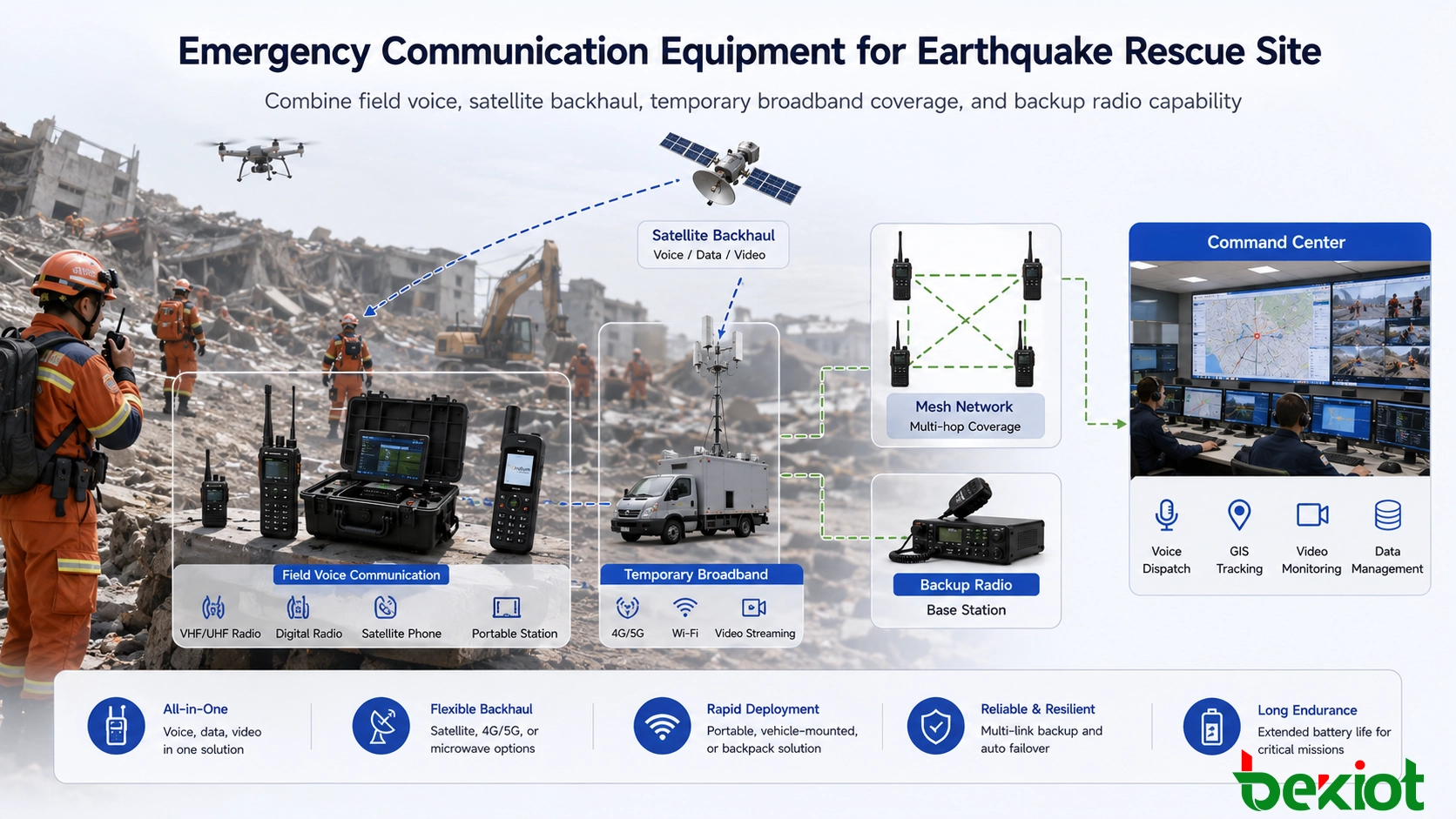
Field Voice Comes First
At an earthquake rescue site, the first communication requirement is fast local coordination. Rescue teams, medical staff, logistics groups, traffic control personnel, and temporary command posts must be able to speak to each other immediately. Two-way radios are still one of the most practical tools because they are easy to operate, quick to deploy, and do not require existing telecom infrastructure.
Conventional radios around 400 MHz and dedicated emergency radios around 370 MHz can quickly establish a local communication environment. In many field conditions, handheld radios can support roughly 2 to 5 kilometers of local communication coverage, depending on terrain, building collapse conditions, antenna height, output power, and surrounding interference.
For small rescue zones, handheld radios may be enough. For larger disaster areas, relay equipment can greatly extend the communication range. Backpack repeaters, vehicle-mounted lifting repeaters, and tethered drone relay systems can expand coverage to more than ten kilometers or even dozens of kilometers. This makes radio communication one of the most essential tools for early-stage earthquake rescue.
Why Radios Remain Irreplaceable
Two-way radios are valuable because they match the rhythm of rescue work. Operators can press a button and speak without dialing, waiting for call setup, or depending on a public network. The operation is simple enough for different rescue groups to learn quickly, even under pressure.
Radio channels also support group communication. One instruction can be heard by multiple team members at the same time, which is useful for search coordination, route clearance, medical transfer, safety warnings, and temporary site management. In a chaotic field environment, this broadcast-style voice capability is often more efficient than one-to-one telephone calls.
However, radio systems also need planning. Channel grouping, command discipline, relay position, battery rotation, spare antennas, and charging methods should be prepared in advance. Without channel management, too many teams using the same channel may cause congestion and confusion.
Connecting the Disaster Zone to the Outside World
After a major earthquake, ordinary communication networks may be unavailable for hours or even days. Base stations may lose power, transmission links may be damaged, and network recovery may require time. During this period, satellite phones are extremely important because they can maintain voice communication without relying on local ground telecom infrastructure.
Satellite phones allow the rescue site to contact the rear command center, government departments, emergency coordination units, medical institutions, and supply teams. They help report damage conditions, confirm rescue demand, coordinate personnel movement, and request urgent materials.
The main value of a satellite phone is reliability under network failure. It may not provide the same user experience as a mobile phone in normal conditions, but in a collapsed or disconnected area, its ability to establish external voice communication can be critical.
When Voice Alone Is Not Enough
Satellite phones solve voice contact, but earthquake rescue increasingly depends on data. The rear command center may need live video from the disaster area. Field teams may need to upload photos, location information, damage reports, drone footage, medical records, and rescue progress. Media teams may also need to send video materials back for editing and broadcasting.
This is where portable satellite terminals become important. A portable satellite station can be rapidly deployed to provide a temporary broadband link. It can support emergency internet access, video backhaul, command platform connection, and temporary restoration of key communication services.
High-throughput portable satellite systems can provide more bandwidth than a voice-only satellite phone. In rescue projects, they are often used as the backhaul link for temporary field networks. The satellite station connects the isolated disaster area to the outside command system, while local networks distribute connectivity to nearby rescue users and devices.
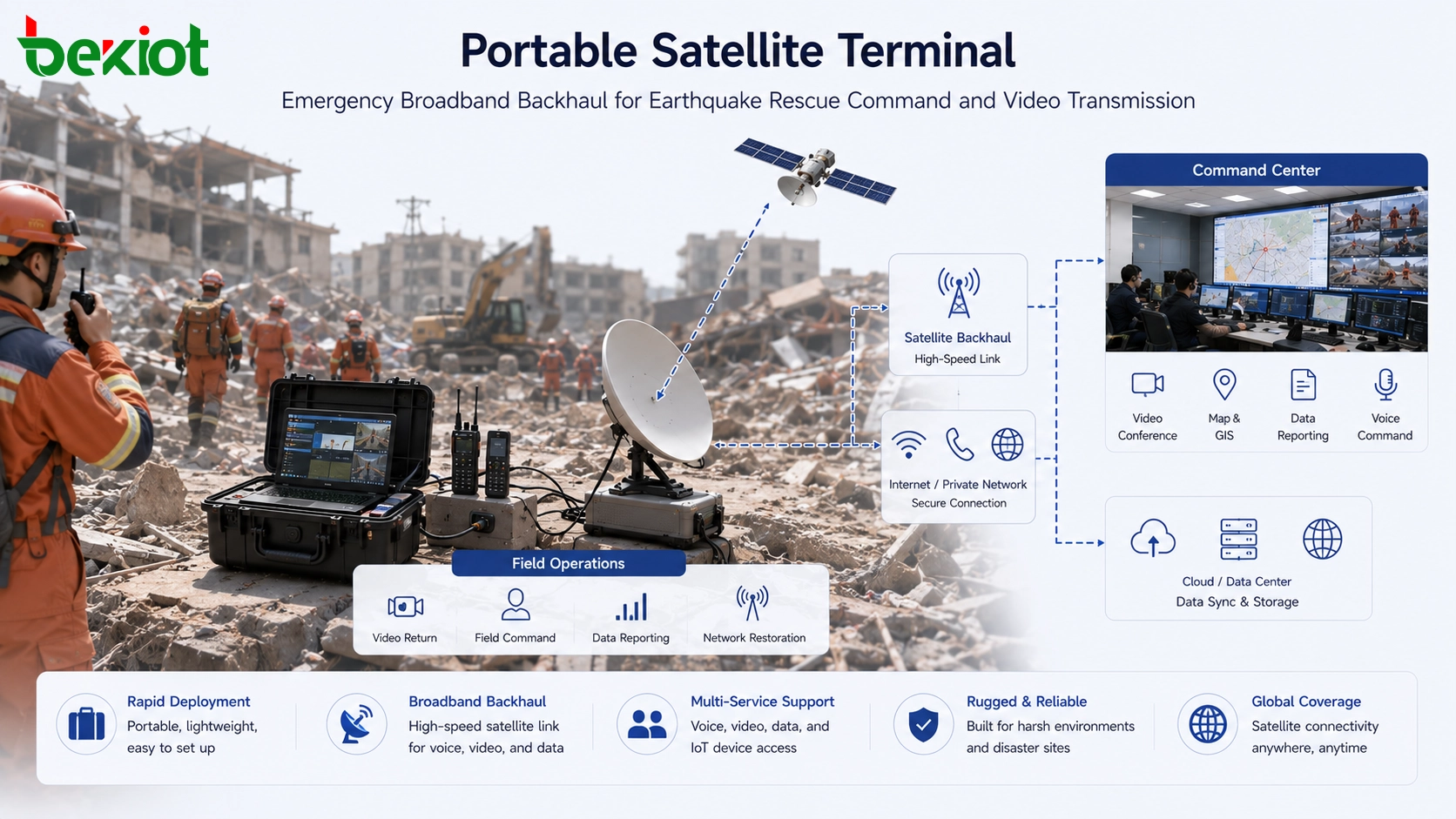
Building Temporary Broadband Coverage
A broadband ad hoc network, also known as a mesh or self-organizing network, is useful when rescue teams need local data connectivity across a disaster area. Unlike a fixed network that depends on existing base stations or wired infrastructure, an ad hoc network can be deployed quickly with portable nodes, vehicle nodes, drone-mounted nodes, or temporary relay points.
In earthquake rescue, broadband ad hoc networking can support field video, voice over IP, sensor data, drone video transmission, mobile command terminals, and temporary data exchange between teams. Depending on equipment, terrain, node height, and deployment density, the network can cover areas from several kilometers to dozens of kilometers.
This type of system is especially useful when multiple rescue teams operate across separated locations. Local nodes can form a temporary network, while a satellite portable station or another backhaul link can send key data to the rear command center. This creates a structure where field teams have local connectivity and the command center has remote visibility.
Combining Mesh Access with Satellite Backhaul
In many earthquake rescue solutions, broadband mesh and portable satellite stations are used together. The mesh network expands local coverage around the rescue site, while the satellite terminal provides long-distance backhaul to the command center.
This combination is practical because satellite bandwidth is valuable and should be used efficiently. Instead of each device trying to connect independently to a remote network, local users and devices connect through the temporary field network. The gateway or command node then forwards important video, voice, data, and reports through satellite backhaul.
For large disaster zones, this architecture can be expanded with multiple temporary nodes. Vehicle-mounted nodes may cover roads and assembly points. Portable nodes may support rescue teams inside affected areas. Drone relay nodes may improve coverage where mountains, collapsed buildings, or terrain obstacles block radio paths.
The Last Backup Still Matters
Shortwave radio is often considered a final backup communication method. Because of its propagation characteristics, shortwave communication can support voice links over hundreds or even thousands of kilometers without relying on local public networks, base stations, or satellite terminals.
In emergency communication planning, this makes shortwave radio valuable as a strategic backup. If ground networks fail, satellite resources are unavailable, or field broadband links cannot be established, shortwave can still provide a communication path for essential messages.
The limitation is that shortwave radio requires trained operators. Frequency selection, antenna setup, propagation conditions, equipment tuning, and communication discipline are more complex than handheld radio or satellite phone use. Because satellite phones are now more widely available, shortwave radios may be used less frequently in daily operations, but they remain important as a backup layer for extreme conditions.
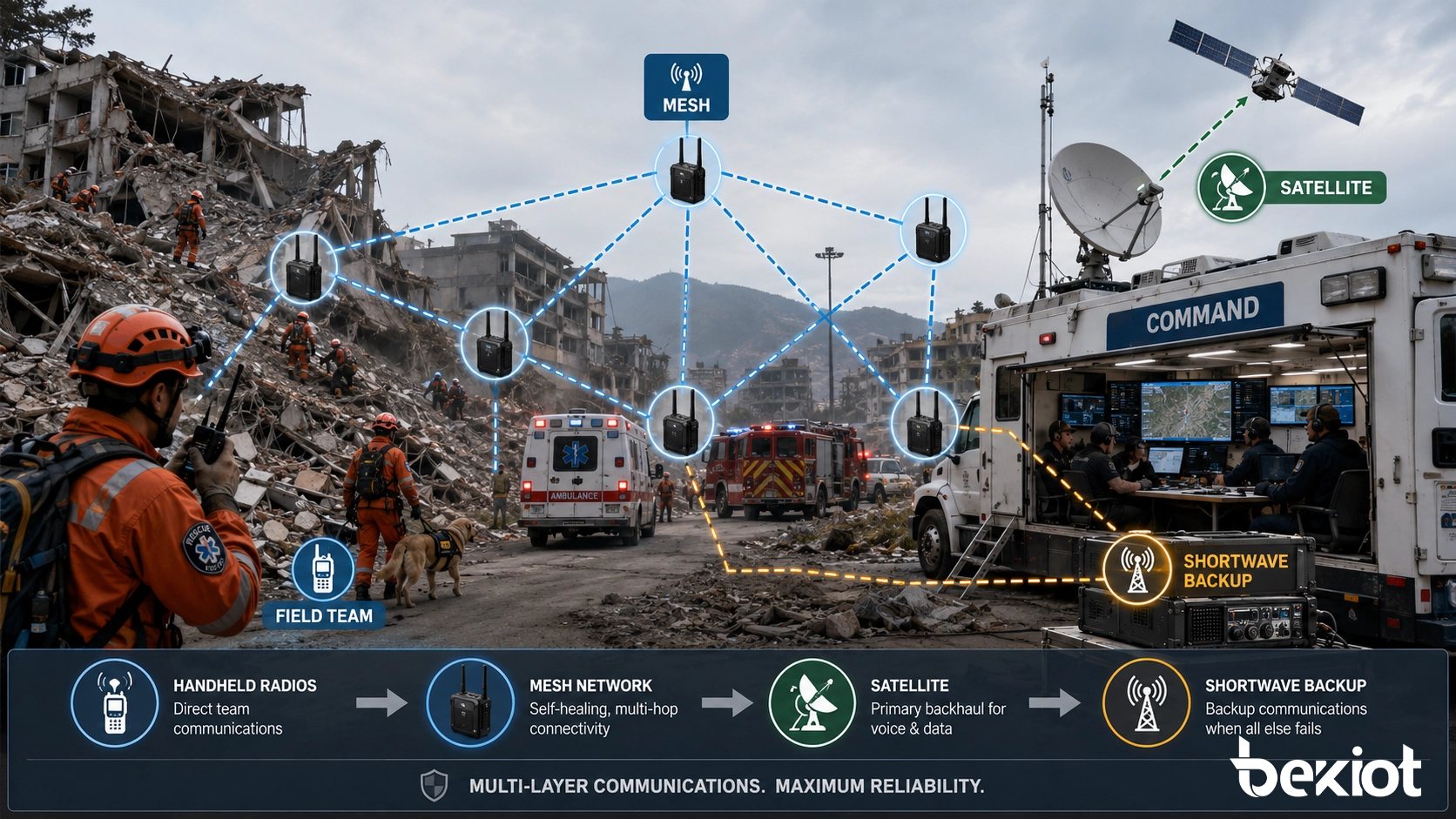
A Layered Architecture for Rescue Communication
A well-designed earthquake rescue communication system usually follows a layered structure. The first layer is local tactical communication, mainly supported by handheld radios and repeaters. This layer helps rescue teams coordinate nearby actions quickly.
The second layer is field data networking, supported by broadband ad hoc network devices. This layer connects field cameras, command tablets, mobile terminals, sensors, and temporary command posts. It allows video, voice, and data to move inside the disaster area.
The third layer is long-distance backhaul. Portable satellite stations and satellite phones connect the rescue site with the rear command center. This layer supports external reporting, resource coordination, video return, and remote decision-making.
The fourth layer is strategic backup. Shortwave radio provides an additional communication path when other systems fail or when long-distance emergency voice communication is required under difficult conditions.
Core Equipment and Their Roles
| Equipment Type | Main Role | Typical Value in Earthquake Rescue |
|---|---|---|
| Two-Way Radios | Local voice coordination | Fast 2–5 km field communication and group dispatch without public network dependence |
| Radio Repeaters | Coverage extension | Expands radio range to more than ten kilometers or even dozens of kilometers |
| Satellite Phones | External voice contact | Maintains communication with command centers when local telecom networks are damaged |
| Portable Satellite Terminals | Broadband backhaul | Supports video return, emergency internet access, and temporary data transmission |
| Broadband Ad Hoc Networks | Temporary field network | Creates local broadband coverage for video, data, sensors, and mobile command terminals |
| Shortwave Radios | Strategic backup communication | Provides long-distance voice links over hundreds or thousands of kilometers when other systems fail |
Deployment Priorities at the Rescue Site
Secure Basic Voice First
The first priority is to establish reliable local voice communication. Rescue teams should distribute handheld radios, define channels, assign command groups, and deploy repeaters where coverage is weak. The goal is to make sure team leaders, search groups, medical points, logistics teams, and temporary command posts can communicate immediately.
Restore External Contact Quickly
Once local communication is available, the site needs a stable way to contact the outside command structure. Satellite phones can provide immediate voice contact. Portable satellite terminals can provide broadband links for richer information exchange, especially when pictures, video, and operational data must be sent back.
Create a Local Data Network
If the rescue area is large or multiple teams are operating at the same time, broadband ad hoc networking should be deployed. This gives field users a temporary network layer and supports live video, mobile command terminals, location sharing, and data exchange between rescue teams.
Prepare Backup Channels
Backup communication should not be planned after the main system fails. Shortwave radios, spare batteries, backup antennas, portable power stations, and printed communication procedures should be prepared in advance. Emergency response depends on redundancy.
Power and Portability Are Critical
Earthquake rescue equipment must be easy to carry, fast to deploy, and able to operate in unstable field conditions. Communication devices should be supported by spare batteries, portable power stations, vehicle power, solar charging where suitable, and clear charging rotation plans.
Portability is equally important. Heavy equipment may provide strong capability but may not reach the first rescue zone quickly. A practical solution should balance backpack equipment, vehicle-mounted systems, drone relay options, and fixed temporary command nodes.
The best field communication system is not only powerful on paper. It must be usable by rescue personnel under pressure, with limited time, damaged infrastructure, and changing site conditions.
Planning Recommendations for Emergency Projects
Emergency communication equipment should be prepared before disasters occur. The project team should not only purchase devices, but also define user roles, channel plans, power plans, equipment storage, testing schedules, and training procedures.
Regular drills are necessary. Rescue personnel should know how to power on devices, select channels, report location, establish contact, switch backup methods, deploy repeaters, connect satellite terminals, and protect equipment in harsh environments.
For command centers, integration is also important. Radio voice, satellite communication, field video, GPS location, rescue reports, and command instructions should ideally be connected into a unified emergency communication workflow. This helps decision-makers understand the situation faster and allocate resources more effectively.
Final Takeaway
Earthquake rescue is a race against time. Communication equipment must be simple, portable, reliable, and suitable for damaged infrastructure environments. Two-way radios provide fast local voice coordination. Repeaters extend field coverage. Satellite phones maintain external voice contact. Portable satellite terminals provide broadband backhaul. Broadband ad hoc networks create temporary field data coverage. Shortwave radios provide a final backup path for long-distance communication.
No single device can solve every communication problem at an earthquake rescue site. A resilient solution should combine several layers: local radio communication, field broadband networking, satellite backhaul, and strategic backup communication. This layered approach improves rescue efficiency, strengthens command coordination, and helps emergency teams maintain communication when normal infrastructure is unavailable.
FAQ
Which communication device should be deployed first after an earthquake?
Local voice devices are usually deployed first because rescue teams need immediate coordination. Handheld radios and repeaters can quickly support command, search, medical, and logistics communication near the rescue area.
Can mobile phones replace emergency communication equipment?
Not reliably. Mobile phones depend on public networks, base stations, and power supply. After a major earthquake, these resources may be damaged or overloaded, so dedicated emergency communication equipment is still necessary.
Why is video backhaul important in rescue operations?
Video helps the rear command center understand real site conditions, assess damage, guide resource allocation, and support decision-making. It is especially useful when roads are blocked or field reports are incomplete.
How can rescue teams reduce communication congestion?
They should assign channels by function, define reporting rules, limit unnecessary calls, use command hierarchy, and separate voice coordination from data transmission where possible.
What should be included in regular emergency communication drills?
Drills should include radio channel use, repeater deployment, satellite phone calling, portable satellite terminal setup, mesh network deployment, battery replacement, backup procedures, and communication reporting formats.







