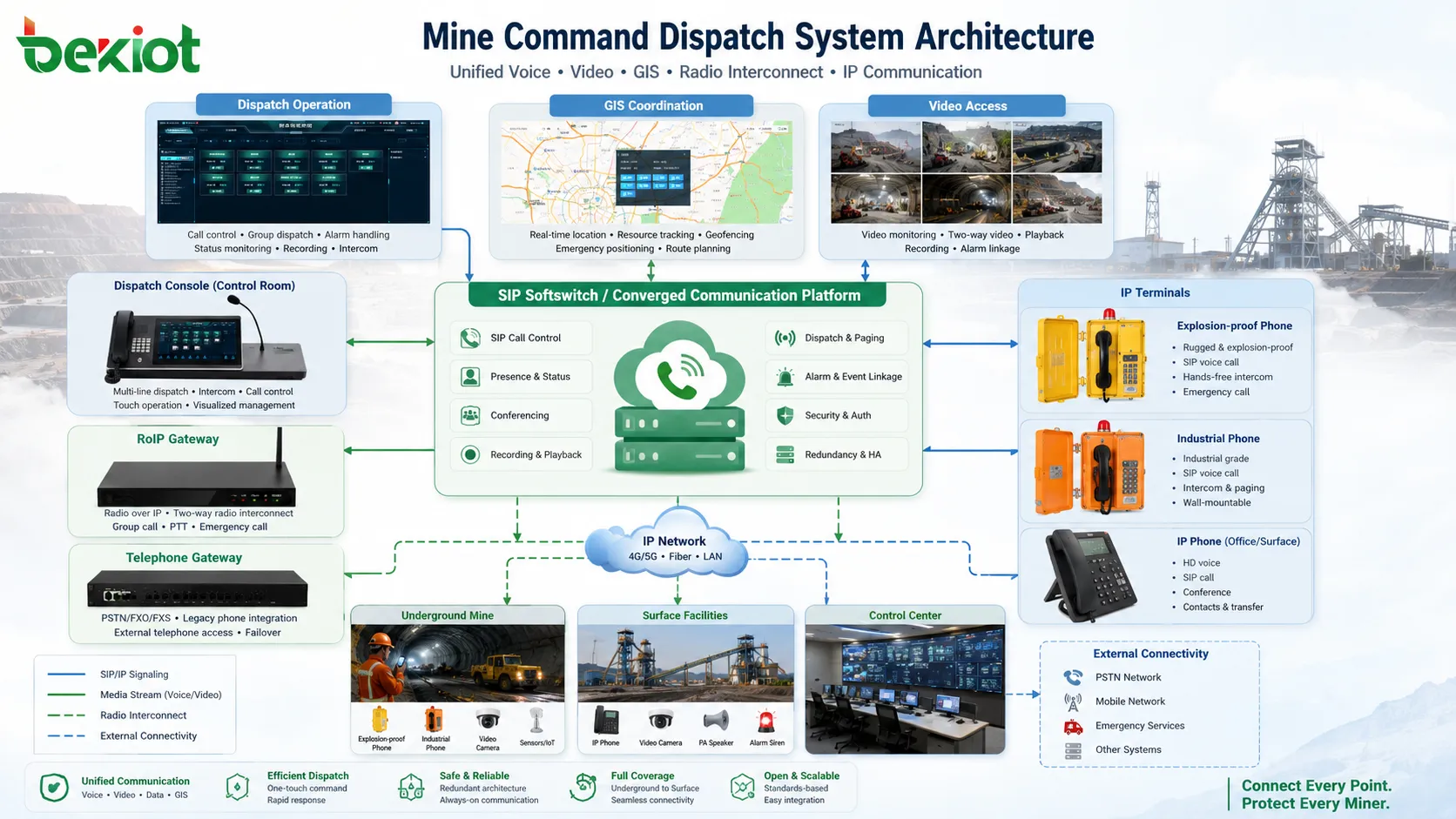
A mine command dispatch system is not a single device or a simple communication console. It is a coordinated communication architecture that connects daily production, field teams, emergency response, video monitoring, radio systems, telephone networks, IP broadcasting, and dispatch workflows. Because different mines may use different communication standards, system sizes, terminal types, and operating environments, the solution must be designed around integration rather than isolated equipment.
For modern mining operations, the goal is to build a multi-functional command platform that supports voice, video, instructions, GIS-based dispatch, radio interconnection, and terminal access. This helps improve daily coordination, emergency handling, production safety, and the overall digital management level of the mine.
Building Around an Integrated Communication Platform
The foundation of the system is an integrated communication platform with dispatch capability. In a mining project, this platform should support audio and video communication, broadband push-to-talk, voice dispatch, video dispatch, instruction dispatch, GIS dispatch, and multi-terminal access.
Based on a SIP softswitch architecture, the platform can connect with different systems and devices more easily. SIP compatibility is important because it allows IP phones, smart terminals, IP broadcasting devices, IP call stations, dispatch consoles, and gateways to work within the same communication framework.
For mining environments, this architecture makes the system more flexible. The mine can connect office users, underground workers, surface teams, control rooms, emergency points, and external communication resources without building separate platforms for every use case.
Connecting Telephone Networks and External Users
Many mining enterprises still need communication between internal IP terminals and external telephone users. This may include office extensions, landlines, mobile phones, duty rooms, public telephone networks, and existing PBX systems.
When the project needs to connect with the public telephone network or a program-controlled telephone exchange, a telephone gateway can be deployed. The gateway links the IP-based dispatch platform with traditional telephone systems, allowing IP terminals, mobile phones, landlines, and dispatch operators to communicate through one unified workflow.
This is useful for management communication, emergency reporting, shift coordination, external support, and communication between field personnel and administrative departments.
Bridging Radio Systems Through RoIP Gateway
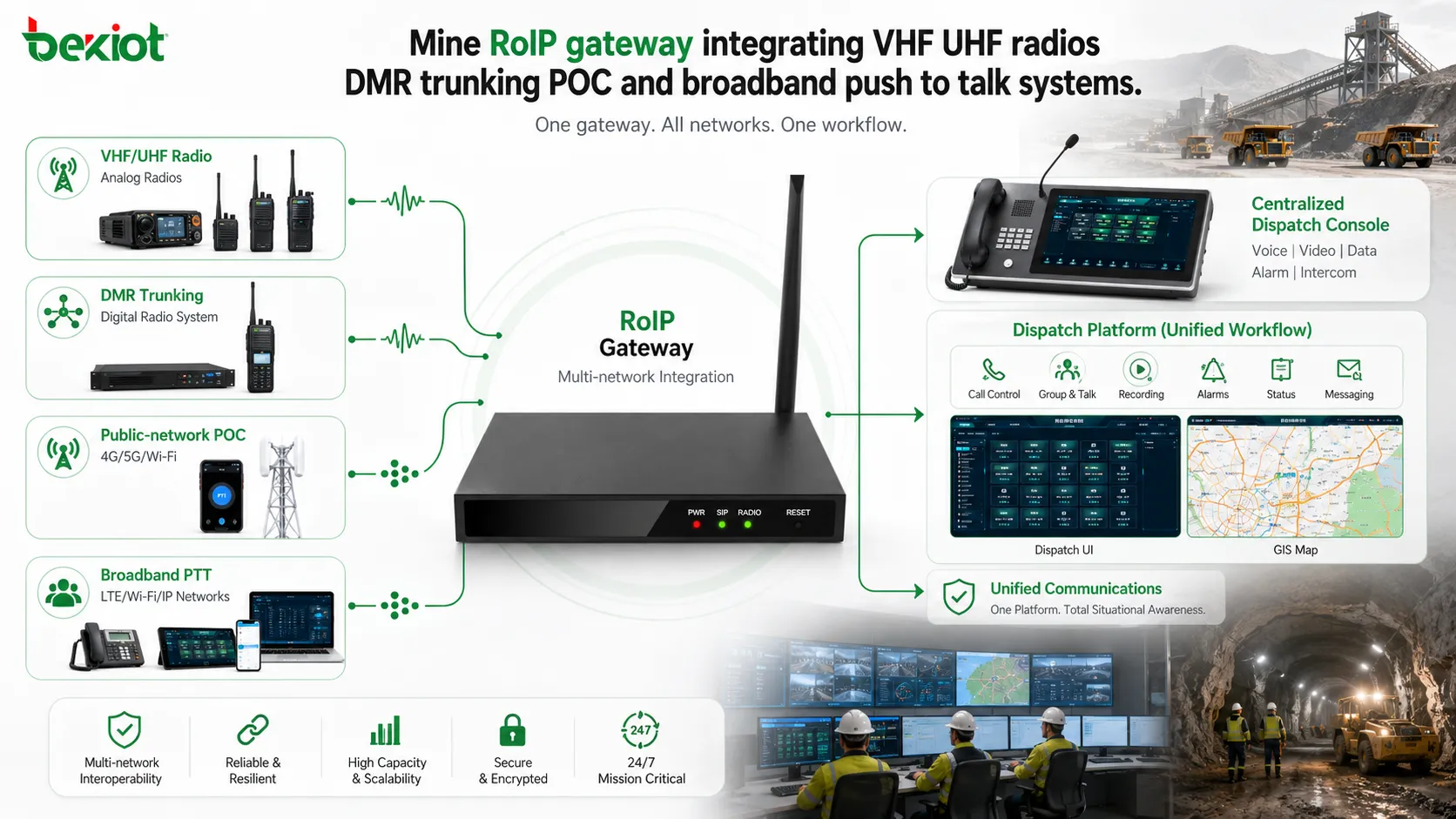
Radio communication is still widely used in mines because it is direct, familiar, and suitable for field operations. However, many mining enterprises already have different types of radio systems, including VHF/UHF radios, narrowband DMR trunking systems, public-network POC radios, and broadband push-to-talk systems.
These radio systems are usually independent from each other. Without integration, dispatch operators cannot easily coordinate different radio groups from one command platform. A RoIP gateway solves this problem by connecting different radio channels into the dispatch system.
After RoIP gateway access, different radio systems can be managed through the dispatch console. Operators can call specific channels, organize radio groups, connect radio users with SIP terminals, and support cross-system communication. This improves field coordination while protecting the mine’s existing radio investment.
The key value of RoIP gateway integration is not replacing existing radios, but making different radio resources dispatchable, interoperable, and easier to manage.
Adding Video to the Command Workflow
A new-generation command dispatch system should not be limited to audio. Video capability is one of the most important features in modern mine dispatch projects. Operators often need to view cameras, verify field situations, distribute video, and support visual decision-making during production or emergency events.
By deploying a video access gateway, the system can connect with existing video monitoring platforms. The gateway can support GB28181 networking and convert video resources into SIP-compatible access for the integrated communication platform.
After integration, smart terminals can view camera images, dispatch operators can distribute video resources, and the command center can support live video applications. This helps the mine combine voice dispatch, video monitoring, and field response into a more complete command process.
Field Terminals for Different Mine Environments
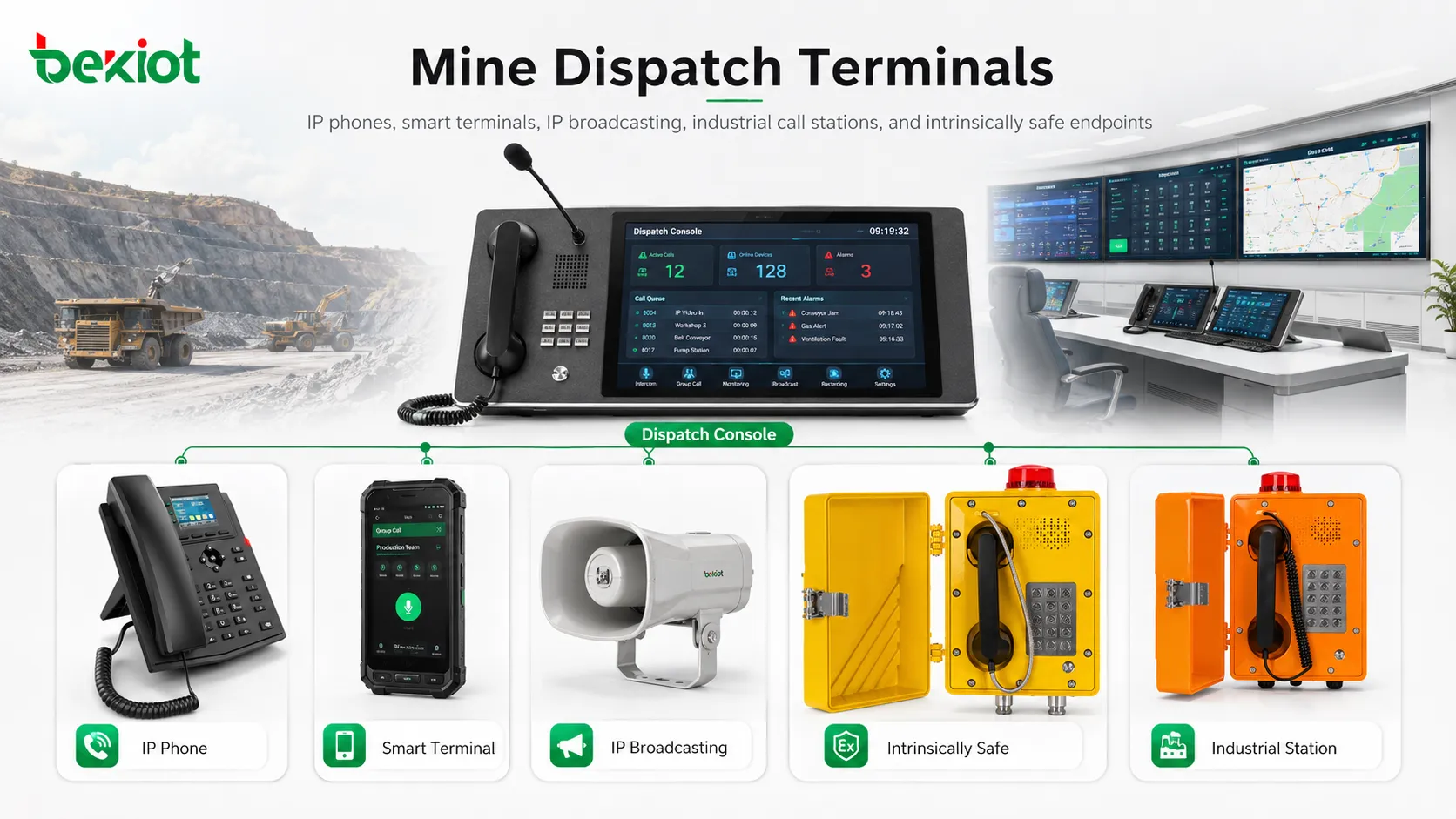
A complete mine command dispatch system needs suitable terminal devices. These may include intelligent terminals, IP phones, IP broadcasting devices, IP call stations, dispatch consoles, and industrial communication endpoints.
Terminal selection should match the field environment. In ordinary office or control room areas, standard IP phones and smart terminals may be enough. In underground, hazardous, dusty, humid, or explosive-risk environments, the project may require explosion-proof or intrinsically safe IP phones, industrial call stations, or rugged terminals.
This is especially important in mining projects because different areas have different safety requirements. A good terminal layout helps ensure that workers, control rooms, emergency stations, and field teams can be reached quickly when communication is needed.
Typical System Composition
A practical mine command dispatch solution is usually composed of the integrated communication platform, telephone gateway, RoIP gateway, video access gateway, dispatch console, and field terminals. These components work together to support daily communication, emergency response, visual monitoring, and multi-system coordination.
| System Component | Main Function | Typical Value |
|---|---|---|
| Integrated Communication Platform | SIP softswitch, voice dispatch, video dispatch, GIS dispatch, instruction dispatch | Provides the core communication and dispatch foundation |
| Telephone Gateway | Connects IP terminals with PBX, landlines, and mobile phones | Supports internal and external voice communication |
| RoIP Gateway | Integrates VHF/UHF, DMR, POC, and broadband push-to-talk systems | Enables radio interconnection and unified dispatch |
| Video Access Gateway | Connects video monitoring platforms through GB28181 and SIP conversion | Supports camera viewing, video distribution, and live video dispatch |
| Field Terminals | IP phones, smart terminals, IP broadcasting, IP call stations, rugged endpoints | Provides communication access for different mine areas |
How the System Works in Daily Operations
During daily production, the dispatch center can use the platform to call field teams, coordinate maintenance work, broadcast instructions, contact radio groups, and communicate with office or external users. The system helps reduce the need to switch between separate phones, radios, video platforms, and broadcasting systems.
For production scheduling, the platform can support communication between control rooms, underground teams, surface workers, maintenance staff, security personnel, and management departments. For inspection tasks, operators can combine voice calling, radio dispatch, and camera viewing to improve coordination efficiency.
When a field issue occurs, the dispatcher can contact the responsible team, check video resources, notify related personnel, and record the communication process. This makes daily management more organized and traceable.
Emergency Response and Safety Coordination
In emergency scenarios, communication speed and system reliability are critical. The command center may need to contact underground workers, surface rescue teams, radio groups, duty offices, external support, and management personnel at the same time.
With an integrated dispatch system, operators can use voice dispatch, radio interconnection, video linkage, emergency broadcasting, and GIS-based coordination in one workflow. This improves response speed and helps the command center understand the situation more clearly.
The system also supports better post-event review. Communication records, dispatch actions, video linkage, and response steps can be reviewed later to improve emergency plans and safety management procedures.
Deployment Logic for Mining Projects
The first step is to investigate existing communication resources. The project team should identify current radio systems, telephone networks, video platforms, terminal locations, control rooms, emergency points, and underground communication requirements.
The second step is to define the integration architecture. The SIP softswitch platform should be used as the core, while telephone gateways, RoIP gateways, and video access gateways should be added according to the systems that need to be connected.
The third step is to match terminals with environments. Ordinary areas can use standard IP phones or smart terminals, while special mine environments may require explosion-proof, intrinsically safe, or rugged communication devices.
The fourth step is to test practical workflows. Testing should include IP calling, radio dispatch, telephone network access, video viewing, GB28181 integration, SIP conversion, broadcasting, GIS dispatch, emergency communication, and terminal stability.
Operational Value for Mine Management
The first value is communication convergence. Multiple systems, including SIP terminals, telephone networks, radios, video monitoring, IP broadcasting, and dispatch consoles, can be connected into one command platform.
The second value is stronger field coordination. Dispatchers can communicate with different teams and devices from one interface, improving the efficiency of production scheduling, inspection, maintenance, and emergency response.
The third value is flexible expansion. A mine can start with basic voice dispatch and gradually add radio integration, video access, GIS dispatch, IP broadcasting, or more field terminals as the project develops.
The fourth value is safety improvement. Visual verification, radio interconnection, emergency calling, and suitable field terminals help build a more responsive and reliable mine communication system.
For mining projects that need integrated voice, video, RoIP access, SIP terminals, broadcasting, and emergency communication, Becke Telcom can provide suitable product support and solution adaptation according to the site environment and dispatch workflow.
FAQ
Can a mine keep its existing radio systems when building a new dispatch platform?
Yes. Existing VHF/UHF radios, DMR systems, public-network POC, or broadband push-to-talk systems can often be connected through RoIP gateways, allowing them to work with the new dispatch platform.
Why is GB28181 important for video integration?
GB28181 is commonly used for video platform networking. In a mine dispatch project, it helps connect video monitoring platforms with the command system so operators can view and distribute camera resources more easily.
When should intrinsically safe terminals be used?
Intrinsically safe terminals should be considered in areas where explosive gases, dust, or hazardous environmental conditions may exist. The terminal type should follow mine safety requirements and project specifications.
Can IP broadcasting be included in the same system?
Yes. IP broadcasting can be connected as part of the communication and emergency notification workflow, helping the command center send announcements, warnings, or evacuation messages to specific areas.
What is the most important acceptance point for this type of project?
The most important acceptance point is whether the system supports real workflows: calling, radio dispatch, telephone access, video viewing, emergency notification, terminal communication, and operator coordination should work together smoothly.