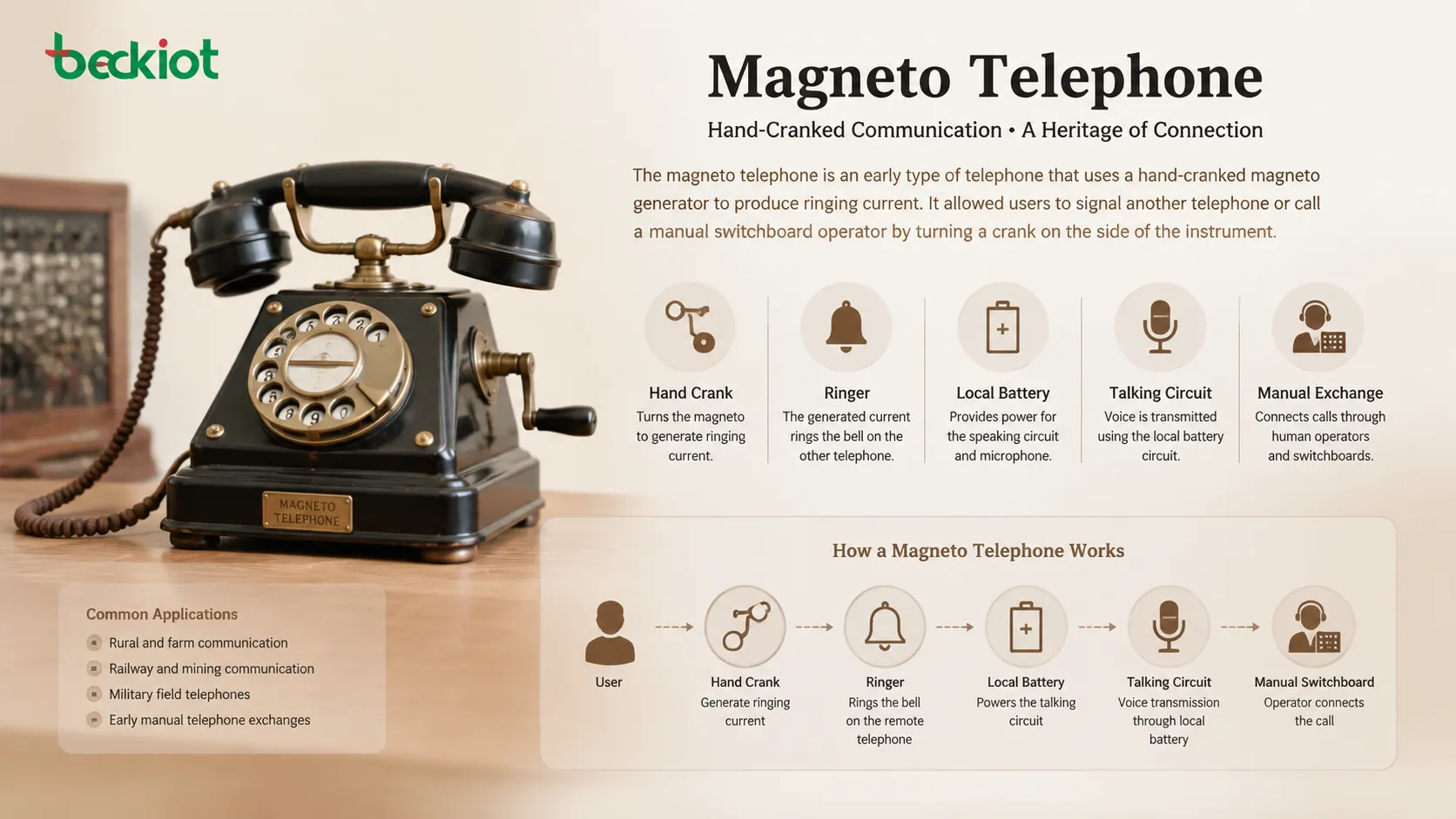
A magneto telephone is an early type of telephone that uses a hand-cranked magneto generator to produce ringing current. Before automatic exchanges, digital switching, VoIP, and modern telephone networks became common, magneto telephones allowed users to signal another telephone or call a manual switchboard operator by turning a crank on the side of the instrument.
These telephones were widely associated with local-battery telephone systems, rural lines, field communication, railway communication, mining sites, military field telephones, estates, farms, and early manual exchanges. Their design reflects an important stage in communication history: users could generate their own call signal locally, while speech transmission depended on a separate talking circuit powered by local batteries.
The Hand-Crank Calling Idea
The most recognizable feature of this telephone is the crank handle. When the user turns the handle, a small generator inside the telephone produces alternating current. This current is sent through the line to ring a bell at the far end or to alert an operator at a manual exchange.
This was useful because early telephone networks did not always provide centralized ringing power. In many rural or small private systems, the user’s own telephone had to create the electrical signal needed to call attention. The crank was therefore not decorative; it was the signaling mechanism.
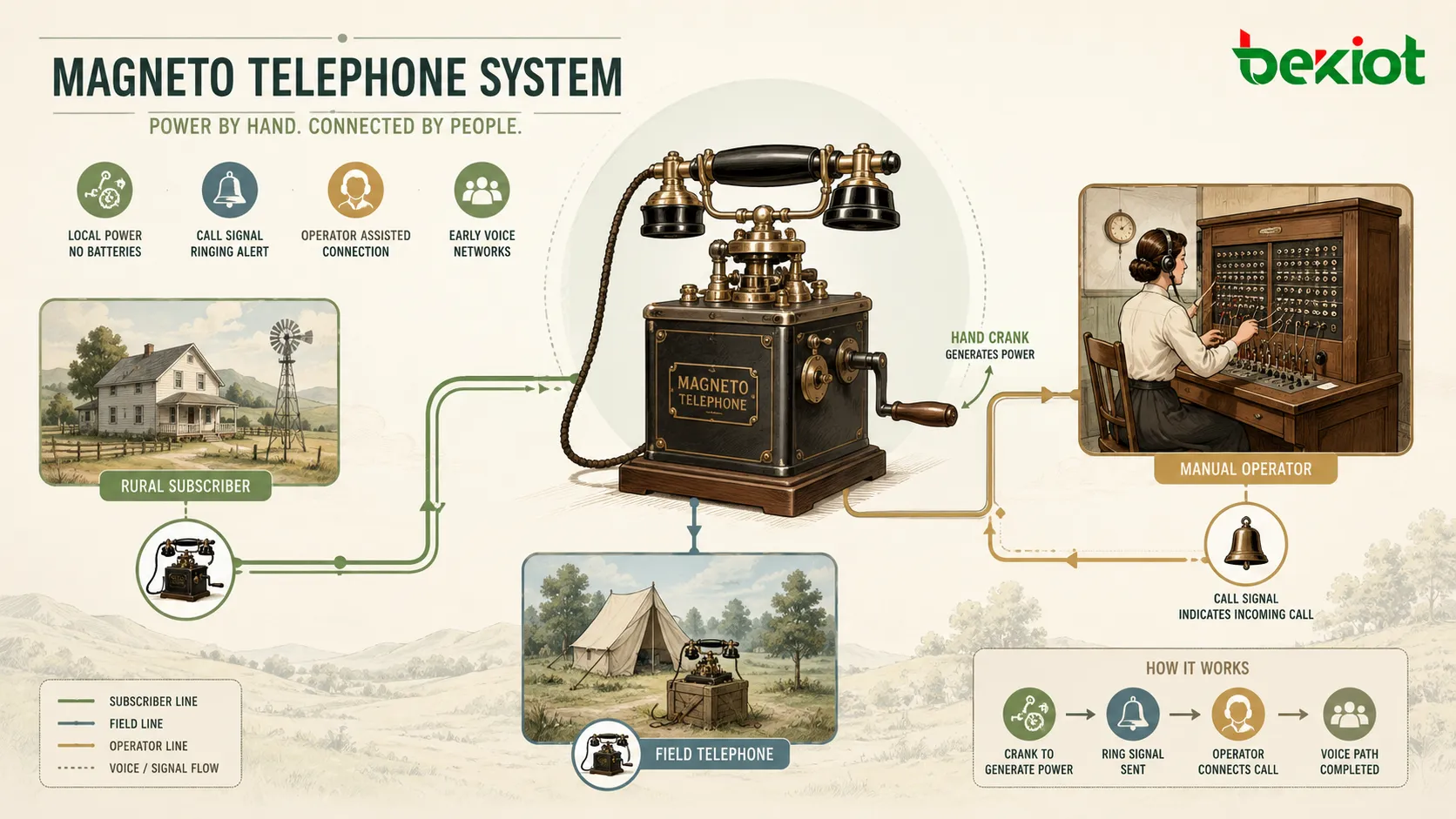
In a simple point-to-point setup, turning the crank could ring the bell on another telephone connected to the same pair of wires. In an exchange-based setup, it could light a signal or ring a drop indicator at the operator’s switchboard, telling the operator that a subscriber wanted to place a call.
Working Principle Behind the Crank
Magneto Generator
The magneto generator is a small hand-powered electrical generator. It usually contains permanent magnets, a rotating armature, gears, and a crank handle. When the user turns the crank, the gear mechanism spins the armature quickly inside the magnetic field.
This movement generates an alternating current suitable for ringing electromechanical bells. The faster and more steadily the crank is turned, the stronger and more consistent the ringing signal becomes.
Ringing Circuit
The ringing circuit is separate from the normal speech path. When the crank is turned, the magneto output is connected to the line so that the ringing current can travel to the remote bell or exchange indicator.
Many designs include a switch that keeps the magneto disconnected from the talking circuit when it is not being used. This prevents the generator circuit from interfering with normal voice communication.
Local Battery for Speech
Many magneto telephones are also local-battery telephones. This means the speech transmitter, often a carbon microphone, receives power from dry cells or wet cells installed near or inside the telephone.
The battery does not usually provide the ringing current. Instead, it powers the talking circuit so that speech can modulate the electrical current and travel along the line to the receiving telephone.
Receiver and Transmitter
The transmitter converts the speaker’s voice vibrations into electrical variations. The receiver at the other end converts those electrical variations back into sound. In early telephones, the transmitter and receiver were often separate parts, with the transmitter fixed to the telephone body and the receiver held to the ear.
Compared with modern telephones, the audio quality was limited, but the principle was revolutionary for its time. It allowed spoken words to travel across wires in real time.
Main Components Inside the Instrument
| Component | Main Function | Why It Matters |
|---|---|---|
| Hand Crank | Allows the user to rotate the magneto generator manually. | Creates the signaling action needed to call another telephone or operator. |
| Magneto Generator | Produces alternating current for ringing. | Provides local call signaling without relying on central ringing power. |
| Local Battery | Powers the carbon transmitter for speech. | Supports voice transmission over the line. |
| Bell or Ringer | Produces an audible ringing sound when called. | Alerts the user that another party or operator is calling. |
| Hook Switch | Changes circuit state when the receiver is lifted or replaced. | Controls whether the telephone is idle, ready to talk, or disconnected. |
| Line Terminals | Connect the telephone to outside wires. | Link the instrument to another phone, exchange, or field line. |
Typical Calling Sequence
A user first lifts the receiver or prepares the instrument for calling. Then the user turns the crank to generate ringing current. If the telephone is connected to another subscriber on a simple line, the remote bell rings. If it is connected to a manual exchange, the operator receives the signal.
After the called party or operator responds, the talking circuit becomes active. The local battery powers the transmitter, and both users speak through the line. When the conversation ends, the receiver is returned to the hook, opening or changing the circuit depending on the telephone design.
In manual exchange systems, the operator played a central role. The subscriber would crank the telephone, speak to the operator, request a destination, and wait while the operator connected the call by plugging cords into the switchboard.
The magneto telephone combined mechanical action and electrical communication: the hand crank created the call signal, while the battery-powered talking circuit carried the voice.
Historical Background
Early Manual Networks
In the early years of telephony, automatic dialing did not yet exist. Calls were commonly connected by operators at manual switchboards. Subscribers needed a way to signal the operator, and the hand-cranked magneto provided a practical solution.
This design was especially useful when telephone service expanded into areas where centralized power and advanced exchange infrastructure were not yet available. The telephone itself could generate the ringing signal, reducing dependence on complex outside equipment.
Rural and Long-Line Use
Rural telephone lines often stretched over long distances and served small communities. Installing and maintaining centralized battery and ringing systems could be expensive or impractical. Local-battery magneto telephones were therefore common on farms, estates, villages, and remote business sites.
Some rural lines were party lines, meaning several subscribers shared the same physical line. Different ringing patterns could identify which subscriber was being called. Users had to listen for their assigned ring, which made telephone use partly technical and partly social.
Field and Military Communication
Magneto-based field telephones were also used in temporary or rugged communication systems. They could be connected by a pair of wires and operated without a modern exchange. This made them useful for military field lines, railway maintenance, mining operations, construction sites, and temporary command posts.
The ability to generate a call signal locally was valuable in places where commercial telephone service was unavailable or unreliable.
Transition to Common-Battery Systems
As telephone networks became more advanced, many systems moved from local-battery operation to common-battery operation. In common-battery systems, the exchange supplied power for the subscriber line, and users no longer needed to maintain local batteries for normal speech transmission.
This change simplified maintenance and improved service consistency. Over time, automatic exchanges, dial telephones, electronic switching, and digital networks replaced the older crank-based systems in most public networks.
Why This Technology Was Important
The magneto design helped make early telephony practical outside large urban centers. It gave subscribers a way to call attention without requiring a fully powered central office system for every function. This supported the expansion of voice communication into rural, industrial, and temporary environments.
It also introduced important ideas that continued in later telecommunications: call signaling, circuit switching, line supervision, local power, operator-assisted connection, and user-controlled call initiation. Even though the hand crank disappeared from everyday service, the need to signal, route, and supervise calls remained central to telephone network design.
From a historical perspective, the instrument represents the transition from purely manual communication methods to organized electrical voice networks. It was simple enough for field use but powerful enough to support real-time voice contact over distance.
Advantages in Early Communication
Independent Signaling
The telephone could generate its own ringing signal. This made it useful in places where central ringing current was not available or where the line needed to operate independently.
Independent signaling also made simple private lines possible. Two locations could be connected with a wire pair and use the crank to call each other.
Suitable for Remote Areas
The equipment could operate in rural or isolated locations with limited infrastructure. As long as the line was intact and the batteries were maintained, users could communicate over significant distances.
This helped farms, railways, mines, estates, military units, and small communities establish voice links before modern networks reached them.
Simple and Serviceable Design
Although the device was mechanical and electrical, many parts were understandable and serviceable. Bells, cranks, terminals, batteries, hooks, and wiring could often be inspected directly.
This practicality was important in an era when specialized technical support was not always nearby.
Limitations and Practical Problems
Battery Maintenance
Local batteries needed inspection and replacement. Wet cells could leak, and dry cells eventually lost power. If the battery was weak, speech transmission could become poor even if the ringing circuit still worked.
This maintenance burden was one reason common-battery systems became attractive later.
Manual Calling Process
Users had to turn the crank and often rely on an operator. There was no direct keypad dialing, no automatic routing, and no instant number selection. The process was slower than modern telephony.
In party-line systems, privacy was limited because multiple subscribers could share the same line and sometimes listen to conversations.
Limited Audio Quality
Early transmitters, receivers, batteries, and line conditions limited voice clarity. Long lines, poor insulation, weak batteries, moisture, and interference could reduce speech quality.
The system worked well enough for practical communication, but it could not match the clarity, reliability, and convenience of later telephone technologies.
Dependence on Physical Lines
Like other wired telephones, the system depended on intact line wires. Broken wires, corrosion, poor connections, and weather damage could interrupt service.
Field and rural systems required regular line inspection, especially in areas exposed to storms, animals, construction, or rough terrain.
Modern Relevance and Preservation
Today, magneto telephones are mainly studied by collectors, museums, historians, telecom engineers, antique restorers, and people interested in the history of communication. They are often restored as display items, educational tools, or working private-line demonstrations.
Some principles remain useful for understanding modern communication systems. The difference between signaling and speech, the need for power, the role of switches, and the importance of line conditions are still relevant, even though the hardware has changed dramatically.
Restoration should be handled carefully. Old batteries may leak, wiring insulation may be brittle, and magneto generators can produce unpleasant or potentially unsafe voltages when cranked. Antique equipment should not be connected to modern telephone networks without proper interface equipment and expert review.
Comparison with Later Telephone Systems
| System Type | Calling Method | Power Arrangement | Main Difference |
|---|---|---|---|
| Magneto Telephone | User turns a crank to generate ringing current. | Often uses local batteries for speech. | Manual signaling and operator or direct-line calling. |
| Common-Battery Telephone | Exchange detects line condition and provides power. | Central office supplies line power. | Less local maintenance and easier network control. |
| Rotary Dial Telephone | User dials digits mechanically. | Powered by exchange line current. | Supports automatic switching without asking an operator for every call. |
| Modern IP Phone | User dials through digital signaling over IP. | Uses PoE, adapter power, or endpoint supply. | Voice becomes data packets managed by SIP, VoIP, and network systems. |
FAQ
Can two old magneto telephones still call each other?
Yes, in a private demonstration setup, two compatible units can often be connected with suitable wiring and batteries. However, the condition of the instruments, line, ringer, and batteries must be checked first.
Is the crank used for talking?
No. The crank is mainly used for signaling and ringing. Voice communication uses the telephone transmitter, receiver, line circuit, and local battery or other talking power source.
Why do some antique units have large internal batteries?
Many early instruments used local batteries to power the carbon transmitter. These batteries were needed for speech transmission, not just for ringing.
Can a hand-cranked telephone be connected to a modern phone line?
It should not be connected directly without proper interface equipment. Modern networks use different signaling and electrical conditions, and the magneto generator may not be compatible with modern telephone equipment.
Why are these telephones popular with collectors?
They combine visible mechanical parts, early electrical engineering, wood or metal craftsmanship, and historical importance. They also show how telephone users once actively generated call signals by hand.