


In 4G wireless communication projects, terms such as LTE Cat.1 and LTE Cat.4 often appear during module selection, terminal planning, public network intercom design, industrial IoT deployment, remote monitoring, and mobile communication system integration. These category names are not simple marketing labels. They describe different LTE capability levels, especially the maximum theoretical uplink and downlink performance that a terminal can support in a 4G network.
For system integrators, product planners, and project buyers, understanding the difference between Cat.1 and Cat.4 is important because it affects communication performance, terminal cost, power consumption, network resource usage, and long-term scalability. Choosing a module with insufficient bandwidth may cause unstable service, while choosing an over-specified module may increase cost without improving the actual user experience.
Why LTE Categories Matter in 4G Projects
4G LTE networks introduced broadband mobile data capabilities for terminals, vehicles, field devices, industrial equipment, and IoT systems. Although 5G continues to develop, 4G remains a widely used network foundation because it has broad coverage, mature infrastructure, stable module supply, and good compatibility with many existing platforms.
Unlike a wired LAN connection, a mobile network is a shared wireless resource. Devices connected to the same base station compete for available spectrum, scheduling time, and data capacity. If every terminal were allowed to occupy resources without classification, network management would become inefficient, especially in dense deployment environments such as industrial parks, logistics centers, city facilities, and public safety systems.
LTE categories help solve this problem by defining the communication capability level of user equipment. The category level tells the network and the device what performance class is supported. In practical projects, this affects how much bandwidth a terminal can use, how much data it can upload or download, and whether it is suitable for voice, data, image, video, or mixed-service communication.
Understanding the Category System
LTE category classification is used to describe different performance levels of LTE terminals. The article’s core point is that LTE categories range from Category 0 to Category 19, often written as Cat.0 to Cat.19, forming 20 levels of LTE capability classification. Each category corresponds to a different theoretical rate and device capability.
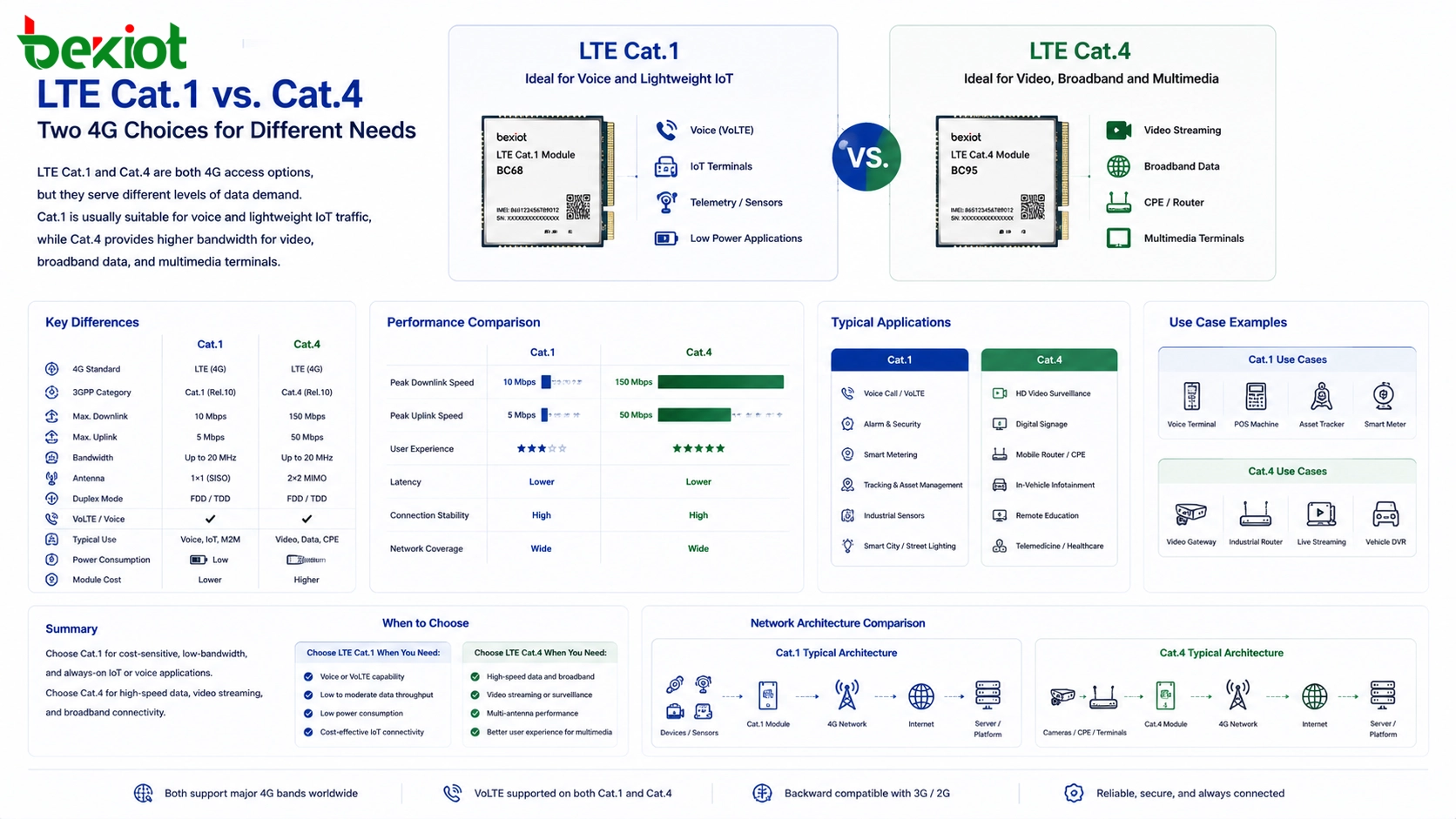
In industrial and IoT applications, Cat.1 and Cat.4 are two commonly discussed categories. They are both based on 4G LTE access, but their performance positioning is very different. Cat.1 focuses on moderate data rates and cost-sensitive connectivity, while Cat.4 is designed for higher throughput and richer data services.
| LTE Category | Maximum Downlink | Maximum Uplink | Typical Positioning |
|---|---|---|---|
| LTE Cat.1 | 10 Mbps | 5 Mbps | Voice communication, lightweight IoT, public network intercom, status reporting, control data |
| LTE Cat.4 | 150 Mbps | 50 Mbps | Video upload, mobile broadband, industrial router, multimedia terminal, high-data communication |
The difference between 10 Mbps downlink and 150 Mbps downlink is significant. The difference between 5 Mbps uplink and 50 Mbps uplink is also important, especially in projects where terminals need to upload video, images, alarms, positioning information, or real-time data to a management platform.
Choosing by Real Service Demand
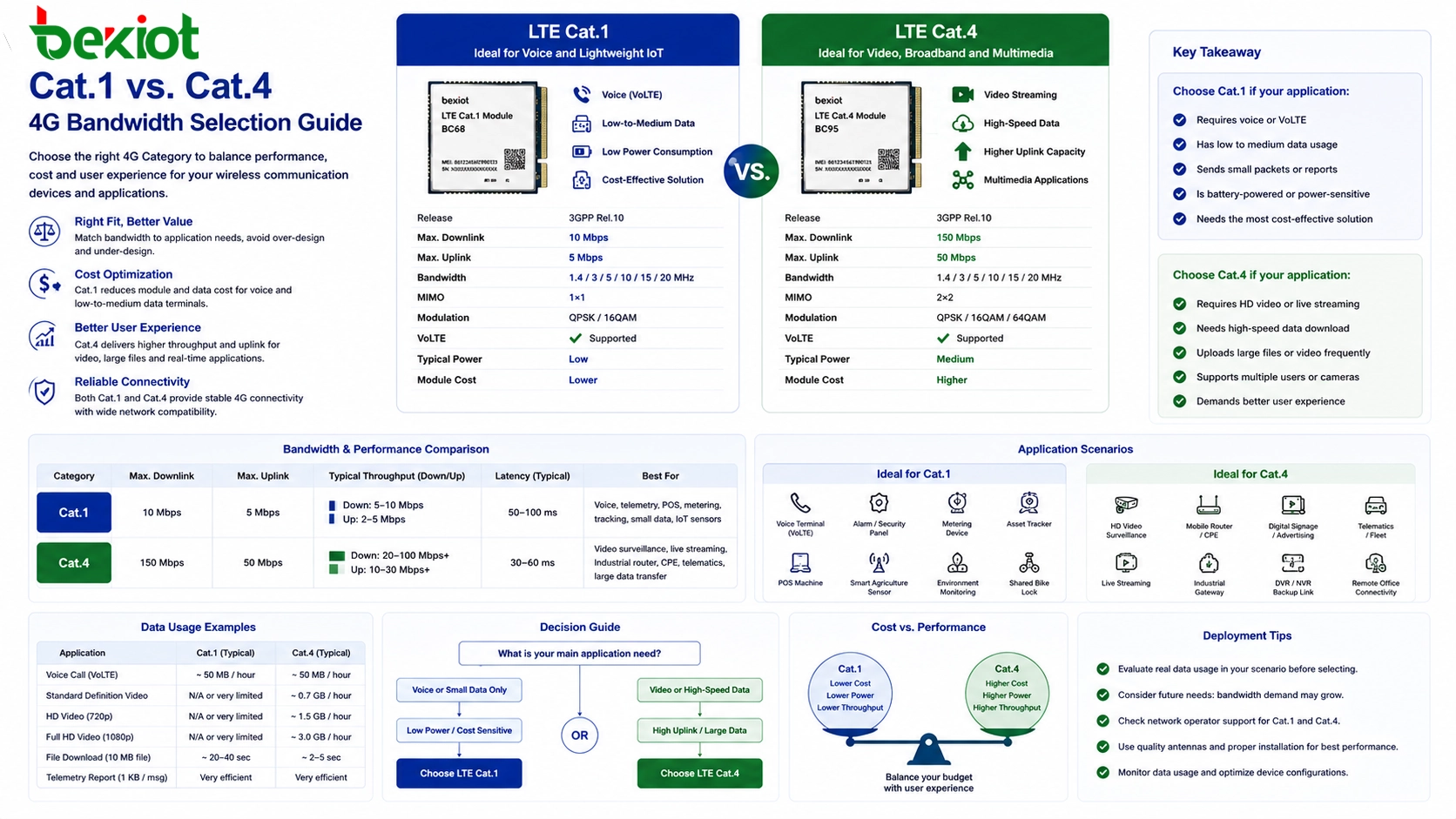
The right LTE category should be selected according to the actual service carried by the terminal. A higher category is not always better, and a lower category is not always weaker. The key is whether the network capability matches the application workload.
For voice communication, command signaling, location reporting, short data messages, device status updates, alarm reporting, and remote control, Cat.1 can often provide enough bandwidth. Its 10 Mbps downlink and 5 Mbps uplink capability can support many IoT and voice-oriented projects without requiring the higher hardware cost of Cat.4.
For applications involving video transmission, real-time image upload, remote visual inspection, vehicle-mounted communication, mobile broadband access, or multi-application data traffic, Cat.4 is usually more suitable. Its maximum 150 Mbps downlink and 50 Mbps uplink provide much more bandwidth headroom, which helps reduce the risk of congestion and improves service smoothness.
Cost and Performance Should Be Balanced
Module cost is a key factor in large-scale deployment. When a project includes hundreds or thousands of terminals, even a small cost difference per device can become a major budget item. Cat.1 modules are often selected in cost-sensitive IoT projects because they provide practical 4G connectivity without the full performance level of Cat.4.
However, cost reduction should not come at the expense of service quality. If a terminal needs frequent video upload or high-volume data transfer, using a lower category only to reduce cost may lead to slow response, unstable transmission, poor user experience, and higher maintenance costs later.
A practical deployment strategy is to divide terminals by service type. Voice terminals, alarm nodes, sensor gateways, positioning devices, and public network intercom devices can use Cat.1 when bandwidth demand is moderate. Video terminals, mobile routers, vehicle-mounted devices, and multimedia dispatch equipment can use Cat.4 when higher throughput is necessary.
Uplink Capacity Deserves More Attention
Many people focus only on downlink speed because it is commonly associated with browsing, downloading, and receiving content. In IoT and industrial communication projects, uplink speed can be even more important. Devices often need to upload data from the field to a cloud platform, command center, dispatch system, or monitoring server.
Examples include alarm data from safety equipment, GPS location from mobile terminals, operating status from industrial devices, voice packets from intercom terminals, and video streams from cameras or body-worn devices. In these scenarios, uplink performance directly affects whether the platform receives field information in time.
This is why the difference between Cat.1 uplink at 5 Mbps and Cat.4 uplink at 50 Mbps should not be ignored. For pure voice and simple IoT data, 5 Mbps may be enough. For video or multi-service upload, 50 Mbps provides a much stronger margin.
Planning for Public Network Intercom and Voice Terminals
Public network intercom systems often use 4G networks to connect handheld terminals, vehicle terminals, dispatch platforms, and management software. The main traffic is usually voice, signaling, location, group call control, and status synchronization. These data types do not normally require extremely high bandwidth.
For this reason, Cat.1 is often a practical choice for voice-first terminals. It can support stable network access while helping reduce module cost and power demand. This is valuable for portable devices, battery-powered terminals, and systems where many users are deployed across different locations.
However, if the terminal also needs video call, image upload, mobile hotspot, remote video dispatch, or larger data services, Cat.4 may be more appropriate. The selection should always follow the actual communication function of the terminal rather than only the product category name.
Planning for Industrial IoT and Remote Monitoring
Industrial IoT projects often include sensors, controllers, edge gateways, data collection units, and alarm terminals. Many of these devices transmit small packets at regular intervals. For these applications, Cat.1 can provide a good balance between 4G coverage, data capability, cost, and energy efficiency.
Remote monitoring systems may require a different approach. If the system only uploads equipment status, temperature, pressure, voltage, current, or fault alarms, Cat.1 may be enough. If the system includes real-time video monitoring, high-frequency data collection, or large-volume file transmission, Cat.4 should be considered.
In industrial environments, communication planning should also consider antenna position, metal obstruction, indoor signal attenuation, operator coverage, and electromagnetic interference. The theoretical category speed is only one part of the solution. Real site performance depends on both module capability and network conditions.
Field Testing Before Large Deployment
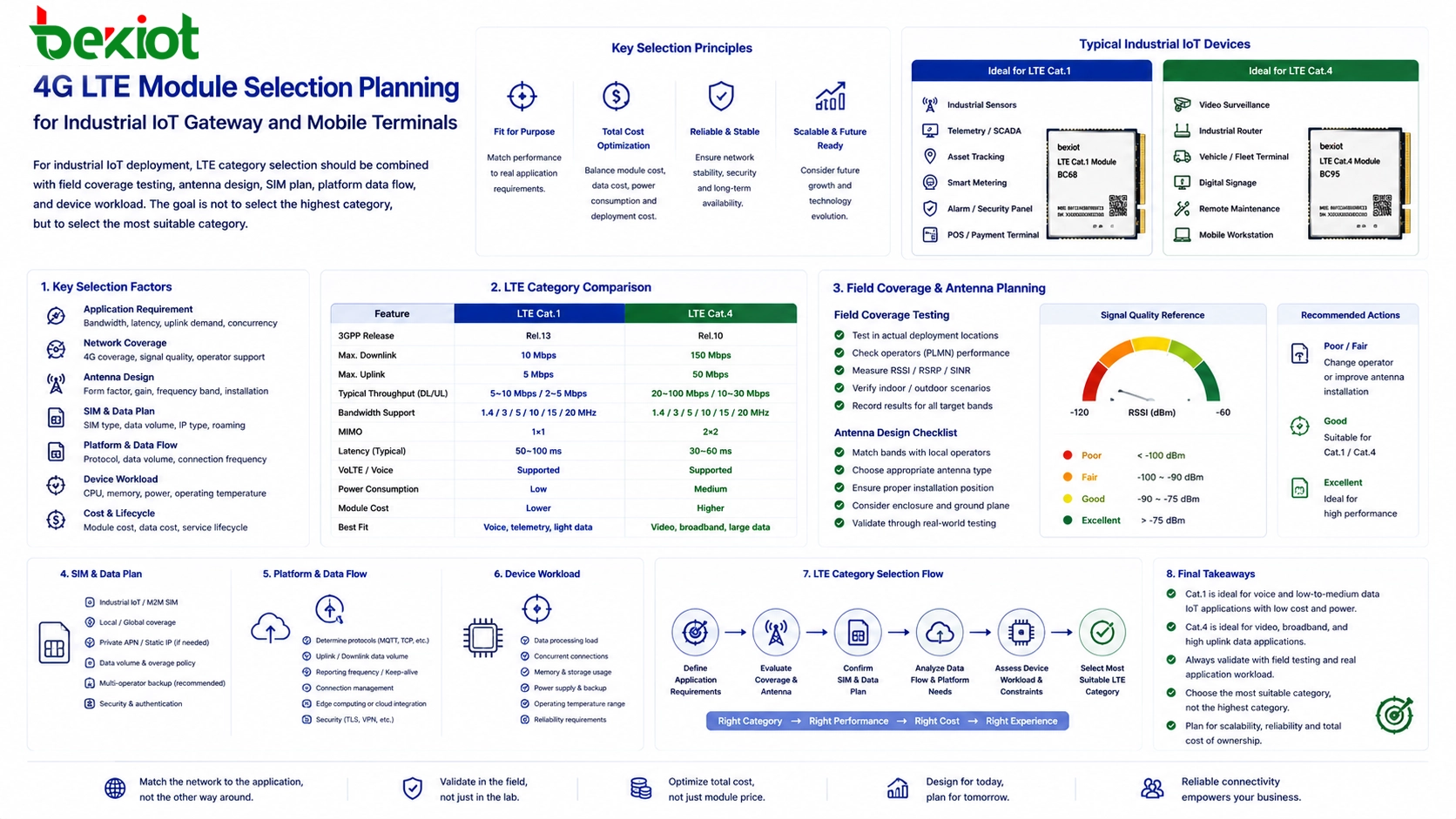
The maximum data rate of Cat.1 or Cat.4 is a theoretical value. Actual network speed may be affected by base station load, signal strength, operator policy, SIM card package, antenna gain, installation position, building structure, and the number of active devices in the same area.
Before mass deployment, project teams should test real uplink and downlink speed in the target environment. Testing should include indoor and outdoor areas, weak-signal zones, moving scenarios, peak network hours, and multi-terminal concurrency. This helps avoid performance problems after installation.
For mission-critical systems, it is also useful to test packet loss, latency, reconnection speed, roaming behavior, and platform response time. A stable communication solution is not only about peak bandwidth; it is also about continuous availability and predictable performance during daily operation.
A Layered Architecture Is Often the Best Choice
In many real projects, the most reasonable architecture is not choosing Cat.1 for everything or Cat.4 for everything. A layered architecture can be more efficient. Different terminals use different LTE categories according to their role in the system.
For example, a smart industrial park may use Cat.1 for alarm terminals, voice intercom devices, access control communication, and status collection nodes. At the same time, it may use Cat.4 for mobile video terminals, vehicle-mounted routers, emergency command devices, and remote monitoring units.
This layered design allows the project to control cost while still reserving enough bandwidth for high-demand devices. It also makes later expansion easier because new terminals can be assigned to the proper communication level according to their function.
Typical Cat.1 Application Scenarios
Cat.1 is suitable for many low-to-medium bandwidth applications. Typical scenarios include public network intercom terminals, smart meters, alarm reporting devices, asset tracking terminals, remote control devices, simple IoT gateways, industrial data collection, wearable communication devices, and portable voice terminals.
These applications usually need wide-area 4G access, stable connection, moderate data throughput, and reasonable cost. They do not require high-speed video transmission or mobile broadband-level performance. For such projects, Cat.1 can be a practical and economical communication choice.
Typical Cat.4 Application Scenarios
Cat.4 is more suitable for applications with stronger data requirements. Typical scenarios include mobile video terminals, vehicle routers, 4G industrial routers, remote video inspection, law enforcement terminals, multimedia dispatch equipment, emergency command terminals, and field devices that need high-speed upload or download.
When the terminal must handle video, multiple services, image transmission, or larger data exchange, Cat.4 gives the system more performance margin. This helps the device maintain better communication quality when network conditions fluctuate or when the service load increases.
How to Make the Final Selection
The final selection should consider service type, bandwidth demand, uplink requirement, terminal quantity, project budget, battery life, deployment environment, operator coverage, and future expansion. If the system is mainly used for voice and lightweight data, Cat.1 is often enough. If the system requires video and high-speed data, Cat.4 is usually safer.
A good 4G communication solution should not only compare theoretical speed. It should match the terminal’s real workload with a suitable communication category. This approach improves reliability, avoids unnecessary cost, and supports long-term system operation.
FAQ
Is Cat.1 only used for low-end devices?
No. Cat.1 is not simply a low-end choice. It is a practical LTE category for devices that need reliable 4G access but do not require high broadband performance.
Can Cat.1 support positioning and dispatch data?
Yes. Positioning, signaling, group control, dispatch messages, and basic device status data usually have moderate bandwidth requirements, so Cat.1 can support many of these services.
When should a project avoid Cat.1?
If the device needs continuous video upload, high-speed file transfer, mobile broadband sharing, or multiple high-data applications at the same time, Cat.4 is usually a better choice.
Does Cat.4 always provide 150 Mbps in real use?
No. 150 Mbps is a theoretical maximum downlink rate. Actual speed depends on signal quality, base station load, operator network conditions, antenna design, SIM policy, and installation environment.
Can one platform manage both Cat.1 and Cat.4 terminals?
Yes. In many systems, Cat.1 and Cat.4 terminals can work under the same management platform as long as the application protocol, SIM access, server connection, and device configuration are properly planned.
Which category is better for battery-powered devices?
Battery-powered devices often prefer a category that matches the real workload. If the application mainly sends voice or small data packets, Cat.1 may help reduce unnecessary power and cost pressure compared with a higher-throughput category.







