


LoRa is a wireless transmission technology widely used in Internet of Things applications. By using specific wireless frequency bands for low-power data communication, it provides the advantages of low deployment cost, wide-area coverage, flexible installation, and strong suitability for distributed sensor networks. In smart parks, smart communities, smart buildings, smart cities, industrial sites, utility monitoring, and environmental sensing projects, LoRa can help collect field data without relying on heavy cable construction.
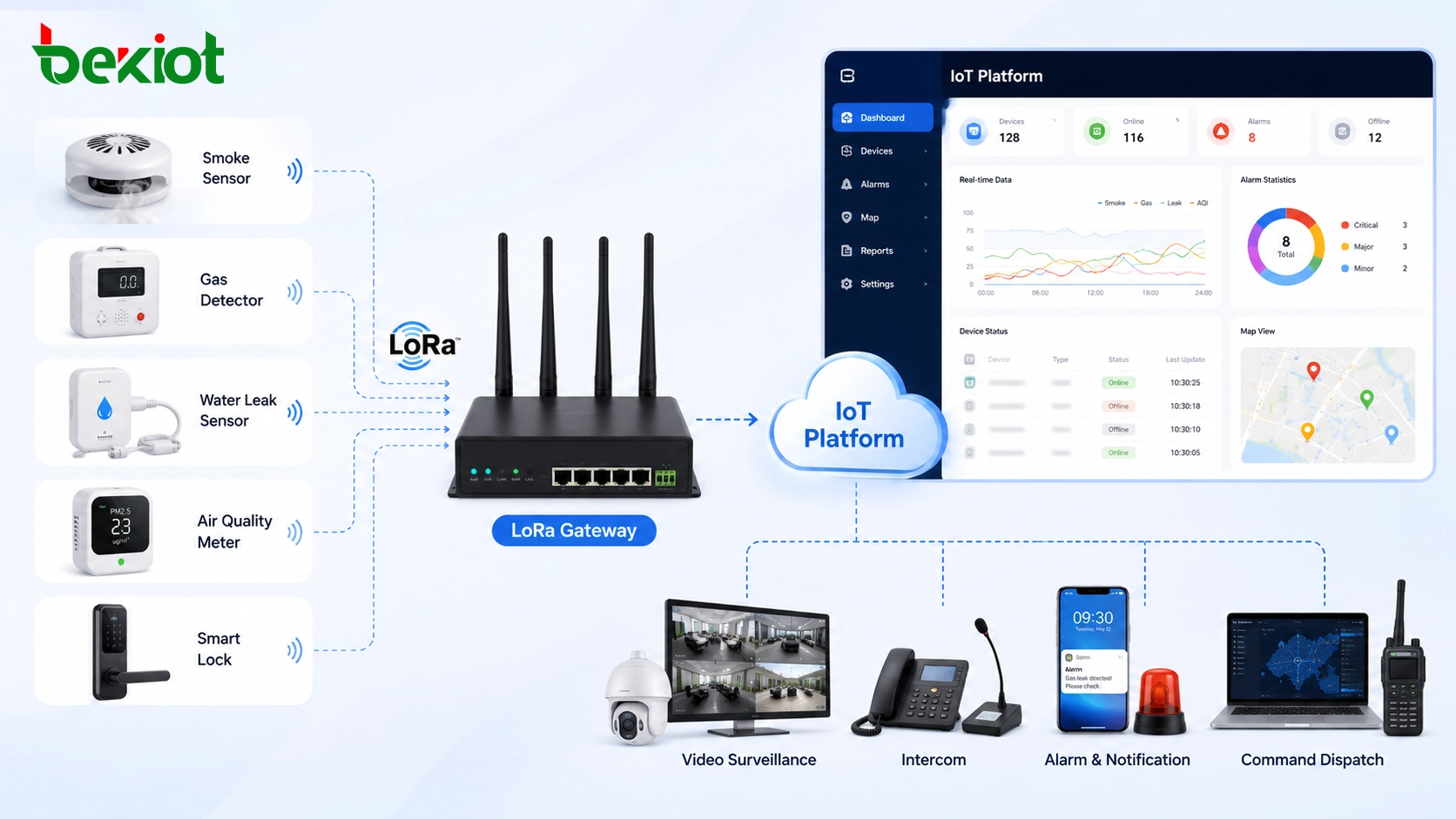
A complete LoRa-based IoT solution is not made of one device alone. It usually includes front-end sensor terminals, LoRa wireless gateways, server-side platforms, application systems, and management tools. Each layer has a clear role: terminals collect data, gateways forward data, servers process and manage data, and applications present the results for users, operators, or other business systems.
Why this wireless approach fits distributed sensing
Many IoT projects need to collect small amounts of data from a large number of points. These points may be installed in buildings, corridors, basements, warehouses, parks, equipment rooms, utility areas, outdoor spaces, or remote corners where cabling is inconvenient. Traditional wired deployment can increase construction cost, extend the project cycle, and make later expansion difficult.
LoRa is suitable for these conditions because it focuses on long-range, low-power, low-data-rate communication. It is not designed for high-bandwidth video or large file transmission. Instead, it is more suitable for sensor values, alarm states, meter readings, switch status, environmental data, and equipment signals. This makes it practical for IoT systems that require wide coverage and low maintenance.
Another important advantage is that many LoRa networks can be deployed by the project owner or system integrator as a private wireless network. Once the network is built within the planned coverage area, field devices can communicate without requiring every sensor to use a separate public network subscription. This can reduce long-term communication cost in projects with many endpoints.
Field terminals collect the original data
Terminal devices are the front-end nodes of a LoRa IoT system. They are usually built around sensors, control points, or metering devices. To simplify project deployment, many products integrate the sensor module and the LoRa wireless module into one terminal, so the device can collect data and send it wirelessly without extra communication wiring.
Common LoRa terminal types include smoke detectors, hazardous gas sensors, water leakage detectors, air quality sensors, temperature and humidity sensors, smart switches, control panels, metering devices, electronic locks, level sensors, pressure sensors, and equipment status monitors. Different projects can choose different terminal types according to the data that needs to be collected.
In practical deployment, the terminal layer should be planned according to monitoring points, installation environment, battery life, reporting frequency, alarm priority, enclosure protection, and maintenance access. For example, an underground water leakage sensor may require strong protection and long battery life, while an indoor air quality sensor may focus more on stable periodic reporting and easy installation.
Wireless coverage reduces cabling work
One reason LoRa is widely used in smart buildings, smart parks, and community projects is that it reduces the need for long-distance signal wiring. After gateways are deployed in suitable locations, terminal devices within the coverage area can send data wirelessly. This is useful for renovation projects, scattered buildings, outdoor points, and areas where trenching or cable routing is difficult.
The reduction of cabling does not mean that planning is unnecessary. Project teams still need to consider building structure, wall penetration, installation height, antenna placement, gateway quantity, coverage overlap, interference sources, and future expansion. Good wireless planning helps improve data reliability and reduces blind spots.
For large sites, the coverage design should be tested in real conditions rather than estimated only from drawings. Different materials, floor layouts, underground spaces, metal structures, and equipment rooms may affect wireless performance. A practical solution usually combines coverage planning, on-site testing, and gateway placement optimization.
Gateways connect sensor nodes to the platform
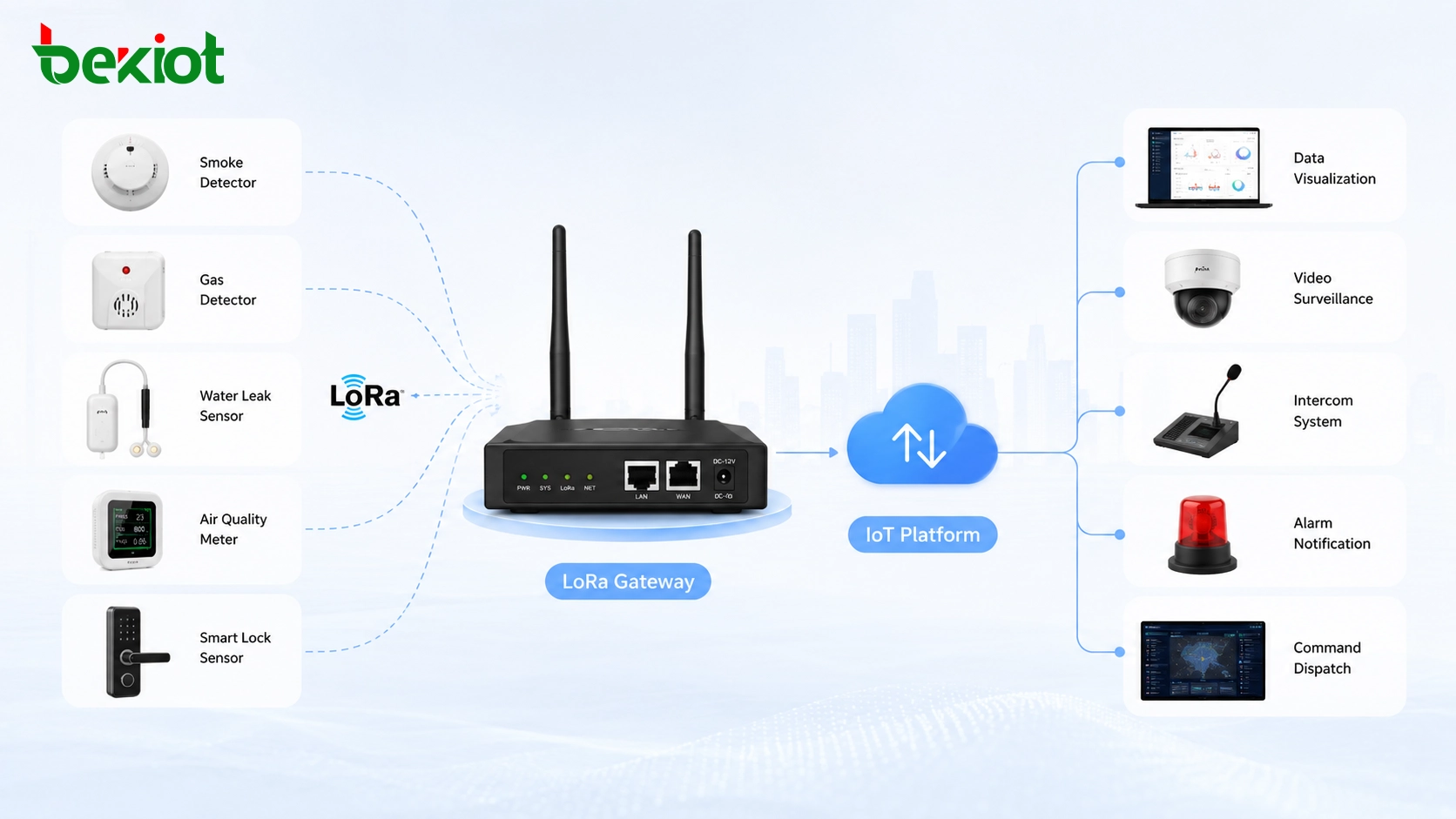
The LoRa gateway is the bridge between field terminals and the server platform. It communicates with multiple LoRa terminal devices on the wireless side and forwards collected data to the server side through an uplink network. This uplink may use Ethernet, cellular networks, fiber access, private networks, or other available IP connections depending on the project environment.
A gateway usually has better processing and communication capability than a single terminal node. It can handle data from many distributed terminals, manage wireless communication within the coverage area, and forward collected information to the platform for storage, analysis, visualization, and alarm processing.
Gateway deployment should consider coverage radius, installation position, power supply, network uplink stability, antenna direction, enclosure protection, maintenance convenience, and redundancy. In important scenarios, multiple gateways may be planned to improve coverage reliability and reduce the risk of a single point of failure.
The server layer is the center of management
The server side is the core of a LoRa IoT system. It receives data forwarded by gateways, organizes terminal information, manages device status, processes alarms, and provides data for upper-layer applications. Depending on the project, the server layer can be deployed on a cloud platform, a private data center, an on-premise server, or a hybrid architecture.
In addition to receiving sensor data, the server platform should support device management, registration, authentication, permission control, encryption, and communication management. These functions are important because IoT systems may contain many distributed devices, and each device must be identified, managed, and protected.
A well-designed server platform does not only display raw data. It should provide structured data processing, historical records, alarm rules, event logs, statistical analysis, and interfaces for application systems. This allows the LoRa network to become part of a larger smart management platform instead of remaining an isolated sensing system.
Applications turn data into usable information
The application layer is where users see and use the collected data. It may include a web dashboard, mobile application, monitoring screen, alarm management page, GIS map, maintenance system, building management platform, or smart city operation platform. The purpose of this layer is to turn sensor data into clear, actionable information.
For example, water leakage data can become an alarm event with location information. Air quality readings can become environmental trend charts. Smoke or gas detection can trigger emergency notification. Meter readings can support energy analysis. Smart lock status can support access control management. The value of the LoRa system depends on how well the data is presented and used.
Application systems should also provide interfaces for integration. Through APIs or data exchange mechanisms, LoRa data can be shared with building automation systems, safety platforms, maintenance systems, command centers, or third-party business applications.
Security and device control cannot be ignored
Because a LoRa IoT system may manage many sensors and alarms, security should be considered from the beginning. Device registration helps ensure that only authorized terminals can join the system. Authentication helps verify device identity. Encryption helps protect data during transmission and platform processing.
Permission management is also important on the application side. Different users may need different access levels. A maintenance worker may only need to view alarms in one area, while an administrator may need to configure devices, gateways, alarm rules, and system settings. Proper permission design improves both security and operational clarity.
For large projects, device lifecycle management should also be planned. This includes device activation, location binding, battery monitoring, signal quality tracking, maintenance records, replacement management, and offline alarm handling.
Integration creates a smarter operating platform
A LoRa IoT system can deliver more value when it is integrated with other communication and management systems. Sensor alarms can be linked with phone systems, intercom systems, public address systems, video surveillance platforms, access control systems, or command dispatch platforms. This allows the project to move from passive monitoring to active response.
For example, when a water leakage sensor reports an alarm, the platform can display the location, notify maintenance staff, trigger a voice announcement, open a related camera view, or create a work order. When a hazardous gas sensor detects abnormal data, the system can send alerts to safety personnel and support emergency coordination.
This kind of linkage is especially useful in smart parks, smart communities, industrial facilities, warehouses, campuses, utility corridors, and city management projects. LoRa provides the sensing layer, while other systems provide communication, verification, dispatch, and response capabilities.
Typical deployment structure
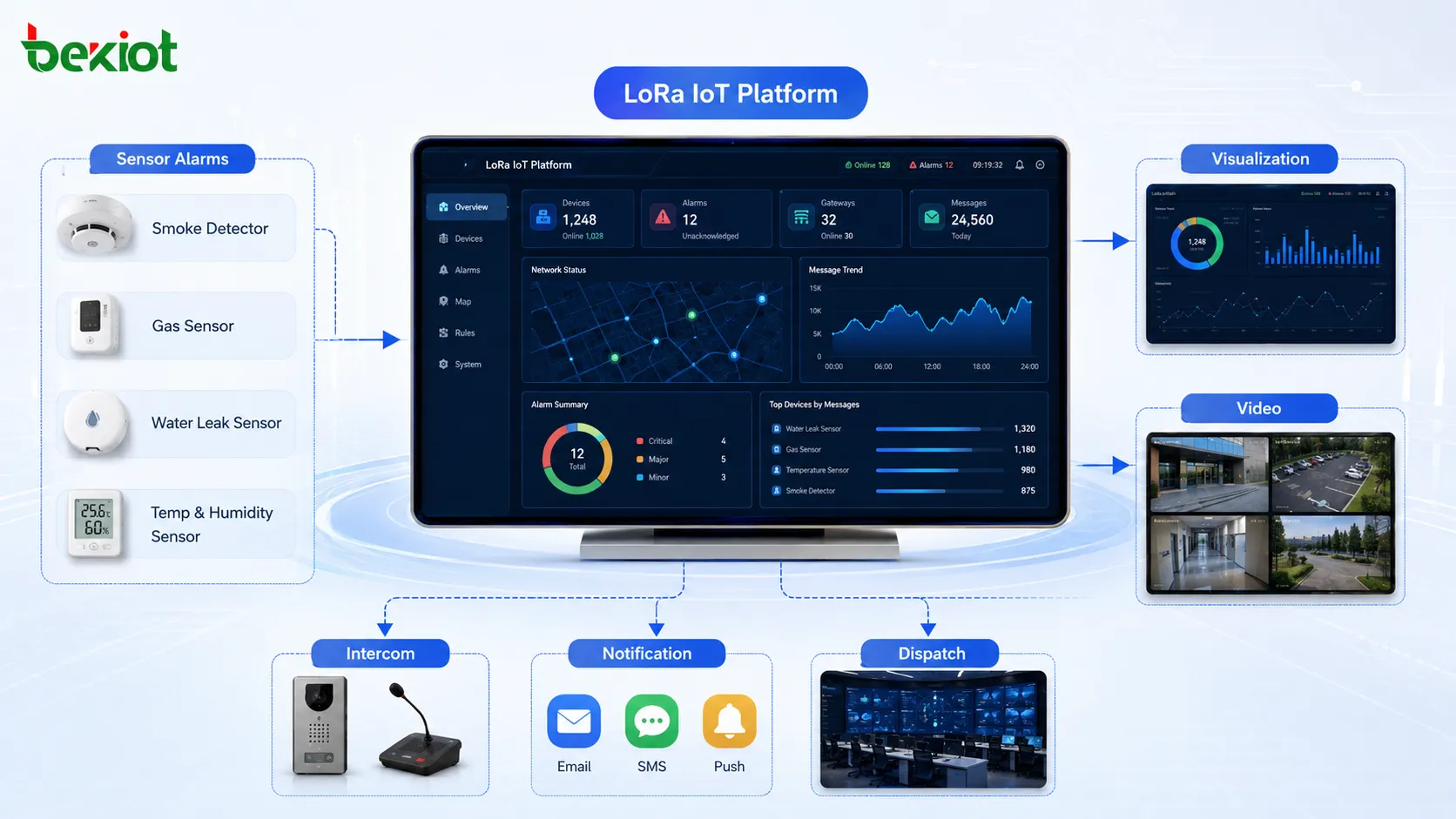
A practical LoRa IoT solution can be divided into four main layers. The first layer is the sensing layer, including smoke sensors, gas sensors, water leakage detectors, air quality sensors, switches, panels, meters, locks, and other terminal devices. These terminals collect status data or alarm information from the field.
The second layer is the wireless access layer, mainly composed of LoRa gateways. Gateways provide wireless coverage, collect data from terminal devices, and forward information to the server platform through an uplink network. The third layer is the platform layer, which manages devices, processes data, stores records, handles security, and provides service interfaces.
The fourth layer is the application layer. This layer presents data through dashboards, maps, alarms, reports, maintenance tools, and integrated management systems. In mature projects, it may also connect with video access gateways, intercom gateways, command dispatch systems, or other smart operation platforms.
Planning points before project deployment
Before building a LoRa IoT system, project teams should first define the data collection purpose. Different projects may focus on safety alarms, environmental monitoring, energy metering, equipment status, access management, or facility maintenance. The required terminal types should be selected according to the actual business goal.
Coverage planning is the next key step. The team should confirm the site area, building structure, terminal density, gateway location, installation height, signal obstacles, and uplink network conditions. A good gateway layout can improve communication reliability and reduce later maintenance work.
Platform planning is equally important. The project should decide whether to use a cloud platform, private deployment, or hybrid deployment. It should also confirm data storage requirements, alarm rules, user permissions, integration interfaces, visualization needs, and long-term device management processes.
Where this solution is most valuable
LoRa-based IoT solutions are suitable for scenarios that require many low-power sensing points and wide-area wireless coverage. In smart buildings, they can support environmental monitoring, water leakage detection, smoke detection, and equipment status collection. In smart parks, they can support outdoor sensing, facility monitoring, access status, and energy data collection.
In smart communities, LoRa can be used for meters, locks, safety sensors, and environmental data. In industrial facilities, it can help collect equipment status, safety alarms, and maintenance signals from areas where wiring is difficult. In city-level applications, it can support distributed monitoring points across streets, utility spaces, public facilities, and outdoor assets.
The main value is not only wireless data transmission. The greater value comes from combining terminals, gateways, platforms, visualization, security management, and system integration into one complete IoT solution.
Conclusion
A complete LoRa IoT solution is built from multiple layers rather than a single product. Sensor terminals collect field data, gateways provide wireless coverage and uplink forwarding, server platforms handle management and processing, and applications turn the data into useful information for users and operators.
With low deployment cost, wide coverage, reduced cabling work, and private network flexibility, LoRa is well suited for smart buildings, smart parks, smart communities, industrial monitoring, and city-level sensing projects. When combined with data visualization, device management, authentication, encryption, and integration with communication or video systems, it can become an important foundation for intelligent operations.
FAQ
Is LoRa suitable for video transmission?
No. LoRa is mainly suitable for low-data-rate sensor information, alarm states, meter readings, and equipment status. Video transmission requires much higher bandwidth and should use other network technologies.
Can LoRa devices work without laying communication cables?
Yes. LoRa terminals communicate wirelessly with gateways within the planned coverage area. Power supply, battery life, installation location, and signal quality still need to be considered during deployment.
Why does a LoRa project need a gateway?
A gateway connects wireless LoRa terminals with the server platform. It collects data from multiple terminals and forwards that data to the platform through an uplink network.
Should the server platform be cloud-based or private?
Both options are possible. Cloud deployment is convenient for distributed management, while private deployment may be preferred when data security, local control, or closed-network operation is required.
What makes a LoRa IoT solution more than a sensor network?
A complete solution includes data processing, device management, authentication, encryption, visualization, alarm rules, application interfaces, and integration with other management or communication systems.







