


In many remote and mobile operation scenarios, video communication is no longer an optional function. Organizations may need to transmit surveillance footage, support video calls, run video conferences, or send live images from the field back to a command center. However, when the network is unstable or bandwidth is limited, traditional video transmission can easily suffer from delay, freezing, packet loss, blurred images, and interrupted playback.
A weak network environment usually refers to satellite communication networks, but it can also include remote wired networks, low-bandwidth wireless networks, offshore networks, temporary field networks, and areas where communication infrastructure is incomplete. In recent years, satellite communication systems have improved in total capacity and transmission rate, yet video applications have also grown rapidly. More cameras, terminals, conference systems, and mobile users now need video services, creating new pressure on limited network resources.
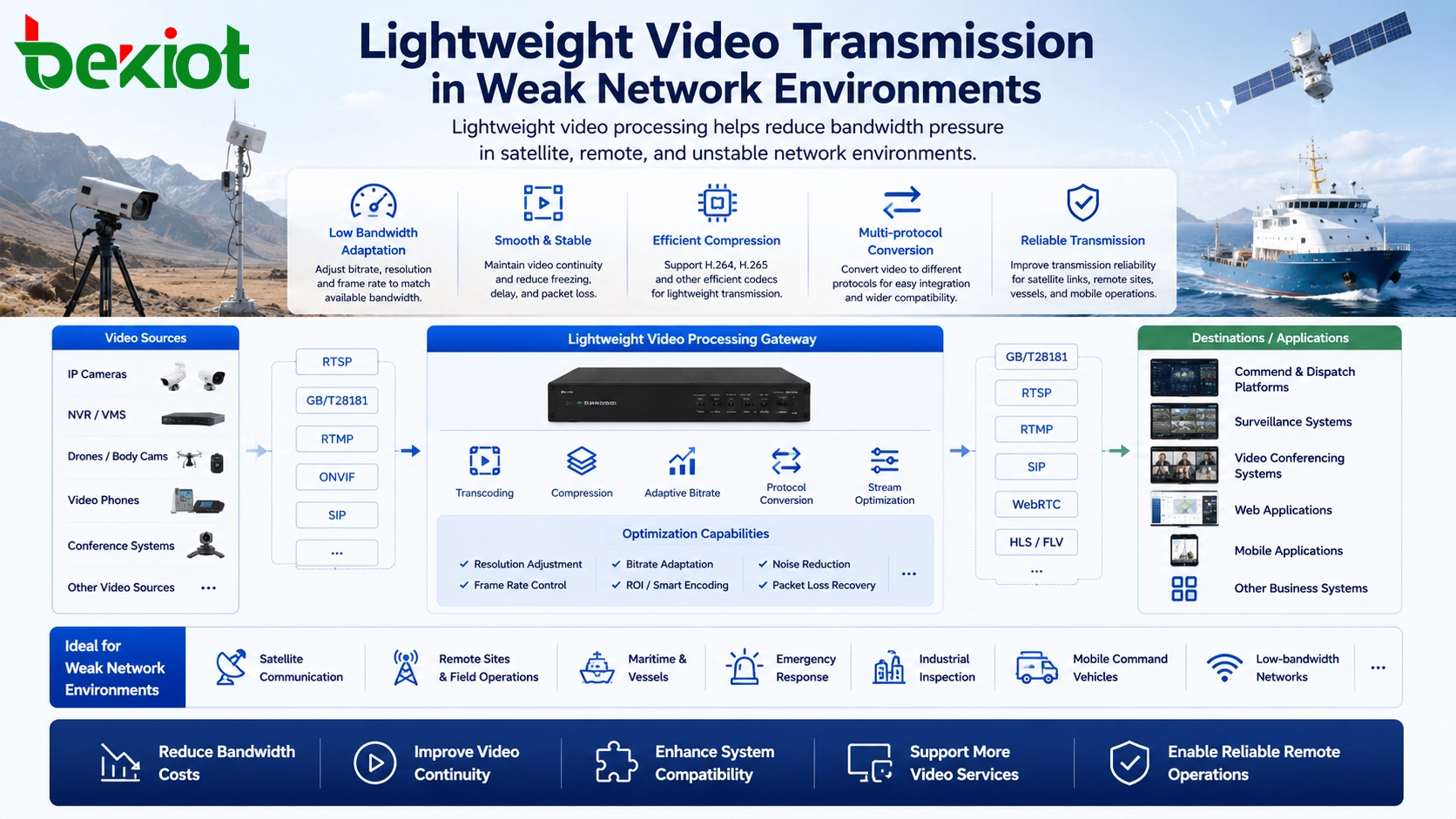
Why Video Becomes Difficult Over Limited Bandwidth
Video data is much heavier than voice, text, or ordinary sensor data. A single high-definition camera stream can occupy a large amount of bandwidth, and multiple video streams can quickly overload a satellite link or a remote access network. When bandwidth is insufficient, the system may reduce image quality automatically, increase buffering, or lose frames during transmission.
In practical projects, this problem appears in many environments: remote camps, field construction sites, exploration areas, offshore vessels, emergency rescue locations, industrial inspection sites, temporary command posts, and mobile operation vehicles. These scenarios often need real-time video, but their network conditions cannot always support high-bitrate transmission.
The goal of a lightweight video solution is not simply to make the video smaller. It must reduce the transmission load while keeping the video usable for command, monitoring, communication, and decision-making. This requires a balance between bandwidth consumption, image clarity, delay, playback continuity, and system compatibility.
Core Idea: Process Video Before Transmission
The most effective method is to process and optimize the video stream before it enters the weak network. Through video transcoding, compression, and adaptive stream adjustment, the system can convert heavy video sources into lighter streams that are more suitable for low-bandwidth transmission.
This process usually includes adjusting the video codec, resolution, frame rate, and bitrate. For example, a high-resolution surveillance stream can be converted into a lower-bitrate stream for remote viewing. A video call can be optimized to maintain continuity instead of forcing unnecessary image detail. A conference stream can be adjusted to match the actual available bandwidth of a satellite or field network.
A well-designed solution should also use intelligent algorithms to maintain smoother playback. In weak network conditions, continuity is often more important than maximum image quality. For emergency command, remote inspection, or vessel communication, a stable and understandable video stream is usually more valuable than a high-definition stream that freezes frequently.
Multi-Source Access for Real Project Environments
A weak network video solution should be able to connect with different types of video sources. In real deployments, video may come from existing surveillance systems, NVR platforms, IP cameras, video phones, smart helmets, mobile terminals, body-worn cameras, conference systems, or third-party application platforms.
To support these sources, the system should be compatible with common access protocols such as GB/T28181, RTSP, RTP, RTMP, ONVIF, and SIP. These protocols allow the solution to connect with surveillance, communication, and dispatch systems without forcing users to rebuild all existing video resources.
This compatibility is important for projects that already have cameras and video platforms in place. Instead of replacing the original system, lightweight video processing can be added as a middle layer. It receives video from existing devices, optimizes the stream, and then delivers a lighter version to remote users, command platforms, or business systems.
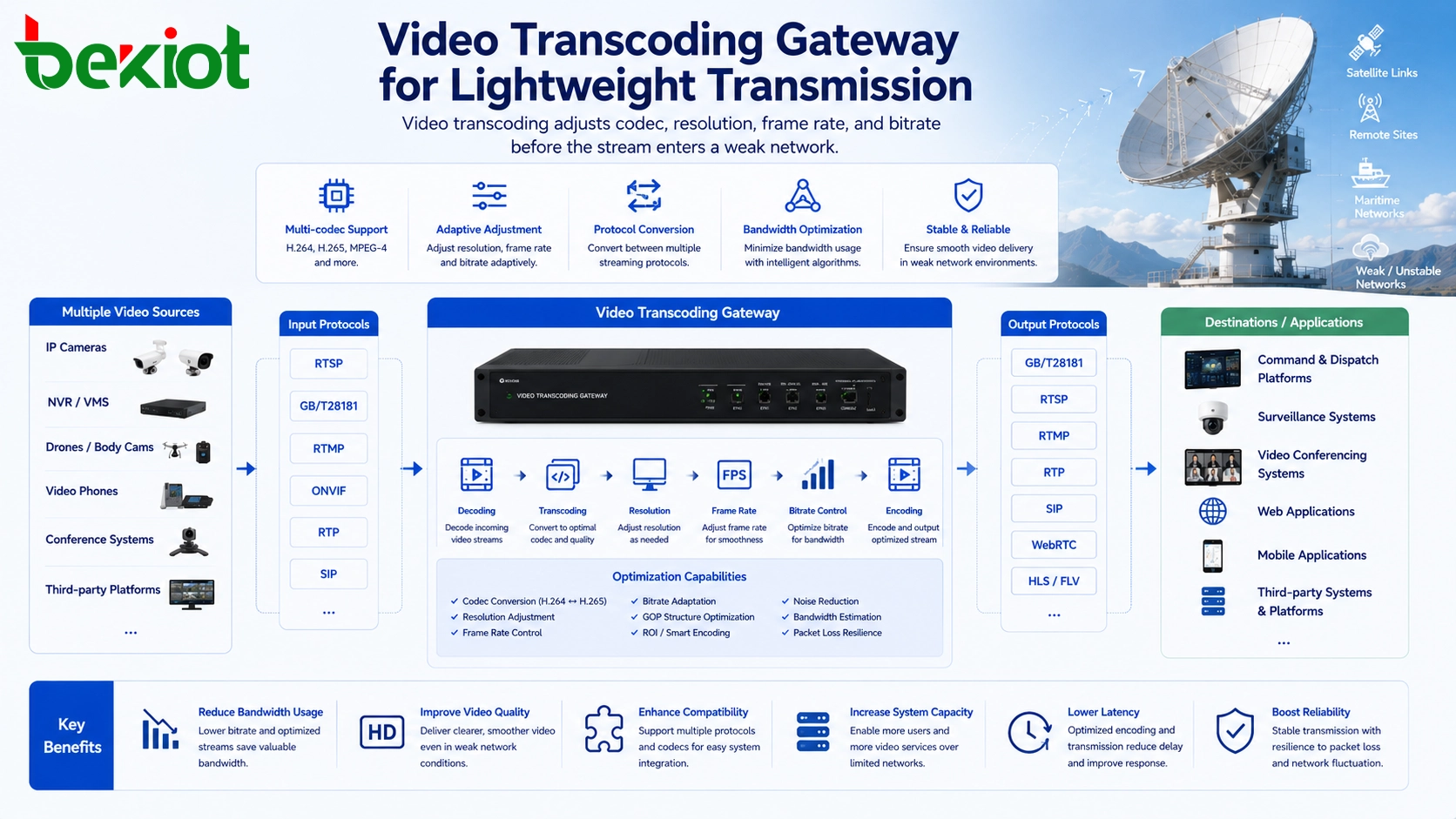
Optimized Delivery for Command and Business Systems
After video is transmitted through a weak network, it may still need to be used by different systems on the receiving side. These systems may include command and dispatch platforms, unified communication systems, video conferencing systems, surveillance platforms, browser-based applications, and mobile clients.
For this reason, lightweight video processing should not only reduce bandwidth at the sending side. It should also support flexible output formats for receiving-side integration. Common output protocols may include GB/T28181, RTSP, RTP, RTMP, SIP, WebRTC, FLV, and HLS. With these formats, optimized video can be distributed to different applications based on their playback and integration requirements.
Codec compatibility is also important. Many existing systems still rely on H.264, while newer deployments may use H.265 or VP9 to improve compression efficiency. A practical solution should support multiple encoding formats so that video can be adapted for both legacy systems and modern web-based applications.
Suitable Scenarios for Lightweight Video Deployment
Lightweight video transmission is especially valuable in areas where video demand is high but network capacity is limited. In maritime communication, vessels may need to transmit surveillance footage, video calls, and conference images through satellite links. In remote construction or exploration projects, site managers may need real-time visual information from locations where ordinary broadband is unavailable.
In emergency response, temporary command centers may need live video from field terminals, mobile cameras, and inspection teams. In public safety, transportation, energy, and industrial projects, video streams may need to cross long-distance networks with unstable bandwidth. In these cases, lightweight processing can help reduce the pressure on the network while keeping video services available.
The same approach can also be used in low-bandwidth enterprise branches, offshore platforms, border areas, mines, tunnels, mountain stations, temporary event sites, and mobile command vehicles. As long as video needs to be transmitted through unstable or expensive network links, lightweight video optimization can improve system usability.
Key Benefits for Weak Network Applications
The most direct benefit is bandwidth reduction. By adjusting bitrate, resolution, frame rate, and codec format, the system can reduce the amount of data that needs to pass through the limited network. This makes it possible to carry more video services over the same network link.
The second benefit is smoother viewing. In weak network environments, users often care about whether the video can continue playing without frequent freezing. Lightweight video processing helps improve playback continuity and supports more reliable remote monitoring, video communication, and command collaboration.
The third benefit is easier system integration. Because the solution can support multiple video access and output protocols, it can connect with existing surveillance systems, video communication platforms, dispatch systems, and third-party business platforms. This reduces reconstruction cost and helps organizations reuse existing video assets.
Deployment Logic for a Complete Solution
A complete lightweight video solution can be designed as a two-side architecture. At the field side, video sources are collected and optimized before entering the weak network. The system reduces the video stream according to bandwidth conditions and application needs. At the receiving side, the video can be restored, converted, distributed, or integrated into command, communication, and monitoring systems.
This architecture is useful because different systems often have different video requirements. A command center may need low-delay video for emergency decision-making. A surveillance platform may need continuous stream access. A browser application may need WebRTC, FLV, or HLS output. A conference system may need a compatible real-time video format. With flexible transcoding and protocol conversion, the same video source can serve multiple business systems.
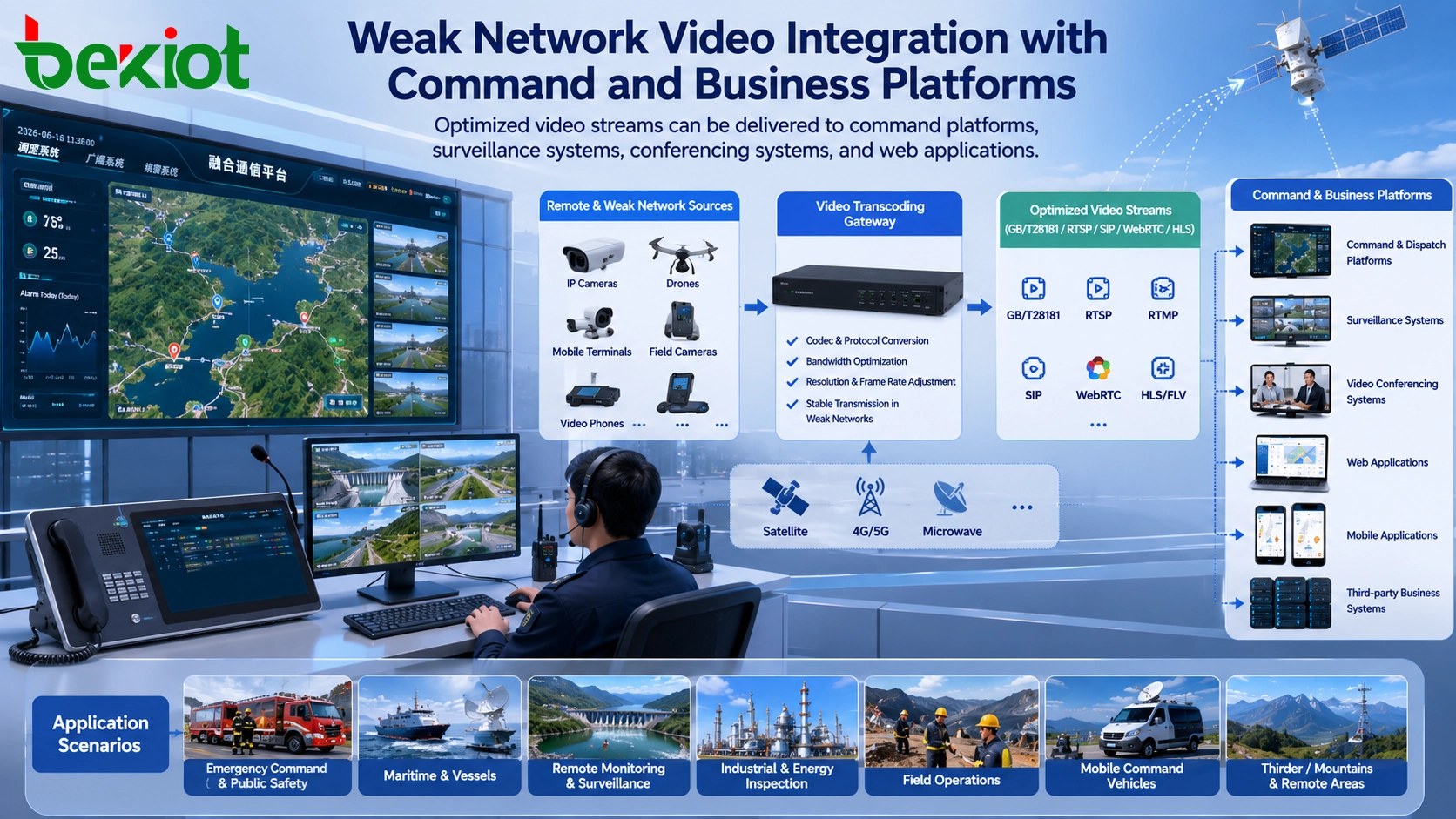
Planning Considerations Before Implementation
Before deploying a lightweight video system, project teams should first evaluate network capacity, bandwidth cost, latency requirements, video source quantity, resolution requirements, and the number of users who need to view video at the same time. The solution should be designed according to actual business needs rather than simply reducing all video quality.
For command and emergency scenarios, low latency and stable continuity may be more important than full image detail. For monitoring scenarios, image clarity and continuous recording may be more important. For video conferencing, audio-video synchronization and user experience should be considered. Different scenarios require different stream optimization strategies.
The system should also consider compatibility with existing platforms. If current devices use surveillance protocols, the solution should support surveillance access. If the receiving system is a browser or mobile application, web-friendly output protocols should be included. If the project needs to connect with a communication or dispatch platform, SIP and real-time media handling may be required.
Conclusion
Weak network environments create real challenges for video transmission, especially when satellite links, remote access networks, mobile networks, or unstable wireless connections are involved. As video monitoring, video calls, video conferences, and field command applications continue to increase, organizations need a more efficient way to transmit usable video over limited bandwidth.
A lightweight video transmission solution solves this problem by processing video before transmission, reducing bitrate, adjusting resolution and frame rate, supporting efficient codecs, and converting streams across multiple protocols. It allows remote sites, vessels, field teams, and command centers to use video services more reliably without placing excessive pressure on weak networks.
For projects that require remote monitoring, emergency command, vessel communication, field inspection, or mobile collaboration, lightweight video processing can provide a practical balance between bandwidth control, image usability, system compatibility, and stable viewing experience.
FAQ
Is lightweight video processing the same as simply lowering video quality?
No. The purpose is not only to reduce quality, but to optimize the stream according to bandwidth, delay, device compatibility, and application needs. A good solution keeps the video useful while reducing unnecessary transmission load.
Can this solution work with existing camera systems?
Yes. If the system supports common access protocols such as RTSP, ONVIF, GB/T28181, and RTMP, it can usually connect with existing IP cameras, NVR systems, and surveillance platforms.
Which is more important in weak networks: clarity or continuity?
It depends on the scenario. For emergency command and video calls, continuity and low delay are often more important. For evidence review or monitoring, clarity may be more important. The stream strategy should match the business purpose.
Does satellite video transmission always require transcoding?
Not always, but transcoding is highly useful when the original video stream is too heavy for the available bandwidth or when the receiving system needs a different codec, resolution, bitrate, or protocol format.
Can optimized video be used by web applications?
Yes. If the receiving side supports formats such as WebRTC, FLV, or HLS, optimized video streams can be delivered to browsers, mobile applications, and web-based command platforms.







