


In many converged communication projects, different systems must work together: radios, video surveillance, telephone networks, dispatch platforms, public address systems, alarm systems, satellite links, and IP communication platforms. Because these systems often use different protocols, interfaces, and deployment models, gateway-based integration is commonly used to connect them into one coordinated communication environment.
Some people may ask whether using gateways is an outdated approach. The answer is no. In large-scale communication systems, gateway-based integration is often a more practical, scalable, and technically mature architecture than forcing every protocol and every access capability into one central server.
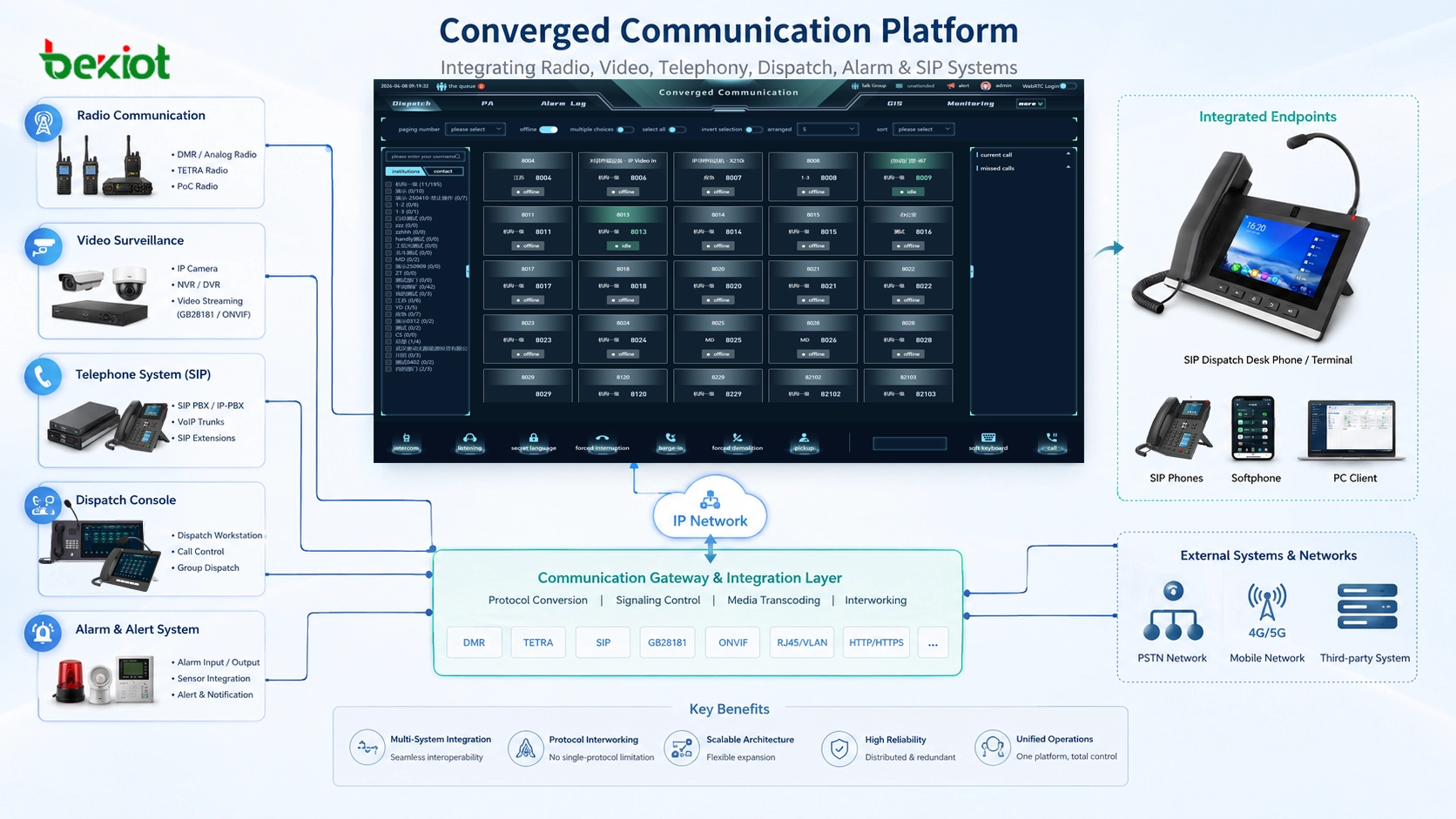
Why Different Systems Still Need Access Gateways
A converged communication system is designed to integrate multiple communication resources and manage them through a unified platform. In real projects, however, these resources are rarely built on the same protocol. Two-way radio systems may use radio audio and PTT control. Video platforms may use RTSP, ONVIF, GB/T standards, SDK interfaces, or private protocols. Telephone systems may use SIP trunks, analog lines, E1 interfaces, FXO, FXS, or other telephony access methods.
This means interconnection is not only a software problem. It is also an interface, signaling, media, security, compatibility, and deployment problem. A radio channel cannot be connected in the same way as a video stream. A PSTN line cannot be handled in the same way as an IP camera. A satellite terminal, alarm input, legacy PBX, or analog broadcast system may each require a different access method.
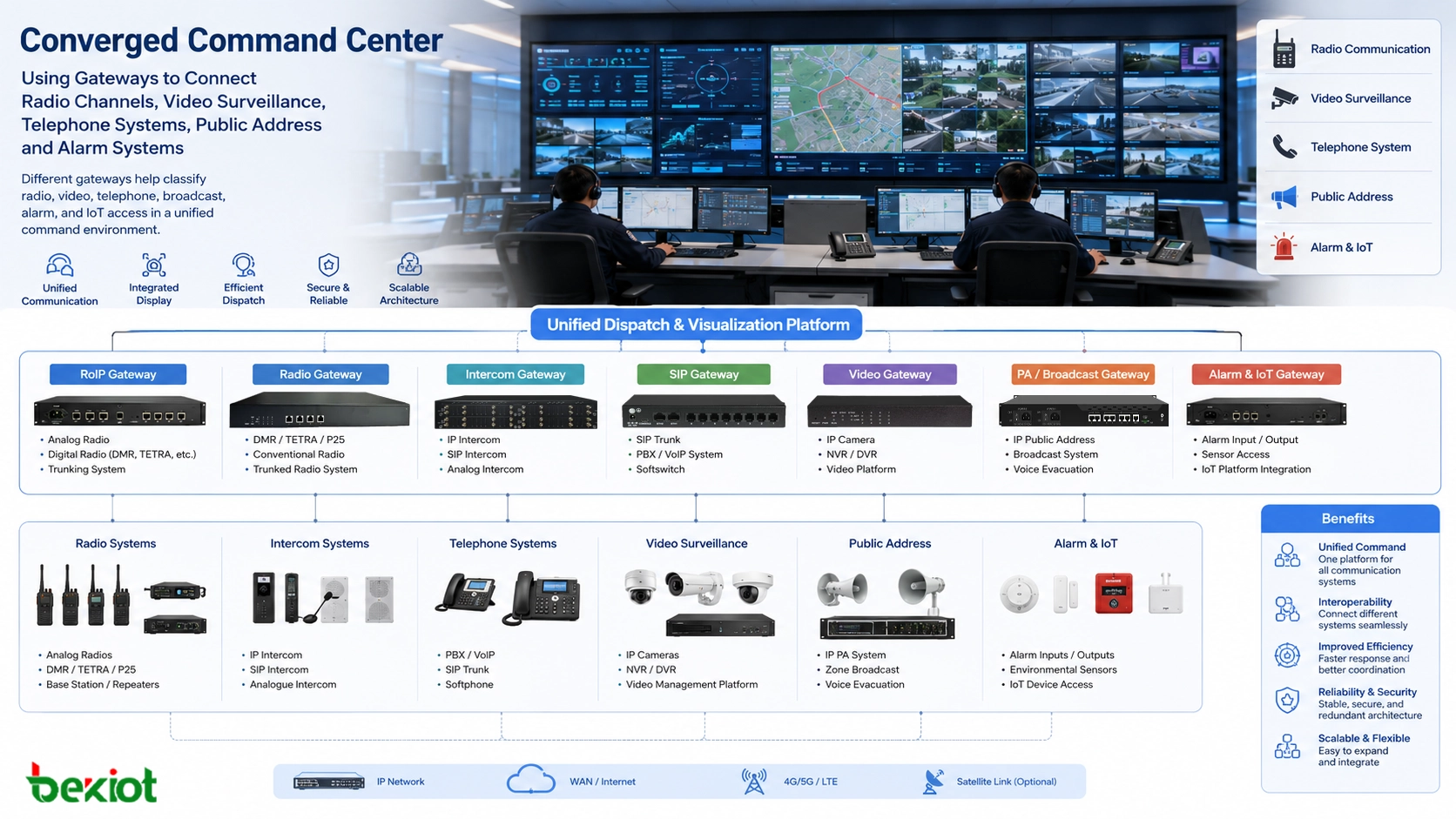
Gateways exist because these differences are real. A cluster intercom gateway can connect radio systems. A video gateway can bring surveillance streams into a command platform. A telephone gateway can connect analog phones, PSTN lines, or PBX systems. Each gateway handles the protocol conversion and interface adaptation required by its own system type.
The Misunderstanding Behind “All-in-One” Integration
A common misunderstanding is that a converged communication platform should directly support every protocol by itself. According to this view, all radios, cameras, telephones, alarm devices, and external systems should connect directly to the main server without external gateway equipment.
This sounds simple, but it is not an ideal architecture for serious engineering projects. If every access protocol, media process, signaling conversion, device driver, and business function is concentrated inside one central server, the platform becomes harder to scale, harder to maintain, and more exposed to system risk.
In this model, every new device type may require new development work. Every vendor protocol may become a compatibility task. Every media stream may increase server load. Every interface change may affect the core system. Over time, the platform can become heavy, fragile, and difficult to upgrade.
Modern Systems Prefer Layered Design
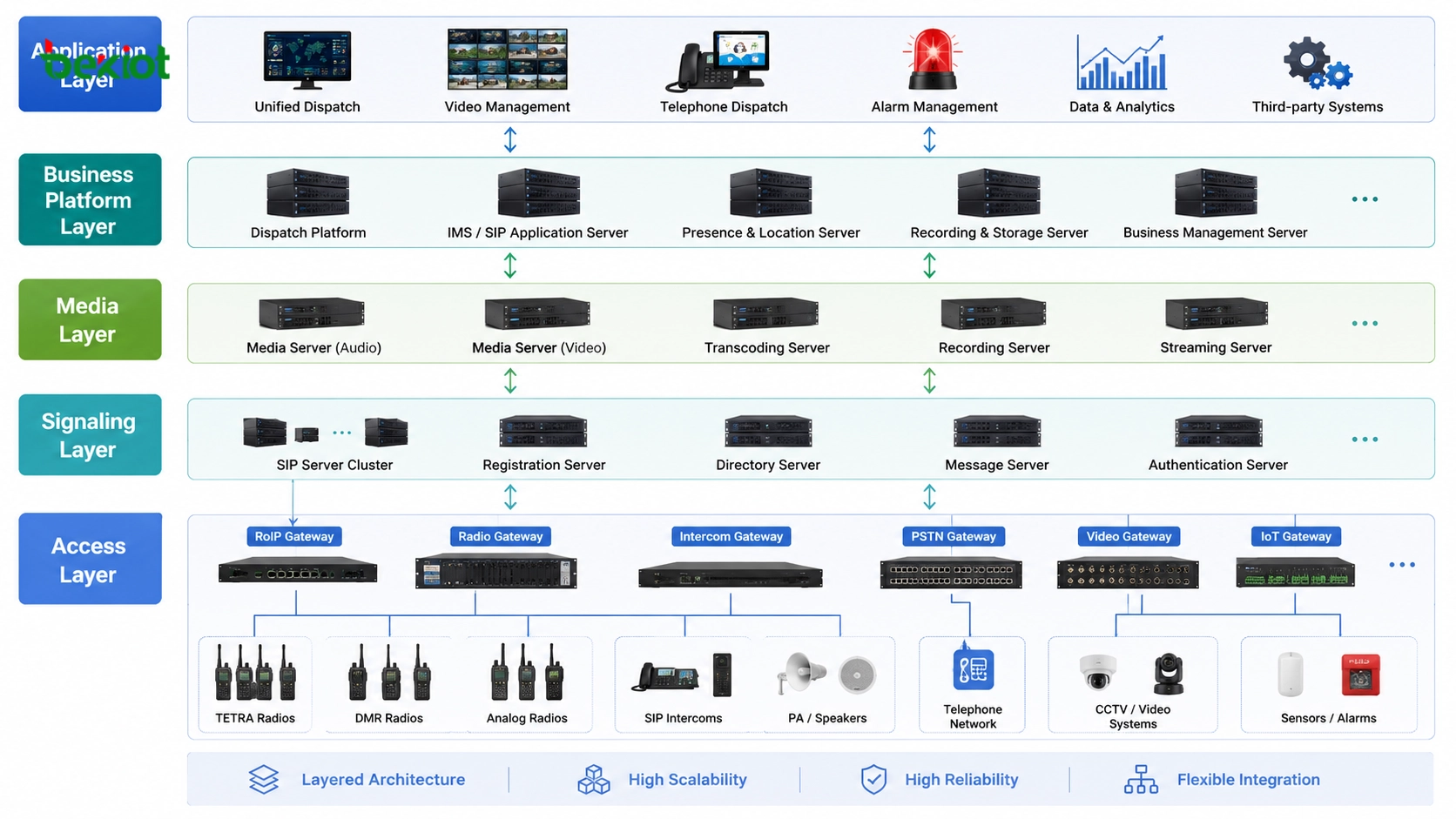
Modern communication systems usually follow a layered architecture. Signaling, media processing, business applications, and gateway access are separated instead of being forced into a single device or single server. This design is widely used in large-scale communication networks because it improves capacity, stability, and operational flexibility.
The same logic can be seen in modern mobile communication systems. Large communication networks do not rely on one machine to handle every function. Different network elements are responsible for access, control, media, session management, service processing, data forwarding, and external interconnection. This separation allows the system to scale by function instead of being limited by one central node.
In converged communication projects, the same design principle applies. The core platform can focus on user management, dispatch control, service logic, recording coordination, permission control, and unified operation. Gateways handle protocol conversion and access adaptation. Media servers handle audio and video processing. This structure is more suitable for large and complex communication environments.
Separation Improves System Capacity
One important reason for using gateways is capacity planning. If signaling control, media processing, device access, and business services are all handled by the same server, system performance may be limited by the heaviest workload. In many communication systems, media processing consumes much more computing and bandwidth resources than signaling.
For example, a dispatch platform may need to manage user presence, call permissions, group communication, emergency priority, recording indexes, map-based operations, and command workflows. At the same time, audio and video streams may need transcoding, forwarding, mixing, storage, or distribution. If everything runs on one server, media load may affect the stability of signaling and business control.
By separating gateway access and media processing, the system can distribute heavy workloads across different devices or servers. More gateways can be added when more access points are needed. More media servers can be added when more audio or video capacity is required. This is one of the practical reasons why gateway-based integration is not backward, but scalable.
Gateways Reduce Core Platform Pressure
Gateways help simplify the core communication platform. Instead of forcing the central system to understand every external protocol, the gateway converts different systems into a standard access method, often SIP or another platform-compatible interface. This makes the platform easier to manage and easier to expand.
For example, a radio gateway can convert radio audio and PTT control into IP-based communication. A video gateway can normalize different camera or video platform interfaces. A telephony gateway can connect PSTN, analog phones, or legacy PBX systems into a SIP-based communication environment. The main platform receives standardized communication resources instead of handling every vendor-specific detail directly.
This design also improves fault isolation. If one external system has an interface problem, the issue can often be limited to the related gateway. The main platform does not need to be modified every time one external subsystem changes. This reduces maintenance risk and helps keep the converged communication system stable during long-term operation.
Security and Reliability Are Easier to Manage
Gateway-based integration also supports stronger security boundaries. In many projects, external systems come from different vendors, departments, networks, or security domains. Directly connecting every external system to the core communication server may increase exposure and make access control more difficult.
A gateway can act as a controlled access point. It can limit which services are exposed, convert only required media or signaling, separate network zones, and reduce unnecessary access to the core platform. In critical communication environments, this separation is important for reducing attack surfaces and improving system reliability.
Reliability is also improved because gateway functions can be deployed close to the connected system. A radio gateway may be installed near a radio base station. A video gateway may be deployed near a surveillance network. A telephony gateway may be placed in a local equipment room. The IP network then carries standardized communication back to the command platform.
Distributed Deployment Supports Large Projects
Large converged communication projects often cover multiple buildings, factories, campuses, tunnels, airports, energy sites, transportation corridors, or regional command centers. In these scenarios, centralized access is not always practical. The system may need distributed deployment across different sites.
Gateways make distributed deployment easier. Each site can connect its local radio system, video system, telephone system, or alarm system through a local gateway. These gateways can then connect back to a central or regional command platform through private networks, VPN, 4G/5G, microwave, fiber, or satellite links.
This allows a project to expand step by step. One site can be integrated first, then another site can be added later. If the system needs more radio channels, more telephone interfaces, or more video access points, new gateways can be deployed without redesigning the entire platform.
Gateways Make Protocol Evolution More Practical
Communication technologies develop quickly. New devices, new vendor platforms, new radio systems, new video standards, new IoT protocols, and new command applications continue to appear. It is unrealistic for one converged communication platform vendor to develop and maintain native support for every possible external system forever.
Without gateways, the platform provider may be forced into endless custom development. Each new subsystem could require a new driver, new protocol stack, new test process, and new software upgrade. This increases cost and slows down project delivery.
In many fields, mature gateway products already exist. These products are designed specifically for protocol conversion, interface adaptation, media access, and system interconnection. Using suitable gateways can shorten deployment time, reduce development cost, and make the project more predictable.
Business Functions Become Easier to Classify
Different gateways can also help classify different business capabilities. Radio access, video access, telephone access, alarm access, broadcast access, and IoT access are different functions. Managing them through different gateway layers makes the system structure clearer.
This is helpful for project planning and operation. Engineers can see which gateway connects which subsystem, which department uses which access resources, and which communication path is used for daily operation or emergency command. Maintenance teams can troubleshoot problems more quickly because each access function has a clearer boundary.
For example, if a radio channel cannot be dispatched, the team can check the radio device, cable, PTT control, radio gateway, SIP registration, and dispatch permission step by step. If a video stream fails, the team can focus on camera access, video gateway, network path, and platform configuration. Clear architecture reduces confusion.
When Native Integration Still Makes Sense
Gateway-based integration does not mean native integration has no value. In some cases, direct protocol integration is useful. If a platform needs deep control of a specific subsystem, such as detailed device status, advanced video analytics, map linkage, alarm metadata, or complex user management, native API integration may provide richer functions than a basic gateway connection.
The right approach is not to reject gateways or reject native integration. The better approach is to choose the proper access method according to the project requirement. Standard voice interconnection, radio access, PSTN access, analog endpoint access, and basic video stream access are often suitable for gateway-based integration. Deeper business data exchange may require API or SDK integration.
In other words, gateway integration is not a sign of backward technology. It is one layer in a complete system architecture. A mature converged communication solution can use gateways, APIs, SIP, media servers, databases, and dispatch applications together.
Practical Architecture for Real Projects
A practical converged communication architecture may include a core dispatch platform, SIP server, media server, recording server, radio gateway, video gateway, telephone gateway, broadcast gateway, alarm interface, and network security devices. Each component handles its own responsibility.
The core platform manages users, groups, permissions, dispatch seats, emergency workflows, call records, maps, and system logic. The gateway layer connects external systems and converts them into standard communication resources. The media layer processes audio and video streams. The network layer provides routing, security, redundancy, and cross-site transmission.
This architecture is suitable for public safety, transportation, industrial parks, airports, energy facilities, tunnels, mines, campuses, emergency command centers, and other multi-system communication environments. For teams building such systems, Becke Telcom can be considered where SIP-based dispatch, industrial telephony, RoIP access, or emergency communication endpoints need to fit into a layered integration framework.
Project Value of Gateway-Based Integration
The first value is scalability. The system can expand by adding gateways or media resources instead of replacing the core platform. The second value is flexibility. Different external systems can be connected according to their own technical characteristics.
The third value is cost control. Mature gateway products reduce the need for repeated custom development. The fourth value is stability. Protocol conversion and external access are separated from core business logic, reducing the risk of one subsystem affecting the entire platform.
The fifth value is long-term adaptability. As new technologies appear, the platform can integrate them through suitable gateway devices, APIs, or interface modules. This protects the overall system investment and avoids locking the project into one rigid technical route.
Conclusion
Using gateways to integrate different systems is not outdated. For converged communication systems, gateway-based integration is often a more advanced and scientific architecture because it separates access, signaling, media, and business functions. This separation improves capacity, reliability, security, deployment flexibility, and long-term maintainability.
A platform that tries to include every protocol and every function inside one server may appear simple at first, but it can become difficult to scale and maintain. A layered system with suitable gateways is closer to how large communication networks are designed. For real-world projects, the question is not whether gateways are backward, but whether the gateway layer is planned correctly and matched to the actual system requirements.
FAQ
Can gateway integration increase system latency?
It may add a small amount of processing delay, but in most voice, video, and dispatch scenarios, proper gateway selection and network design can keep latency within an acceptable range. The main factors are codec settings, media forwarding path, network quality, and server load.
Should every subsystem use a separate gateway?
Not always. Some systems can share gateway resources, while others should be separated for security, capacity, or management reasons. The decision should be based on protocol type, traffic volume, fault isolation, and operational importance.
How should a project team choose between API integration and gateway access?
Gateway access is suitable for standard communication interconnection such as voice, radio, telephone, video stream, and broadcast access. API integration is better when the platform needs deep business data, device status, metadata, analytics, or advanced control functions.
What is the most common mistake in gateway-based projects?
A common mistake is treating the gateway as only a hardware adapter. In reality, gateway deployment also requires planning for protocol conversion, permissions, routing, recording, redundancy, cybersecurity, maintenance responsibility, and future expansion.







