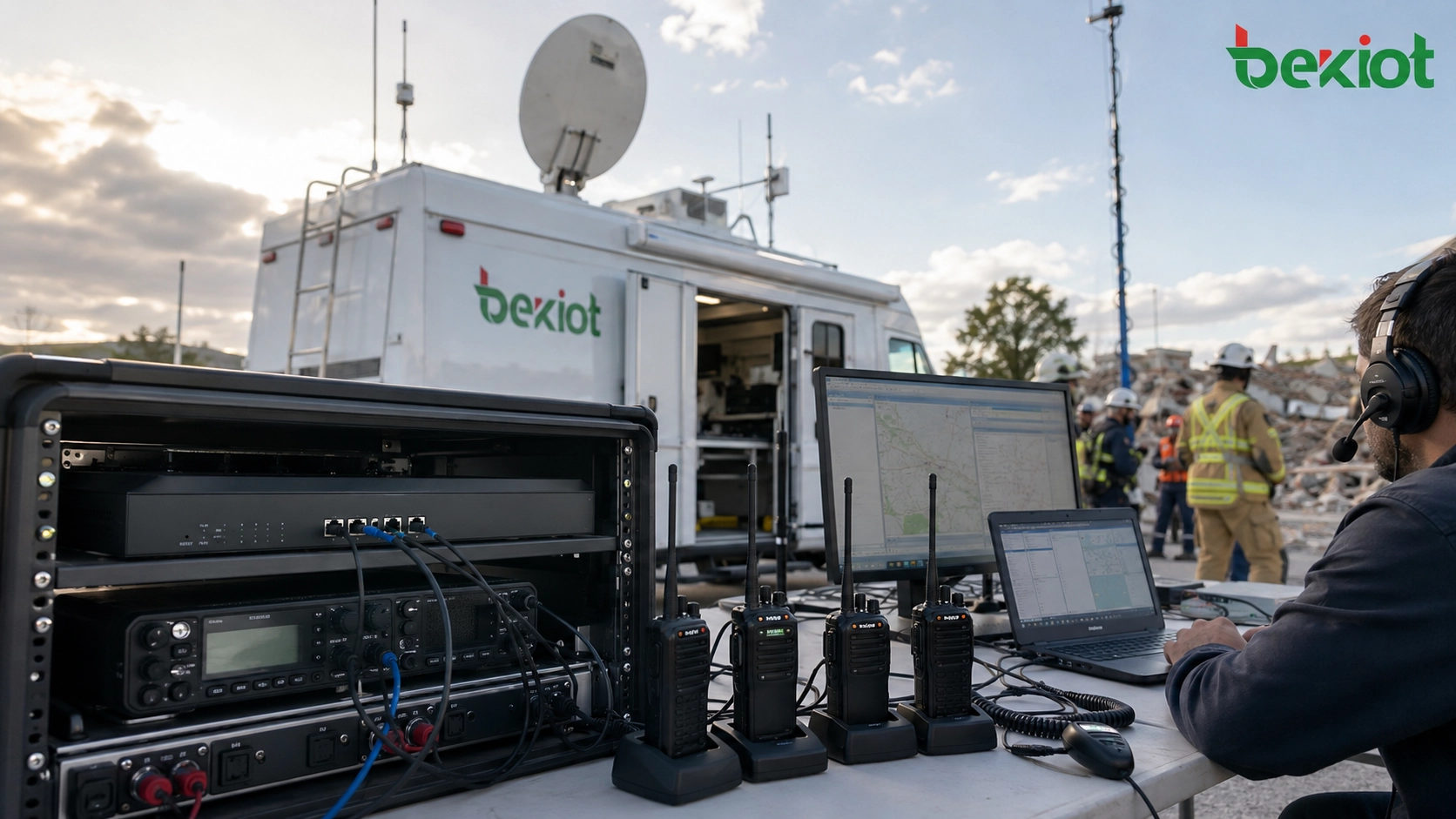
Emergency command vehicles are designed to become mobile command centers when disasters, accidents, traffic incidents, public safety events, or large outdoor operations require fast coordination. However, one common challenge remains: field teams often rely on walkie-talkies, while the command vehicle uses IP networks, dispatch software, video systems, satellite links, and integrated communication platforms.
Connecting on-site walkie-talkies to an emergency command vehicle bridges this gap. It allows radio users, dispatch operators, vehicle crews, remote command centers, and multi-agency teams to communicate through a unified system instead of working in isolated voice channels.
Why Field Radio Access Matters in Mobile Command Operations
Walkie-talkies are still widely used in emergency response because they are simple, fast, and reliable for push-to-talk communication. Rescue teams, police officers, firefighters, traffic control units, security teams, medical support groups, and utility repair crews can communicate instantly without dialing phone numbers or waiting for call setup.
In many emergency sites, field radios may work on different channels, frequency ranges, or radio systems. Some teams may use 400 MHz radio networks, while other specialized teams may rely on different VHF or UHF channels. In certain scenarios, equipment may need to support channel coordination across frequency resources such as 370 MHz, 350 MHz, or other locally assigned bands. Without a proper access layer, the command vehicle may not be able to communicate with every field group directly.
This is why radio access from the emergency command vehicle is important. It turns the vehicle from a separate command post into a live communication hub that can listen, transmit, relay, record, and dispatch radio traffic across the entire response area.
From Local Walkie-Talkie Channels to IP-Based Command Networks
A traditional walkie-talkie network is usually limited by radio coverage, terrain, buildings, mountains, tunnels, and local repeater placement. Field teams inside the same coverage area can talk to each other, but the communication may not reach a remote emergency command center, government dispatch room, or cross-regional support team.
A RoIP gateway changes this structure. RoIP, or Radio over IP, converts radio voice and push-to-talk control signals into IP data streams. Once radio communication is converted into IP, it can be transmitted through wired networks, 4G/5G routers, microwave links, satellite links, private networks, or command vehicle communication systems.
This means the command vehicle can connect local walkie-talkie users with remote dispatchers, SIP-based communication systems, recording platforms, public address systems, video surveillance centers, and unified command platforms. Radio traffic is no longer trapped inside one local RF coverage area.
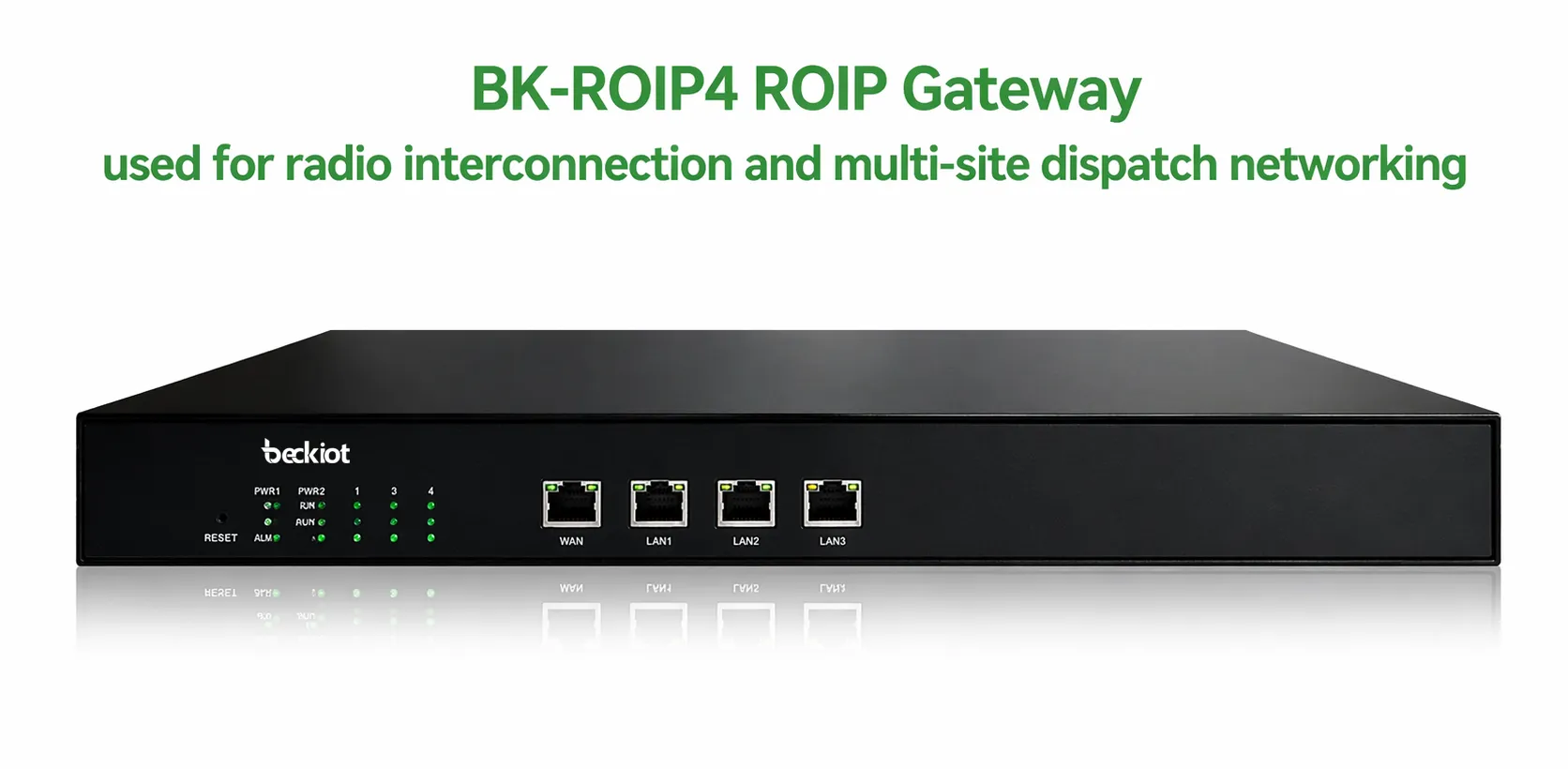
Through Becke Telcom BK-4-Channel RoIP Gateway
Better Coverage for Complex Rescue Environments
Emergency scenes are rarely simple. A response area may include mountains, tunnels, collapsed buildings, underground spaces, riverbanks, highways, industrial plants, temporary shelters, or multiple rescue zones. Radio users may be distributed across a wide area, and one direct radio channel may not cover everyone clearly.
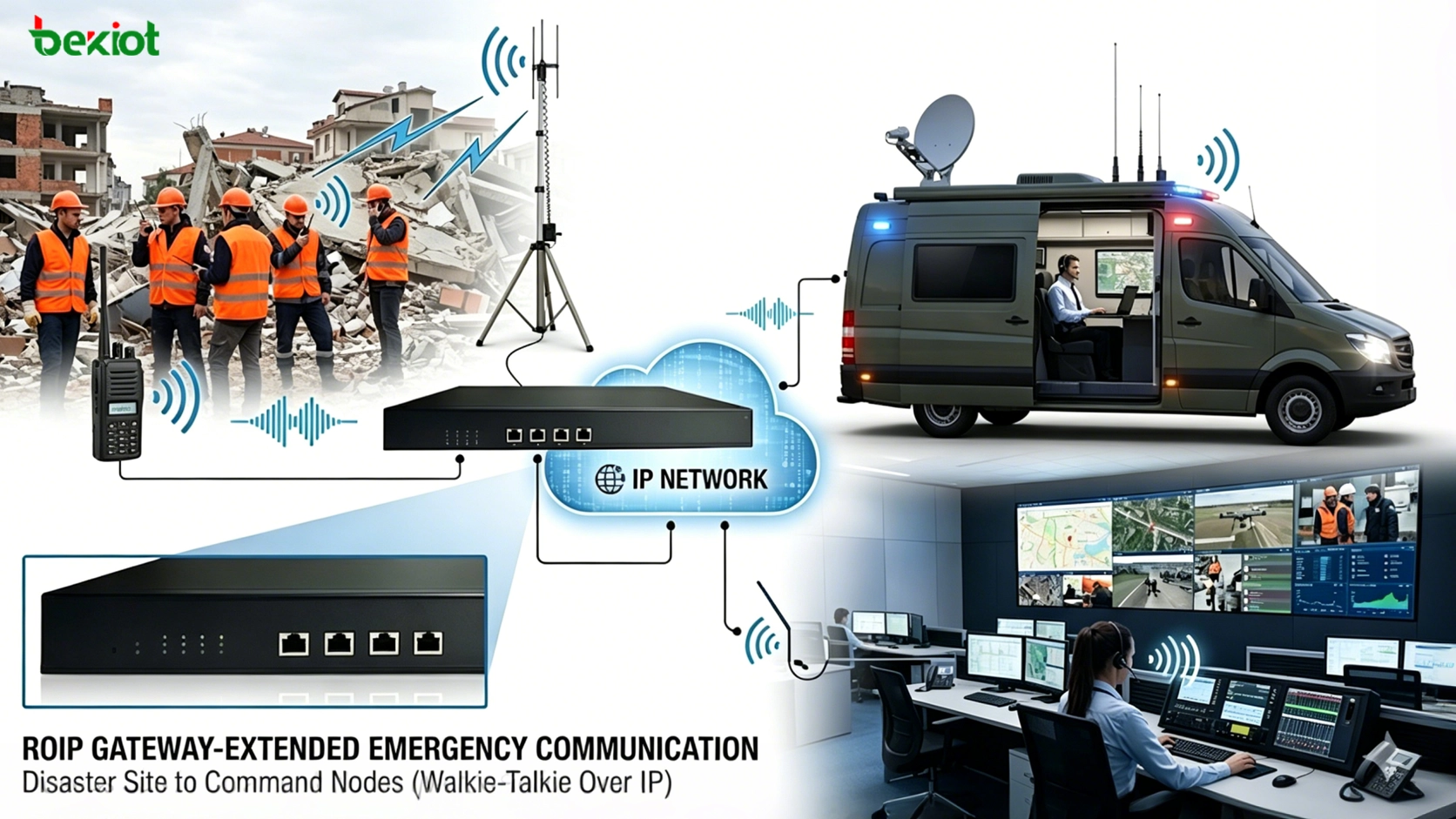
When the command vehicle connects walkie-talkies through a RoIP gateway, radio communication can be extended beyond local RF limitations. The command vehicle may act as a mobile relay point, while IP backhaul connects the vehicle with a remote command center. If satellite or cellular backhaul is available, radio calls from the scene can be forwarded to operators far away from the incident site.
This improves command continuity. Even when a rescue team moves outside direct radio range, the system can still maintain communication through network-connected gateways, repeaters, or vehicle-mounted communication equipment. For large-scale emergency response, this creates a stronger communication chain between front-line teams and decision-makers.
Multi-Team Coordination Without Replacing Existing Radios
One major advantage of connecting walkie-talkies to an emergency command vehicle is that field teams do not need to replace all existing radio devices. Many rescue departments, security teams, industrial emergency teams, and local government units already own large numbers of handheld radios and vehicle radios.
Instead of forcing every team to migrate to a new system immediately, a RoIP gateway can connect existing radio channels to the command vehicle’s IP communication system. This protects previous radio investment and reduces deployment pressure during urgent operations.
The command vehicle can also support mixed communication environments. A dispatcher may talk to radio users, SIP phone users, mobile command terminals, and remote control room operators from one interface. For emergency managers, this reduces communication fragmentation and helps different teams work under one coordinated command structure.
Faster Dispatch and Clearer Command Instructions
In emergency response, speed matters. A command vehicle that can access field walkie-talkies allows dispatchers to issue instructions directly to front-line teams. Operators do not need to rely on a chain of manual message forwarding, which can cause delays, misunderstanding, or duplicated commands.
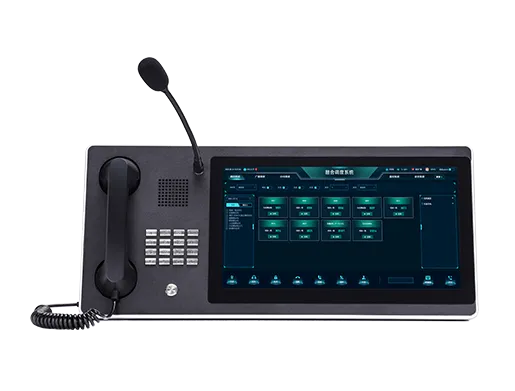
Dispatch staff can group radio channels by rescue area, task type, department, or priority. For example, one channel may serve fire rescue, another may serve medical transfer, another may serve traffic control, and another may serve logistics support. When these channels are connected into the command vehicle, the dispatcher can coordinate multiple teams more efficiently.
This model is especially useful when the command vehicle is deployed near the site. The vehicle becomes a local command node, while higher-level command centers can still join communication through IP links. Local and remote command layers can therefore share the same voice communication environment.
Recording, Review, and Accountability
Traditional walkie-talkie conversations are often temporary. Once a radio message is transmitted, it may not be stored unless a separate recording system is available. In major incidents, this can make it difficult to review command decisions, verify instructions, analyze response timelines, or improve future emergency plans.
After field radio traffic is connected to the emergency command vehicle through a RoIP gateway, voice communication can be routed into recording and dispatch systems. Important conversations, command instructions, emergency reports, and coordination records can be stored for later review.
This improves accountability and operational analysis. Emergency organizations can study what happened, when instructions were issued, which teams responded, and where communication bottlenecks occurred. For public safety, transportation, industrial rescue, and government emergency management, this information can support training, reporting, and continuous improvement.
Integration With Video, GIS, and Unified Dispatch
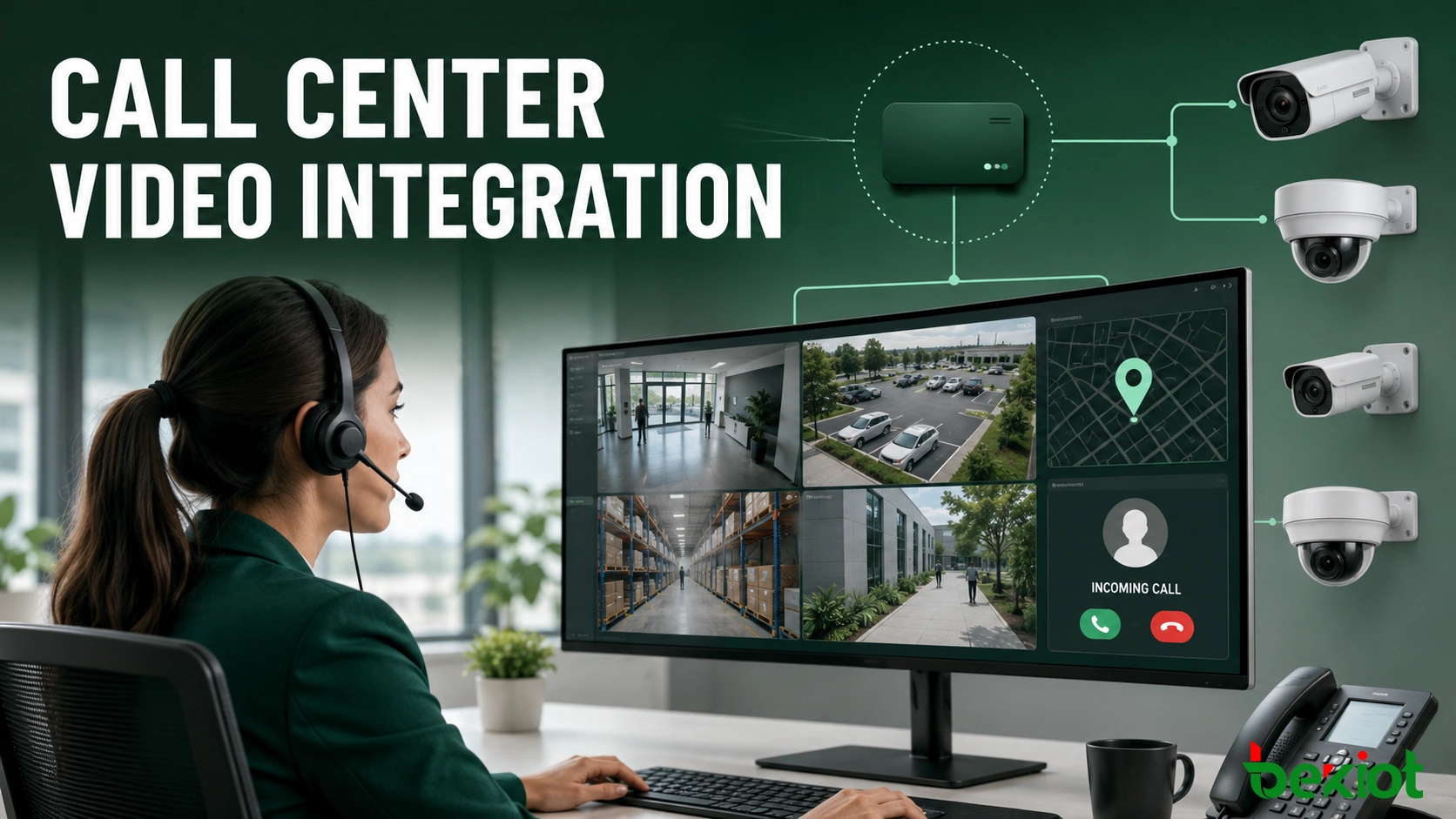
Modern emergency command vehicles are not only radio vehicles. They may include video monitoring, drone video return, GIS maps, satellite communication, mobile broadband, conference systems, SIP phones, public address interfaces, and data terminals. Radio access becomes more valuable when it is integrated with these systems.
For example, when a field team reports a hazard by walkie-talkie, the dispatcher can check the GIS map, view nearby video feeds, identify available rescue resources, and send instructions through the same command workflow. Voice, video, location, and task dispatch can work together instead of being handled as separate systems.
This integrated model improves situational awareness. The command vehicle can become a real-time information center where operators hear field reports, see scene conditions, track resources, and coordinate decisions from one operational environment.
Practical Deployment Architecture
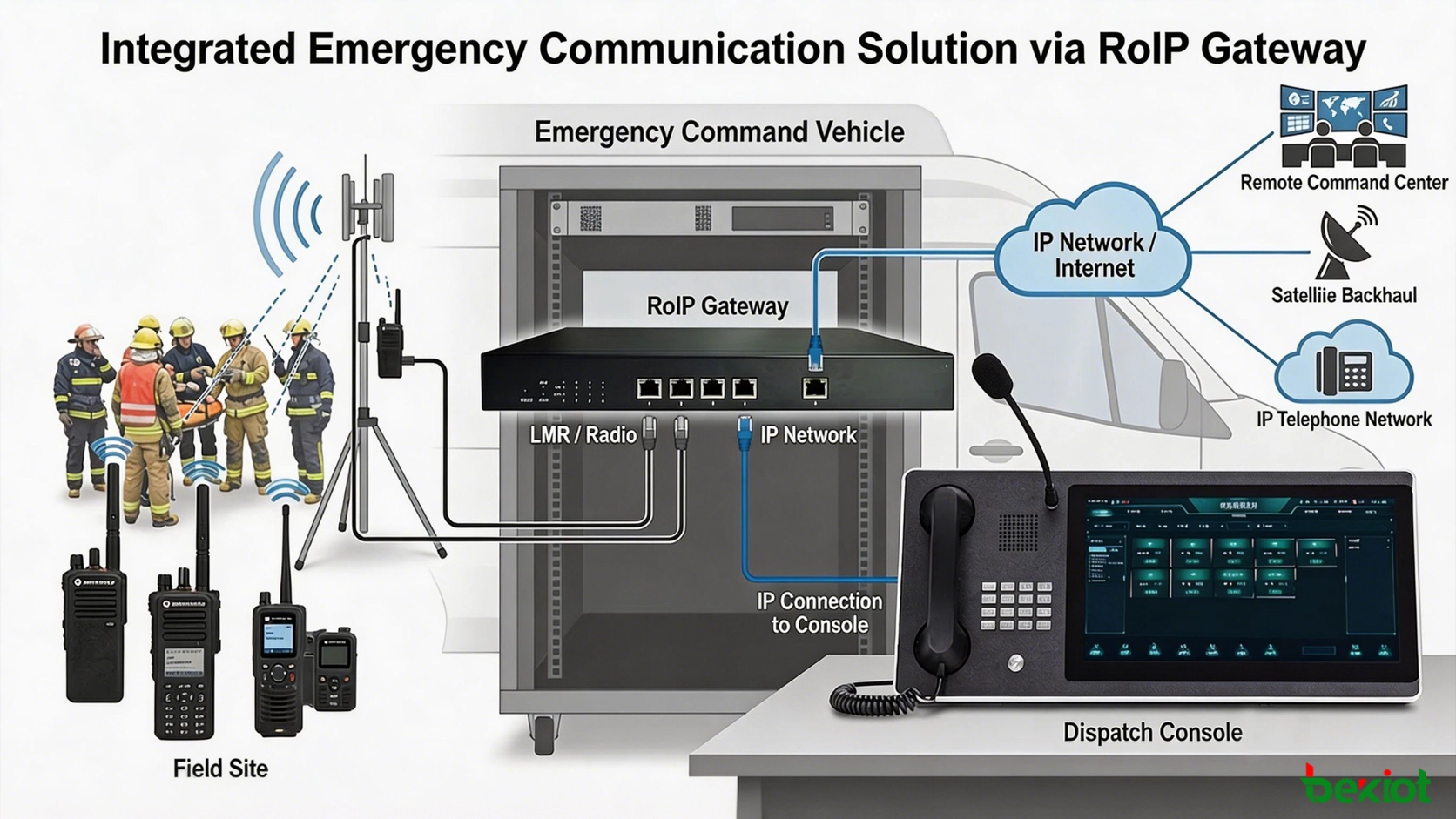
A typical deployment includes field walkie-talkies, radio repeaters or radio terminals, a RoIP gateway, an emergency command vehicle network, dispatch software, backhaul links, and a remote command center. The RoIP gateway connects the radio side with the IP side, allowing voice and push-to-talk signals to move between both environments.
In a four-channel design, multiple radio channels can be connected at the same time. This allows different departments or task groups to remain separated while still being managed from the command vehicle. Each channel can correspond to a specific radio group, operating area, or emergency function.
The IP side can connect to a SIP server, dispatch platform, recording server, VPN, private network, satellite terminal, or mobile broadband router. This flexibility makes the solution suitable for temporary disaster response, mobile police command, fire rescue support, highway emergency response, large event security, industrial emergency drills, and cross-regional coordination.
Key Benefits for Emergency Response Teams
The first benefit is communication interoperability. Different field radio groups can be connected into the command vehicle without forcing every user to change communication habits. The second benefit is extended reach. Radio traffic can be carried over IP networks, allowing remote command centers to participate in local operations.
The third benefit is dispatch efficiency. Operators can talk to multiple field groups from a unified interface and coordinate rescue resources more clearly. The fourth benefit is resilience. When public networks are unstable, the command vehicle can use flexible backhaul options such as satellite, private network, or mobile broadband to maintain communication.
The fifth benefit is operational traceability. Recording, monitoring, and system logs help emergency organizations review actions after the incident. These benefits make walkie-talkie integration an important capability for any modern emergency command vehicle.
Conclusion
Connecting field walkie-talkies to an emergency command vehicle is not only a radio upgrade. It is a practical way to bring traditional push-to-talk communication into a modern IP-based command environment. Through RoIP gateway access, radio users, dispatchers, remote command centers, and mobile response teams can work together through one coordinated communication structure.
For emergency management, public safety, transportation, industrial rescue, and large-site operations, this approach improves coverage, interoperability, dispatch speed, command visibility, recording capability, and multi-team coordination. As emergency response becomes more digital and platform-based, RoIP-enabled command vehicle communication will continue to play an important role in field operations.
FAQ
Can a command vehicle connect analog and digital walkie-talkies at the same time?
It depends on the radio interface, gateway capability, and channel configuration. In many projects, analog radios, digital radios, and different radio groups can be connected through suitable gateways or radio interface adapters, but the final design should be confirmed according to the actual radio system.
Does RoIP access require internet connectivity?
Not always. RoIP requires an IP network, but that network can be a private LAN, VPN, microwave link, 4G/5G router, satellite link, or dedicated emergency communication network. Public internet access is only one possible transmission path.
How many radio channels should an emergency command vehicle support?
The number of channels should match the response structure. Small teams may only need one or two channels, while larger operations may require separate channels for fire rescue, medical support, traffic control, logistics, security, and command coordination.
What should be checked before deploying a RoIP gateway in a command vehicle?
Key checks include radio interface compatibility, PTT control method, audio level matching, power supply stability, network security, backhaul reliability, antenna placement, recording requirements, dispatch software integration, and field testing under realistic operating conditions.