


In communication system projects, the terms IPPBX and softswitch are often mentioned together. In many enterprise scenarios, they may even appear to describe similar voice communication platforms. Both are used to process voice calls, connect users, route communication traffic, and support IP-based telephony. However, their system positioning, deployment environment, management logic, scalability, and typical application scope are not exactly the same.
In simple terms, an IPPBX is usually closer to an enterprise communication system, while a softswitch is more commonly used as a carrier-grade or platform-level switching system. Understanding this difference is important when designing office communication, industrial dispatch, call center access, multi-site voice networks, or large-scale telecom service platforms.
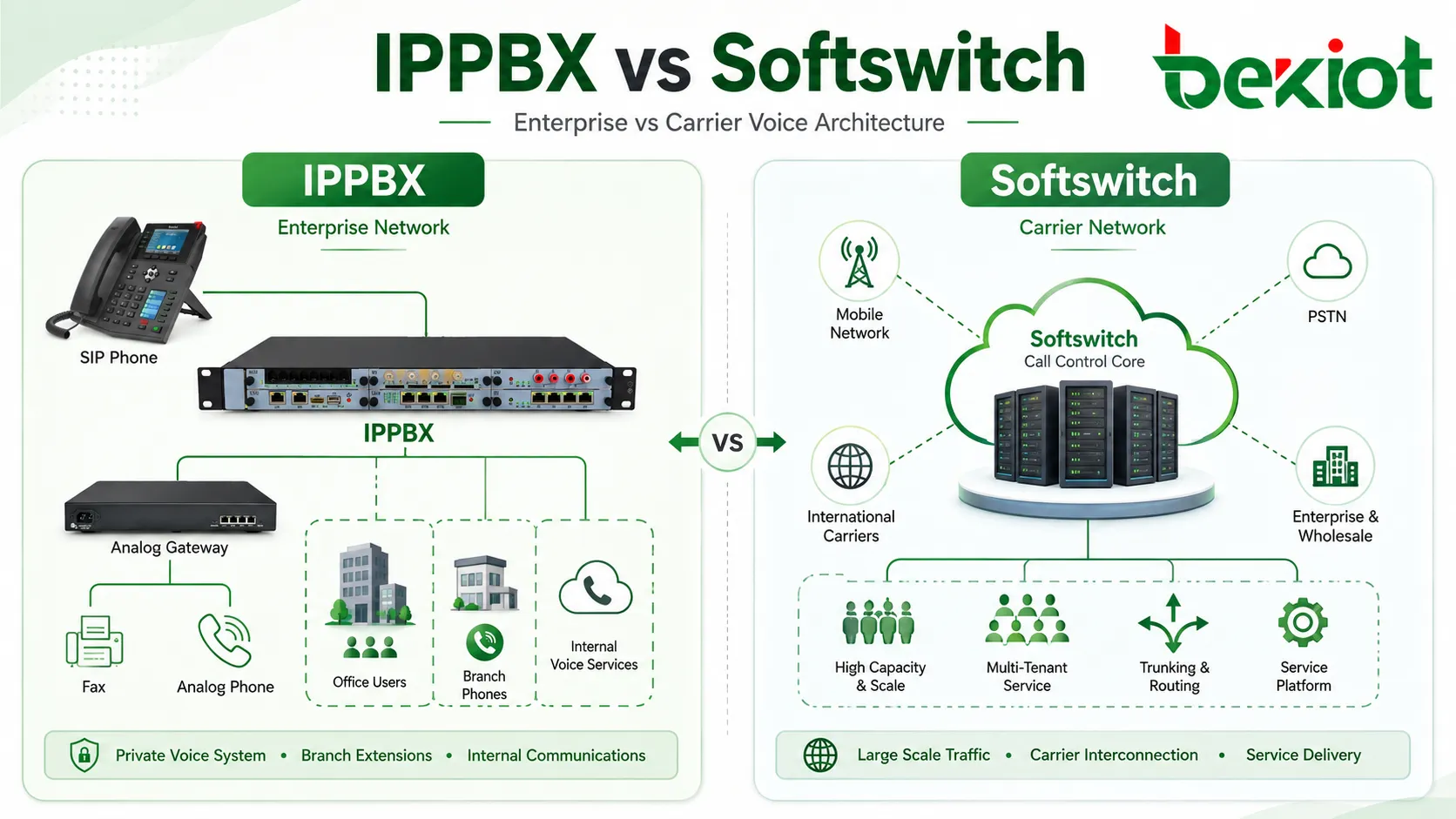
Different roles in voice communication networks
IPPBX stands for Internet Protocol Private Branch Exchange. It is a private branch exchange system based on IP networks. Compared with traditional PBX systems, an IPPBX combines telephone switching functions with IP network advantages. It can manage internal extensions, route incoming and outgoing calls, connect IP phones, support SIP trunks, and provide common enterprise voice services.
A softswitch is a software-based telephone switching system. It separates call control from media transmission and is often used in service provider networks, operator platforms, or large communication service systems. Its main role is to connect different telephone networks, process call routing, manage trunk resources, and support large volumes of voice traffic.
This difference in positioning affects almost every later design decision. An IPPBX is usually selected to solve communication needs inside an organization. A softswitch is more suitable when the project needs platform-level switching, carrier interconnection, large user capacity, number management, billing support, and high availability across a wider network.
Where each system is usually deployed
An IPPBX is commonly deployed inside an enterprise, campus, factory, hotel, hospital, office building, command center, or industrial communication network. It is used to manage internal and external voice communication for a specific organization. Users may include desk phones, SIP intercom terminals, analog phones through gateways, dispatch consoles, call center agents, and remote extensions.
A softswitch is usually deployed in larger networks, such as telecom operator networks, VoIP service provider platforms, hosted communication platforms, or large-scale multi-tenant communication systems. It is designed to process many calls, connect multiple networks, control routing policies, and provide service-level functions for a large number of users or organizations.
From a solution planning perspective, the deployment environment is one of the clearest ways to distinguish the two. If the project mainly serves one company or one private organization, an IPPBX is often the more direct choice. If the project needs to provide voice services to many customers, branches, tenants, or external networks, a softswitch architecture may be more suitable.
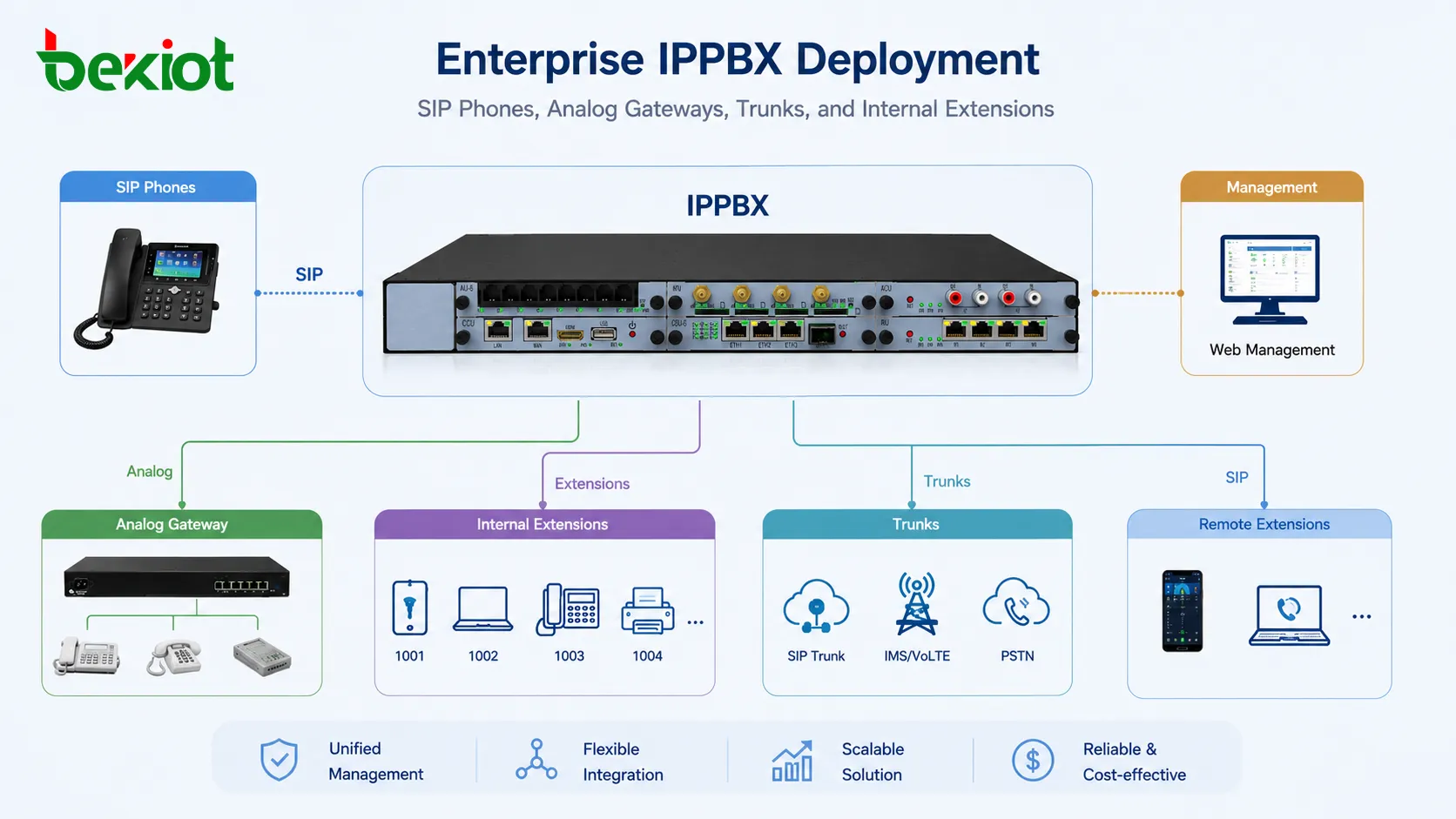
Function focus is not the same
An IPPBX usually provides the communication features that enterprises need every day. These may include extension dialing, call transfer, call hold, call forwarding, voicemail, auto attendant, ring groups, conference calling, call recording, IVR, SIP trunk access, and user-level management. In many projects, it can also integrate with email, instant messaging, video conferencing, customer service platforms, access control, or dispatch applications.
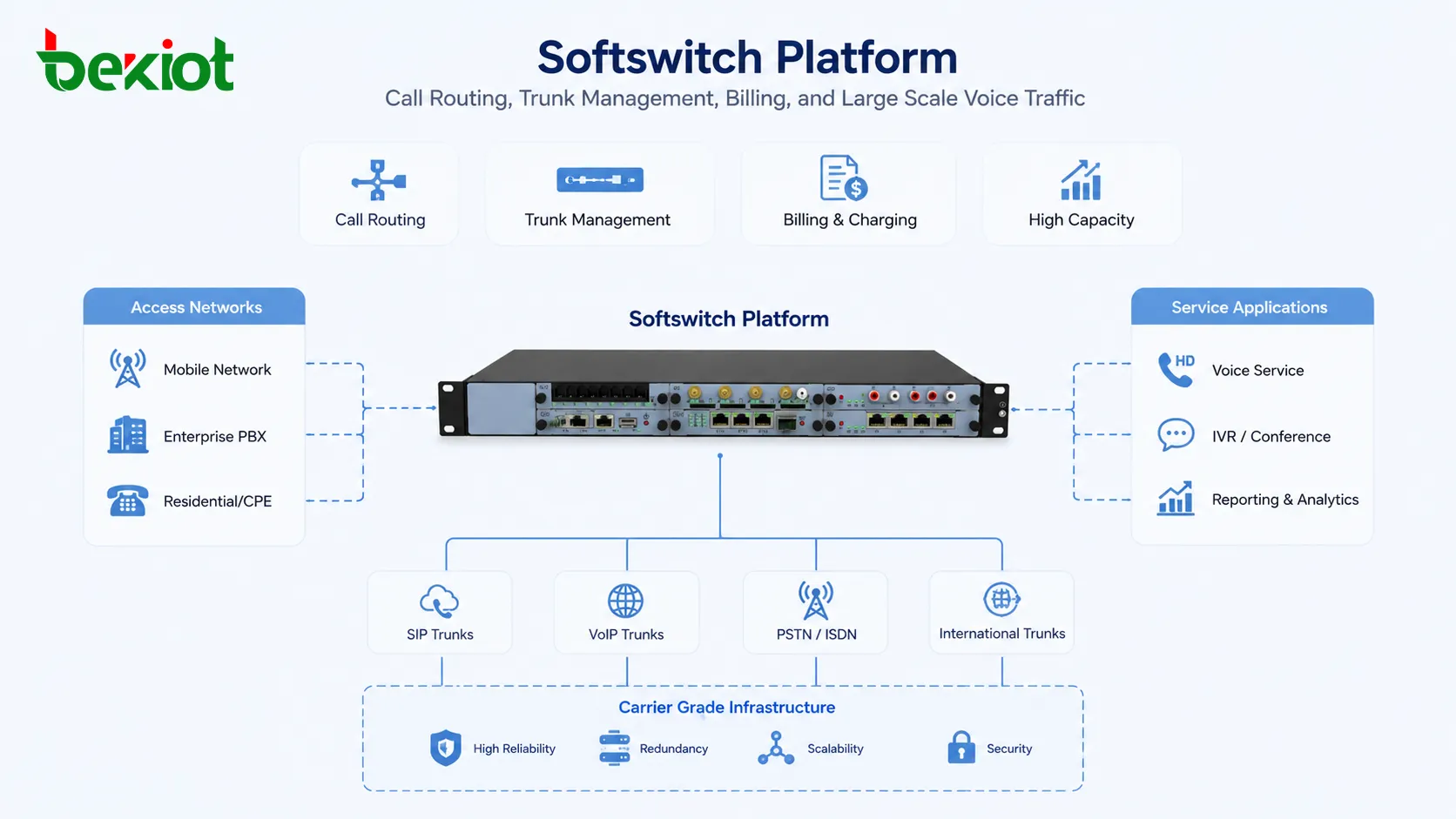
A softswitch focuses more on call control, routing, trunking, service delivery, and network-level management. It is often responsible for connecting different telephone networks, processing large-scale voice exchange, managing numbers, handling billing-related functions, supporting interconnection rules, and maintaining high-capacity call routing across multiple network domains.
This means the IPPBX is usually closer to the user-facing communication experience, while the softswitch is closer to the core switching and service control layer. An enterprise administrator may care more about extensions, departments, call permissions, ring groups, and user features. A softswitch operator may care more about routing tables, trunk groups, number resources, billing records, capacity, redundancy, and interconnection policies.
Management and customization requirements
Because an IPPBX is usually deployed for a single organization, it is often easier to manage and customize according to business needs. Administrators can adjust extension numbers, call permissions, trunk routes, department groups, voice menus, recording rules, and user accounts based on the internal workflow of the organization.
A softswitch normally serves a larger and more complex network. Its management system may involve multiple layers, including carrier routing, customer account management, number allocation, billing policy, trunk access, security rules, redundancy status, and traffic monitoring. This makes the system more powerful, but also more complex to operate.
In smaller projects, choosing a softswitch when an IPPBX is already sufficient may increase deployment cost and management difficulty. In larger service platforms, using only an IPPBX may limit scalability, routing flexibility, and carrier-grade operation capability. Therefore, the right choice depends on the actual service model rather than the name of the system.
Capacity and reliability expectations
IPPBX systems are designed for enterprise-level communication. Their capacity can range from small office deployments to larger multi-site organizations, depending on the platform design, server resources, SIP trunk capacity, gateway access, and concurrent call requirements. For most enterprise communication scenarios, an IPPBX provides enough flexibility and control.
Softswitch systems are usually built for larger call volumes and higher platform-level reliability. They are more likely to support distributed deployment, redundancy, fault tolerance, multi-node architecture, large routing tables, and high concurrent call processing. This is why softswitch systems are often seen in operator-grade networks and service provider platforms.
Reliability planning is also different. In an IPPBX project, administrators may focus on server backup, SIP trunk redundancy, gateway backup, network stability, and power protection. In a softswitch platform, the design may also include geographic redundancy, load balancing, multi-carrier interconnection, signaling security, database redundancy, and continuous service monitoring.
How to choose for a real project
If the project is mainly about building an internal telephone system, connecting SIP phones, managing extensions, accessing SIP trunks, integrating analog gateways, or improving office communication, an IPPBX is usually the practical choice. It provides the features most organizations need without adding unnecessary platform complexity.
If the project needs to provide voice services to multiple customers, support large numbers of users, manage carrier interconnection, process large call traffic, provide billing functions, or build a public VoIP service platform, a softswitch is usually more suitable. Its architecture is designed for higher scalability and more complex service control.
Some projects may use both. For example, a service provider may use a softswitch as the core switching layer and deploy IPPBX systems for enterprise customers. A large organization may also use an IPPBX at branch level while relying on a higher-level switching platform for inter-branch routing and centralized trunk access.
Comparison table for solution planning
| Item | IPPBX | Softswitch |
|---|---|---|
| Main positioning | Enterprise private voice communication system | Carrier-grade or platform-level switching system |
| Typical deployment | Inside enterprises, campuses, factories, hotels, hospitals, and offices | Operator networks, VoIP service platforms, and large multi-tenant systems |
| Core functions | Extensions, call transfer, voicemail, IVR, conferencing, recording, SIP trunks | Call routing, trunking, number management, billing, interconnection, large traffic control |
| Management style | Usually easier for enterprise administrators | More complex and suitable for professional network operation teams |
| Scalability focus | Organization-level expansion | Platform-level and carrier-grade expansion |
Recommended architecture approach
For most enterprise projects, the first step is to define the communication boundary. If all users belong to one organization and the goal is to manage internal extensions, external trunks, call routing, and daily voice services, the IPPBX model is usually more efficient. It is easier to deploy, easier to operate, and more aligned with enterprise workflows.
For service platforms, hosted communication providers, telecom access projects, or large networks with multiple external interconnections, the softswitch model should be considered. It provides stronger control over routing, capacity, billing, redundancy, and service delivery.
A good solution does not depend only on whether the system is called IPPBX or softswitch. It depends on user scale, call volume, deployment environment, required functions, management responsibility, integration requirements, and future expansion plans. Choosing the right architecture at the beginning can reduce later migration cost and avoid unnecessary system complexity.
Practical decision checklist
Choose IPPBX when the system mainly serves one enterprise or organization.
Choose IPPBX when the main requirements are extension management, SIP trunk access, voicemail, call transfer, conferencing, and internal communication.
Choose softswitch when the system needs carrier-grade routing, large traffic handling, billing, number management, or multi-customer service delivery.
Consider softswitch architecture when scalability, redundancy, and interconnection with multiple networks are core requirements.
Use a layered design when a platform needs both enterprise-level user features and carrier-level switching control.
FAQ
Can an IPPBX connect to traditional telephone lines?
Yes. An IPPBX can connect to traditional telephone lines through suitable gateways or trunk interfaces. This allows enterprises to keep some existing telephone resources while moving daily communication to an IP-based system.
Is a softswitch only used by telecom operators?
Not always. Although softswitch systems are common in operator networks, they can also be used by large service platforms, hosted voice providers, and organizations that need platform-level call control and large-scale routing.
Can an enterprise use both systems together?
Yes. In some large networks, a softswitch may work as the higher-level routing and service control layer, while IPPBX systems provide local enterprise features for branches or customer sites.
Which system is easier to maintain?
For most enterprise teams, an IPPBX is easier to maintain because it focuses on internal users and common business communication features. A softswitch usually requires more professional operation and monitoring.
Is cloud PBX the same as IPPBX?
Cloud PBX can be understood as a hosted form of PBX service delivered through the cloud. It may provide functions similar to an IPPBX, but the deployment, ownership, management model, and service responsibility are different.







