


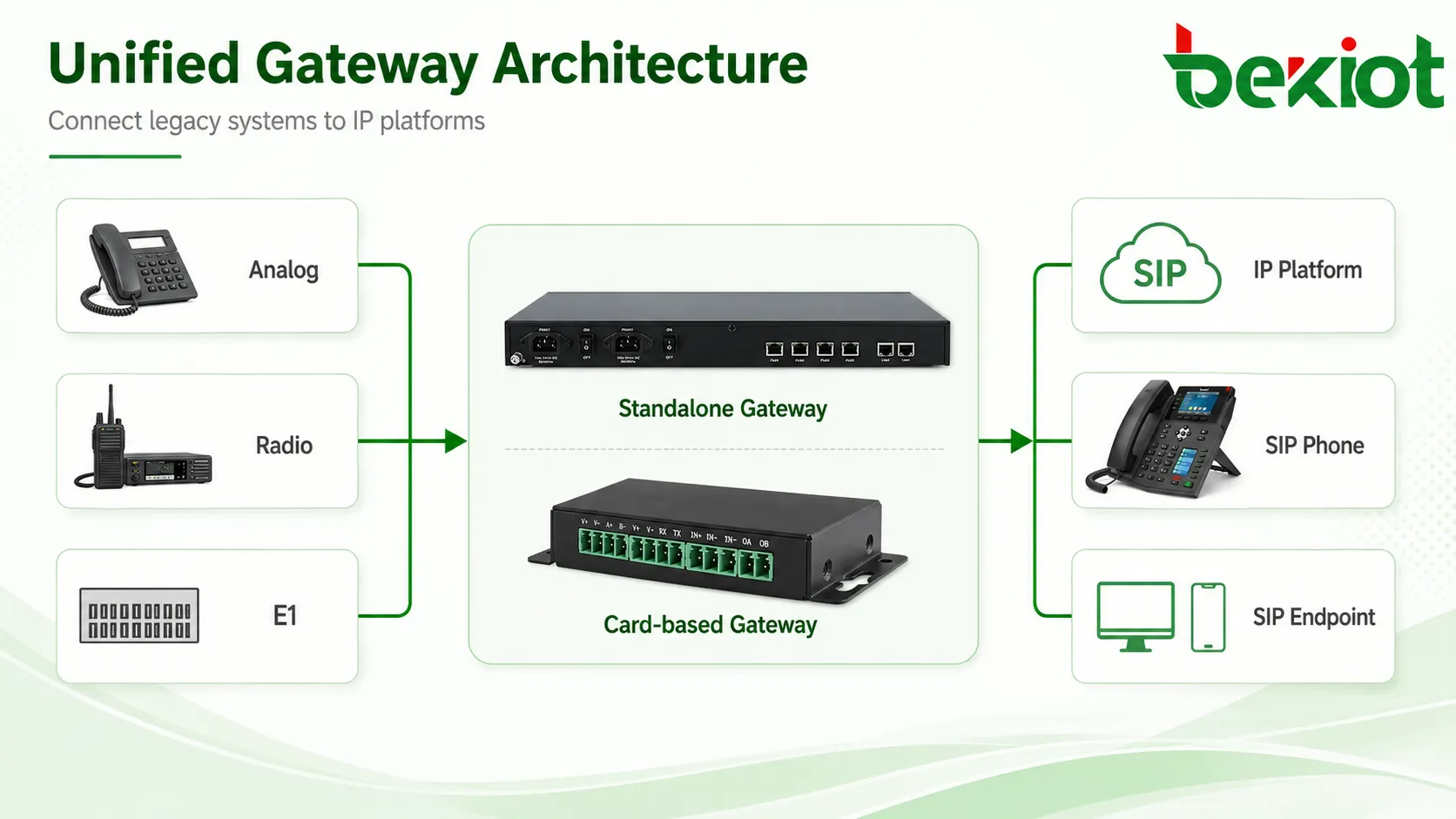
In unified communications projects, gateways are often the bridge between different communication systems, terminals, networks, and service platforms. They may connect analog telephones, PSTN trunks, E1 lines, radio systems, audio equipment, dispatch platforms, and IP-based communication servers. A well-planned gateway architecture can reduce system complexity, improve deployment flexibility, and make future maintenance easier.
In real-world integration projects, two gateway forms are commonly seen: card-based gateways and standalone gateways. Both can support cross-system communication, but they are not suitable for the same project conditions. The better choice depends on site layout, interface type, deployment distance, maintenance model, expansion needs, and total project cost.
For system integrators, the decision should not be made only by comparing the number of ports or the initial device price. Gateway selection affects wiring design, cabinet space, troubleshooting speed, spare device strategy, remote management, and future system upgrades. A gateway that looks powerful on paper may create unnecessary complexity if the actual project is distributed across multiple rooms, buildings, or remote sites.
Why gateway planning matters in system integration
Unified communications projects often include equipment from different generations and different technical standards. For example, one site may still use analog telephone extensions, another may need PSTN trunk access, while a command center may require E1 connectivity, radio dispatch integration, or external audio input.
Without suitable gateways, these systems remain isolated. With the right gateway design, legacy interfaces and modern IP communication platforms can be connected into one manageable system. This makes call routing, dispatching, emergency communication, recording, intercom linkage, and centralized management easier to implement.
The key question is not simply whether a gateway can provide the required ports. The more important question is whether its structure fits the project’s physical environment, network topology, operation workflow, and long-term maintenance requirements.
In many projects, gateways are also part of the reliability design. If the gateway layer is poorly planned, a single wiring mistake, interface mismatch, or device failure may affect communication between departments, control rooms, emergency points, or remote stations. Therefore, gateway architecture should be considered together with network redundancy, power supply, cabinet layout, grounding, and operation management.
Two common gateway structures
Card-based gateway design
A card-based gateway places multiple interface boards inside one chassis. Different boards can provide different functions, such as FXS analog extension interfaces, FXO analog trunk interfaces, E1 interfaces, radio communication interfaces, and audio interfaces.
This structure is highly integrated. Multiple service capabilities can be concentrated in one device frame, which is useful when the project requires many interface types in a limited installation space. It is often considered for compact sites, centralized equipment rooms, vehicle-mounted systems, or environments where different communication interfaces must be assembled into one chassis.
The main advantage of this design is centralized management. When all boards are installed in one frame, engineers can manage several access functions from one physical location. This can simplify cabinet planning and reduce the number of separate devices. However, it also means that the chassis becomes an important system node, so power protection, spare boards, ventilation, and service continuity should be carefully planned.
Standalone gateway design
A standalone gateway is usually an appliance-style device with a fixed interface type and clear functional boundary. For example, one gateway may mainly serve FXS analog users, another may handle FXO trunk access, another may support E1 access, and another may connect radio systems to an IP dispatch platform.
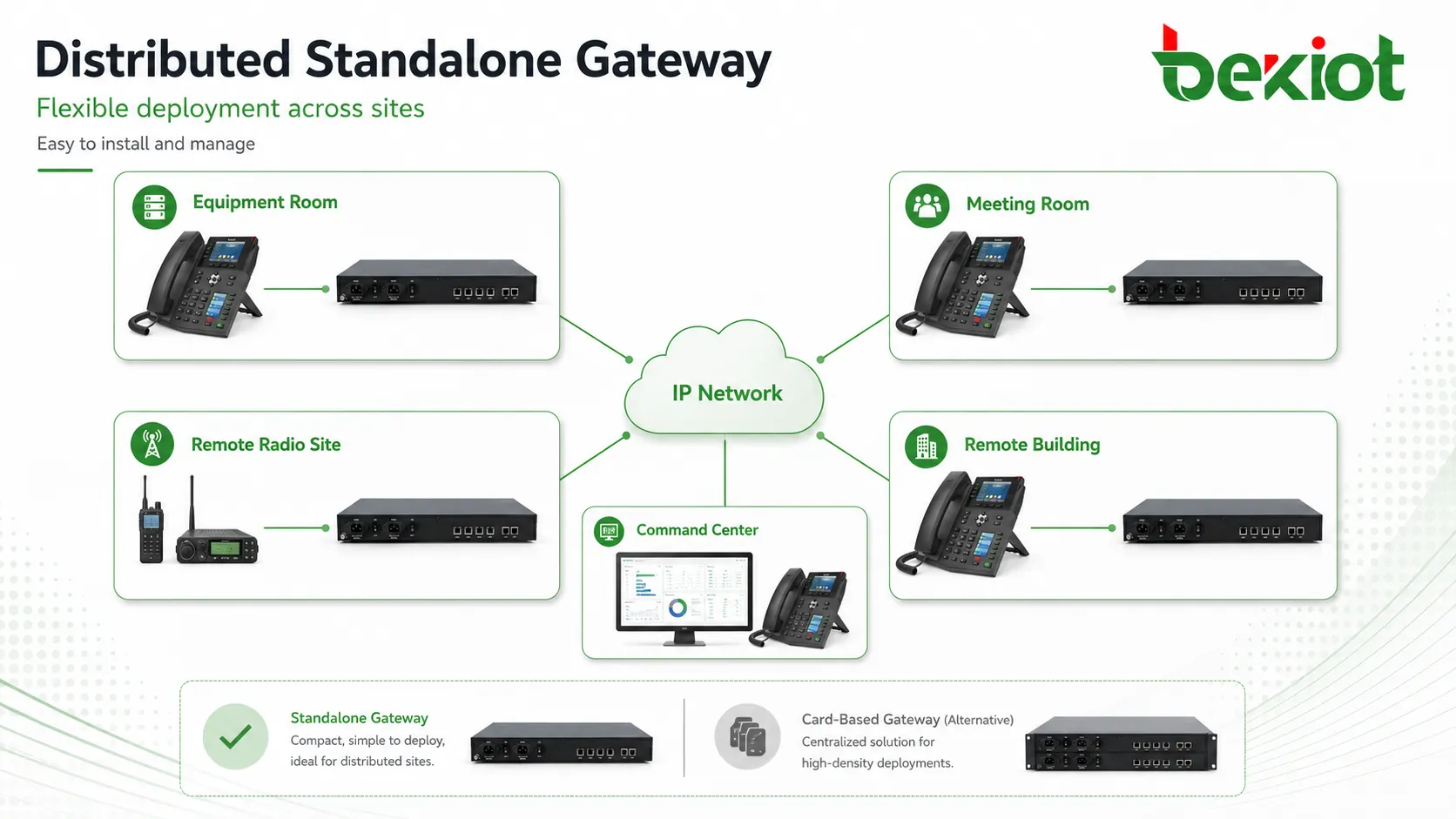
Many standalone gateways use a 1U rackmount design or a compact industrial enclosure. Instead of concentrating every function inside one frame, standalone gateways are distributed across different sites and connected through the IP network. This makes them suitable for multi-room, multi-building, multi-region, or cross-network projects.
The advantage of this design is clear responsibility. Each gateway handles a defined access task, making configuration, replacement, and troubleshooting more direct. When a site only needs one type of interface, a standalone gateway can avoid the cost and complexity of a larger integrated chassis.
Site layout often decides the practical choice
Card-based gateways are suitable when several interface types are physically located in the same place. For example, if analog lines, E1 access, audio input, and radio integration are all concentrated in one equipment room, a card-based structure can reduce device quantity and save rack space.
However, this advantage becomes weaker when interfaces are distributed across different locations. If an audio interface needs to connect to a mixing console in a meeting room, while telephone trunks are in the main equipment room and radio stations are located in remote sites, putting everything into one card-based chassis may create unnecessary cabling and installation difficulty.
Standalone gateways are more flexible in distributed deployment. They can be installed close to the actual equipment they connect to. A radio gateway can be placed near a radio base station, an audio gateway can be placed near a conference system, and an analog gateway can be placed near legacy telephone wiring. IP networking then connects these nodes back to the unified communication platform.
This distributed method is especially useful in campuses, industrial parks, transportation hubs, utility facilities, factories, tunnels, and emergency command systems. These projects often have multiple buildings or remote rooms, and the communication access points are not always close to the main server room. In such cases, forcing all interfaces into one central cabinet may increase cable length, installation cost, and future maintenance workload.
Deployment and commissioning differences
A card-based gateway usually requires more planning during installation. Different boards may have different wiring requirements, interface definitions, service purposes, and configuration logic. Engineers need to distinguish slot positions, board functions, line routing, grounding conditions, and application scenarios before commissioning the system.
Because several services are integrated into one chassis, configuration errors may affect multiple functions at the same time. This does not mean card-based gateways are unreliable, but it does mean that deployment teams need stronger technical preparation and clearer documentation.
Standalone gateways are generally easier to configure because each device usually solves one specific access problem. A standalone FXS gateway focuses on analog telephone users. A standalone FXO gateway focuses on trunk lines. A standalone E1 gateway focuses on digital trunk access. A radio gateway focuses on radio-to-IP interconnection.
This functional separation makes installation more straightforward. Engineers can configure, test, replace, or expand one gateway type without changing the whole gateway frame. For projects with multiple contractors, multiple sites, or phased construction, this simpler boundary can reduce communication cost and implementation risk.
During commissioning, standalone gateways also make acceptance testing easier. Each interface type can be tested independently, and problems can be located by site, device, cable, or service function. This is helpful when the project schedule is tight or when some parts of the system need to be delivered before the full project is completed.
Maintenance, expansion, and project cost
Maintenance requirements should be considered from the beginning of the project. In a card-based structure, a single chassis may carry several critical services. If the chassis, power module, management module, or backplane has a problem, multiple communication functions may be affected together. Spare parts planning and fault isolation therefore become important.
Standalone gateways provide clearer service separation. If one standalone gateway fails, the affected service scope is usually limited to that device and its connected interface. This can make troubleshooting faster and replacement easier, especially for projects where local technicians may not be familiar with complex card-based systems.
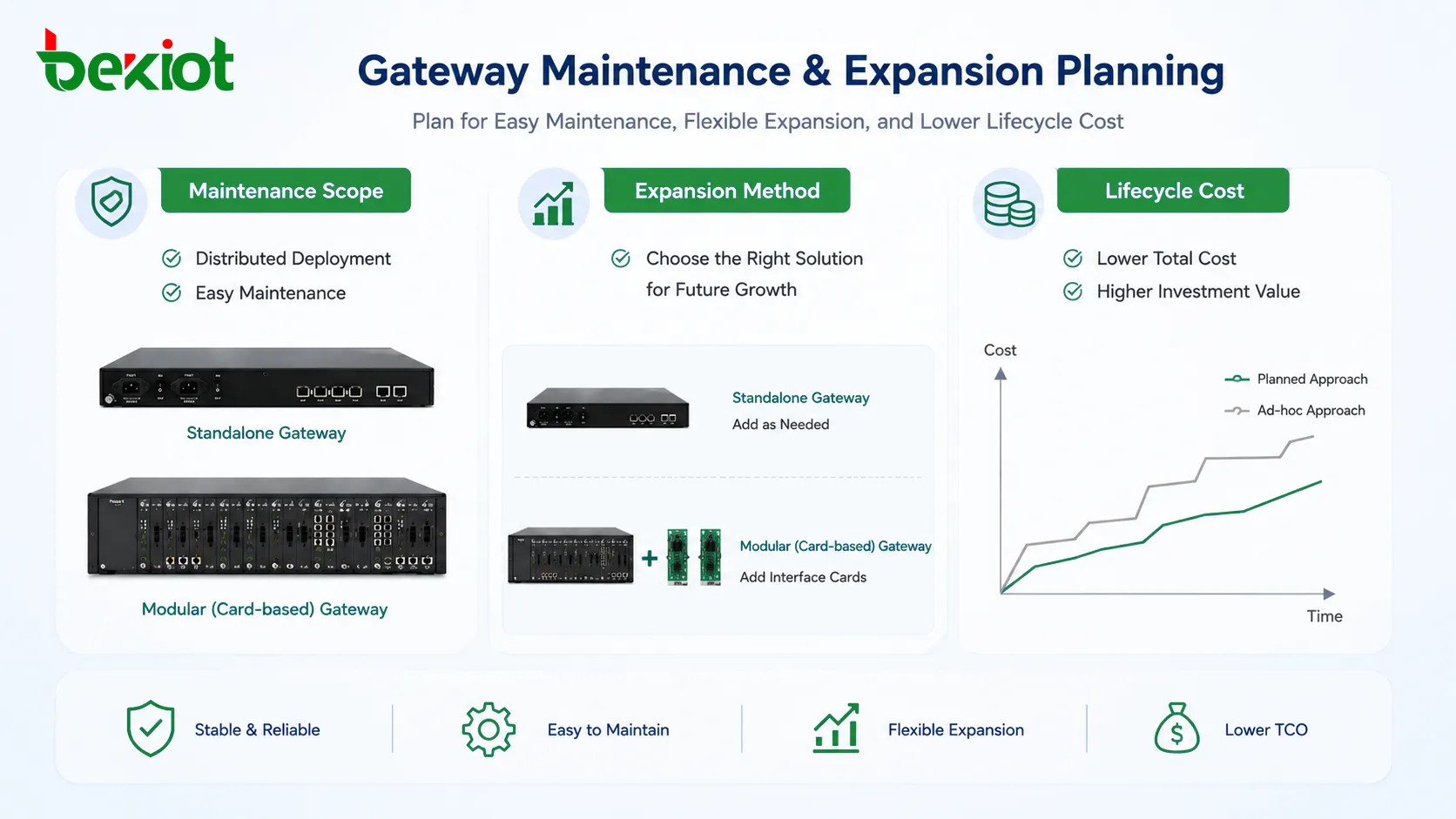
Expansion logic is also different. Card-based gateways expand by adding or replacing boards when chassis capacity allows. This is efficient when future requirements are predictable and centralized. Standalone gateways expand by adding another device at the required node, which is more flexible when the project grows site by site.
From a cost perspective, standalone gateways are often more suitable for general integration projects because they usually have lower entry cost, simpler deployment requirements, and more flexible purchasing options. Card-based gateways may be more economical in highly concentrated systems with many interface types, but they require careful capacity planning to avoid underused slots or future limitations.
Lifecycle cost should also include training, documentation, spare units, replacement time, and remote support. A lower device price does not always mean a lower project cost. If the gateway structure causes complicated wiring, difficult troubleshooting, or poor scalability, the long-term maintenance cost may become higher than expected.
Recommended selection approach
A card-based gateway is a better fit when the project has a simple and centralized network structure, multiple interface types are located in the same equipment area, installation space is limited, and the system requires high integration inside one chassis.
A standalone gateway is usually better when the project involves distributed nodes, different rooms, remote sites, cross-network access, phased deployment, or independent maintenance requirements. It is also a practical choice when each gateway only needs to solve one access function, such as analog extension access, analog trunk access, E1 access, radio integration, or audio linkage.
In many unified communications projects, the final design does not need to choose only one form. A hybrid architecture can also be used. Core interfaces that are highly concentrated can be handled by an integrated gateway, while remote or special-purpose access points can use standalone gateways. This approach balances rack space, deployment flexibility, maintenance convenience, and cost control.
A practical design process is to map all access points first, then classify them by interface type, physical location, service priority, and maintenance responsibility. After that, the project team can decide which interfaces should be centralized and which should be deployed locally. This method is more reliable than selecting equipment only after counting total port numbers.
Practical decision checklist
Choose card-based gateways when many interfaces are centralized in one equipment room.
Choose standalone gateways when access points are distributed across different sites or rooms.
Consider card-based design for compact environments, vehicle-mounted systems, or space-limited cabinets.
Consider standalone design for easier deployment, simpler configuration, lower maintenance difficulty, and flexible expansion.
Use a hybrid design when centralized and distributed access requirements exist in the same project.
Review lifecycle cost including cabling, spare devices, engineer training, fault recovery time, and future interface expansion.
FAQ
Can a standalone gateway support large unified communications projects?
Yes. Standalone gateways can support large projects when they are planned as distributed access nodes. Their advantage is not only port capacity, but also the ability to place the right gateway close to the equipment it serves.
Is a card-based gateway always more professional?
Not necessarily. A card-based gateway offers high integration, but professionalism depends on whether the architecture matches the project. In a distributed project, several standalone gateways may produce a cleaner and more maintainable design.
Which gateway type is easier for future expansion?
Standalone gateways are usually easier for phased expansion because new devices can be added where new access points are needed. Card-based gateways are efficient when expansion remains within the planned chassis capacity.
Should gateway selection be based only on port quantity?
No. Port quantity is only one factor. Site distribution, wiring distance, interface type, power supply, maintenance responsibility, network security, redundancy, and lifecycle cost should also be considered.
Can both structures be used in the same project?
Yes. A hybrid structure is often reasonable. Centralized, high-density access can use an integrated gateway, while remote or dedicated access points can use standalone gateways. This allows the system to keep both integration efficiency and deployment flexibility.







