


A command and dispatch platform is a specialized communication system designed for emergency response, production coordination, operational management, and field command. It uses voice, video, data, geographic information, and real-time collaboration tools to help decision makers communicate with teams, sites, devices, and remote locations more efficiently.
In public safety, transportation, industrial parks, mining, energy, utilities, manufacturing, and large enterprise environments, different users may already have different communication resources. Some organizations depend on telephone systems, some use video conferencing, some rely heavily on video surveillance, while others still use private radio or trunked radio networks. For this reason, command and dispatch platforms are usually built in four common ways, each based on a different technical foundation.
Related Solution: Becke Command Dispatch System
Why the platform foundation matters
The construction method of a command and dispatch platform determines its communication capability, integration scope, expansion path, and long-term operation model. A platform built from a telephone or unified communication system will naturally emphasize voice dispatch and SIP interconnection. A platform based on video conferencing will focus more on remote consultation and multi-party meeting collaboration. A system based on video surveillance will make visual monitoring and video resource access the core. A radio-based platform will give priority to field communication and push-to-talk operation.
None of these methods is absolutely better in every project. The correct choice depends on the user’s existing infrastructure, command workflow, emergency response requirements, field communication habits, and future multimedia integration needs. In many modern projects, the final system is not built from only one technology. Instead, different platforms are connected together to form a more complete dispatch environment.
A good planning process should first identify what the organization already has, what must be retained, and what needs to be improved. This prevents repeated investment and makes the new command system easier to integrate with legacy communication assets.
Built from a unified communication system
One common method is to build the dispatch platform on top of a unified communication system. Early dispatch systems were often developed from telephone systems because telephone networks were already widely deployed and easy to use. With the development of IP communication, unified communication systems now support much richer capabilities than traditional voice calling.
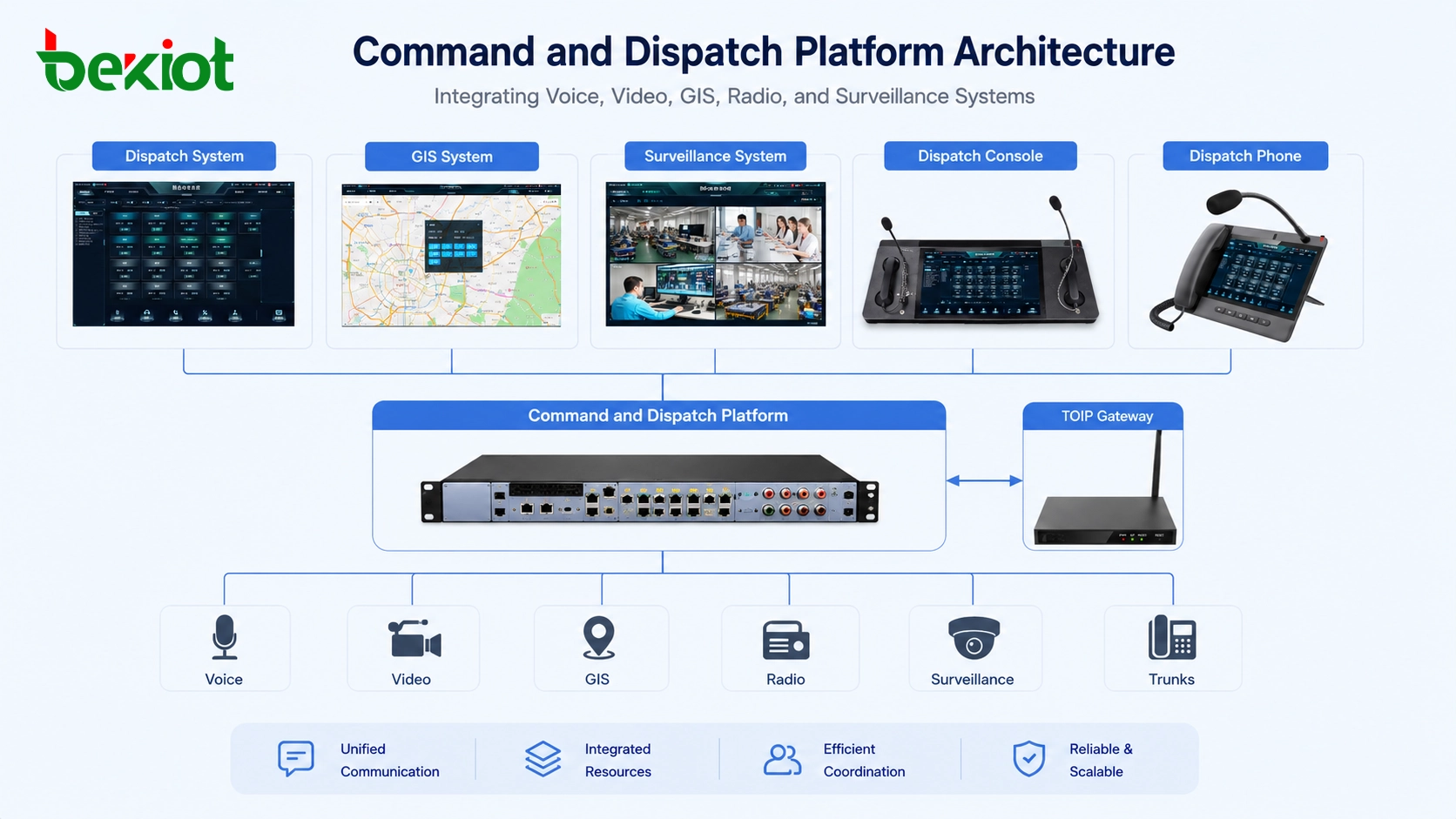
A SIP-based unified communication platform can integrate telephone systems, video conferencing systems, video surveillance systems, trunked radios, broadband push-to-talk systems, intercom terminals, mobile clients, and other communication resources. Because SIP is an open and widely used communication protocol, it is suitable for connecting different terminals and systems in a flexible way.
This approach is widely used because it provides a balanced foundation for voice dispatch, video dispatch, radio dispatch, GIS-assisted command, emergency calling, recording, and centralized management. It is especially suitable for organizations that need to coordinate different departments, different sites, and different types of communication terminals.
In practical deployment, the unified communication platform may act as the core communication layer. Dispatch consoles, IP phones, SIP intercoms, gateways, video terminals, and mobile clients can all register or connect to the same communication system. This makes numbering, routing, calling, group communication, and emergency notification easier to manage.
Designed around meeting and consultation workflows
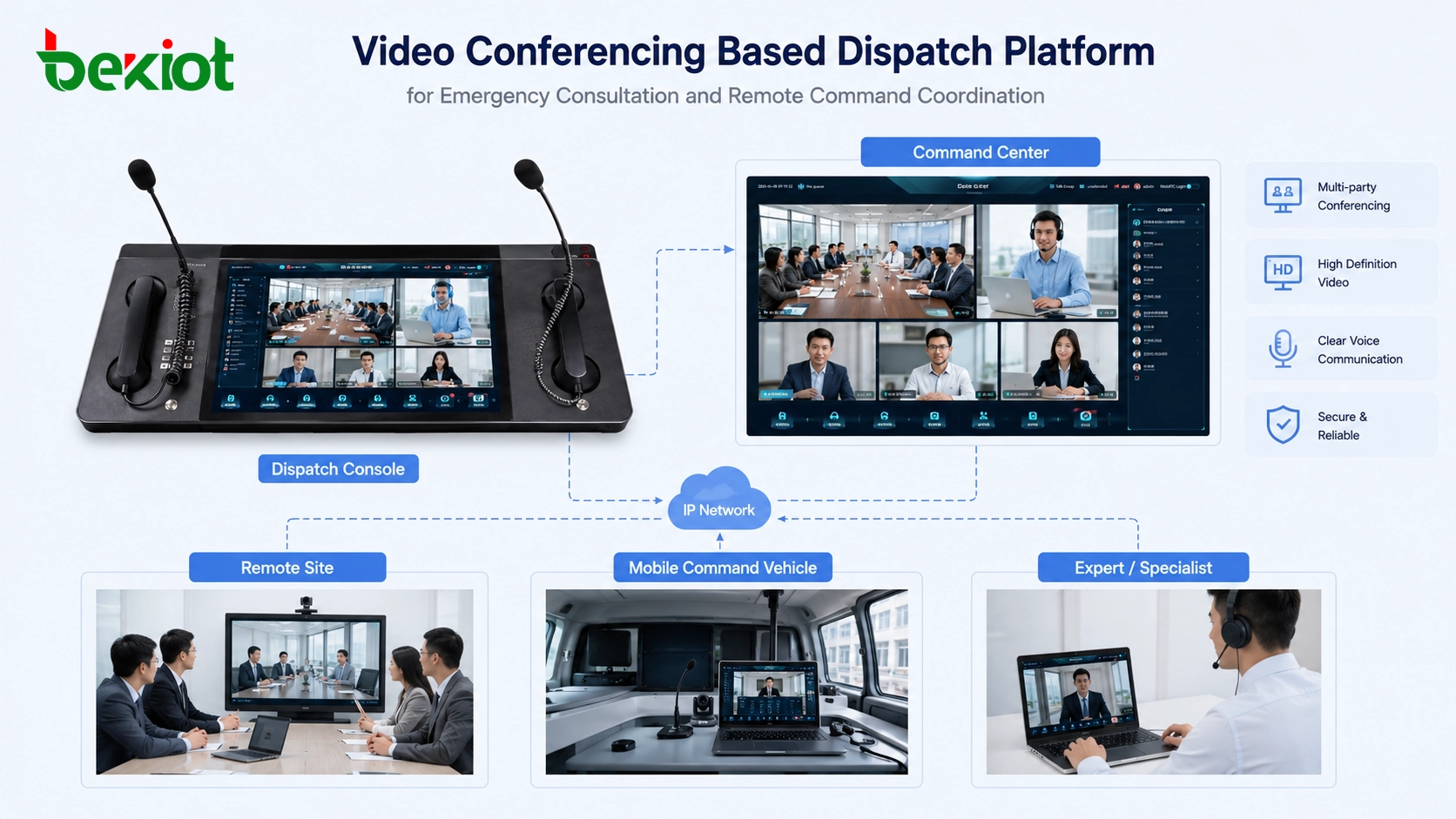
Another common construction method is based on video conferencing. Video conferencing systems are widely used for remote collaboration, expert consultation, emergency meetings, and cross-regional coordination. In emergency command scenarios, the ability to quickly bring multiple departments or experts into one visual meeting is very valuable.
In this type of design, the video conferencing MCU or conference platform becomes the foundation of the command system. Through SIP extension capabilities and interface development, the platform can expand beyond normal meeting functions and support dispatch command, emergency consultation, remote coordination, and multi-terminal access.
The advantage of this method is clear. It strengthens real-time visual communication and allows command centers to connect meeting rooms, conference terminals, mobile users, telephones, and remote participants. It is suitable for scenarios where decision making depends heavily on consultation, coordination, and multi-party discussion.
However, a video-conference-based platform may need additional integration when the project requires stronger field dispatch, radio communication, GIS linkage, or routine production scheduling. Therefore, this method is often combined with SIP communication systems, surveillance access, or dispatch control modules to create a more complete command solution.
Centered on visual monitoring resources
Some command and dispatch systems are built from video surveillance platforms. This is common in traffic management, public safety, transportation, city operation, industrial parks, and other industries where video monitoring is already a major information resource. In these projects, the command center often needs to see what is happening before making decisions.
A surveillance-based dispatch platform usually integrates camera resources, video walls, recording systems, monitoring centers, and video management platforms. It may use GB/T 28181 as an important technical framework for video resource access and interconnection. By expanding communication and dispatch functions around video resources, the system can support visual command, incident verification, remote inspection, and event tracking.
The key advantage of this method is strong video awareness. Operators can use real-time video to understand road conditions, facility status, security risks, accident scenes, or production environments. When combined with voice communication, intercom, GIS, and emergency notification, the platform becomes more useful for real-time command.
This method is especially suitable when visual evidence and scene awareness are central to the work process. For example, a traffic command center may need to combine road cameras, GIS maps, voice dispatch, and field team communication. A factory control room may need to link video monitoring with emergency broadcasting, intercom calling, and alarm response.
Based on private radio and trunked communication
Radio communication remains important in many industries. Private radios, trunked radio systems, and push-to-talk terminals are widely used because they are simple, fast, and reliable in field operations. In many special environments, radio communication is still difficult to replace.
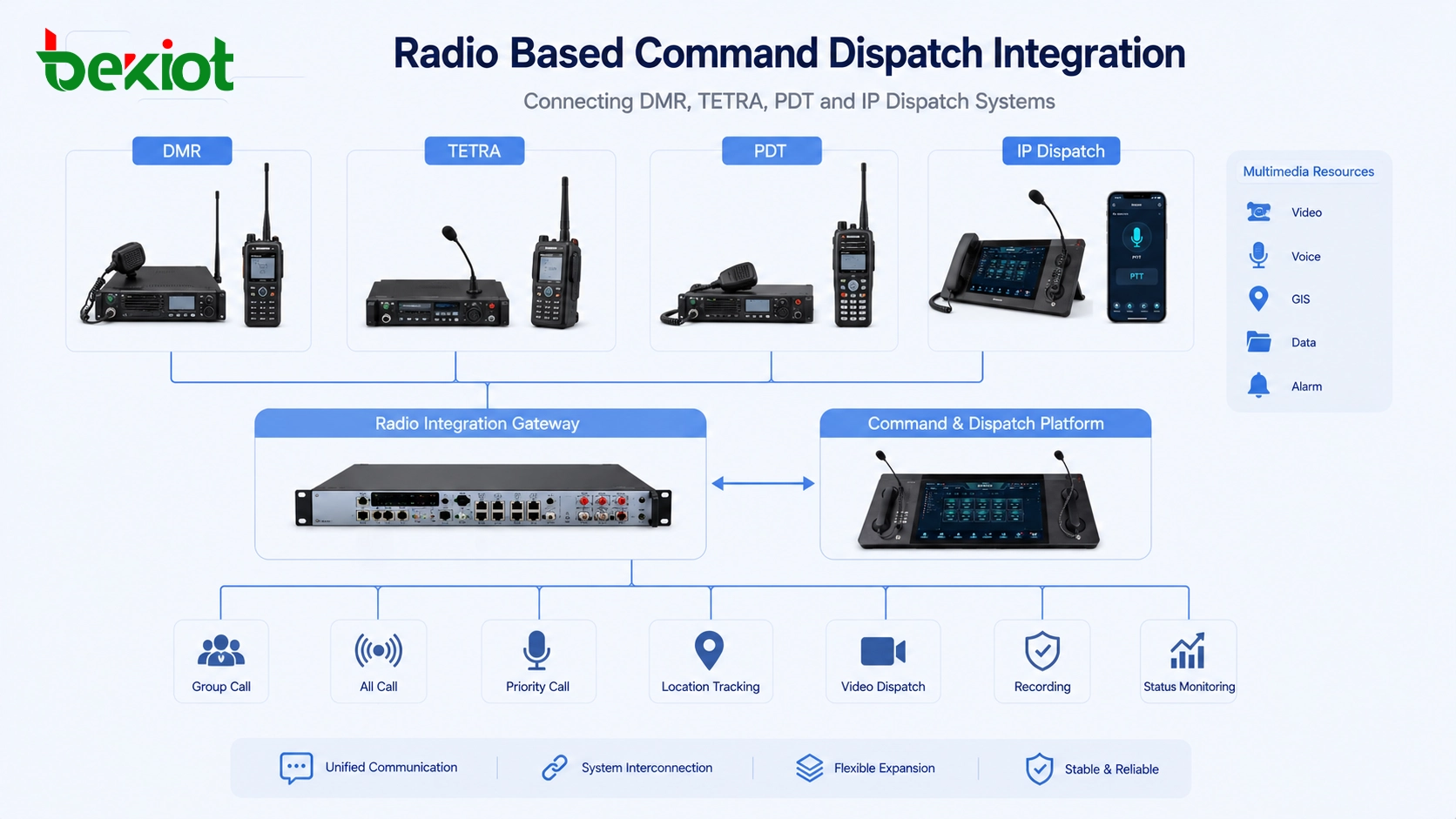
Common digital trunked communication systems such as DMR, TETRA, and PDT have been deployed in many sectors. They are often used by public safety teams, transportation departments, industrial users, security teams, utility workers, and emergency response groups. These systems are strong in narrowband voice communication and group calling.
However, traditional radio-based systems also have limitations. They mainly focus on voice communication and usually cannot provide rich broadband multimedia services by themselves. They may need additional integration to support video linkage, GIS positioning, recording, dispatch console operation, mobile collaboration, or public-network communication.
In modern command projects, radio systems are often connected to IP-based dispatch platforms through radio gateways, ROIP gateways, trunked radio gateways, or other interconnection devices. This allows field radio users to communicate with command center operators, SIP users, mobile clients, and other dispatch terminals. It also helps protect the user’s existing radio investment while expanding the system into a more open communication environment.
The trend is system convergence
Although the four construction methods have different starting points, the development direction is increasingly clear: command and dispatch systems are moving toward convergence. Users no longer want isolated telephone dispatch, isolated video meetings, isolated surveillance monitoring, or isolated radio communication. They need a platform that can combine these capabilities and support real operations.
A converged platform can connect voice calls, video meetings, video surveillance, private radio, broadband push-to-talk, GIS maps, emergency alarms, recording systems, and mobile terminals. This makes the command center more flexible. Operators can call a field team, view the incident location, open nearby cameras, invite experts into a video meeting, and issue instructions from the same operational environment.
This trend is especially important in emergency response and industrial management. Emergencies often involve multiple departments, multiple information sources, and multiple communication channels. If each system works separately, operators may lose time switching between platforms. If the systems are integrated, command decisions can be faster and more accurate.
How to choose the right construction path
If the project focuses on internal communication, extension management, dispatch calling, intercom access, and cross-system voice communication, a unified communication foundation is usually a practical choice. It offers strong SIP integration capability and can support voice, video, and gateway access in a relatively balanced way.
If the project focuses on emergency consultation, remote meetings, expert participation, and multi-party collaboration, a video conferencing foundation may be more suitable. This is especially useful when command decisions depend on real-time discussion between departments or remote specialists.
If the project focuses on visual monitoring, scene verification, traffic control, security operation, or video resource management, a surveillance-based platform is more appropriate. It can make camera access, video display, event review, and video linkage the center of dispatch work.
If the project depends heavily on field teams, radio users, patrol groups, emergency crews, or private radio networks, a radio-based construction method should be considered. It allows the platform to keep the speed and reliability of push-to-talk communication while expanding toward IP dispatch and multimedia linkage.
Practical planning checklist
Choose a unified communication foundation when voice dispatch, SIP access, telephone integration, intercom linkage, and multi-terminal communication are core requirements.
Choose a video conferencing foundation when emergency consultation, expert meetings, remote collaboration, and multi-party decision making are the main use cases.
Choose a surveillance-centered design when camera resources, video monitoring, GB/T 28181 access, and visual command are central to the workflow.
Choose a radio-based approach when private radio, DMR, TETRA, PDT, field push-to-talk, and group communication must be preserved and integrated.
Use converged architecture when the project needs voice, video, GIS, radio, alarms, recording, and mobile communication in one dispatch environment.
Recommended solution approach
For most modern projects, the best approach is not to treat the four construction methods as isolated choices. Instead, the project team should analyze the current system base and then define the target command capability. If the user already has a mature video surveillance center, the system can start from video resources and expand voice and GIS dispatch. If the user already has a SIP communication network, the system can start from unified communications and add video, radio, and monitoring integration.
A scalable command platform should support modular growth. The first phase may focus on voice dispatch and intercom access. The second phase may add video surveillance linkage and GIS location. A later phase may integrate radio systems, mobile clients, emergency alarms, recording, or intelligent event handling. This phased method reduces deployment risk and protects existing investment.
In solution design, the most important goal is operational efficiency. The system should help users see the situation, contact the right team, coordinate resources, record the process, and respond quickly. Technology is only useful when it supports these real command tasks.
FAQ
Can one command platform support all four construction methods?
Yes. A well-designed platform can integrate unified communication, video conferencing, video surveillance, and radio communication. The key is to choose an open architecture with suitable interfaces and expansion capability.
Is GB/T 28181 only used for video surveillance?
GB/T 28181 is mainly used for video surveillance networking and video resource access. In command platforms, it is often combined with voice, GIS, intercom, and alarm systems to support broader dispatch functions.
Why are radio systems still important in modern dispatch projects?
Radio systems provide fast push-to-talk communication and are already widely used in field operations. They are especially valuable in patrol, emergency response, transportation, industrial, and public safety scenarios.
Should a new platform replace existing communication systems?
Not necessarily. In many projects, the better strategy is to integrate existing telephone, video, surveillance, and radio resources into a new dispatch environment instead of replacing everything at once.
What is the main risk in platform construction?
The main risk is building isolated subsystems without unified planning. If voice, video, GIS, radio, and alarm resources cannot work together, the command center may still face slow response and inefficient coordination.







