


In many voice communication systems, users often see two similar terms in product settings or technical documents: VAD and VOX. They may appear in IP phones, intercom terminals, radio gateways, dispatch systems, push-to-talk devices, and other audio communication equipment. Although both are related to voice detection and audio activation, they are not the same technology and should not be selected or configured in the same way.
VAD focuses on identifying whether real speech exists in an audio signal, while VOX focuses on triggering a device action when sound volume reaches a preset threshold. Understanding this difference helps system designers improve voice quality, reduce unnecessary transmission, avoid false triggering, and select the right communication mode for different environments.
In project design, the difference between VAD and VOX becomes more important when the communication system is deployed in noisy, mobile, industrial, or emergency environments. A function that works well in an office may perform very differently in a workshop, tunnel, mine, vehicle, command center, or outdoor field site. Therefore, these two functions should be understood as different design tools rather than interchangeable audio options.
Key Point: VAD is mainly used for intelligent speech activity detection, while VOX is mainly used for sound-triggered device activation.
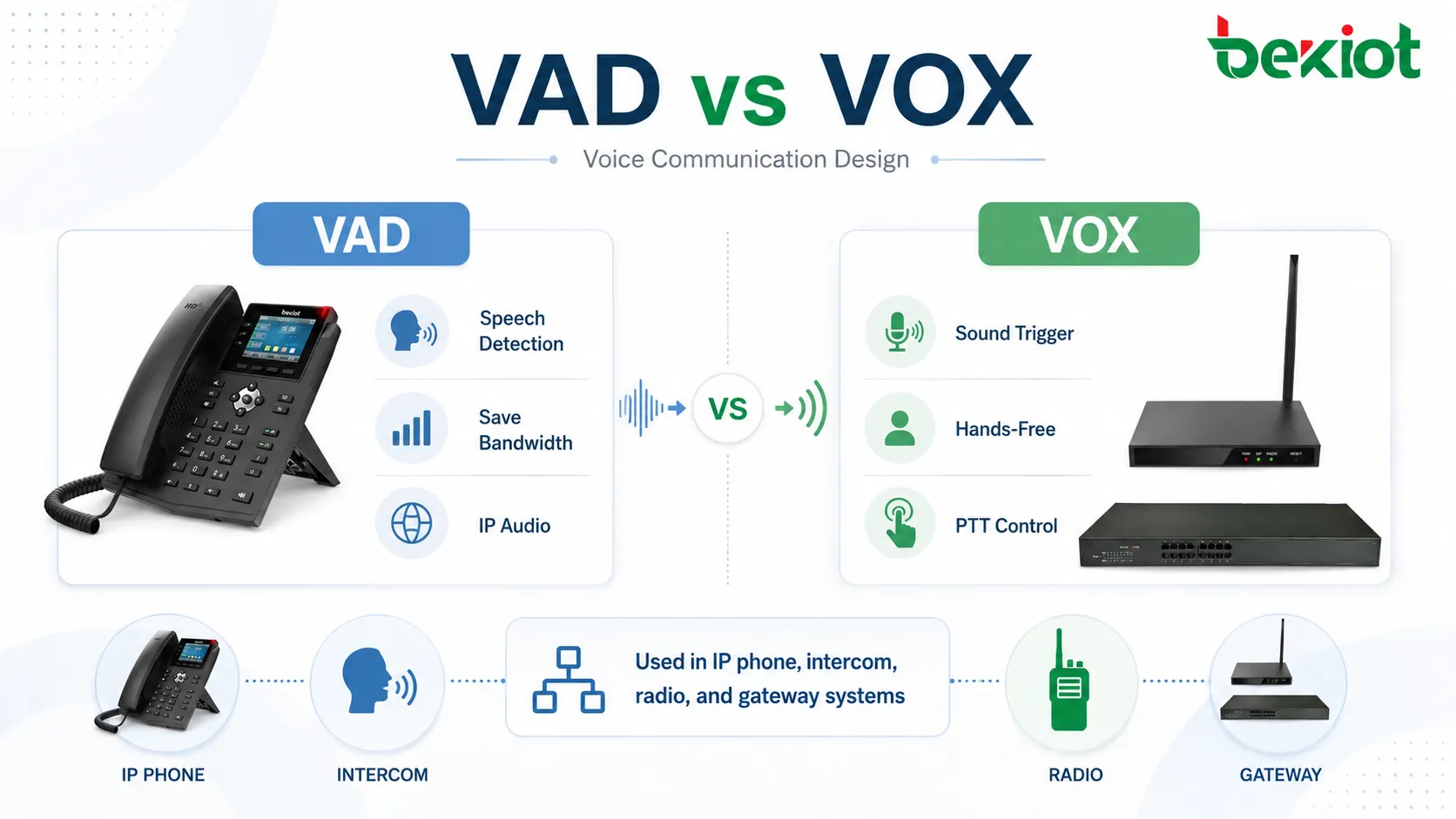
Why these two settings are often confused
VAD and VOX are both used in audio-related systems, and both may respond to voice or sound. This makes them look similar from the user interface. For example, a technician may see VAD in an IP phone configuration page and VOX in a radio or intercom setting menu, then assume both functions simply mean “voice activation.”
In reality, the design logic is different. VAD is usually part of the audio processing chain. It analyzes the input signal and decides whether the signal contains valid speech. VOX is more like a voice-controlled switch. It listens for audio level changes and turns a function on or off when the sound exceeds or falls below a configured threshold.
This difference affects system performance. In a quiet office, both functions may appear to work smoothly. In a noisy factory, tunnel, control room, vehicle, mine, or outdoor emergency site, incorrect configuration may cause clipped speech, false activation, delayed transmission, or unnecessary bandwidth usage.
How speech activity detection works
VAD stands for Voice Activity Detection. It is used to determine whether an audio signal contains human speech. Instead of simply checking whether the sound is loud, VAD may analyze energy level, frequency features, noise pattern, speech characteristics, and other audio parameters to decide whether someone is actually speaking.
This makes VAD useful in IP voice communication, voice coding, audio conferencing, intercom systems, voice recognition, call recording, and software communication platforms. When no valid speech is detected, the system can reduce or stop the transmission of silent audio packets. This helps save bandwidth, reduce unnecessary encoding work, and improve communication efficiency.
In IP-based communication systems, VAD is often connected with silence suppression. During a call, the system does not need to encode and transmit continuous silence. By detecting non-speech segments, VAD can reduce network traffic and processing load while keeping the voice session active.
This is especially valuable when many users or channels are online at the same time. In a large dispatch system, call center, multi-channel intercom network, or gateway platform, reducing unnecessary silence transmission can help improve bandwidth utilization and reduce processing pressure on the server, gateway, or terminal side.
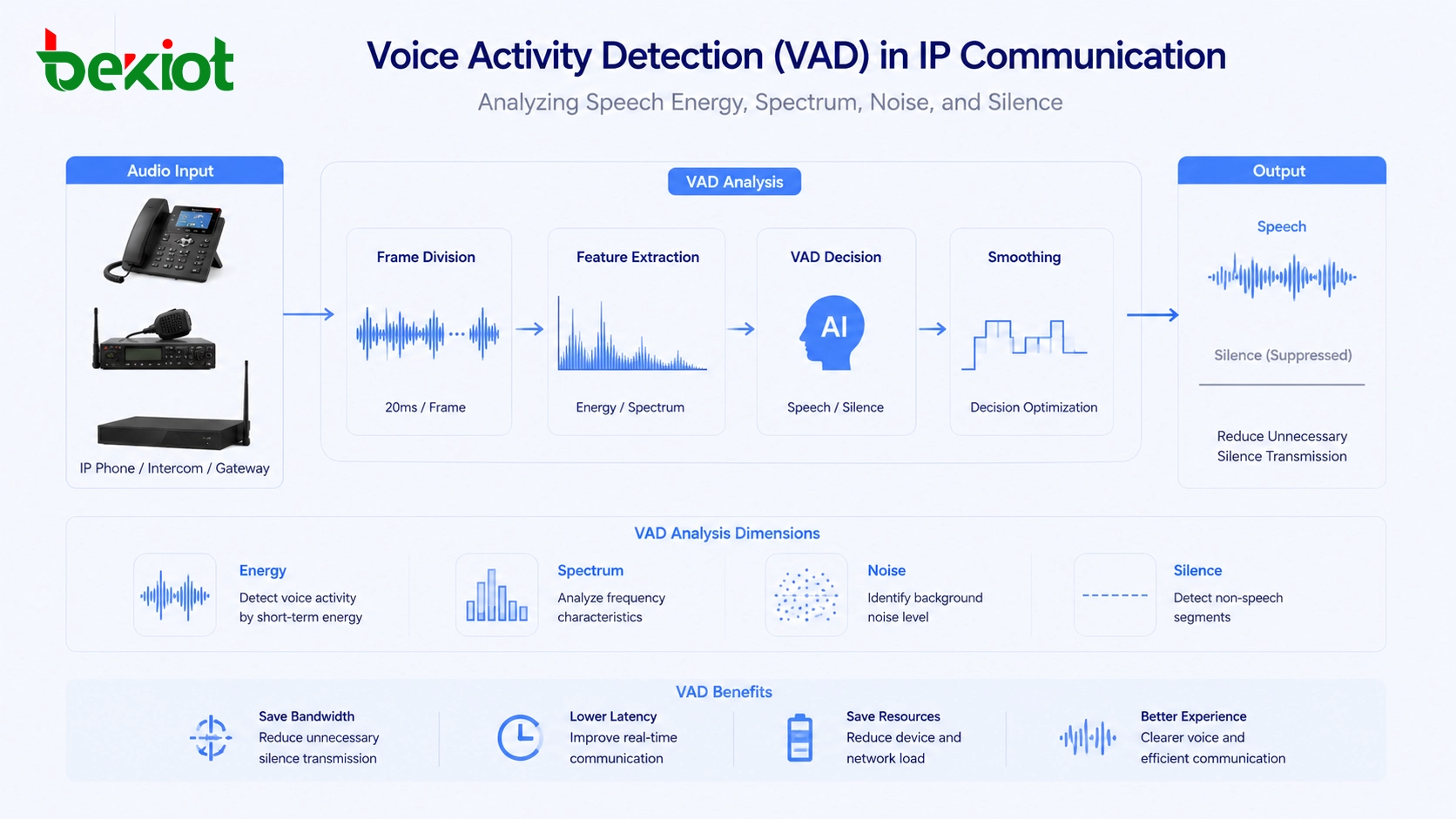
Where intelligent detection adds value
VAD is especially valuable in systems that need efficient audio transmission. IP phones, SIP intercoms, dispatch terminals, voice gateways, conferencing platforms, and communication software can all benefit from detecting speech more accurately.
In a networked communication environment, every audio stream consumes bandwidth and processing resources. If silent packets are transmitted continuously, the system may waste network capacity, especially when many users, channels, or terminals are active at the same time. VAD helps reduce this unnecessary load.
VAD also supports more advanced audio applications. In voice recognition, it helps separate useful speech from silence. In recording systems, it can help mark active speech segments. In noise-aware communication systems, it can work together with echo cancellation, noise suppression, and automatic gain control to improve voice experience.
How sound-triggered switching works
VOX stands for Voice Operated Exchange. It is often understood as a voice-operated switch or sound-activated switch. Unlike VAD, VOX usually works by monitoring the volume level of the incoming sound. When the audio level is higher than a preset threshold, the device automatically activates a function. When the level falls below the threshold, the device closes, releases, or returns to standby.
This mechanism is widely used in radios, intercoms, recording devices, hands-free communication equipment, and push-to-talk scenarios. In a two-way radio system, VOX can automatically activate the transmission function when the user speaks, without requiring the user to press the PTT button manually.
The core advantage of VOX is convenience. It allows hands-free operation in scenarios where users cannot easily press a button, such as maintenance work, field operation, vehicle communication, security patrol, or industrial tasks. However, because VOX relies heavily on audio level, it must be configured carefully in noisy environments.
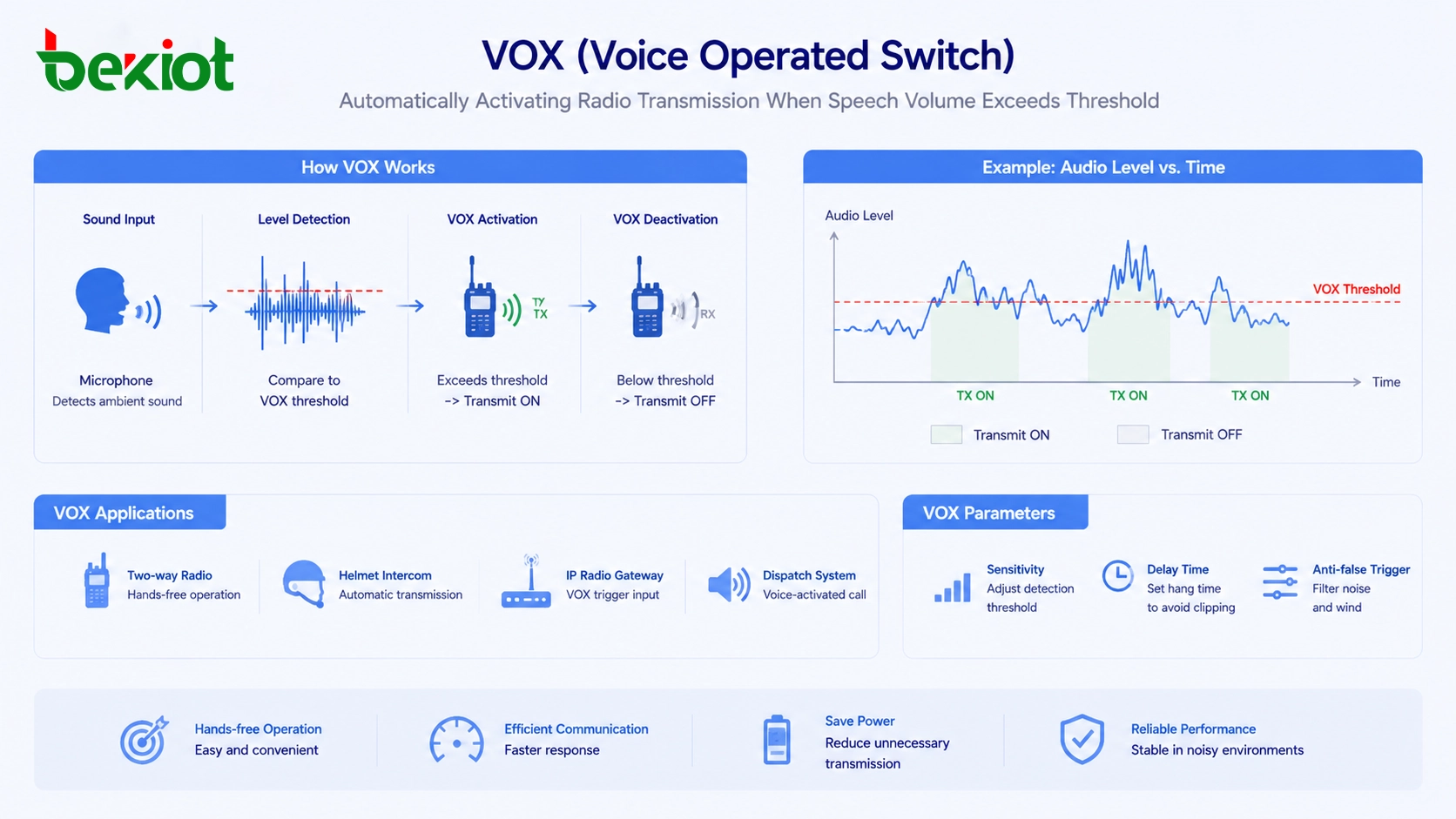
Practical differences in system behavior
The biggest difference is the decision method. VAD tries to identify whether the signal is speech. VOX usually checks whether the sound level is high enough to trigger a device action. This means VAD is more focused on speech intelligence, while VOX is more focused on control behavior.
In a clean acoustic environment, VOX can be simple and effective. When the user speaks, the device opens. When the user stops, the device closes. But if there is strong background noise, machinery sound, wind, alarms, or other loud audio, VOX may be triggered even when no one is speaking.
VAD is generally more suitable for systems that need to distinguish speech from silence or background audio. It can be more complex than VOX because it may depend on algorithms, audio models, noise estimation, and signal analysis. This is why VAD is widely used in modern IP communication systems and voice gateways.
VOX is more closely related to device control. For example, in a half-duplex radio or intercom scenario, once VOX is triggered, the system may occupy the transmit path. If the release time is too long, the channel may stay occupied after the user finishes speaking. If the release time is too short, the system may drop between words and make communication sound broken.
Choosing the right function for the scenario
For IP communication systems, VAD is often the better choice when the main goal is to reduce silent transmission, save bandwidth, support voice coding, or improve audio processing efficiency. It is suitable for SIP phones, IP intercoms, voice gateways, conferencing platforms, dispatch systems, and software-based communication platforms.
For radio communication and hands-free activation, VOX is often more practical. It is useful when users need to transmit voice without pressing a PTT button. This can improve convenience in field work, but threshold, sensitivity, delay, and release timing should be adjusted according to the actual acoustic environment.
In some systems, VAD and VOX may coexist. VAD can help the communication platform process speech intelligently, while VOX can help the terminal or radio-side device trigger transmission. The key is to understand which layer each function belongs to and what problem it is designed to solve.
Configuration risks that should not be ignored
Incorrect VAD settings may cause the beginning or end of speech to be cut off, especially when speech starts softly or when background noise changes quickly. If VAD is too aggressive, it may treat weak speech as silence. If it is too loose, it may transmit too much non-speech audio.
Incorrect VOX settings may cause false triggering or missed triggering. If the threshold is too low, background noise may activate the device repeatedly. If the threshold is too high, the user must speak loudly before transmission starts. If the release delay is too short, the device may close between words. If it is too long, the channel may remain occupied unnecessarily.
For professional communication projects, these settings should be tested in the real operating environment. Office testing alone is not enough for factories, tunnels, mines, transportation sites, emergency command centers, or outdoor radio systems.
Recommended planning method
A practical design process should begin with the communication goal. If the goal is efficient packet transmission, silence suppression, voice coding, or better IP audio processing, VAD should be reviewed carefully. If the goal is hands-free radio activation or automatic PTT control, VOX should be the focus.
The second step is to evaluate the sound environment. Quiet offices, noisy workshops, vehicle cabins, outdoor patrol routes, and underground spaces have very different noise characteristics. The same VAD or VOX settings may perform differently in each location.
The third step is field verification. Engineers should test speech start, speech end, background noise, long pauses, quick responses, low-volume speech, and high-noise conditions. Only after real testing can the system achieve stable voice activation and reliable communication behavior.
For projects that include dispatch systems, radio gateways, SIP intercoms, or emergency communication terminals, engineers should also test the full communication path instead of testing one device alone. A setting that looks correct on a single terminal may behave differently after passing through a codec, gateway, network, dispatch platform, recorder, or radio interface.
Practical decision checklist
Use VAD when the system needs to detect real speech activity and reduce silent audio transmission.
Use VAD for IP phones, SIP intercoms, voice gateways, software communication, conferencing, and voice coding applications.
Use VOX when the device needs to activate automatically based on detected sound volume.
Use VOX for hands-free radio transmission, intercom activation, recording trigger, or automatic PTT operation.
Adjust thresholds carefully in noisy environments to avoid false triggering, missed speech, or channel occupation.
Test in the real site because acoustic conditions strongly affect both VAD and VOX performance.
Verify the complete audio chain including microphone input, codec behavior, gateway processing, network transmission, speaker output, and recording results.
FAQ
Can VAD replace noise reduction?
No. VAD detects whether speech activity exists, while noise reduction tries to reduce unwanted background sound. They can work together, but they solve different audio problems.
Why does VOX sometimes start transmitting too late?
This usually happens when the trigger threshold is too high, the user speaks too softly, or the device has an activation delay. Adjusting sensitivity and testing speech start behavior can help.
Is VOX suitable for very noisy industrial sites?
It can be used, but the threshold and delay settings must be carefully tuned. In very loud environments, VOX may be falsely triggered by machinery, alarms, wind, or impact noise.
Does VAD always save bandwidth?
VAD can reduce unnecessary silence transmission in many IP voice systems. However, the actual benefit depends on codec settings, platform behavior, network design, and whether silence suppression is enabled.
Which function is better for push-to-talk communication?
VOX is more directly related to push-to-talk activation because it can trigger transmission without pressing a PTT button. VAD may still be used in the audio processing layer, but it is not the same as PTT control.
Should VAD or VOX be enabled by default?
It depends on the product type and operating environment. VAD is often useful in IP audio systems, while VOX should be enabled only when hands-free activation is required and the acoustic environment has been tested.







