


GB/T 28181 was originally developed for large-scale security video surveillance networking, especially in public safety projects where cameras, platforms, recorders, and control systems from different vendors must exchange video, control information, device status, and alarm data in a standardized way. Because of this background, many people still associate GB/T 28181 mainly with police, government, and public security video networks. In reality, the standard itself is not limited to public safety. It can be used in any project that requires unified video access, cross-platform interconnection, remote camera management, and standardized video resource sharing.
In modern video surveillance projects, cameras are no longer installed only for passive monitoring. They are increasingly connected with emergency response, production management, environmental supervision, facility inspection, dispatching, operation centers, and business platforms. A video system may need to support live viewing, historical playback, PTZ control, alarm linkage, status monitoring, and multi-level platform cascading at the same time. GB/T 28181 provides a practical foundation for these requirements by turning scattered video devices into manageable video resources.
The key value of GB/T 28181 is not only that it is a national standard. Its real engineering value lies in cross-vendor compatibility, large-scale device access, simplified platform connection, unified signaling, and long-term expansion capability. For system integrators, it reduces repeated protocol adaptation. For project owners, it helps avoid closed vendor ecosystems and makes future platform integration easier.
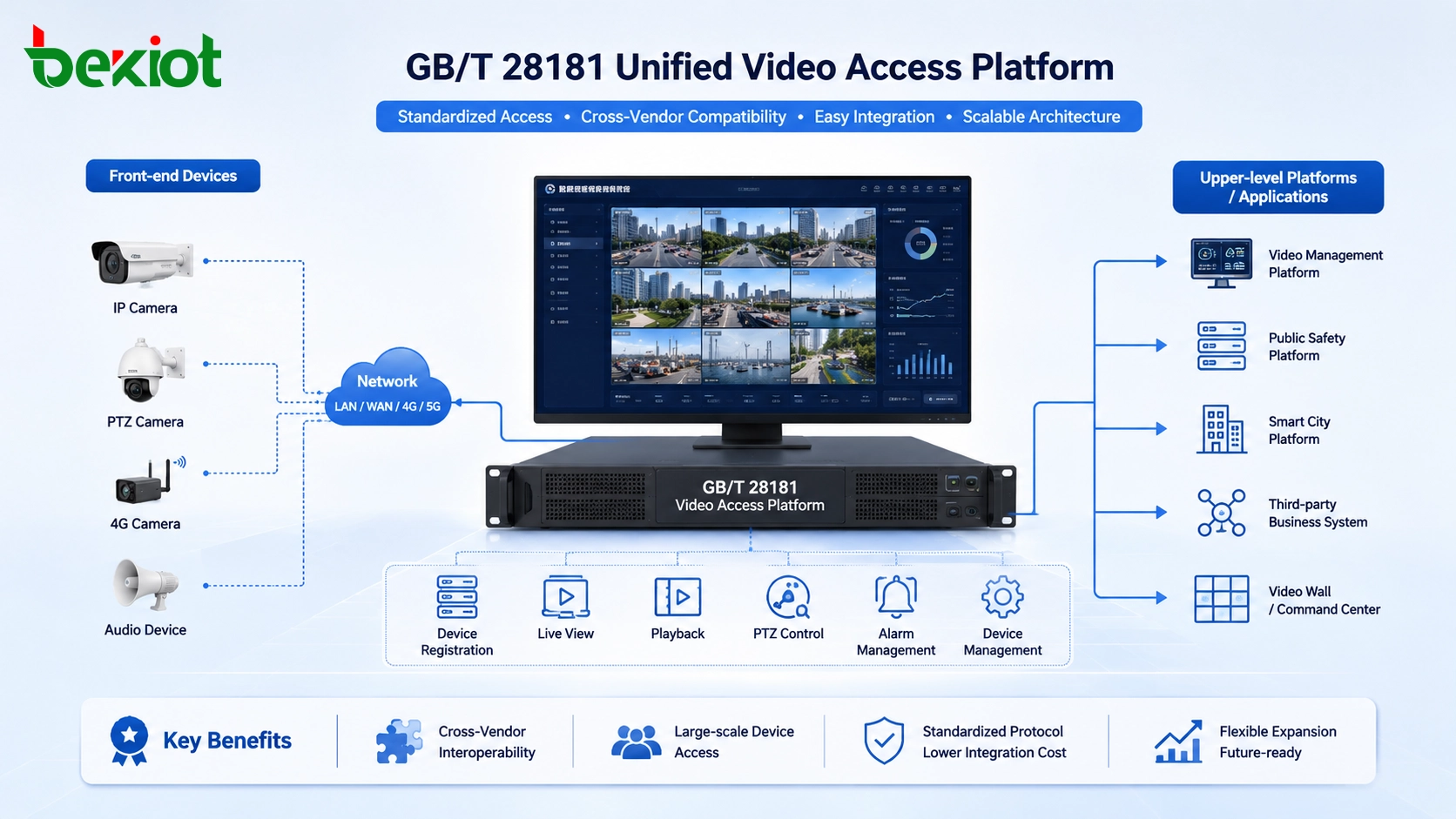
A Standard Built for Complex Video Networks
GB/T 28181 is the standard code for Technical Requirements for Information Transmission, Switch and Control in Security and Protection Video Surveillance Networking Systems. It was released to solve a common problem in large video projects: different camera brands, recorders, and platforms often used different private protocols, making unified access and centralized management difficult.
In large-scale video surveillance projects, the number of front-end devices can reach thousands, tens of thousands, or even hundreds of thousands. Without a common communication and control framework, device registration, live video request, recording retrieval, platform cascading, PTZ control, alarm reporting, and status synchronization would become fragmented. GB/T 28181 provides a standardized mechanism for device access, catalog management, media stream request, signaling interaction, and upper-lower platform interconnection.
This is why many cameras installed in public spaces support GB/T 28181. The standard helps different manufacturers’ devices work together in one networked environment, reducing protocol barriers and improving the scalability of surveillance systems. More importantly, the same advantages can also be used outside public safety projects.
Not Restricted to Public Safety Projects
Although GB/T 28181 was widely adopted in public safety scenarios first, it does not technically restrict use to that field. Any organization that needs standardized video access can use it, as long as the front-end devices, NVRs, video gateways, or platforms support the standard.
This means GB/T 28181 can be used in industrial parks, smart water conservancy, energy stations, construction sites, campuses, logistics centers, transportation facilities, scenic areas, factories, warehouses, ports, substations, highways, and municipal operation projects. The standard is especially useful when a project needs to connect cameras from multiple brands or share video data with a larger management platform.
For many projects, the decision to use GB/T 28181 is not about whether the site belongs to the public safety industry. It is about whether the system needs unified access, multi-vendor compatibility, centralized viewing, platform-level control, remote deployment, and future integration capability.
Why It Fits Multi-Industry Video Projects
One important reason GB/T 28181 is widely used is device availability. In the Chinese video surveillance market, many mainstream cameras already provide GB/T 28181 access capability. This includes professional surveillance cameras, NVRs, 4G cameras, access gateways, and many economical cameras used in small and medium-sized projects.
For project deployment, this greatly lowers the access threshold. A system integrator does not always need to select devices from only one manufacturer. If cameras, NVRs, and video platforms support the standard, they can often be connected into the same video access architecture through configuration rather than heavy custom development.
Compatibility has also improved through years of practical deployment. GB/T 28181 is not only used to connect cameras. It can also be used to connect network video recorders, lower-level platforms, access gateways, and third-party business systems. This gives system designers more flexibility when building layered video networking solutions.
How the Access Mechanism Works
In a typical GB/T 28181 system, the front-end device or lower-level platform registers to the upper platform. After successful registration, the platform can maintain the device catalog, identify online and offline status, request live video streams, control PTZ functions, retrieve historical recordings, and receive alarm or event information. This creates a standardized relationship between video resources and the management platform.
The access process usually involves device coding, platform ID configuration, SIP server information, authentication parameters, media stream negotiation, and network address planning. These details are important because a camera may be physically online but still fail to stream video if the signaling path, media path, port mapping, or authentication settings are incorrect.
For engineering teams, understanding this mechanism helps reduce deployment problems. Instead of treating GB/T 28181 as a simple checkbox in the camera configuration page, the project should treat it as a complete access process that includes identity, signaling, media, catalog, control, storage, and platform coordination.
Core Capabilities for a Unified Video Layer
In many projects, GB/T 28181 is used as the video access layer between front-end surveillance devices and upper-level business platforms. Once devices are registered and configured, the platform can usually obtain core video functions without rebuilding every device interface separately.
Common capabilities include live video viewing, video stream access, recording retrieval, playback control, PTZ operation, alarm information reporting, device status access, catalog synchronization, and audio intercom support where the device provides this function. These capabilities are especially valuable for command centers, operation centers, dispatching platforms, emergency response systems, and industry supervision platforms.
For integrators, this reduces repeated protocol adaptation. Instead of developing a separate interface for each camera brand, the project can use GB/T 28181 as a common entry point and focus more on business workflows such as event handling, video linkage, alarm verification, inspection, reporting, emergency command, and remote collaboration.
Remote Camera Access over 4G and 5G
Many modern video projects are no longer limited to fixed LAN environments. Cameras may be deployed along rivers, reservoirs, construction areas, highways, substations, pipelines, farms, temporary work sites, border areas, unmanned stations, or remote industrial zones. In these scenarios, traditional local network-based video access can be difficult because the network environment is scattered and often depends on mobile communication.
GB/T 28181 is useful in this type of deployment because many 4G cameras can register directly to a central platform through mobile networks. A project can deploy cameras with IoT SIM cards, configure GB/T 28181 access parameters, and allow the devices to register to a unified video access platform. This simplifies remote video access and avoids building complex site-to-site network structures for every location.
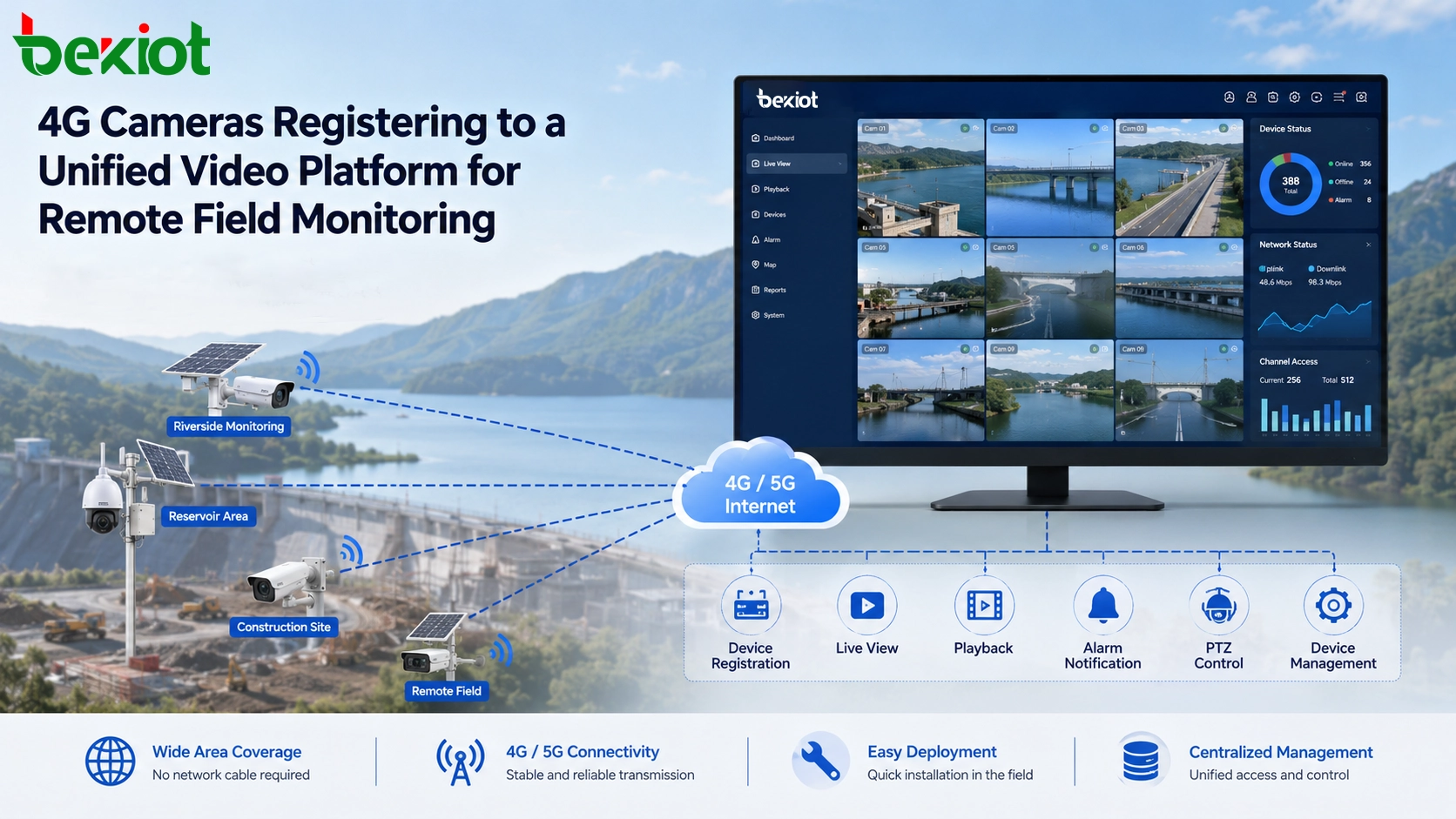
Smart water conservancy is a typical example. Monitoring points may be distributed across rivers, reservoirs, gates, pumping stations, and field facilities. A unified GB/T 28181 platform can collect video from these remote cameras and provide live viewing, playback, and integration interfaces for the upper business system.
Transportation, energy, and environmental supervision projects have similar needs. Monitoring points are often far away from central offices, and the network environment may change over time. By using GB/T 28181 as the access standard, the system can maintain a consistent video management method even when the camera locations, network types, and device brands are different.
Recommended Solution Architecture
A typical GB/T 28181-based solution can be divided into several layers. The front-end layer includes IP cameras, 4G cameras, NVRs, and other video devices. The network layer may include LAN, private networks, public networks, VPN, 4G, or 5G. The access layer is usually a GB/T 28181 platform or video access gateway that handles device registration, signaling, stream access, catalog synchronization, and platform interconnection.
Above the access layer, the business application layer can include a command platform, emergency management system, smart water platform, industrial operation platform, campus management system, transportation supervision system, or enterprise security center. These systems can use standardized video capability to support monitoring, event verification, visual dispatch, alarm linkage, operation analysis, inspection records, and evidence review.
This architecture keeps video access separate from business logic. The video platform focuses on device connection and stream management, while the business platform focuses on workflows, data, user roles, maps, reports, alerts, and decision support. This makes the entire system easier to expand and maintain.
Key Planning Points Before Deployment
Before implementation, the project team should confirm device compatibility, stream format, network accessibility, registration mode, authentication requirements, device coding rules, platform capacity, storage strategy, and bandwidth planning. Although GB/T 28181 improves interoperability, different manufacturers may still have differences in configuration details and function support.
Device coding should be planned carefully. In a large project, cameras may be grouped by region, site, building, floor, channel, or functional area. A clear naming and coding strategy helps operators locate cameras quickly and also helps the platform manage device catalogs more efficiently.
Bandwidth planning is another important factor. Live viewing, recording upload, playback retrieval, and multi-user preview may create different traffic pressure. If many users request the same remote stream at the same time, the system may need stream forwarding, transcoding, relay servers, or edge storage to reduce front-end pressure.
Storage strategy should also match the project goal. Some sites may require continuous recording, while others only need alarm-triggered recording or scheduled recording. Remote 4G camera projects should evaluate data traffic cost carefully because long-term live streaming and cloud recording can generate significant usage.
Compatibility Testing Matters
GB/T 28181 improves interoperability, but it does not mean every function will work perfectly without testing. Different cameras and platforms may vary in how they handle registration intervals, keepalive messages, catalog updates, stream requests, playback commands, PTZ commands, alarm reporting, audio intercom, and network traversal.
Before large-scale deployment, it is useful to test live view stability, stream startup time, offline reconnection, recording retrieval, time synchronization, PTZ response, alarm upload, platform cascading, and abnormal network recovery. These tests can reveal problems that may not appear during simple device registration.
For projects involving remote cameras, the test should also include weak signal conditions, public network access, NAT traversal, SIM card traffic control, and unstable mobile network scenarios. A camera that works well in an office test environment may behave differently in a field installation with limited signal quality.
When to Choose This Approach
GB/T 28181 is a strong choice when a project includes cameras from multiple vendors, needs centralized access, may require future platform integration, or has many distributed monitoring points. It is also useful when the project owner wants to avoid being locked into a single manufacturer’s private protocol.
It is also suitable when the video system needs to provide capabilities to other systems. For example, an alarm platform may need to call nearby live video after an event occurs. A command center may need to view field cameras during emergency dispatch. A smart facility platform may need to display camera status and video snapshots on a map. A maintenance system may need video evidence linked to inspection records.
Even if a project does not need upper-level networking immediately, selecting cameras and recorders that support GB/T 28181 can preserve future expansion potential. When integration becomes necessary later, the project can add a video access platform or gateway instead of replacing existing front-end devices.
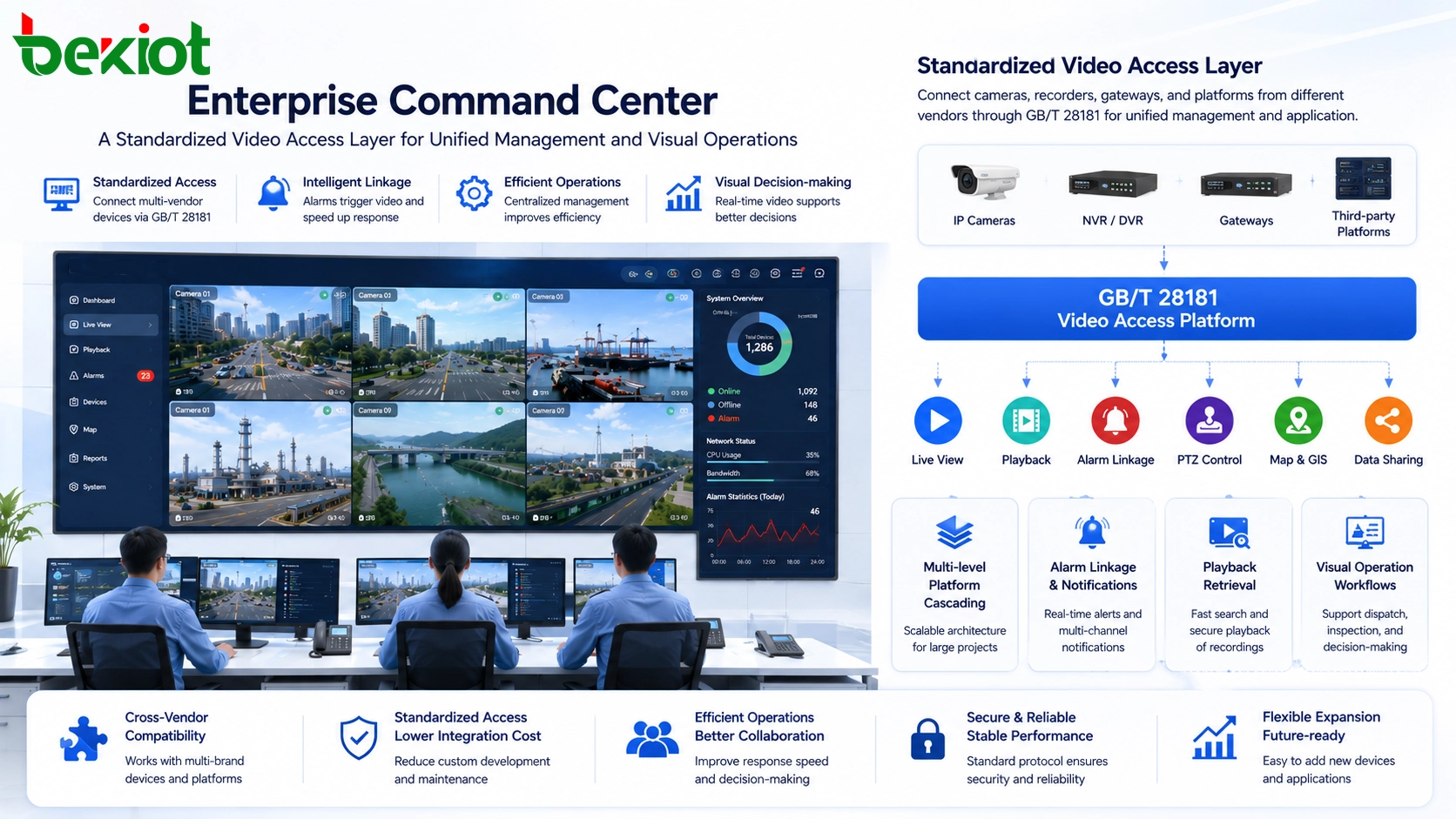
Operational Value for Long-Term Projects
For system integrators, GB/T 28181 provides a practical way to reduce repeated adaptation work. Instead of building separate connections for every camera brand, the project can use a standard-based access strategy to unify video resources. This improves delivery efficiency and reduces long-term maintenance complexity.
For project owners, the value is flexibility. A standardized video architecture makes it easier to expand camera points, replace devices, connect new platforms, and share video capability with other business systems. It also helps protect earlier investment because existing cameras and recorders may continue to be used if they support the standard.
For operation teams, standardized video access also improves daily maintenance. Device online status, camera catalog, stream availability, playback access, and platform connection status can be managed more clearly. When a camera goes offline or a stream fails, maintenance staff can troubleshoot the issue from device, network, signaling, media, and platform levels instead of relying only on vendor-specific tools.
For industry platforms, GB/T 28181 makes video a reusable resource. Video is no longer only stored inside a surveillance system. It can become part of emergency response, inspection management, facility operation, production supervision, safety control, and remote collaboration.
Common Misunderstandings
A common misunderstanding is that GB/T 28181 is only useful when a project must connect to a government platform. In fact, many private projects use it simply because it provides a standardized video access method. Even if no public platform connection is required, the standard can still simplify device access and future system expansion.
Another misunderstanding is that GB/T 28181 replaces all other video protocols. In practice, it is often used together with other technologies. A system may use GB/T 28181 for standardized access and platform cascading, while using RTSP, WebRTC, HLS, or private SDK interfaces for specific display, low-latency preview, browser playback, or AI analysis workflows. The best architecture depends on the project’s latency, compatibility, storage, and integration requirements.
It is also important not to treat GB/T 28181 support as a single yes-or-no feature. A device may support basic registration and live view but have limited support for playback, alarm reporting, PTZ control, or audio intercom. Professional project delivery should verify the actual function set rather than relying only on a product brochure.
Final Notes
GB/T 28181 should not be understood as a protocol only for public safety. It started from large-scale security video networking, but its standardization, device popularity, compatibility, and platform interconnection capability make it valuable in many industries.
When building a new video surveillance system, it is wise to consider whether cameras, recorders, gateways, and platforms support GB/T 28181, even if the project does not have immediate networking requirements. This choice can make future video integration, platform connection, and business expansion much easier.
For smart projects that involve distributed cameras, 4G access, multi-vendor devices, centralized operation, alarm linkage, or command center integration, GB/T 28181 can serve as a reliable foundation for building a scalable and future-ready video networking solution.
FAQ
Can GB/T 28181 be used in private enterprise projects?
Yes. Private enterprises, industrial sites, campuses, utilities, logistics parks, and smart facility projects can use GB/T 28181 when their devices and platforms support the standard.
Is GB/T 28181 the same as ordinary camera live streaming?
No. Ordinary live streaming usually focuses on video preview. GB/T 28181 is more suitable for standardized device registration, catalog management, stream request, control interaction, recording retrieval, alarm reporting, and platform interconnection.
Does every GB/T 28181 camera support all platform functions?
Not necessarily. Basic registration and live view are common, but playback, PTZ, alarm upload, audio intercom, and platform cascading may vary by device, firmware, and platform implementation. Compatibility testing is recommended.
Is it suitable for remote 4G camera projects?
Yes. Many remote monitoring projects use 4G cameras that register to a central video platform through GB/T 28181. The project should still evaluate mobile signal quality, data usage, stream stability, and recording strategy.
Should old cameras be replaced if they do not support GB/T 28181?
Replacement is not always necessary. Some projects can use NVRs, protocol gateways, or platform-side access tools to integrate existing video resources. The best approach depends on device capability, project scale, and integration goals.
What is the main value for future expansion?
The main value is that video resources can be connected through a standardized access layer. This makes it easier to add cameras, connect platforms, support command center workflows, and provide video capability to other business systems later.







